
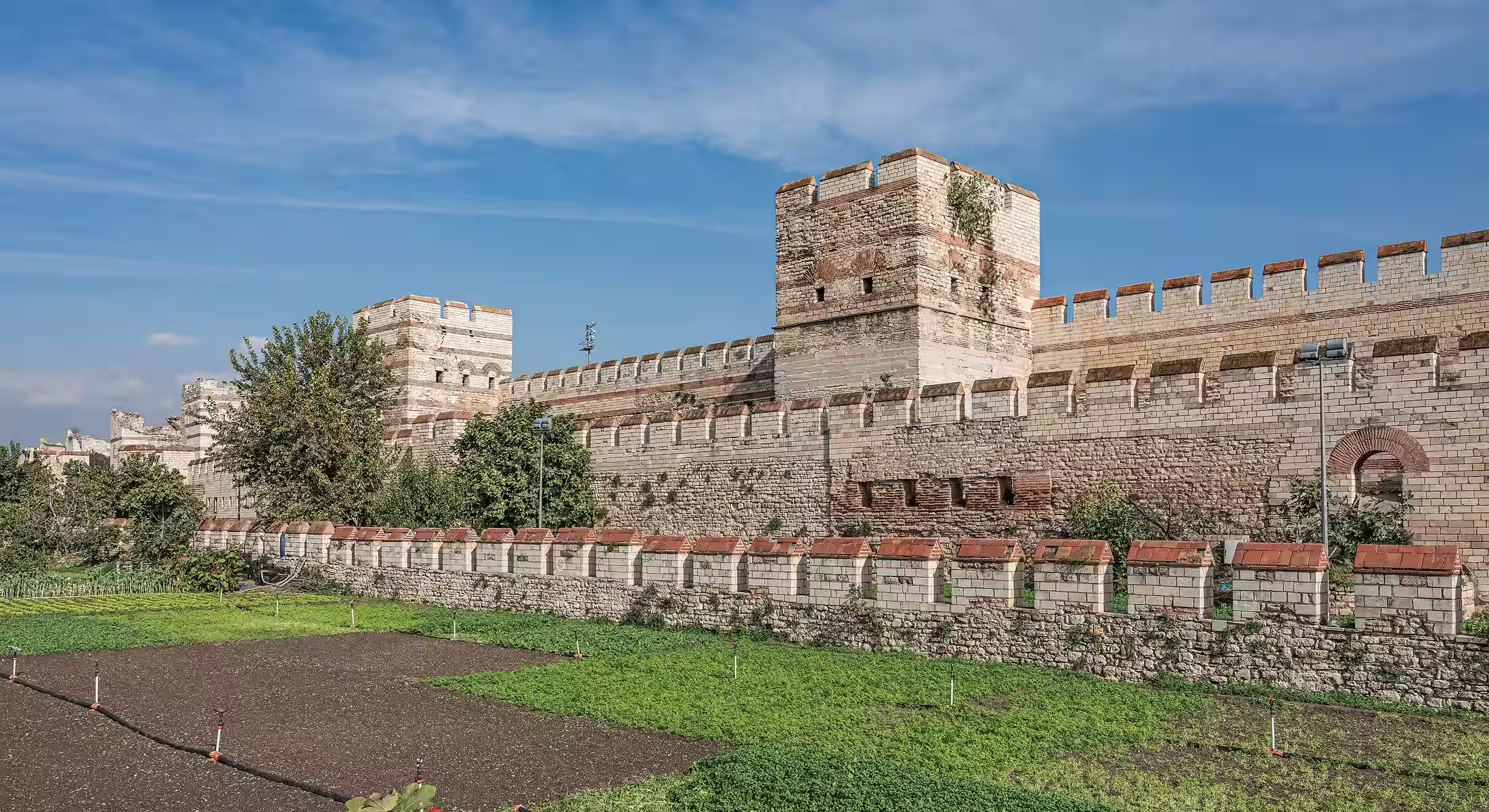
The Walls of Constantinople: the formidable guardians of the Queen of Cities
The walls of Constantinople stand as a monumental testament to Byzantine fortification engineering skills, as well as their resilience. Thanks to this monumental set of fortifications erected between the 5th and the 9th century, and constantly enhanced and maintained, the Byzantine capital was able to repel countless sieges, greatly contributing to the resilience of the empire for over a millennium.
Fortifications of Byzantium during the Antiquity.
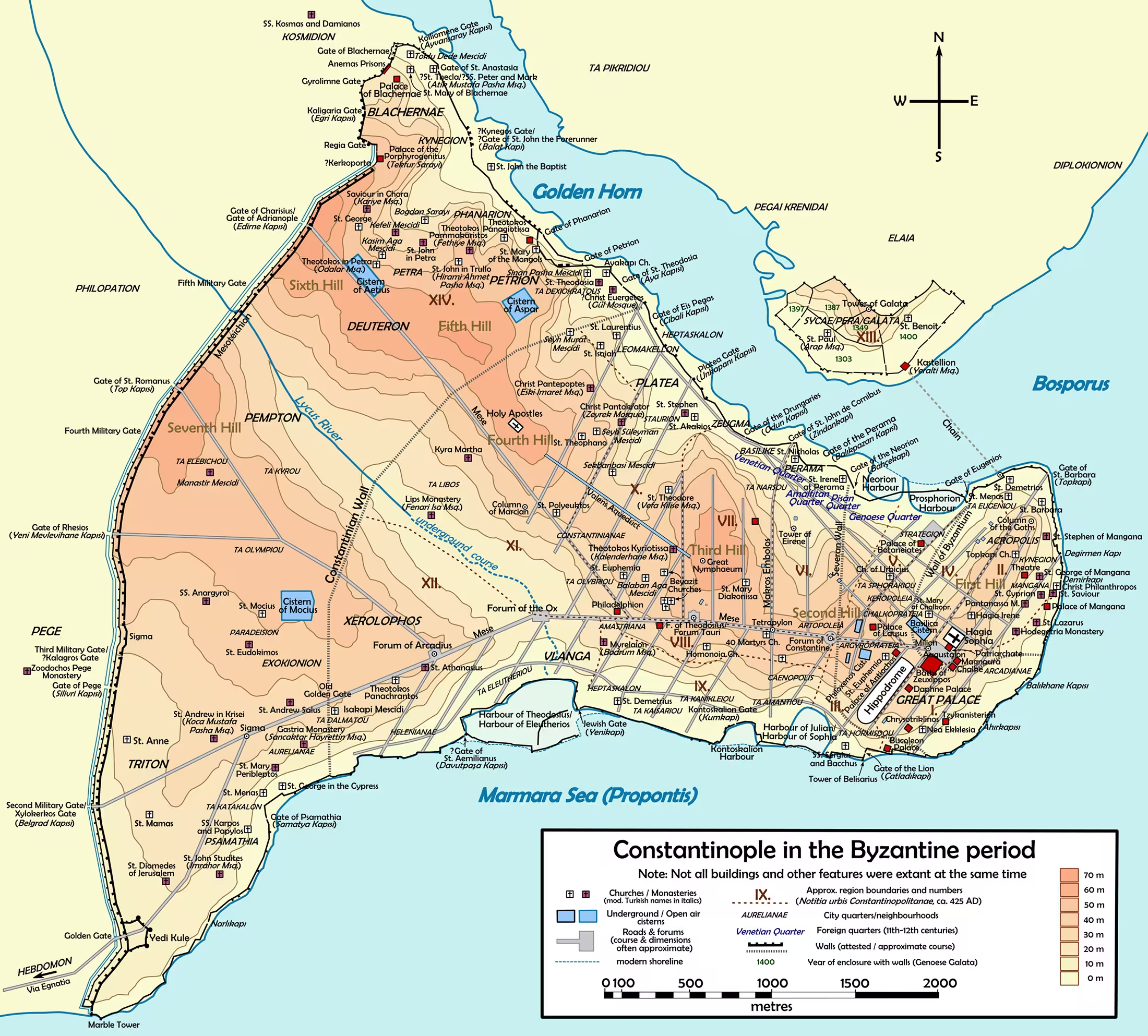
The story of the city’s fortifications doesn’t start with the Byzantine era. Byzantium was founded by Greek colonists in the 7th century BCE. It grew in importance due to its strategic location, and by the time Constantine decided to move the capital of the Roman Empire, it was reported as being a well-fortified city. However, the extent of the populated area at that time was small and limited to what later became the heart of the Byzantine capital.
Part of the fortifications of this time were later reemployed when the sea walls of the city were erected.
Defending the New Rome: Constantine’s Wall.
When deciding to move the capital of the Roman Empire to the East, Constantine was aware of the need to defend the newly founded Constantinople. In 270, the invasion of North Italy by the Vandals and Juthungi had prompted the construction of the Aurelian Walls in Rome, aimed at alleviating the vulnerability of the capital and bolstering the people’s trust.
The new capital also required fortifications to ensure security in the face of constant external challenges and internal strife. Alongside the monumental buildings erected for New Rome, Constantine ordered the construction of the first terrestrial wall, known as the Constantine Wall, which laid the foundation for the city’s defense.
The Theodosian Walls: A testament to Byzantine engineering
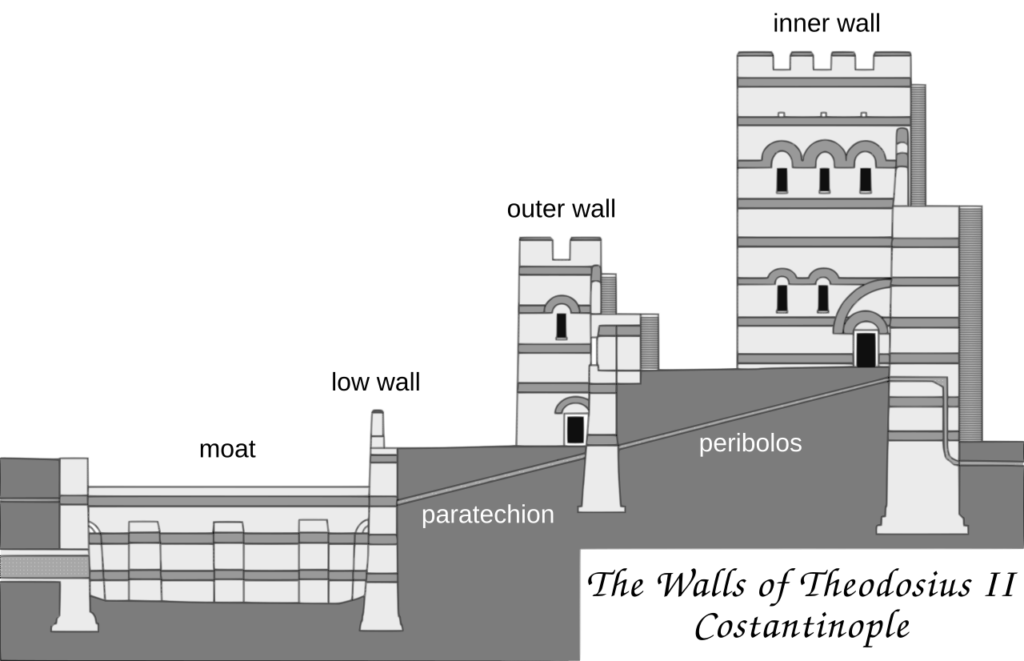
However, by the early 5th century, Constantinople had expanded beyond the Constantinian Wall. A new set of fortifications was built, enclosing an area twice the size, under the reign of Emperor Theodosius II. This ambitious project, known as the Theodosian Walls, produced a double line of walls that defined Constantinople’s defences for centuries to come and remains a testament to the genius of Byzantine military architecture.
The Constantinian fortifications, though no longer serving as the first line of defense, didn’t immediately fall into disuse. It appears that they remained as an inner wall protecting the heart of the city until at least the 9th century.
The seaward walls of Constantinople.
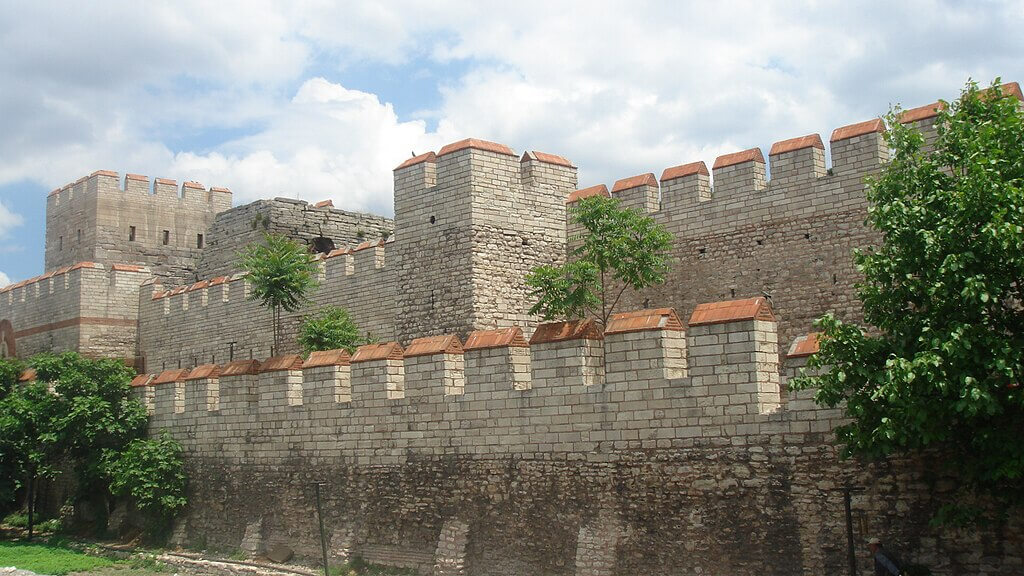
However, at that time, it is uncertain if the city was fully enclosed in fortifications. Traditionally, the construction of the seaward walls has been attributed to Constantine. But the first known reference to their construction comes in 439, when the urban prefect was ordered to repair the city walls and complete them on the seaward side. However, some scholars doubt the existence of any seaward fortifications, as they are not specifically mentioned as extant by contemporary sources until around 700.
In their construction, the walls are similar to the Theodosian Walls, but much simpler. It is only a single wall, much lower than the land walls, with inner circuits in the locations of the harbors. Enemy access to the walls facing the Golden Horn was prevented by the presence of a heavy chain, installed by Leo III (717-741), supported by floating barrels. The strong currents on the Marmara Coast made an attack by a fleet almost impossible on that side.
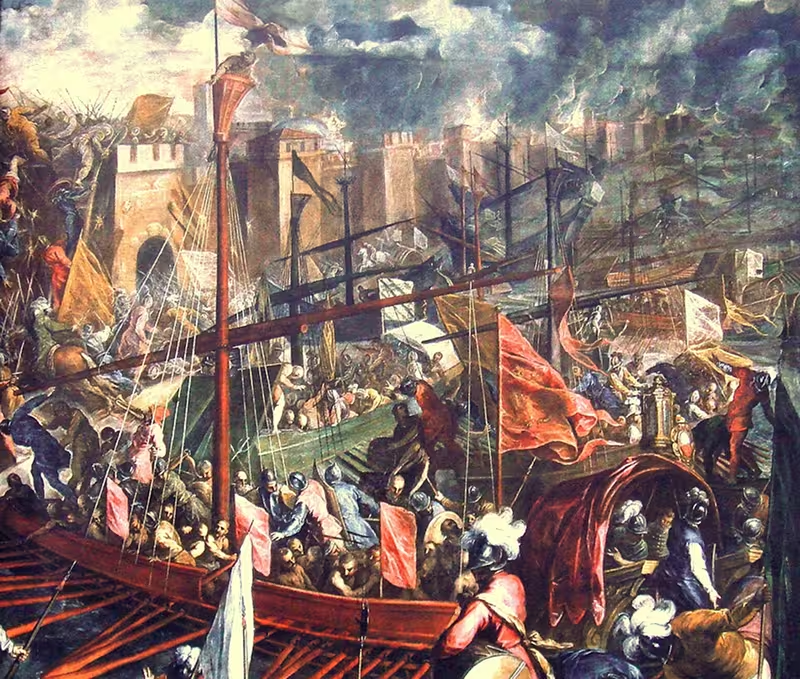
Though few threats ever came from the sea, it became apparent in 1204 that the seaward walls were a weak point in the city’s defense, as the Crusaders managed to storm them, leading to the sack of the city and the irretrievable fragmentation of the Byzantine Empire.
Endurance and adaption of Constantinople Walls.
Throughout Byzantine history, constant maintenance and adaptation of the walls occurred. Soon after their construction, severe earthquakes damaged them. The first occurred in 437, followed by another in 447 and subsequent ones in 448. In 478, as the capital was threatened by Attila’s presence in the Balkans, another earthquake occurred. The walls were then repaired in a record time of 60 days by employing thousands of inhabitants. In 557, another earthquake damaged them. Floods of the Lycus River also occasionally caused damage. Throughout Byzantine history, they needed to be maintained, repaired, and enhanced.
The most significant later development was the construction of the so-called Wall of Manuel I Komnenos, built in the Blachernae area to enclose and protect the imperial palace, which had become the preferred residence of the court since the late 11th century. This wall was just the last and most refined layer in a fortification system built up in phases: the first addition came under Heraclius (610–641) after the Avaro-Persian siege of 626, when a roughly 500-meter wall with about 13 rectangular towers was raised to protect the revered Church of the Theotokos at Blachernae, considered miraculously spared during the attack; a further wall, known as the Wall of Leo, extended the line afterward.
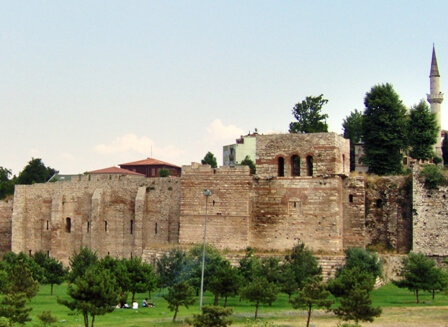
Manuel’s 12th-century wall, by contrast, was an architecturally superior work — about 220 meters long, some 5 meters thick at the top (thicker than the Theodosian Walls), built of large masonry blocks in a series of arches, with eight alternating round and octagonal towers and a final square tower — while a later, cruder stretch of about 150 meters and four square towers connected it to the Prison of Anemas. Altogether, the Blachernae walls stood 12–15 meters high, were thicker and more closely spaced with towers than the Theodosian Walls, but lacked a continuous moat except on the lower stretch toward the Golden Horn, added later by John VI Kantakouzenos.
Despite ongoing Byzantine efforts to maintain them, this sector remained the system’s weak point — it was here that the Crusaders of the Fourth Crusade breached the defenses and first entered Constantinople in 1204.
After the recovery of Constantinople in 1261, the Palaeologus had the maritime walls heightened by 2 meters, and when an attack by the Crusaders seemed imminent at some point, they even had a second wall built behind the first one to better protect the seaside.
Fall of Constantinople in 1453.
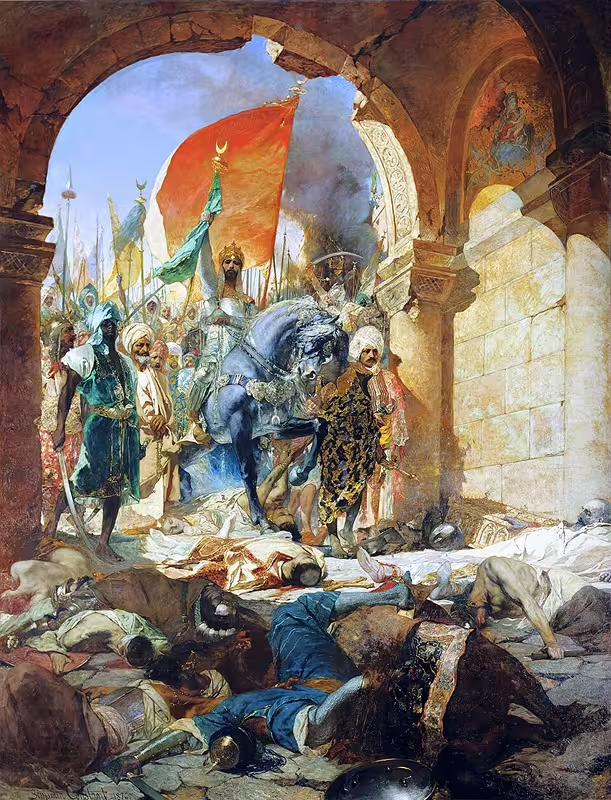
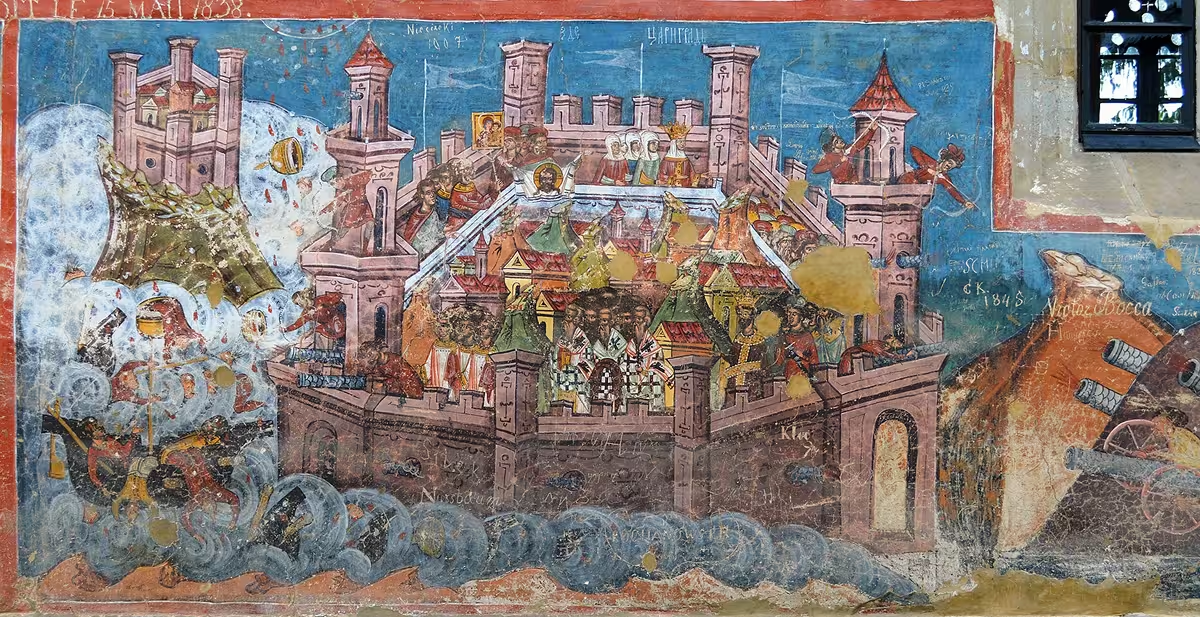
The Constantinople Walls remained formidable until the end of Byzantine history, even though the dire state of imperial finances could not sustain continuous maintenance, and they were only occasionally repaired when a siege seemed imminent. Still, the capital city managed to repel a first siege by the Ottomans in 1422. But it was only a reprieve, and the threat remained imminent, as evidenced by the repair works on the walls in 1439.
However, the empire was exhausted, and when Mehmet II brought the first cannon used in the Occident behind the wall, this artillery was able to pierce the mighty walls, hastening the fall of the city. It is symbolic that the iconic defenses of the city only fell to a new powerful weapon, tying it to the end of an era – some historians consider 1453 as one of the dates marking the end of the medieval period.
Legacy and preservation
With the swift expansion of the Ottoman Empire, no serious threat came to Constantinople before the end of the 18th century, and the walls mostly fell into disrepair. On the seaside, many parts of the walls were covered or destroyed when the city modernized. Nonetheless, most of the fortifications of Constantinople didn’t disappear, unlike in other cities, such as Thessaloniki. A significant portion of them thus made it to our days, even though they are nowadays in a rather poor state that causes worry and justifies their inscription on the list of endangered monuments.
Though the empire itself is long gone, the walls of Constantinople still stand — a reminder of the city’s storied past and its enduring spirit. Few monuments evoke the resilience of Byzantium so powerfully. To see them for yourself, plan your trip with our guide to Byzantine Istanbul.
Credits of cover image: A. Savin, Wikipedia.


One Comment