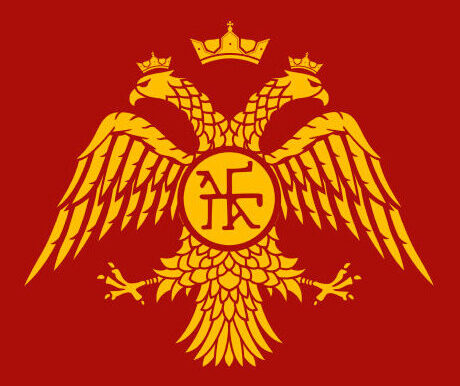
The Late Byzantine period
The dramatic sacking of Constantinople in 1204 during the Fourth Crusade marked the end of the Middle Byzantine period and the beginning of a tumultuous era for a dismantled and weakened Byzantine imperial power, known as the Late Byzantine period. The establishment of Latin states and the rise of competing Greek successor powers – such as the Empire of Nicaea, the Despotate of Epirus, and the Empire of Trebizond – created a fragmented political landscape. Even after the recapture of Constantinople in 1261, the restoration of the Byzantine Empire did not resolve these divisions, which largely persisted until they were ultimately brought to an end by the Ottoman Turks in the years following the fall of Constantinople in 1453.
Historical overview of the Late Byzantine period.
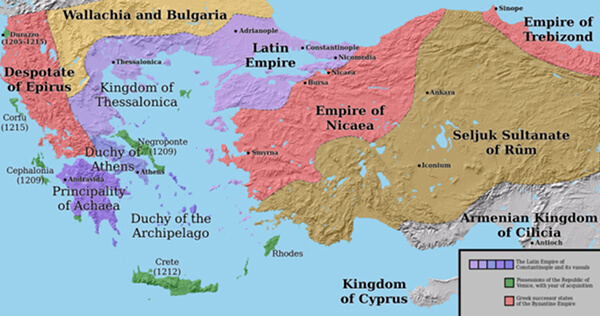
The Late Byzantine period is characterized by increasing fragmentation and a weakened imperial authority. The loss of Constantinople in 1204 was a severe blow for the Byzantines, whose state had long been highly centralized.
Amid the chaos and the conquest of vast stretches of territory by the Crusaders and the Venitians, different Byzantine successor states emerged on the peripheries of the empire, each aspiring to resist Western encroachment and to restore the unity of the Byzantine imperial realm.
The Rise of Byzantine Successor States and their rivality.
The Empire of Trebizond.
One of the first of these states was established shortly before the fall of Constantinople in 1204 by a branch of the Komnenos family. Fleeing the political turmoil in the capital and opposing the ruling Dukas dynasty, they founded a polity around Trebizond (today Trabzon) on the southeastern coast of the Black Sea. Claiming direct inheritance from the Komnenian emperors, its ruler proclaimed himself emperor.
Although the Empire of Trebizond proved to be one of the most enduring of the Byzantine successor states, surviving until 1461, it was never in a position to reconquer Constantinople or dominate more than a narrow stretch of territory along the Pontic coast. Yet its longevity was remarkable. The Komnenos dynasty ruled it continuously, and Trebizond grew into a vibrant cultural and artistic center, preserving elements of Byzantine ceremonial, manuscript production, and artistic traditions long after the Latin occupation of Constantinople and even after the restored Byzantine Empire began to decline.
The Empire of Nicaea.
Theodore I Laskaris founded the Empire of Nicaea around 1204-1205. He gathered many refugees from Constantinople, including the patriarch. With this support and with a clear claim to imperial continuity, the Laskarids became the strongest candidates for reunifying Byzantium. They stabilised their state and resisted Turkish pressure. They even pushed westward against the Latin and the Despotate of Epirus, which they eventually forced it into submission. Michael VIII Palaiologos overthrew the Laskarids in 1259. He retook Constantinople in 1261 and restored the Byzantine Empire, which his dynasty ruled until 1453.
The Despotate of Epirus.
The Despotate of Epirus formed after 1204 under the Komnenos Doukas family, and quickly developed into a strong and ambitious state centered around Arta. Under Theodore Komnenos Doukas, Epirus expanded eastward and seized Thessaloniki. Theodore received a coronation there and claimed the imperial title. For a brief moment, Epirus appeared capable of restoring the Byzantine Empire and even reclaiming Constantinople. This ambition collapsed after his defeat at the Battle of Klokotnitsa in 1230, when the Bulgarian army crushed his forces and captured him.
After this event, the Despotate entered a long period of instability. Successors struggled to maintain control, and the state fragmented under pressure from Nicaea, Serbia, and local rivals. In the second half of the 13th century, the despotate still enjoyed a period of relative peace and prosperity. Arta became an important regional cultural and artistic center under the impulse of its rulers. However, dynastic changes weakened Epirus further, as Italian, Albanian, and other regional families gained influence or seized power. The Despotate gradually lost territory and political cohesion. By the late 14th and early 15th centuries, it faced constant Ottoman pressure. The Turks absorbed its remaining lands step by step, ending its existence as an independent power. Nevertheless, the despotes turned their was an important cultural and artistic
The Principality of Theodoro.
A small Byzantine principality also survived in the southern Crimea. Known as the Principality of Theodoro or Gothia, it emerged in the 13th century around the fortified city of Mangup. Its rulers claimed Byzantine heritage and maintained close cultural and religious ties with the other greek states. The principality remained small, but it held a strong defensive position in the Crimean mountains and controlled several key routes linking the coast to the interior. Despite pressure from Genoese colonies on the coast and from steppe powers in the north, Theodoro endured for nearly two centuries. It preserved Orthodox traditions, local Greek culture, and a modest but active artistic life. The Ottomans conquered it in 1475, only twenty-two years after the fall of Constantinople, marking the end of the last Byzantine state.
The struggles of the restored Byzantine Empire (1269-1453).
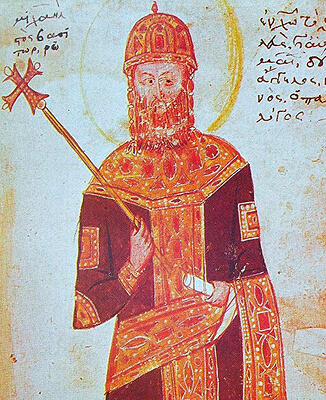
Michael VIII Palaiologos retook Constantinople in 1261 from the Latin Empire, restoring the Byzantine Empire. He attempted to rebuild and reinforce the state, but the Palaiologos dynasty soon faced instability. Civil wars, court rivalries, and social unrest struck the empire throughout the 14th century, and it could never regained its earlier power. These conflicts also weakened the state and increased its dependence on Western aid. Ottoman expansion posed a constant threat, and the empire continued to shrink until its end at the fall of Constantinople in 1453.
Economic troubles also marked this period. The loss of territory and the disruption of trade routes undermined the state’s financial base. Constantinople remained a vibrant center of commerce and culture, but it no longer matched its earlier scale. Religious life intensified as well. Hesychasm gained wide influence, and debates over the Union of the Churches created deep divisions. Several emperors supported union with the Latin Church in the hope of securing Western military aid, but this policy was met with strong opposition within Byzantine society.
Culture and art in the Late Byzantine period: the Palaiologan Renaissance.
Despite – or perhaps because of – the dire situation the Byzantines faced during the Late Byzantine period, it witnessed a notable flourishing of intellectual and artistic activity. Scholars and artists worked to preserve and expand the rich cultural heritage of Byzantium. The study of classical texts and the production of illuminated manuscripts thrived, showing a strong commitment to learning and the arts. Religious art, especially iconography and fresco painting, remained central to Byzantine culture. Artists blended traditional forms with new trends, including a greater humanisation of figures compared to the more rigid hieratism of the Middle Byzantine period.
These new artistic tendencies, clearly visible in Constantinople and Thessaloniki, influenced other regions such as the Morea and the Despotate of Epirus. Scholars later called this movement the Palaiologan Renaissance. It left a deep artistic legacy, visible in the work of Italian painters of the Quattrocento and in the Cretan School, which flourished in the 15th and 16th centuries.
The fall of Constantinople to the Ottomans ended the Byzantine Empire, but not its cultural influence. Byzantine scholars and manuscripts reached Italy and helped preserve the classical heritage, contributing to the rise of the Western Renaissance from the 15th century onward.
The Late Byzantine period is the empire’s long twilight — and, paradoxically, one of its most luminous. Restored against all odds in 1261, Byzantium spent its final two centuries as a shrinking, impoverished state, yet in those same years it produced the dazzling art of the Palaiologan Renaissance and clung to its faith and identity to the very end. The fall of Constantinople in 1453 closed not just a chapter but the eleven-century history of the Roman Empire itself, leaving behind a legacy in faith, art, and learning that would outlive the empire by far. It was the last act of a story that began more than a thousand years earlier on the shores of the Bosphorus. To follow that story from its very beginning to this final chapter, explore our complete history of the Byzantine Empire.