Byzantine Military History: The army, the soldiers, and the art of war
The Byzantine Empire, strategically located at the crossroads of Europe and Asia, faced constant challenges from a wide array of adversaries. To the east, the Persian Empire and later the Islamic Caliphates sought to push into Byzantine territory, threatening core regions like Anatolia and the Levant. From the north, Slavic tribes, Avars, Bulgars, and later the Rus posed recurring dangers, testing the empire’s ability to secure its borders. In the west, Gothic and Lombard invasions challenged Byzantine holdings in Italy, while the empire eventually confronted the Normans and the Crusader states. By the late Byzantine period, the empire faced its most formidable adversaries yet: the Seljuk Turks and the rising Ottoman Empire.
To counter these threats, Byzantium developed a robust and adaptable military system, but its defense strategy extended well beyond the battlefield. It rested on a literate, doctrine-driven officer corps that studied and wrote its own manuals of war; on a network of fortifications that turned cities into strongpoints and borders into defense-in-depth; and, again and again, on individual emperors and generals whose skill on campaign changed the empire’s fate for a generation at a time.
This page traces that story end to end — the army’s organization across all three eras of Byzantine history, the distinctive Byzantine art of war and siegecraft, the fortifications that anchored it, the commanders who defined it, and the battles that decided it.
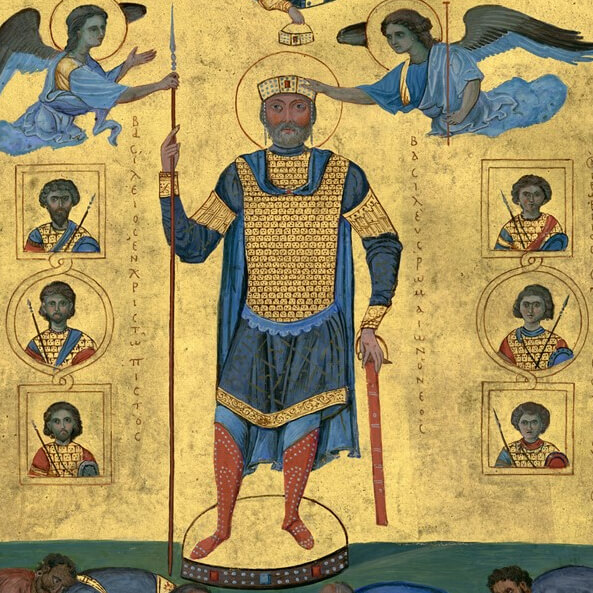
Replica of a miniature of the Psalter of Venice, showing Basil II as a warrior-emperor.
The Byzantine Army through the ages
The Early Byzantine Period: A Roman Inheritance
The Byzantine military of the early period was a direct continuation of the late Roman army, inheriting its organization, tactics, and discipline. However, as the empire transitioned from its Roman roots, it adapted to new challenges, including the rise of powerful enemies like the Sassanian Persians and migrating barbarian tribes such as the Goths, Vandals, and Huns.
Organization and tactics.
The early Byzantine army was divided into two main groups: the comitatenses (field armies) and the limitanei (border troops). The comitatenses were elite mobile units capable of responding to threats across the empire, while the limitanei garrisoned frontier regions, providing local defense and monitoring enemy movements. Alongside them stood the foederati — allied barbarian contingents, often Gothic or Hunnic in origin, who fought under their own chieftains in exchange for pay and land, a practice that gave the army manpower and mobility but also, over time, made it dependent on the loyalty of outsiders.
Byzantine generals, drawing on Roman traditions, continued to emphasize discipline and the integration of various arms — infantry, cavalry, and archers. Infantry troops, often heavily armored, formed the backbone of the army, while cavalry gained increasing prominence due to the mobility required to confront fast-moving threats such as the Huns. Chief among the new cavalry was the cataphract: a horseman and horse both armored, fighting in close order with lance and bow, and combining the shock of heavy cavalry with the flexibility of mounted archery. The cataphract would remain the signature strike force of Byzantine armies for the rest of the empire’s history. Field armies of this period, drawn from the eastern provinces and reinforced by allied contingents, could number in the tens of thousands for a major campaign — a scale the empire would rarely be able to match again after the seventh century.
Key conflicts and campaigns.
The reign of Emperor Justinian I (527–565) marked a turning point for the Byzantine military. Justinian’s ambitious campaigns aimed to reclaim former Roman territories in the west, including North Africa, Italy, and parts of Spain. These efforts, led by the brilliant general Belisarius, demonstrated the adaptability and strategic ingenuity of the Byzantine army.
In the Vandalic War (533–534), Belisarius employed a combination of naval power and swift land campaigns to dismantle the Vandal kingdom in North Africa, restoring these territories to Byzantine control. Similarly, the Gothic War (535–554) in Italy showcased the army’s ability to conduct prolonged sieges and maneuver against larger forces, despite facing logistical challenges and devastating plagues.
New threats: Avars, Slavs and Sassanids.
The early Byzantine period saw the emergence of new enemies and tactics that required innovation. The empire faced successive waves of invasions from the Avars and Slavs in the Balkans, necessitating the construction of defensive fortifications and the use of guerrilla-style tactics to counter these incursions.
On the eastern front, the Byzantine army engaged in a protracted struggle with the Sassanian Empire. These wars, characterized by large-scale battles and sieges, culminated in the devastating Byzantine–Sassanian War (602–628) — one of the most cataclysmic conflicts in the empire’s history, and the culmination of centuries of rivalry between the Roman and Sassanian worlds for dominance in the Near East. This prolonged war severely tested the resilience of the Byzantine military and inflicted devastating consequences on the urban civilization of Anatolia and the Middle East.
The war began when the Sassanian King Khosrow II exploited internal turmoil within the Byzantine Empire, including the usurpation of Emperor Phocas, to launch an aggressive campaign. The Persians quickly advanced into Byzantine territory, capturing the vital city of Dara in Mesopotamia in 605 and proceeding to devastate much of Anatolia. By the early 7th century, the Persian army had overrun Syria, Palestine, and Egypt, capturing Jerusalem in 614 and desecrating its holy sites, including the Church of the Holy Sepulchre. Ancient cities such as Antioch, Caesarea, and Tyre were sacked, while many others were abandoned altogether, dealing a severe blow to the urbanized and economically vibrant centers of the Byzantine East.
In 626, the Sassanian army, in collaboration with the Avars and Slavs, launched a direct assault on Constantinople itself. Although the Persians approached the city from the Asian side, their inability to cross the Bosporus and the steadfast defense of the Theodosian Walls prevented the city from falling — one of the most critical moments in Byzantine history, since Constantinople’s survival ensured the continuity of the empire.
The tide of the war shifted dramatically under Emperor Heraclius, who, after securing his position as emperor, orchestrated a bold counteroffensive. Between 622 and 627, Heraclius launched a series of daring campaigns deep into Persian territory, culminating in the decisive Battle of Nineveh in 627. This victory forced Khosrow II to sue for peace, restoring Byzantine control over lost territories — but at immense cost. The war left both empires exhausted and vulnerable, their resources depleted and their cities devastated. For the Byzantines, the loss of urban centers in the Middle East and Anatolia marked the beginning of a long decline in the region’s urban civilization, leaving these areas dangerously exposed to the Islamic conquests that followed within a decade.
Fortifications and defense.
Throughout this period, fortifications remained a cornerstone of Byzantine defense. The Theodosian Walls of Constantinople, completed in the 5th century, proved impenetrable during numerous sieges, including the invasions of Attila the Hun and the early Islamic conquests. Elsewhere, fortified cities and strongholds across the Balkans and the eastern provinces provided a buffer against invading forces, allowing the empire to regroup and launch counteroffensives.
The Middle Byzantine period: Adapting to new realities.
The middle Byzantine period (7th–11th centuries) was marked by profound transformation in the empire’s military structure, strategies, and territorial focus. After the devastating losses to the Arab conquests in the 7th century, including the permanent loss of Egypt, Syria, and much of North Africa, Byzantium adapted to survive in a drastically altered geopolitical landscape. During this period, the Byzantine military evolved into a more localized and defensive force, while simultaneously retaining the capacity for strategic offensives when opportunities arose.
The Theme System: A new defensive paradigm.
One of the most significant military reforms of this era was the establishment of the theme system, begun under Heraclius and refined by his successors. The themes were territorial military districts, each governed by a strategos (military governor) who managed both civilian administration and local defense. Soldiers in the themes were often tenant-farmers granted land in exchange for military service, creating a cost-effective and locally grounded army. This decentralized structure allowed the empire to better respond to frequent Arab raids and invasions, especially in Anatolia, which became the primary defensive heartland of the empire.
The thematic armies were complemented by the tagmata, elite professional units stationed around Constantinople. The tagmata served as a mobile reserve force, capable of reinforcing threatened regions or engaging in offensive campaigns. This dual structure of localized defense and a central strike force proved highly effective throughout the period.
The navy and Greek fire
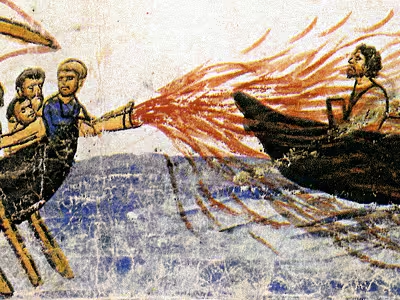
Land defense was only half the picture. The Byzantine navy — organized around its own thematic fleets and, from the ninth century, a central imperial fleet — protected Constantinople’s sea approaches, secured the grain routes from Egypt and later the Black Sea, and projected power across the Aegean and eastern Mediterranean. Its most famous weapon was Greek fire: an incendiary liquid, reportedly invented in the 7th century and launched from bronze siphons mounted on the bows of Byzantine warships, that could burn on water and devastate an enemy fleet at close range. The formula was treated as a closely guarded state secret, and Greek fire is credited with helping break both Arab sieges of Constantinople by destroying attacking fleets in the Bosporus and the Sea of Marmara.
Fortifications and defensive strategies.
The middle Byzantine period saw an intensified focus on fortifications, reflecting the empire’s defensive posture. Cities, towns, and rural settlements were often surrounded by walls, and existing fortresses were expanded or reinforced. Constantinople remained the empire’s ultimate bastion, with its Theodosian Walls serving as an impregnable barrier against repeated Arab sieges in 674–678 and 717–718. In Anatolia, a network of fortified strongholds provided safe havens for Byzantine forces and civilians during Arab incursions, combined with strategic retreat tactics that let the Byzantines wear down invaders through attrition rather than direct confrontation.
The Macedonian Renaissance: Renewed strength.
The Macedonian dynasty (867–1056) marked a period of military resurgence and territorial expansion. Under emperors like Nikephoros II Phokas, John I Tzimiskes, and Basil II, the empire shifted from a defensive stance to an aggressive reconquest strategy.
Nikephoros II, renowned as one of Byzantium’s most brilliant military minds, recaptured Crete from Arab control in 961, restoring Byzantine naval dominance in the eastern Mediterranean. He also launched successful campaigns in Syria, culminating in the reconquest of Aleppo. His successor, John I Tzimiskes, continued this momentum, advancing deep into Mesopotamia and capturing key cities like Nisibis and Amida.
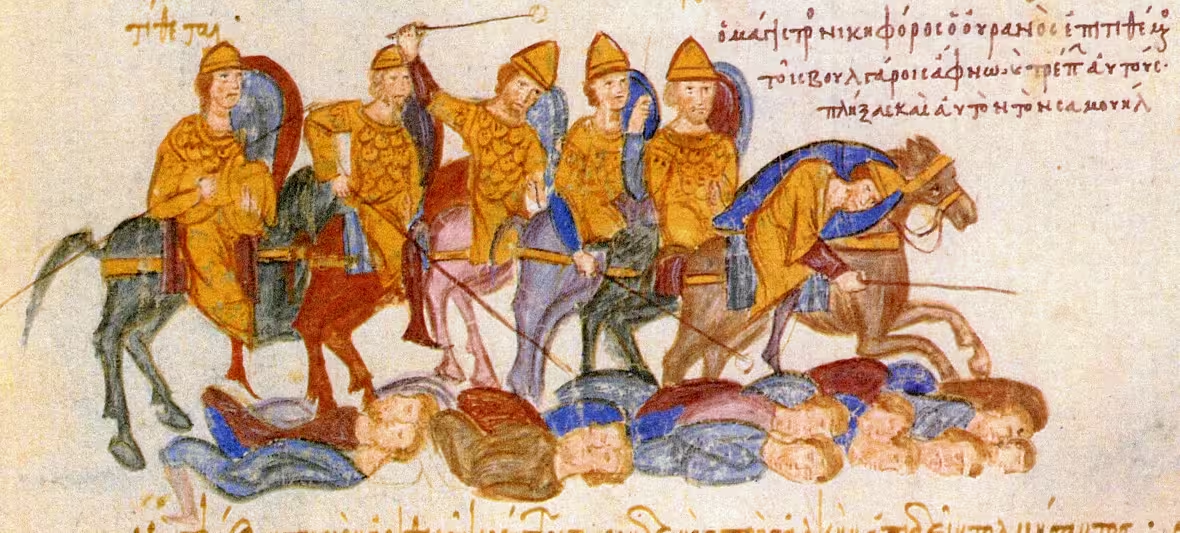
Basil II, known as the “Bulgar Slayer,” focused on the Balkans, where he crushed the First Bulgarian Empire after decades of conflict. His victory at the Battle of Kleidion in 1014 marked the zenith of Byzantine power in the region, securing the empire’s dominance in southeastern Europe. By the time of his death in 1025, the empire controlled more territory than it had since the sixth century.
New threats and the role of diplomacy
Despite its successes, the empire faced new challenges from the 10th century onwards. The rise of the Seljuk Turks, Pechenegs, and other nomadic groups tested Byzantine defenses, particularly in the east. The middle Byzantine military, while formidable, was not invulnerable, and over-reliance on thematic troops sometimes left the empire vulnerable to large-scale invasions.
Byzantine military strength was always complemented by skillful diplomacy — strategic marriages, alliances, and the use of bribes or subsidies to placate nomadic groups. As the treatises discussed in the next section make clear, the Byzantines regarded diplomacy not as an alternative to warfare but as an extension of it, a tool for winning without fighting or for fighting on more favorable terms.
By the mid-11th century, the empire had regained much of its former prestige, but the seeds of future challenges were already evident. The Seljuk Turks would soon emerge as a formidable force, and internal weaknesses within the thematic system would begin to undermine the cohesion of the Byzantine military. The defeat at Mantzikert in 1071 and the civil war that followed cost the empire almost all of Anatolia within a decade — the loss of the thematic heartland that had sustained the middle Byzantine army for four centuries.
The Komnenian restoration
Alexios I Komnenos and his successors rebuilt the army largely from scratch after Mantzikert. With the thematic system in ruins, the Komnenian emperors leaned heavily on a new mechanism, the pronoia — grants of state revenue (and later land) to soldiers, particularly cavalry, in exchange for military service, functioning as a Byzantine analogue to Western feudal tenure. They also recruited widely from outside the empire: Western knights, Pecheneg and Cuman horse-archers, and Varangian Guard troops (originally Rus, later heavily Anglo-Saxon and Scandinavian) all served in Komnenian armies. Manuel I Komnenos pushed this reconstructed army back into Anatolia and Italy with real success, but his defeat at Myriokephalon in 1176 against the Seljuks closed the door on retaking the central Anatolian plateau for good.
The Late Byzantine period: Improvisation and twilight
1204 and its aftermath
The Fourth Crusade’s sack of Constantinople in 1204 was the single greatest catastrophe in Byzantine military history — not a battlefield defeat but the fall of the capital itself to a Western army, and the fragmentation of the empire into competing Byzantine and Latin successor states. The Empire of Nicaea, one of these fragments, rebuilt enough military strength to retake Constantinople in 1261 and restore the empire under the Palaiologan dynasty — but the restored state never recovered the territory, revenue, or manpower of its Komnenian predecessor.
The Palaiologan twilight
The Palaiologan army was, by any earlier Byzantine standard, small. Chronic shortage of funds meant a shrinking core of professional troops supplemented, increasingly, by foreign mercenary companies — most famously the Catalan Company in the early 14th century, hired to fight the Turks and then turning on their employers when payment stalled. Byzantine emperors of this era spent as much energy negotiating with Genoese and Venetian fleets, and courting Western crusading aid that rarely arrived in time or in force, as they did commanding armies of their own.
The end came at the fall of Constantinople in 1453. Constantine XI Palaiologos defended the city with a garrison numbering only a few thousand men, against an Ottoman army equipped with massive siege cannon that finally broke walls that had held for a thousand years. The fifty-day siege, and the emperor’s death fighting in the breach, marked the end of the Roman state that the Byzantine army had defended, in one form or another, since the fourth century.
Soldiers and warriors: Byzantine men in arms
Behind every campaign and every emperor’s reputation stood the ordinary soldier — and Byzantium’s rank and file were never quite as ordinary as the term suggests. Military service was one of the empire’s few genuine channels of social mobility: a peasant recruit with ability and luck could rise through the ranks to command, and several emperors, including Justin I and, later, Heraclius’s own line, began their careers as soldiers rather than aristocrats. That meritocratic thread ran through the thematic system as well, where free farmer-soldiers held land in exchange for service and had a direct, personal stake in defending the ground they stood on.
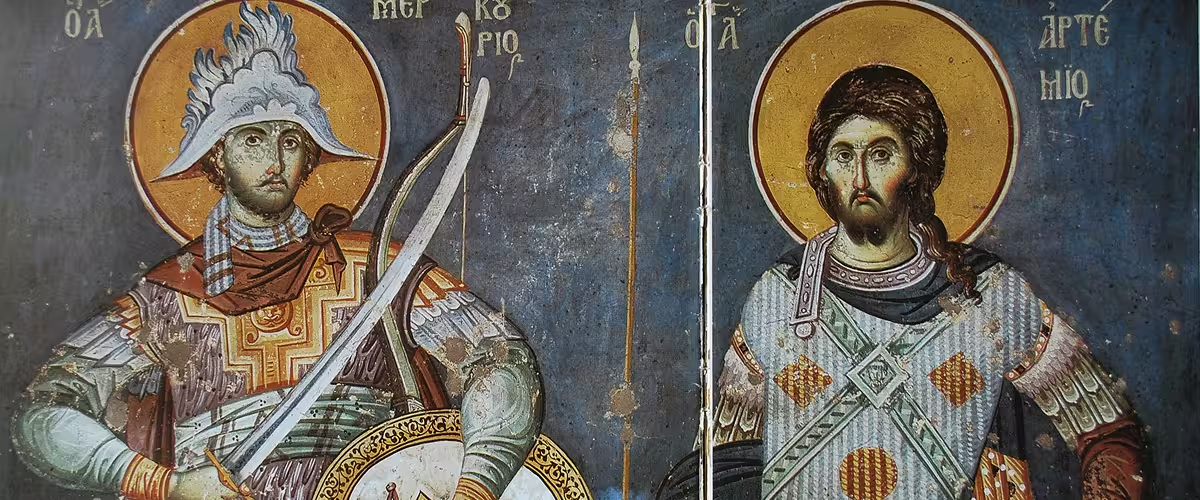
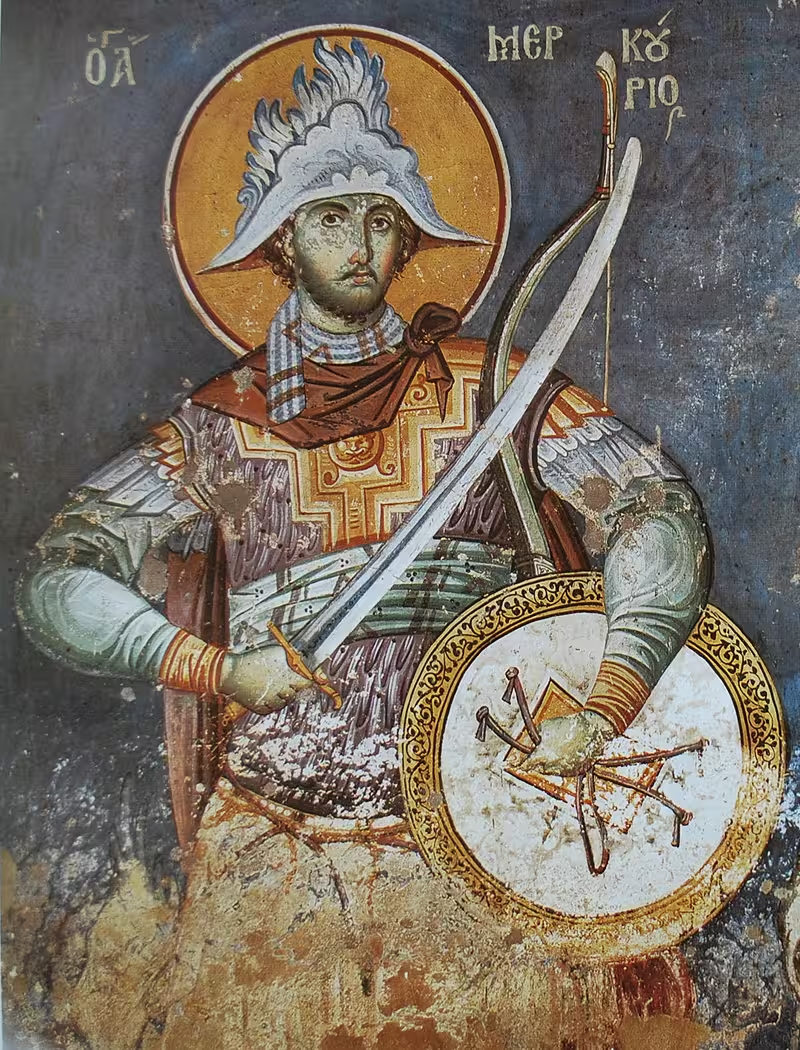
Not all soldiers served the same way. Thematic troops were part-time, locally raised, and tied to their province; the tagmata were full-time professionals garrisoned near Constantinople; and foreign units — Rus, Scandinavian, and later Anglo-Saxon warriors recruited into the famous Varangian Guard, along with Pecheneg and Cuman horse-archers in the Komnenian era — served as household troops whose loyalty ran to the emperor personally rather than to any province or faction. Equipment varied just as widely by role and era, from the lamellar armor and long spears of thematic infantry to the mail, lance, and bow of the cataphract, and from the humble sling and javelin of provincial levies to the axe that made the Varangians so feared in close combat.
The fuller story of these men — their recruitment, their daily life on campaign and in garrison, their equipment, and the units that made up the Byzantine order of battle — is covered on our dedicated Byzantine Soldiers and Warriors page.
The Art of War: Strategy, Tactics, and Poliorcetics
What set the Byzantine military apart from most of its medieval contemporaries was not just its equipment or its fortifications, but the fact that it thought about war in writing. Byzantine officers were expected to study strategy as a discipline, not just absorb it through experience — a habit inherited from antiquity and sustained for centuries after most of the post-Roman West had lost the practice.
The military manuals
The Strategikon, attributed to the Emperor Maurice around the end of the 6th century, is the foundational text of Byzantine military science: a practical handbook covering cavalry tactics, army organization, logistics, and — notably — detailed advice on the fighting styles of specific enemies, from the Avars and Slavs to the Franks and Persians. Three centuries later, Emperor Leo VI’s Taktika updated and expanded this tradition for the middle Byzantine army, drawing heavily on the Strategikon while incorporating lessons from the Arab wars. Alongside these major works sat a body of more specialized 10th-century treatises on siege warfare, border skirmishing, and campaign logistics, many composed under or for Nikephoros II Phokas — themselves evidence of an officer class that treated its own military history as a resource to be studied and reused.
Poliorcetics: the science of the siege
Siege warfare — poliorcetics — was central to Byzantine strategic thinking on both sides of the wall. On the offense, Byzantine armies used siege towers, battering rams, mining to undermine foundations, and torsion artillery to bombard defenders, later supplemented by counterweight trebuchets adopted from contact with the Crusader states and the Islamic world. On the defense — the side Byzantium found itself on far more often — the empire’s manuals covered countermining to intercept enemy tunnels, the stockpiling of provisions and water to withstand prolonged blockade, and coordinated sorties timed to disrupt a besieger’s siege lines before they could be completed. It was this defensive expertise, layered on top of the fortifications discussed below, that let cities like Constantinople outlast attackers who often had every material advantage except patience.
Signature technologies
Several technologies became distinctively Byzantine. Greek fire, discussed above, gave the navy a decisive edge in ship-to-ship combat for centuries. The cataphract charge — heavily armored lancers riding in close formation — remained the army’s primary shock weapon from the sixth century into the Komnenian period. Horse archery, adapted from steppe peoples the Byzantines fought and recruited from in turn (Huns, Avars, later Pechenegs and Cumans), gave Byzantine cavalry a skirmishing capability that few Western armies could match. And the dromon, the Byzantine navy’s principal war galley, combined oar-driven speed with the fire-siphons that made the fleet as feared as the army.
Diplomacy as a weapon
Byzantine strategic writing treated diplomacy, bribery, and the deliberate manipulation of rival peoples against one another as legitimate instruments of war, not a lesser alternative to it. Subsidies to steppe nomads to attack a common enemy, marriages that bound a dangerous neighbor into the imperial family, and intelligence networks that gave emperors warning of an attack before it arrived were all part of the same strategic toolkit as the army and navy — and often the more cost-effective part.
Fortifications: The Empire’s Shield
No account of Byzantine warfare is complete without its fortifications, which did as much to keep the empire alive as any army in the field. The Theodosian Walls of Constantinople — a triple line of walls and a moat, built in the 5th century — repelled every siege brought against the capital for a thousand years, until Ottoman gunpowder artillery finally breached them in 1453. Beyond the capital, a dense network of fortified cities, hilltop kastra, and frontier strongholds — Thessaloniki, Antioch, and Trebizond among them — turned the empire’s borders into defense-in-depth, absorbing raids and buying time for field armies to respond, rather than relying on a single defensible line.
The full engineering and architectural story of these fortifications — how they were built, how they evolved, and how they were eventually overcome — is covered on our dedicated Byzantine Fortifications page.
Warrior-emperors and great generals
Byzantine military success was rarely anonymous. Time and again, the empire’s fate turned on individual commanders — often emperors themselves — whose skill, or failure, on campaign shaped a generation.
Belisarius — Justinian’s leading general and arguably the finest Byzantine commander of any era. He reconquered Vandal North Africa in a single lightning campaign (533–534) and spent two decades fighting the Gothic War in Italy, repeatedly holding besieged cities and outmaneuvering larger armies with a fraction of their resources.
Heraclius — the emperor who personally led the counteroffensive that broke the Sassanian Persian Empire, reversing near-total defeat between 622 and 627 and saving Byzantium at its lowest point before the Arab conquests.
Nikephoros II Phokas — a general-turned-emperor and one of the sharpest military minds of the Macedonian Renaissance, who recaptured Crete from Arab control in 961 and drove Byzantine power back into Syria.
John I Tzimiskes — Nikephoros’s successor, who pushed the reconquest deep into Mesopotamia and brought the empire to the edge of Jerusalem before his death.
Basil II, “the Bulgar Slayer” — the soldier-emperor who spent decades of campaigning to destroy the First Bulgarian Empire, leaving Byzantium at its largest territorial extent since the sixth century.
Romanos IV Diogenes — the emperor whose defeat and capture at Mantzikert in 1071 triggered the civil war that cost Byzantium Anatolia — a reminder that this history is not only one of triumphs.
Manuel I Komnenos — the most militarily ambitious of the Komnenian emperors, who rebuilt Byzantine power in Anatolia and Italy before his defeat at Myriokephalon in 1176 ended hopes of a full reconquest of the interior.
Constantine XI Palaiologos — the last Roman emperor, who chose to die fighting in the breach of the walls during the fall of Constantinople in 1453 rather than surrender or flee.
Decisive Battles and Sieges
Siege of Constantinople, 626 — A combined Avar, Slav, and Sassanian Persian assault on the capital failed against the Theodosian Walls and Byzantine naval control of the Bosporus, preserving the empire at the height of the Persian war.
Arab sieges of Constantinople, 674–678 and 717–718 — Two sustained attempts by the Umayyad Caliphate to take the capital, both broken by the walls, Greek fire, and Byzantine diplomacy with the Bulgars — arguably the battles that kept the Arab conquests from overrunning southeastern Europe.
Battle of Kleidion, 1014 — Basil II’s decisive victory over the First Bulgarian Empire, effectively ending Bulgarian independence and marking the height of Macedonian-era Byzantine power in the Balkans.
Battle of Manzikert, 1071 — The Seljuk victory over Emperor Romanos IV Diogenes that, through the civil war it triggered rather than the battle itself, cost Byzantium most of Anatolia within a decade — arguably the single most consequential defeat in the empire’s medieval history.
Fourth Crusade / Sack of Constantinople, 1204 — The only time the capital fell to a foreign army before 1453, and the wound from which the empire never fully recovered even after its restoration in 1261.
Fall of Constantinople, 1453 — The fifty-day Ottoman siege, broken by gunpowder artillery against walls that had stood for a thousand years, and the death of Constantine XI — the end of the Roman Empire in the east.
A thousand years of adaptation
Seen end to end, the story of the Byzantine army is one of continuous reinvention: a late Roman force that became a thematic militia to survive the Arab conquests, an aggressive professional army during the Macedonian Renaissance, a reconstructed and increasingly foreign-staffed force under the Komnenoi, and finally a small, resource-starved garrison holding a thousand-year-old wall against gunpowder artillery in 1453. What stayed constant across all four incarnations was a doctrine-driven officer corps that studied its own history, a defensive architecture built to outlast any single siege, and a willingness to fight with diplomacy as readily as with the sword. That combination, more than any single victory, is why the empire lasted as long as it did.