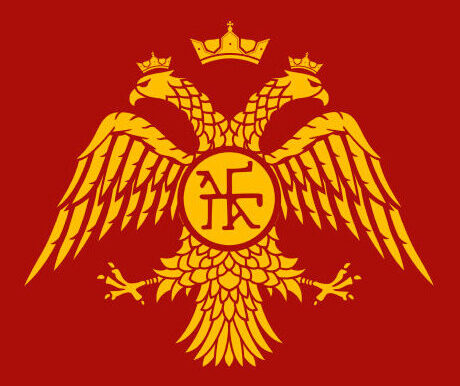
The Early Byzantine period: The dawn of Byzantium
The Early Byzantine period, spanning from the 4th to the 7th century, marks the formative era of the Eastern Roman Empirem corresponding to the end of Late Antiquity and the beginning of the medieval times. Following the division of the Roman Empire and the founding of Constantinople by Emperor Constantine the Great in 330, Byzantium emerged as a powerful political, cultural, and religious center. This period laid the foundations for an empire that would endure for over a thousand years, blending Roman governance, Christian faith, and Hellenistic culture into a unique and lasting civilization.
Overview of the Early Byzantine period.
The formation of the Eastern Roman Empire.
The Eastern Roman Empire emerged from reforms and crises that reshaped the late Roman world. When Constantine founded Constantinople in 330, he sought a new center of power that lay closer to the wealthy provinces of the eastern Mediterranean.
The city stood on ancient Byzantium, but Constantine transformed it into a Christian imperial capital. A stable administrative structure, a professional bureaucracy, and a strong fiscal system supported its early development. The East soon became the political and economic core of the Empire as the Western half weakened under repeated invasions.
By the end of the 4th century, the Eastern Empire had taken on a distinct character. It still claimed Roman tradition, yet it adapted to new religious and cultural realities that would shape its future.

The Theodosian Dynasty.
Under the Theodosian dynasty (379–457), the Eastern Empire consolidated its institutions. Theodosius I made Nicene Christianity the official faith of the Empire, ensuring the Church’s deep integration into political life. His sons, Arcadius and Honorius, ruled East and West separately, confirming the permanent division of the Empire.
Constantinople grew into a thriving metropolis with ornate churches, and expanding administrative quarters. Despite internal court tensions and pressures from Goths, Huns, and other groups, the Theodosian rulers maintained the stability of the East.
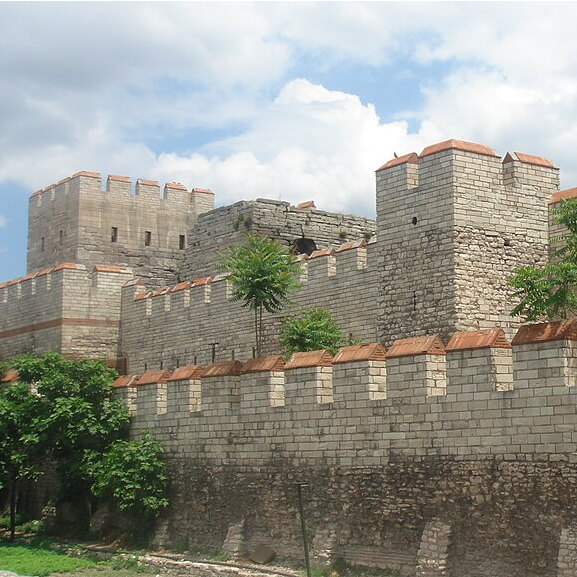
The construction of the Theodosian Walls around the capital symbolized the dynasty’s defensive strength. These walls protected Constantinople for centuries and allowed the Empire to withstand many sieges, especially in the 7th centuries, until its fall to the Turks in 1453.
Justinian and the attempt at reclaiming the West.

Justinian I (527–565) sought to restore Roman glory through ambitious reforms and military campaigns. His generals, Belisarius and Narses, reconquered large territories in North Africa, Italy, and parts of Spain. These campaigns placed heavy burdens on state finances, yet they temporarily revived the idea of a united Roman world. Justinian commissioned major building projects in the capital and the whole empire, including the Hagia Sophia, which rose as a symbol of imperial piety and technical mastery.
His codification of Roman law, the Corpus Juris Civilis, became one of the most enduring achievements of Late Antiquity and had a major impact on the Western world from the 11th–12th centuries onward.
His immediate successors struggled to preserve his gains. Wars with Persia, the first outbreaks of plague, and religious conflicts weakened imperial power. Yet the administrative and legal structures shaped under Justinian continued to guide the Empire for generations.
The Dark Age.
From the late 6th to the early 7th century, the Empire entered a period often described as a “dark age.” Slavic and Avar incursions reshaped the Balkans. The Persian Wars drained resources and devastated key provinces. Soon after, the rapid Arab conquests deprived the Empire of Syria, Egypt, and much of North Africa. These losses forced a profound transformation. The Empire reorganized its military and administrative systems, most notably through the emergence of the theme structure. Urban life contracted, and Constantinople became even more central to imperial survival. Although difficult, this period marked the transition from Late Antiquity to the medieval Byzantine state. A more compact and resilient Empire emerged from crisis, ready to define a new chapter in its history.
Society, cities, and economy.
Before the Dark Age.
Early Byzantine society blended Roman legal tradition, Christian ethics, and Greek cultural heritage. The imperial court and the Church shaped elite behavior, while rural communities preserved older customs. Social mobility existed, although wealth, office-holding, and patronage networks largely defined status. Until the 6th century, the aristocracy and elite lineages remained mostly those of Late Antiquity.
Cities remained vital centers of administration, trade, and religious life, and urban life continued along lines familiar from Late Antiquity. Constantinople dominated the urban network with its palaces, forums, monasteries, and ports. Other cities such as Alexandria, Antioch, and Thessaloniki maintained regional importance, though many began to decline after earthquakes, invasions, plagues, and economic shifts.
Many regions still enjoyed prosperity. The economy relied on agriculture, long-distance trade, and artisanal production. Grain from Thrace, Egypt, and later Asia Minor fed the capital. Trade routes linked Byzantium to the Mediterranean, the Black Sea, and the Near East. Silk production gradually expanded, strengthening imperial control over luxury goods. Despite crises, the East maintained a relatively stable fiscal system, which allowed it to endure while other post-Roman states fragmented.
The shifts of the Dark Age.
The destructive twenty-year war against the Sassanids, the other major power of the time, combined with Avar invasions, the advance of the Slavs in the Balkans, and later the rise of Islam and the Arab conquests, created a completely new landscape. Across the Empire, cities suffered devastation from raids and conflicts. Constantinople itself was besieged several times in the 6th and 7th centuries, and most cities in the Near East, Asia Minor, and, to some extent, the Balkans were severely damaged. These events, compounded by earthquakes, brought an abrupt end to urban life inherited from Antiquity in many regions.
Population groups sought refuge in areas that were difficult to reach or easy to defend. Many urban sites were abandoned, while some rural settlements grew. This produced a transformed landscape in which villages gained greater importance, while cities shrank and adopted characteristics that defined the medieval period. The Arab invasions also dealt a heavy blow to the Empire, which lost within a few decades several of its core provinces: North Africa, Egypt, and Syria. Asia Minor then became exposed to enemy raids and emerged as the new heartland of the Byzantine state.
Art and Architecture during the Early Byzantine period.
Early Byzantine art developed from late Roman models but emphasized Christian symbolism and spiritual meaning. Artists favored frontal figures, luminous surfaces, and hierarchical compositions. Mosaics in churches like those in Ravenna illustrate this aesthetic, blending imperial imagery with sacred themes. Icons emerged as central objects of devotion, serving both as liturgical tools and as mediators between worshippers and the divine.
Architecture reached new heights under Justinian. The Hagia Sophia, with its vast dome and innovative use of light, defined the era’s architectural ambitions. Engineers experimented with complex vaulting, large centralized spaces, and rich interior decoration. Churches became the focal points of community identity, filled with marble, gold, and shimmering mosaics.
These artistic and architectural achievements shaped medieval Christian art across the Mediterranean and influenced both Western Europe and the Islamic world.
The Early Byzantine period is thus remembered as a time of both brilliant achievements and profound change – a crucial moment in history when the Eastern Roman Empire transformed into Byzantium, which would come to dominate the medieval eastern Mediterranean. Let’s explore some of its wonders.