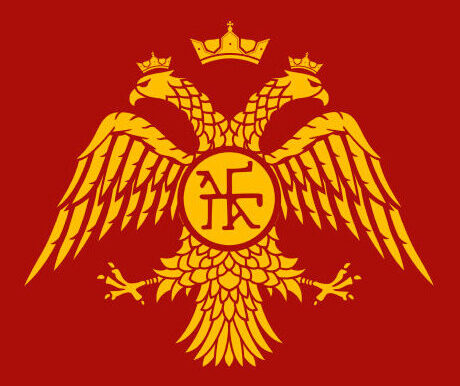
What is Byzantium?
What is Byzantium?
Byzantium was originally the name of the ancient Greek city known today as Istanbul. In antiquity, it was an important city, though never a first-rank power. With the rise of Macedonia, it was incorporated into the empire of Alexander the Great, and later into the Roman Empire.
In the 3rd and 4th centuries AD, the Roman Empire faced not only invasions by various “barbarian” groups but also political instability and a demographic and economic decline in its western provinces.
To address these challenges, Emperor Constantine moved the capital to the city of Byzantium, which he refounded as Constantinople. In 395, the empire was definitively divided into two distinct halves.
In 476 AD, Odoacer deposed the last Western Roman emperor, leaving the Eastern Roman Empire as the sole legitimate heir to Rome. Over time, this entity came to be known as the Byzantine Empire, or Byzantium, echoing the ancient name of its capital city.
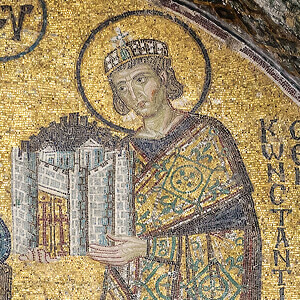
The Byzantine Empire was shaped by a fusion of Greek cultural heritage, the enduring legacy of classical antiquity, the Orthodox Christian faith, and a distinctly Roman conception of law, administration, and imperial authority. Its capital, Constantinople, stood as one of the most influential cities in the world, arguably the only true megacity of the medieval Christian world, renowned for its wealth, learning, and strategic power.
Over eleven centuries of rich and turbulent history, the Byzantines weathered profound crises and faced the loss of vast territories to waves of invaders – among them the Arabs, Slavs, Bulgarians, Crusaders, and eventually the Turks. Yet despite repeated setbacks and the empire’s ultimate fall in 1453, Byzantium endured as a spiritual, artistic, and cultural beacon, radiating influence far beyond its borders. Its legacy continues to resonate in the modern world, a testament to resilience, innovation, and cultural synthesis.