Explore Byzantine Art: Eleven centuries of Masterpieces
Where Faith, Power, and Beauty Meet.
Byzantine art refers to the visual and architectural production of the Eastern Roman Empire, spanning roughly from the 4th century – when Emperor Constantine moved the capital to Constantinople – to the fall of the city in 1453. Rooted in late Roman traditions and transformed by Christian theology, it encompasses mosaics, icons, frescoes, illuminated manuscripts, sculpture, and monumental architecture. Characterized by gold backgrounds evoking divine light, frontal figures conveying spiritual authority, and a deliberate move away from classical naturalism toward transcendent abstraction, Byzantine art shaped the visual culture of the Orthodox world and left a lasting imprint on the Italian Renaissance.The scope of this artistic legacy is as vast as it is extraordinary. Although the empire disappeared nearly six centuries ago, its art continues to resonate — offering insights into a sophisticated culture where faith, politics, and aesthetics were inseparable. From the shimmering mosaics of Constantinople to the intimate beauty of devotional icons, these traditions crossed borders, shaped Eastern Orthodoxy, and quietly transformed the visual language of the European Renaissance.
Sacred and Secular: The two faces of Byzantine Art.
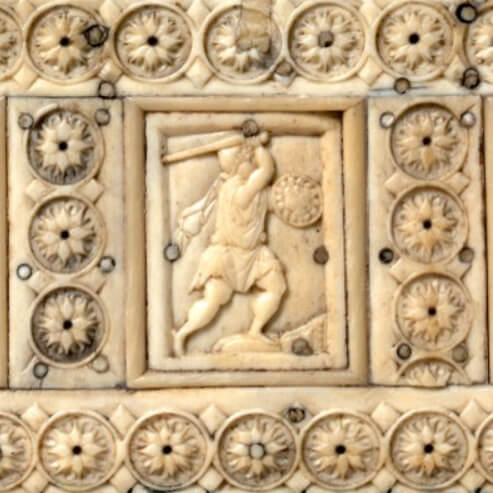
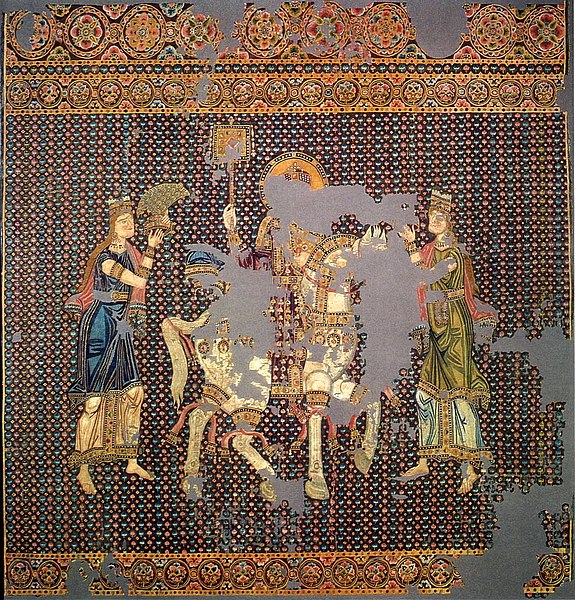
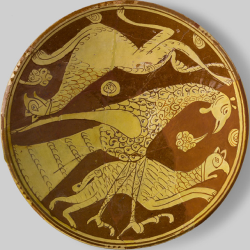
People often think of Byzantine art as purely religious. That view comes from what has survived, mainly works made for churches and devotion. But it is not the full story. Secular art also flourished. It appeared in painting, sculpture, jewelry, and elegant decorative objects. Many works continued classical traditions, inspired by ancient statues that still stood in Constantinople’s public spaces and kept the legacy of antiquity alive.
Beyond the church, secular Byzantine art flourished in painting, sculpture, jewellery, and elegant decorative objects — a side of Byzantium often overlooked.
Uncover the secular side
Though very codified, sacred art was where Byzantine creativity reached its greatest heights, producing masterpieces still venerated today.
Dive into sacred art
Defining characteristics of Byzantine art.

Gold backgrounds.
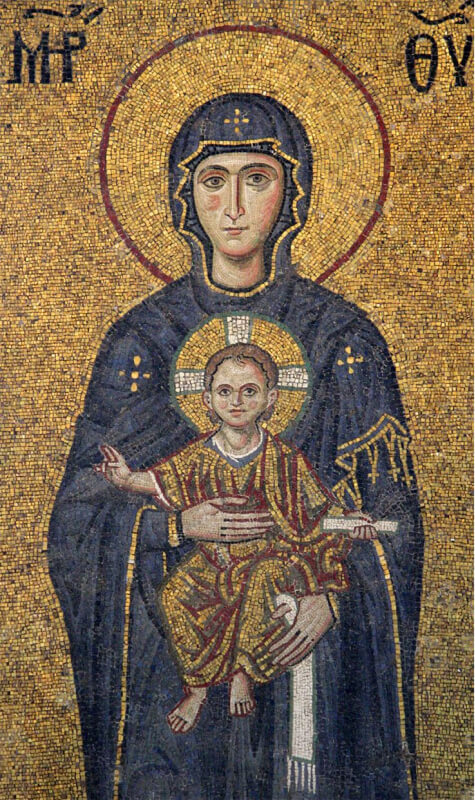
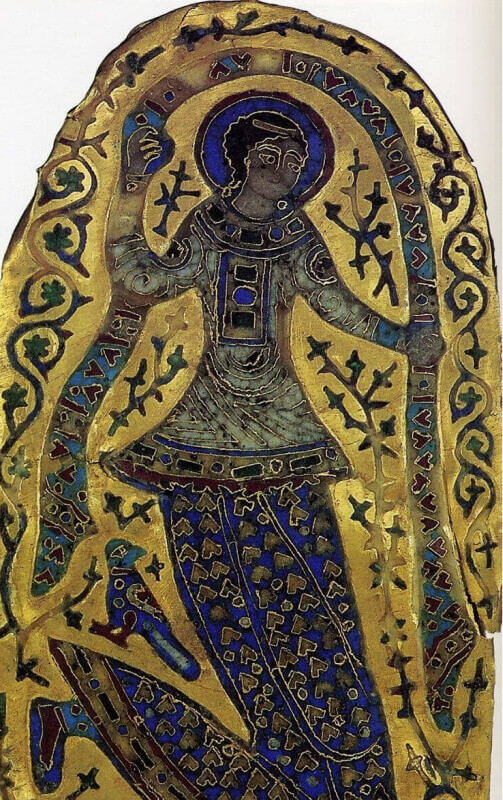
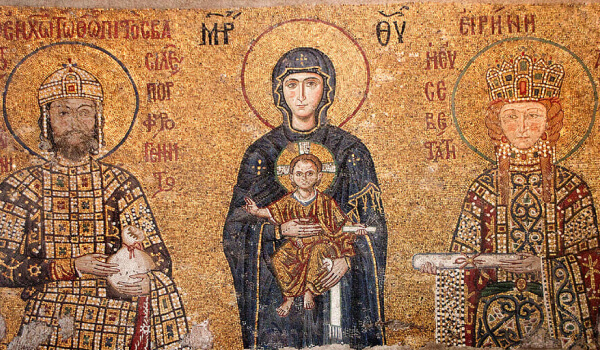
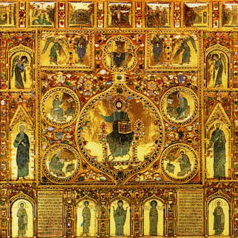
In Byzantine art, gold is not just decoration – it is theology. The gleaming grounds that appear in mosaics, illuminated manuscripts, and luxury objects alike all serve the same purpose: to evoke the light of the divine, removing sacred and imperial figures from earthly time and space.
What makes this convention remarkable is its consistency across every medium and every century. The Virgin and Child in a church apse, the imperial couple in a court manuscript, the dancing figure on a ceremonial crown — all inhabit the same luminous void. Whether in glass tesserae, painted on vellum, or in cloisonné enamel, gold signals the same thing: this figure exists beyond the physical world. Even secular subjects were elevated by this visual grammar into something timeless and ceremonial.
This is what distinguishes Byzantine gold from gilding found in other traditions. It is not a sign of wealth, though wealth was certainly involved. It is a cosmological statement: what you are seeing belongs not to history, but to eternity.
Hieratic figures.
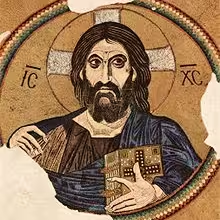
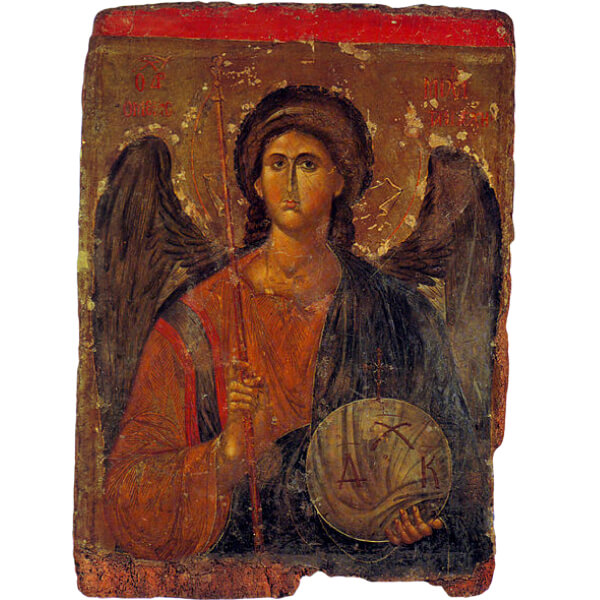
Frontality is the dominant convention in Byzantine art – Christ, the Virgin, and saints in devotional contexts typically face the viewer directly, with controlled gestures and idealized features. This formality was deliberate: it conveyed spiritual authority and invited contemplation rather than narrative drama. The Christ Pantocrator gazing down from the dome of Daphni Monastery is perhaps the most concentrated expression of this principle.
Narrative scenes allowed more movement and three-quarter views, but even there, figures retain a gravity and restraint absent from classical or Western medieval art.
Tension between abstraction and naturalism.

In devotional and monumental contexts, Byzantine artists deliberately moved away from classical illusionism. Bodies are flattened, drapery falls in stylized patterns, and spatial depth is avoided in favour of a symbolic plane. Faces are idealized rather than individualized – elongated, with large eyes that seem to look through the viewer rather than at them. This was a theological choice: the physical world recedes so that the spiritual can come forward.
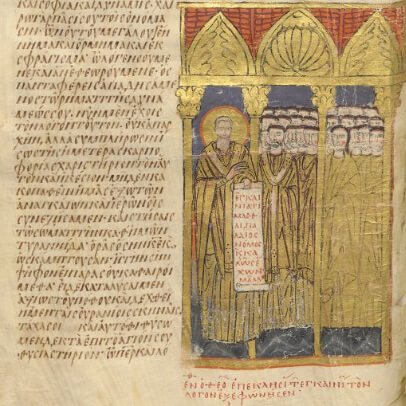
Yet the classical tradition never fully disappeared. Secular art – ivory carvings, decorative objects, court manuscripts – often retained strong naturalistic tendencies. And during the Macedonian Renaissance of the 10th century, artists consciously revived antique models: the Paris Psalter includes reclining personifications that could pass for Roman paintings. Byzantine abstraction was not a rupture with antiquity but a permanent tension with it – one that gave the tradition much of its dynamism.
Symbolic use of colour.
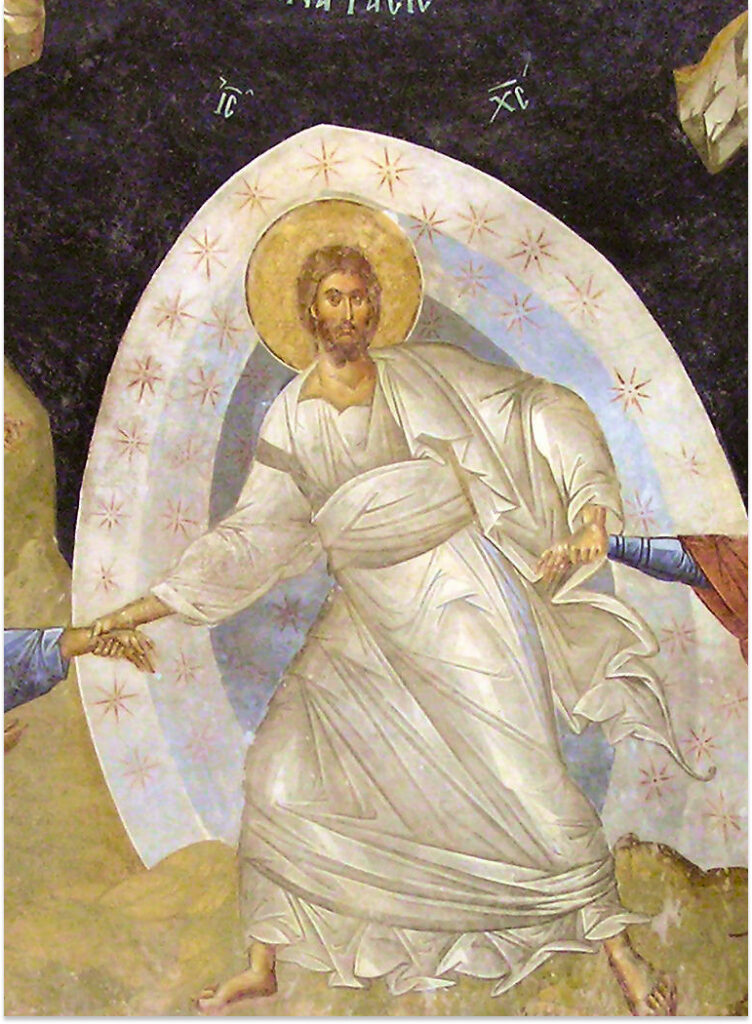
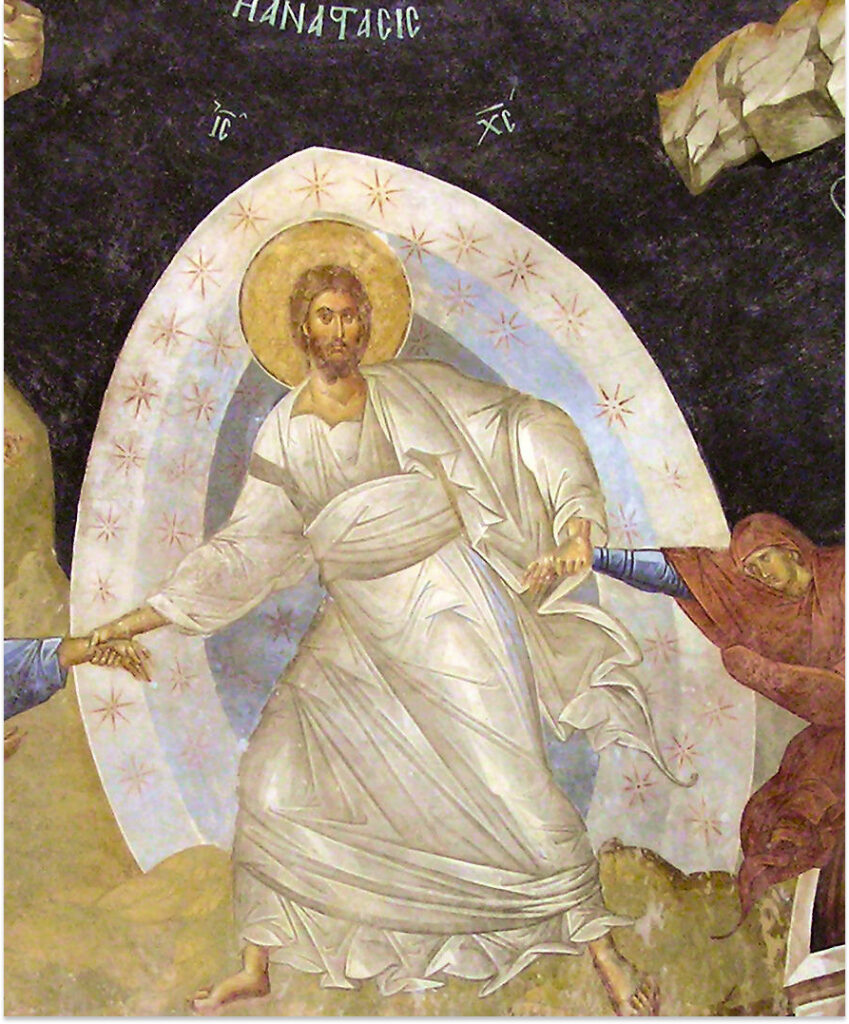
In Byzantine art, colour was never purely aesthetic – it carried fixed theological and imperial meaning. Purple, extracted from murex shellfish at extraordinary cost, was reserved for emperors and their closest circle; to wear it was to make a political statement. White signalled resurrection and divine purity. Red and crimson marked martyrdom and sacrifice, appearing consistently in depictions of Christ’s Passion and the robes of warrior saints.
The most distinctive colour of all emerged late. The deep, luminous blue of the Palaiologan period – seen at its most concentrated in the frescoes of the Chora Church – was not simply a pigment choice. Applied in dense, almost jewel-like passages against gold grounds and pale flesh tones, it came to evoke transcendence itself: a colour that seemed to belong to another order of reality. It remains one of the most immediately recognizable signatures of Byzantine art at its peak, and one of the hardest to replicate.
Codified iconographic programs.
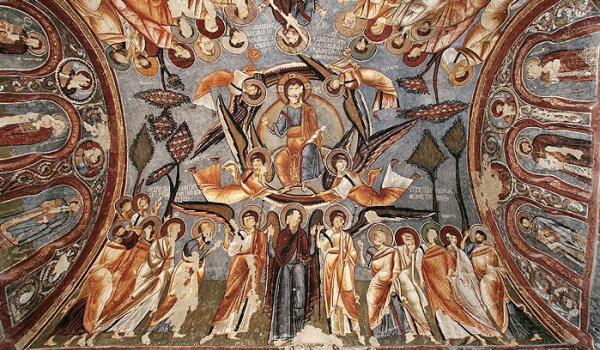
The decorative programs of Byzantine churches were not improvised – they followed a logic established in the post-iconoclast period and consolidated after the Triumph of Orthodoxy in 843. Christ Pantocrator dominated the dome, the Virgin Orans occupied the apse, apostles and saints descended through the hierarchy of the building according to liturgical rank. Narrative cycles unfolded across the walls in sequence tied to the liturgical calendar. Once established, this fundamental structure evolved remarkably little across centuries and regions.
Yet the program was never entirely rigid. It adapted to context: monastic churches might emphasize saints venerated by the community, the narthex regularly featured the Last Judgment and scenes from the life of the Virgin, and funerary chapels – like the stunning parekklesion of the Chora Church – concentrated on resurrection, judgment, and salvation. The building type shaped what was shown and where.
Imperial palaces and public monuments followed a different logic altogether. Freed from theological prescription, secular programs drew on hunting scenes, chariot races, military triumphs, and personifications of provinces and seasons – imagery designed less for devotion than for the projection of imperial power. A Byzantine worshipper entering a church stepped inside a vision of the cosmos. A visitor to the Great Palace encountered a vision of empire.
All these defining characteristics were not fixed from the start – they were forged across more than a thousand years of artistic, theological, and political upheaval.
History of Byzantine Art through the age.
Early Byzantine Art: Origins and Development (3rd–6th century).
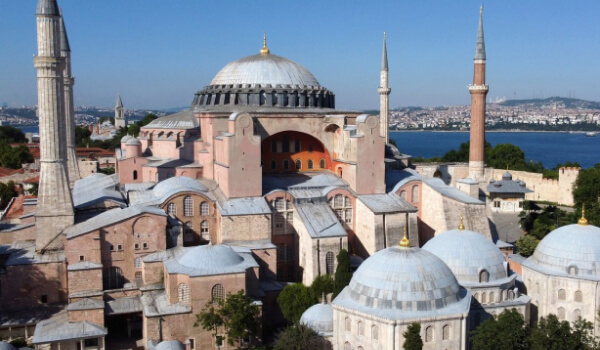
Byzantine art emerged from the fusion of late Roman traditions and the new demands of Christian worship. From the 3rd century onward, artists began depicting biblical narratives and scenes of salvation in catacombs and early basilicas, adapting Roman imagery to religious purposes. The conversion of Emperor Constantine accelerated this transformation, as imperial patronage funded grand churches and ambitious mosaic programs. The reign of Justinian I (527–565) marked the first great peak: his church-building program pioneered the centralized domed plan, using pendentives – curved triangular surfaces that allow a circular dome to rest on a square base – to create vast, luminous interiors, with Hagia Sophia as its supreme achievement. Alongside this architectural revolution, the mosaics of Ravenna and the early icons preserved at Saint Catherine’s Monastery in Sinai established the core visual language of Byzantine art – gold backgrounds evoking divine light, frontal figures conveying spiritual authority, and a deliberate move from classical naturalism toward transcendent abstraction.
The Iconoclast Controversy and its impact on art (726–843).
In 726, Emperor Leo III banned the veneration of religious images, triggering a crisis that would reshape Byzantine art for over a century. Iconoclasts – “image-breakers” – destroyed mosaics, frescoes, and icons across the empire, replacing figural decoration with abstract motifs, crosses, and ornamental patterns. The rare surviving examples, such as the apse mosaic of Hagia Irene in Constantinople, offer a glimpse of what iconoclast art looked like. The controversy unfolded in two phases, interrupted by a brief restoration of images in 787, before ending definitively with the Triumph of Orthodoxy in 843. Far from being merely destructive, this period forced a deeper theological reflection on the role of images in Christian worship – one that would shape Byzantine artistic production for centuries to come. After 843, images returned to churches with renewed purpose – central to devotion, teaching, and imperial representation – and workshops flourished with accumulated creative energy.
The Macedonian Renaissance (867–1056).
The Macedonian dynasty ushered in one of the most prolific periods in Byzantine art history. Drawing on the classical heritage preserved in Constantinople’s libraries and collections, artists revived naturalistic figural styles while infusing them with the spiritual intensity of Orthodox theology. Architecture and mosaics reached extraordinary refinement, as seen in the monastic complexes of Hosios Loukas and Nea Moni in Chios – both UNESCO World Heritage Sites. Illuminated manuscripts flourished under imperial patronage, with the Paris Psalter standing as a masterpiece of classical revival. Ivory carving, goldsmithing, and enamelwork also reached new heights, producing luxury objects that circulated across Europe as diplomatic gifts. Byzantine art of this period became a template for the wider Orthodox world, with craftsmen and models exported to Russia, the Balkans, and the Caucasus.
Byzantine Art under the Komnenian Dynasty (1081–1204).
The Komnenian period produced a distinctive style marked by elegant elongated figures, expressive faces, and an increasingly refined treatment of drapery. Emotional intensity became a defining quality – grief, compassion, and spiritual yearning were conveyed with new directness in icons and fresco cycles alike. Imperial patronage drove ambitious commissions far beyond the empire’s borders: Byzantine mosaicists worked in Norman Sicily, producing the magnificent artistic hybrid programs of Cefalù, Palermo, and Monreale, while Venice’s San Marco drew heavily on Byzantine craftsmen and models. Manuscript illumination flourished with sophisticated colour and narrative invention. Greek and Armenian masters carried Byzantine techniques across Eastern Europe and the Middle East, cementing the empire’s cultural reach well beyond its political borders.
Art in the Successor States (1204–1261).
The sack of Constantinople by the Fourth Crusade in 1204 was a catastrophe for Byzantine culture – countless works were looted or destroyed, and the empire fragmented into competing successor states. Yet Byzantine artistic traditions did not disappear: they dispersed. Three main successor courts emerged – the Empire of Nicaea, the Despotate of Epirus, and the Empire of Trebizond – each becoming a centre of Byzantine cultural life. Nicaea, under the Laskarid dynasty, was particularly active in preserving the imperial artistic tradition. The Latin presence meanwhile introduced new cultural exchanges, as Crusader art blended Byzantine and Western Gothic elements across Cyprus and the Holy Land. Serbian and Bulgarian rulers invited Byzantine artists to their courts, giving rise to vibrant regional schools that would outlast Byzantium itself.
The Palaiologan Renaissance (1261–1453).
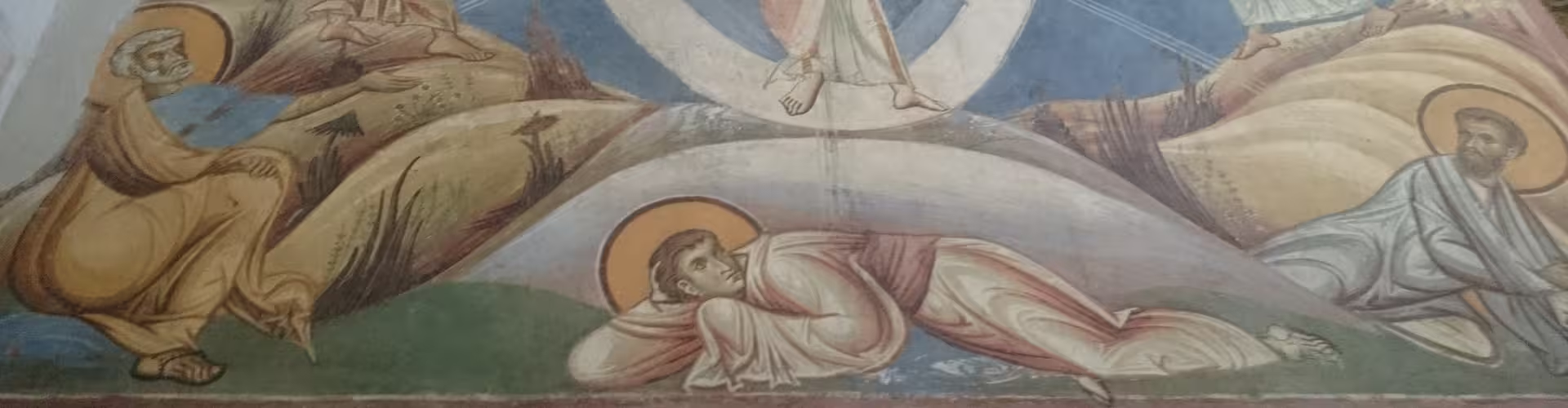
After the reconquest of Constantinople in 1261, the Palaiologos dynasty led a final and brilliant artistic flowering. Artists embraced expressive figures, refined modelling of light, and dynamic spatial compositions, introducing greater psychological depth to sacred scenes. Monasteries and churches commissioned ambitious fresco cycles – the church of Chora in Constantinople remains the supreme example of the period’s art and architecture. Icons, meanwhile, grew more intimate and emotionally poetic. A distinctive deep blue, known as Palaiologan blue, became the hallmark of the era’s most refined works. This last flowering would prove highly influential: its innovations in naturalism and emotional expressiveness anticipate developments that would shape the Italian Renaissance.
Delve into the various realms of Byzantine Art.

Who produced these masterpieces?
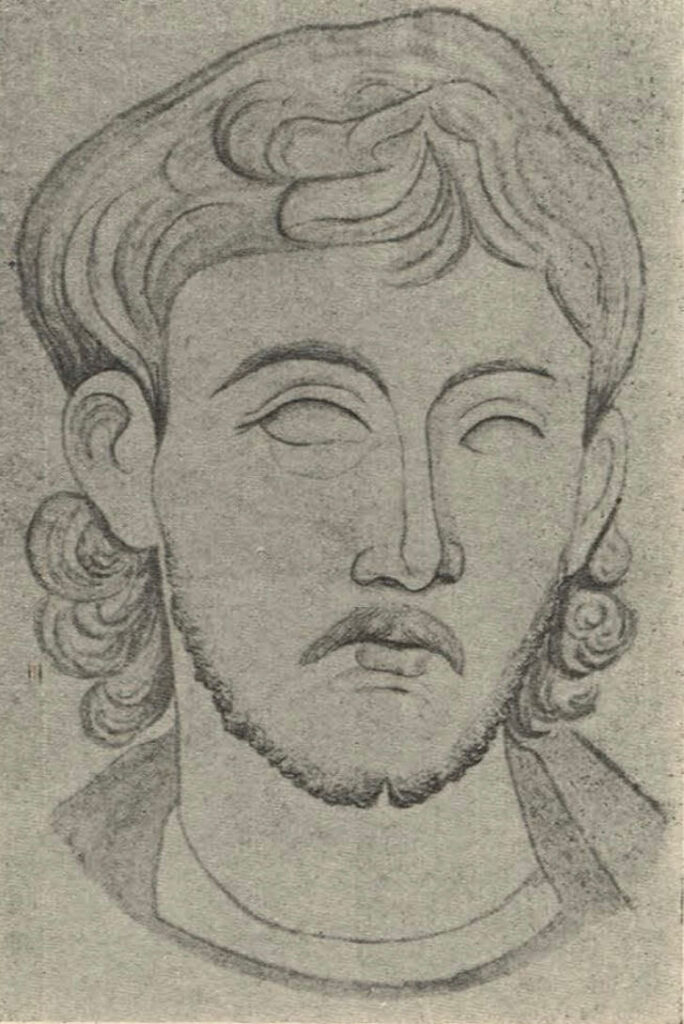
Byzantine artists remain largely anonymous – their names lost to time, their identities deliberately subordinated to the sacred work they created.
Yet behind every mosaic, icon, and illuminated manuscript stood skilled craftsmen, court workshops, and monastic painters whose techniques were passed down across generations.
A few names have survived: Eulalios, who decorated the Holy Apostles in Constantinople, Theophanes the Greek, who carried the Byzantine tradition into Russia or the Astrapas Brothers, prominent figures of the Macedonian school.
Who were these artists, how did they work, and what do we know about their lives?
Where to see Byzantine Art today.
In situ – art in its original context.
Byzantine art is best encountered where it was made. Standing beneath the Christ Pantocrator of Daphni Monastery, walking through the mosaic-covered interior of Ravenna’s San Vitale, or entering the frescoed shell of the Chora Church in Istanbul — these are experiences that no reproduction can prepare you for – see them in our guide to the most beautiful Byzantine mosaics. The scale, the light, and the spatial logic of the iconographic program only fully reveal themselves in context. In Greece alone, Hosios Loukas, Nea Moni on Chios, and the painted churches of Mystras offer encounters with Byzantine art still embedded in the landscape and the liturgical life it was created to serve.
In museum collections across the world.
For those who cannot travel to these sites, the great museum collections offer an equally rewarding entry point — and in some respects a complementary one, bringing together objects from across the empire that would otherwise never be seen side by side. Dumbarton Oaks in Washington D.C. holds one of the finest dedicated Byzantine collections in the world, with exceptional pieces in ivory, enamel, and jewellery. The Museum of Byzantine Culture in Thessaloniki is essential for anyone seeking depth across every medium. The Louvre, the Metropolitan Museum in New York, and the Vatican Museums each hold significant works, while the Treasury of San Marco in Venice preserves some of the most spectacular objects looted – and ultimately preserved – by the Fourth Crusade.