
Byzantine soldiers and warriors
In the grand tapestry of medieval history, the Byzantine Empire stands as a beacon of resilience and military prowess. The soldiers and warriors of Byzantium were not merely defenders of territory but guardians of a rich cultural and political legacy that spanned over a millennium. From the elite Varangian Guard to the innovative use of siege warfare, we will uncover the stories of those who stood at the frontlines, preserving the glory of Byzantium against the tides of time and conflict.
Organization and structure of the Early Byzantine army: A legacy of Roman discipline.
The Early Byzantine army was a direct descendant of the late Roman military, inheriting its organizational structure and ethos. This continuity ensured that the Byzantine forces retained the discipline and strategic acumen that had characterized Roman legions. The army was structured into several key units, each playing a vital role in the empire’s defense and expansion.
The army as a path to social mobility and power.
The Byzantine army was more than just a defensive force; it was a powerful institution that significantly shaped the empire’s political landscape. For many men, the army offered a path to social advancement, where soldiers could rise through the ranks based on merit and bravery. This structured environment fostered discipline, training, and camaraderie, providing a sense of belonging and purpose. The system, which allowed for some meritocracy and was inherited from the Roman military, ensured that service to the empire was a respected and honorable profession, enabling soldiers to earn prestige and material rewards.
This dynamic was exemplified by several emperors who ascended to the throne through their military careers. Notable figures include Justin I, who rose from the ranks of the army to become emperor in the 6th century, and Heraclius, whose military prowess helped him secure the throne in the early 7th century. These examples underscore the army’s role as a social mobility enabler, where military prowess and loyalty could propel individuals to the highest offices of the empire. The army not only defended Byzantium but also served as a catalyst for political and social transformation.
Recruitement of the Byzantine army.
The Byzantine army was a diverse institution, reflecting the broader social fabric of the empire. Soldiers were drawn from various backgrounds, including native Byzantines – or Romans, as they call themselves, as well as recruits from conquered territories and allied tribes. Many soldiers came from rural areas, where military service offered an escape from agricultural life and a chance for social advancement. The rank and file were often composed of peasants and lower-class citizens seeking the stability and honor that military service provided. Officers, on the other hand, typically hailed from the aristocracy or the landed gentry, leveraging their social status and education to secure leadership positions. However, the Byzantine military’s meritocratic system allowed exceptional soldiers to rise through the ranks and achieve officer status, regardless of their initial social standing. This blend of backgrounds fostered a dynamic and resilient military culture, where loyalty, bravery, and tactical acumen were valued above all else.
Crisis and transformation.
Toward the end of the Early Byzantine period, the empire faced significant challenges from external foes, including the Sassanids, Avars, and later the Arabs. These conflicts strained the military and led to a period of crisis and transformation. The wars against these formidable adversaries marked the beginning of a darker era for the Byzantine Empire, necessitating a reorganization of the army to adapt to new threats and realities.
Reorganization of the Byzantine army in the Middle Byzantine period.
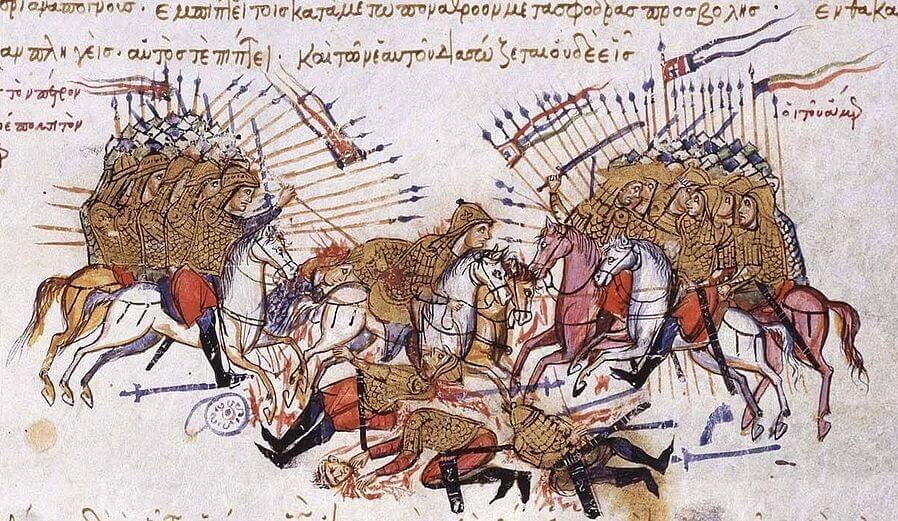
The Middle Byzantine period, spanning from the 7th century to the sack of Constantinople in 1204, witnessed significant transformations in the organization and structure of the Byzantine army. These changes were driven by the need to adapt to the loss of vast parts of the empire, new military challenges, and the evolving social landscape, while Constantinople faced direct threats. The reorganization of the army during this time was marked by the establishment of the theme system, an innovative approach to military administration and recruitment.
The Theme System: A new military framework.
Under this system, the empire was divided into administrative districts called themes, each governed by a military commander known as a strategos. This integration of military and civil administration allowed for more efficient resource management and defense coordination.
The themes were responsible for recruiting and maintaining local military forces, primarily drawn from the peasantry. This shift towards local recruitment reduced the empire’s reliance on mercenary troops and fostered a sense of regional loyalty and responsibility. Soldiers were often granted land in exchange for their service, creating a class of soldier-farmers who were invested in the defense of their communities.
The success of this reorganization of the empire becomes evident through the stabilization of the borders in the 9th century, followed by a period of renewed expansion under the Macedonian dynasty – reconquest of Crete, destruction of the Bulgar Empire, expansion on the eastern frontier, and advances in both the Balkans and the Near East.
Recruitment and the role of the peasantry.
The recruitment of soldiers from the peasantry became a cornerstone of the Byzantine military strategy during the Middle Byzantine period. This approach not only provided a steady supply of manpower but also strengthened the bond between the army and the rural population. Peasant soldiers were trained and equipped to defend their localities, ensuring that the empire’s military presence was widespread and deeply rooted in the community.
However, the reliance on peasant soldiers also presented challenges. The diminution of the peasantry, due to factors such as economic hardship and the consolidation of land by the nobility and the Church, began to affect the army’s recruitment capabilities. As the number of free peasants declined, so did the pool of potential recruits, leading to a gradual weakening of the theme system.
The Byzantine soldiers during the Late Byzantine period.
The sack of Constantinople in 1204 by the forces of the Fourth Crusade marked a catastrophic turning point for the Byzantine Empire. The event not only resulted in the temporary dismantling of the empire but also had profound and lasting impacts on its military capabilities and organizational structure. The challenges faced by the Byzantine army in the aftermath of this collapse were multifaceted and severe, shaping the empire’s trajectory for centuries to come.
Fragmentation and loss of territory.
The fall of Constantinople led to the fragmentation of the Byzantine Empire into several smaller states, each vying for control and survival. This political disunity significantly weakened the empire’s ability to maintain a cohesive and effective military force. The loss of territory further exacerbated these issues, as the empire’s resources and manpower were stretched thin across disparate regions.
The recruitment of soldiers became increasingly difficult in the wake of the empire’s collapse. The theme system, which had previously provided a steady supply of peasant soldiers, was severely disrupted. The diminution of the peasantry, coupled with the economic devastation wrought by the crusaders, left the empire with a significantly reduced pool of potential recruits. This shortage of manpower forced the Byzantine army to rely more heavily on mercenaries, a trend that had already been growing in the years leading up to the collapse.
Heavy reliance on mercenaries.
The Byzantine army’s heavy reliance on mercenaries became a double-edged sword. While mercenaries provided much-needed military expertise and manpower, their loyalty was often fickle and dependent on payment. This dependence strained the empire’s already depleted treasury and introduced an element of uncertainty into military operations. Mercenaries, drawn from diverse backgrounds and motivated primarily by financial gain, lacked the cohesion and shared purpose that had characterized the theme-based armies of the past.
The case of the Catalan Company epitomizes this situation. A mercenary force composed mainly of Catalan and Aragonese Almogavars and formed around 1299, it was hired by Emperor Andronikos II to fight the Turks in Asia Minor. Initially successful, the Company soon fell into conflict with Byzantine authorities, and it became feared and hated by the local population. In 1305, their leader Roger de Flor – who had been married into the imperial family – was assassinated, likely with the emperor’s approval. The Company retaliated with brutal force, devastating Thrace and Macedonia for years. Unable to return home, they moved south, seizing control of territories in Greece and ruling the Duchy of Athens and Neopatras under the nominal authority of the Crown of Aragon for several decades.
The financial strain imposed by the need to pay mercenaries, coupled with the destruction of military infrastructure during the sack of Constantinople, further weakened the Byzantine army. The loss of fortifications, supply chains, and training facilities hindered the empire’s ability to mount effective military campaigns and defend its remaining territories. The rebuilding of these infrastructures was a slow and arduous process, hampered by the ongoing political instability, economic hardship, and civil wars.
The collapse of the Byzantine Empire in 1204 had long-term consequences that extended beyond the immediate military challenges. The strugles of the Byzantines to reassert their authority on part of the former Empire, the disruption of traditional recruitment methods and the increasing reliance on mercenaries fundamentally altered the character of the Byzantine army. It was a factor contributing heavily to the incapacity of the Byzantines to efficiently defend their positions and to prevent the Turks ultimately conquer most of their remaining territories.