
The Psalter of Basil II
The Psalter of Basil II is a Byzantine illuminated manuscript created in the early 11th century for Emperor Basil II (r. 976–1025), one of Byzantium’s most formidable rulers. Renowned for his military prowess and his drive to consolidate imperial power, Basil had the psalter produced in a Constantinopolitan workshop, its lavish miniatures designed to assert his authority and his divine mandate as protector of the empire. It is sometimes called the Venice Psalter after its present home in the Biblioteca Marciana, where it landed after a long journey.
Quick Facts
Date: early 11th century (commissioning date debated — see below)
Patron: Emperor Basil II
Origin: imperial workshop, Constantinople
Contents: the 150 Psalms, with full-page miniatures
Shelfmark: Venice, Biblioteca Marciana, Marcianus graecus Z. 17 (=421)
Famous image: the imperial frontispiece, folio IIIr
Imperial iconography and themes of power in the Psalter
The Psalter of Basil II was as much political statement as devotional object: a carefully crafted image of imperial power sanctioned by Heaven. That political message is worth examining in detail.
The imperial frontispiece
The manuscript’s most celebrated page is a full-page triumphal portrait of the emperor (folio IIIr) that fuses military glory with divine approval. Basil stands in the battle dress of a Roman general, a lance in one hand and a sheathed sword at his side. Two archangels attend him: one lowers a jewelled crown onto his head — a crown sent down from a medallion of Christ who blesses the scene from above — while the other presents his lance. Six military saints, depicted as busts, flank him on either side. At his feet, small figures bow low to the ground.
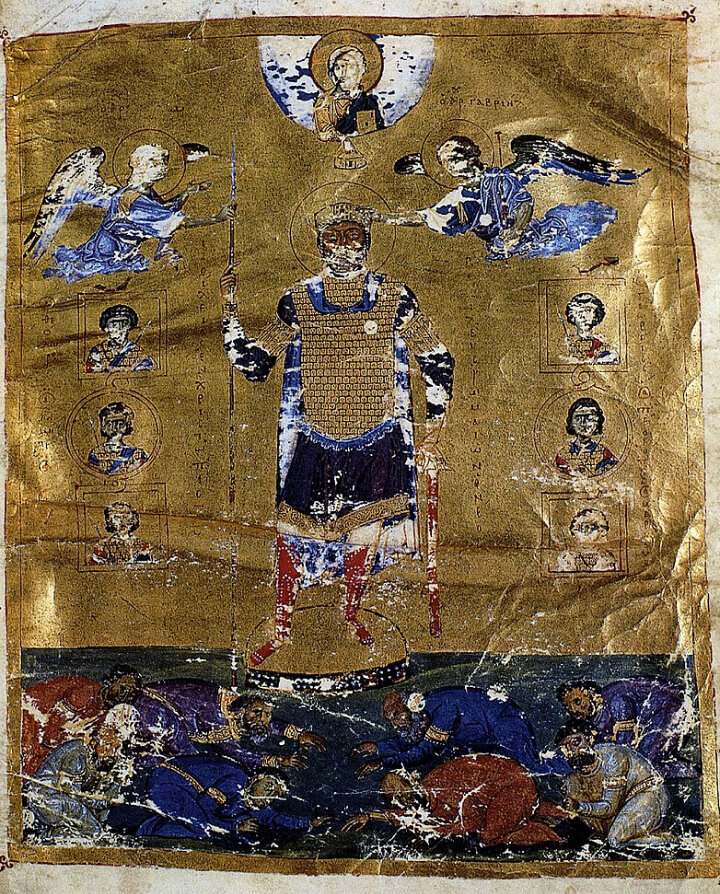
Frontispiece of the Psalter of Basil II, folio IIIr. 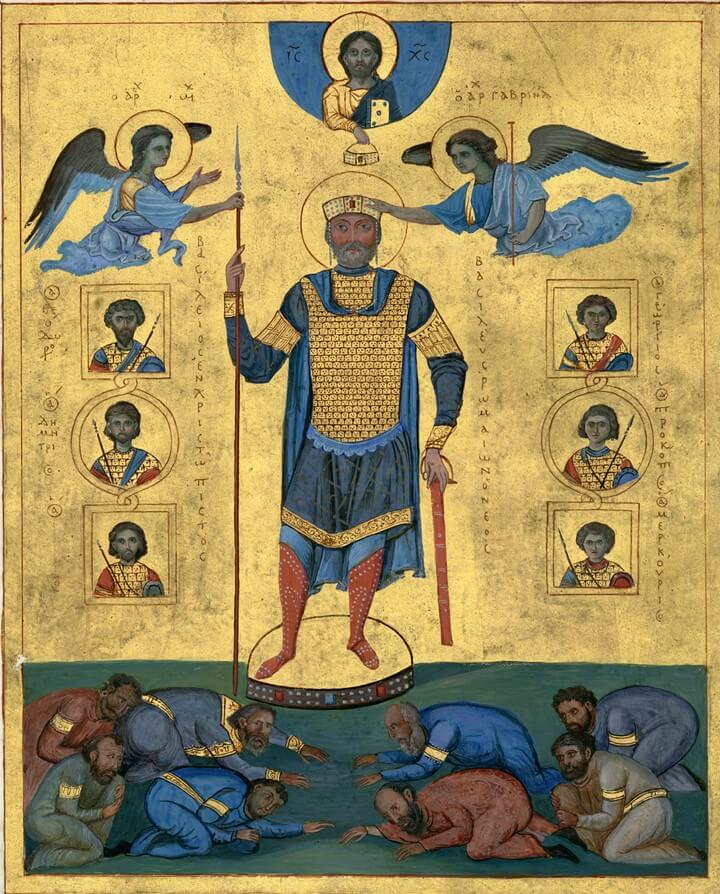
Replica of the frontispiece.
The dedicatory poem
A dedicatory poem written on the facing page (folio IIv) spells out the meaning of the image: the prostrate figures are those “cast down” before the emperor by the saints who fight alongside him. The whole composition is a visual argument — Basil rules by the will of God and the protection of heaven’s warriors.
A strange marvel here among the things one sees: Christ, with his life-giving right hand, holds out from heaven the crown, the symbol of power, to the faithful and mighty lord Basil. Below are the foremost of the bodiless ones [the archangels]: one, having received the crown, joyfully bears it and crowns him; the other, adding victories to his power, brings a sword — a weapon that strikes fear in his foes — and places it in the lord’s hand. And the martyrs [military saints] fight as his allies and friends, casting down the enemies who lie before his feet.
Notably, the poem names them only as “enemies,” not as Bulgarians — which is why their identification remains debated.
Who are the figures at the emperor’s feet?
The bowing figures have long been read as the Bulgarians Basil defeated — the reading that ties the manuscript to his great triumph of 1018 and his epithet “the Bulgar-Slayer.”
That identification, however, is not certain. Anthony Cutler and others argue the figures are not a specific defeated people at all but a conventional image of submission, possibly representing the domestic aristocratic rivals Basil crushed during his rise to power. The image works as timeless imperial propaganda rather than a record of one battle.
When was the manuscript made?
The psalter cannot be dated precisely, and scholars disagree. The traditional view places it around 1017–1018, linking it to the Bulgar triumph. Anthony Cutler proposed 1001–1005 on the basis of the crown’s resemblance to coins (histamena) minted in those years. More recently, Alberto Longhi has argued for a date after 992, connecting the imagery to Basil’s earlier consolidation of power. What is agreed is that it is a product of the early 11th-century imperial workshop, closely related to the famous Menologion of Basil II.
Structure and purpose of the manuscript.
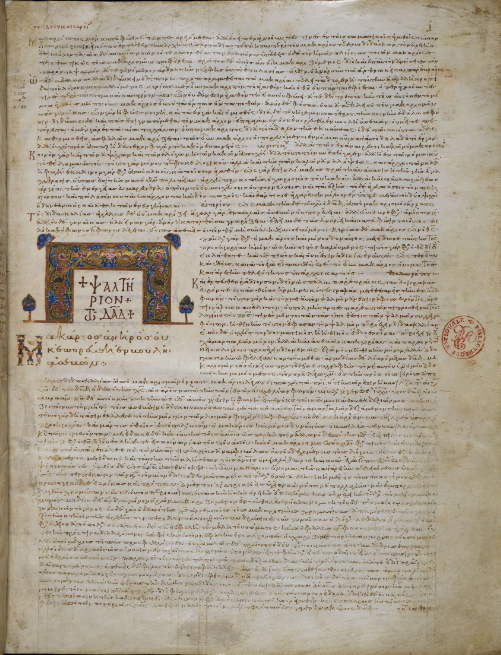
The Psalter of Basil II is built around the 150 Psalms but its miniatures reach well beyond private devotion. Alongside the imperial frontispiece, it carries a cycle illustrating the life of King David — including David killing the bear and David and Goliath.
The choice is deliberate: David was the warrior-king who led his people both spiritually and in battle, the perfect biblical mirror for Basil. By aligning himself with David, the emperor cast his own campaigns as divinely guided.
Basil likely used the book for personal prayer, but it doubled as an instrument of imperial image-making, presenting him at once as a devout Christian and a disciplined, victorious ruler.
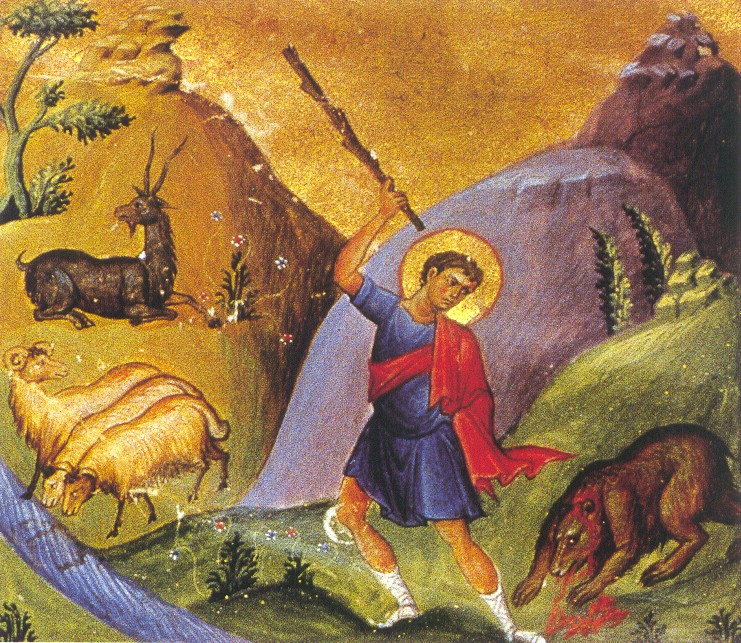
Miniature showing David killing the bear 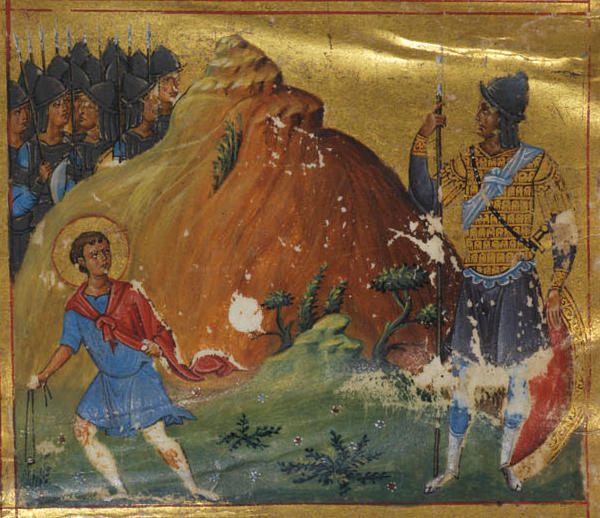
Miniature showing David and Goliath.
Imperial iconography and themes of power.
The Psalter of Basil II is notable for its depiction of the emperor in a full-page triumphal image that connects his military achievements with divine approval. The most prominent miniature in the manuscript shows Basil in full military attire, surrounded by two angels—one holding his spear and the other his crown. At his feet, high-ranking figures are prostrated. Above the scene, Christ holds another crown over the emperor’s head, emphasizing the divine sanction of Basil’s rule.
The manuscript’s artist portrayed Basil’s face in a detailed, almost lifelike manner, creating an unmistakable link between the emperor and biblical kings such as David, who also led his people both spiritually and militarily. The story of David is the subject of another miniature in the psalter.
The Psalter of Basil II is not only an artistic achievement but also a theological one. Its miniature reflects the imperial propaganda of the time and elevate Basil’s status to one of almost saintly reverence. Through its blend of religious and imperial symbolism, the manuscript creates a visual narrative that legitimizes Basil’s rule as divinely inspired, while also reinforcing his reputation as a fierce and disciplined emperor.
Byzantine artistic style and techniques
The illuminations belong to the Macedonian Renaissance, the period when Byzantine art revived naturalistic and classical forms. The artists used shading, modelling and convincing proportions to give the figures three-dimensional weight, setting the work apart from the flatter, more iconic style of earlier manuscripts. That naturalism, combined with a lavish use of gold ground and saturated colour, reflects the craftsmanship of the imperial workshop in Constantinople.
The historical journey of the Psalter of Basil II.
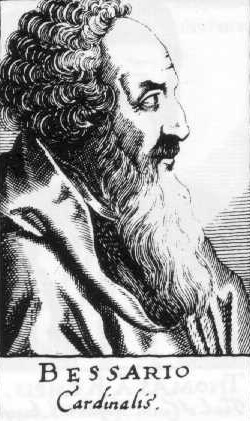
The psalter’s history after Basil’s death is patchy.
As recorded in an annotation on folio 410v, in the 14th century it was at the Peribleptos Monastery – probably the one in Mistra, in the Peloponnese, which was one of the last strongholds of Byzantine culture in the 14th century. However, another monastery of the same name existed at the same time in Constantinople, so that location cannot be entirely ruled out. In the following century it passed to Cardinal Bessarion, the humanist scholar and titular Latin Patriarch of Constantinople.
In 1468 Bessarion gave his entire library — this manuscript among it — to Venice, founding the Biblioteca Marciana, where it remains today as Marcianus graecus Z. 17 and can be viewed online here.
Frequently asked questions
Where is the Psalter of Basil II kept?
In the Biblioteca Nazionale Marciana in Venice (Marcianus graecus Z. 17), where it has been since Bessarion’s 1468 donation.
When was it made?
In the early 11th century; the exact commissioning date is debated, with proposals ranging from after 992 to around 1017–1018.
What does the frontispiece show?
Emperor Basil II in military dress, crowned by an archangel under a blessing Christ, flanked by six military saints, with defeated figures bowing at his feet.
Why is David shown in the manuscript?
David, the biblical warrior-king, served as a model for Basil as a ruler who led his people in both faith and war.
Sources and links.
Sources & further reading
- The digitized manuscript — Venice, Biblioteca Nazionale Marciana, Marcianus graecus Z. 17: view online (Internet Culturale)
- Full codicological record (date, scribe, dimensions, provenance, Bessarion’s ownership note): Göttingen Septuaginta — Ra 1215
- The dedicatory epigram (Greek text and apparatus): Database of Byzantine Book Epigrams — Occurrence 17031
- On the disputed dating: Alberto Longhi, On the date of the Menologion and the Psalterion of Basil II, Project DBBE (Ghent University)
- On the frontispiece and its interpretation: Paul Stephenson, A note on the portrait illumination of Basil II in his Psalter
- Cardinal Bessarion and the founding of the Marciana: Biblioteca Nazionale Marciana · Britannica
- General overview: World History Encyclopedia — Psalter of Basil II
Select scholarship:
S. Der Nersessian, “Remarks on the Date of the Menologium and the Psalter Written for Basil II,” Byzantion 15 (1940–41)
I. Spatharakis, The Portrait in Byzantine Illuminated Manuscripts (Leiden, 1976)
A. Cutler, The Aristocratic Psalters in Byzantium (Paris, 1984)
M. Lauxtermann, Byzantine Poetry from Pisides to Geometres (Vienna, 2003)
A. Rhoby, Ausgewählte byzantinische Epigramme in illuminierten Handschriften (Vienna, 2018)