The Hippodrome of Constantinople: Riots, Chariots, and Imperial Power
No building in Constantinople, save Hagia Sophia itself, mattered more to the daily life of the Byzantine state than the Hippodrome. For nearly a thousand years, this vast U-shaped arena was where the people of the city and their emperor faced one another directly — cheering victories, screaming for blood, watching prisoners paraded in chains, and, on one catastrophic week in 532, very nearly bringing down the empire itself.
To call the Hippodrome a racetrack is technically accurate and almost entirely misleading. It was that, certainly — chariot racing was Byzantium’s great public passion, and the Hippodrome the largest stage for it anywhere in the empire. But it was equally a throne room without walls, a courtroom, an execution ground, and the one place in the entire empire where the emperor’s power was performed directly in front of tens of thousands of his subjects, for better and very often for worse.
Quick facts about the Hippodrome of Constantinople
Original construction
Begun c. 203 CE under Septimius Severus; left unfinished at his death in 211
Completed and expanded byConstantine the Great, 324–330 CE, as part of founding New Rome
Dimensions
Roughly 400–450 m long, c. 120 m wide
Estimated capacity
Uncertain — estimates range from c. 30,000 to 100,000
Connected to
The Great Palace, via the Kathisma (imperial box)
Deadliest single event
The Nika Riots, 532 CE — tens of thousands killed
Sacked by
The Fourth Crusade, 1204
Survives today as
Sultanahmet Square, Istanbul, with three original spina monuments still standingOriginal construction
Origins: From Severus’s unfinished arena to Constantine’s showpiece
The Hippodrome’s origins predate Constantinople itself. Around 203 CE, the emperor Septimius Severus — having besieged and razed the old Greek city of Byzantium three years earlier for backing the losing side in a Roman civil war — began rebuilding the settlement along Roman lines, with a forum, baths, colonnaded streets, and a hippodrome among the planned public works. Severus died in 211 with the project reportedly still unfinished, and it was left that way for well over a century.
Everything changed after 18 September 324, when Constantine defeated his last rival, Licinius, at the Battle of Chrysopolis and became sole ruler of the Roman world. Two months later he began transforming Byzantium into his new capital, and completing — really re-founding on a grander scale — the Hippodrome was central to that project. He enlarged the seating, added the imperial viewing box modeled directly on the one at Rome’s Circus Maximus, and connected the whole structure directly to his new palace. The finished arena stretched some 400 to 450 meters long and roughly 120 meters wide, making it, after Rome’s Circus Maximus, one of the largest structures of its kind anywhere in the ancient or medieval world. When Constantinople was formally dedicated as the empire’s new capital on 11 May 330, chariot races in the freshly completed Hippodrome were part of the inaugural celebration — a deliberate statement that this new city was Rome’s true heir.
A Roman inheritance: Why chariot racing outlived the Arena
Chariot racing was already an old tradition by the time Constantine rebuilt Byzantium’s arena — its roots run back through Etruscan and Greek precedents into the Circus Maximus of Republican Rome, where teams sponsored by wealthy patrons competed before crowds that could number in the hundreds of thousands. By the height of the Roman Empire, virtually every major city carried its own hippodrome or circus: Antioch, Alexandria, Thessaloniki, Caesarea, Rome itself, and dozens more across the Mediterranean world all staged races as a matter of civic prestige.
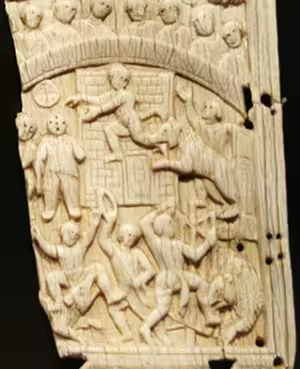
What is striking is how differently chariot racing and gladiatorial combat fared as the empire Christianized. Gladiatorial fights and the venationes — staged hunts and executions of condemned prisoners by wild beasts — had been Rome’s other great spectator obsession, but both fell into terminal decline from the fourth century onward: Christian writers condemned them as pagan bloodletting, emperors increasingly withdrew official sponsorship, and the sheer expense of maintaining trained gladiators and imported animals became harder to justify. The last such spectacle in Rome is usually dated to around 440; in Constantinople, similar contests lingered a little longer at a separate venue, the Cynegion, but had vanished from public life by the early sixth century. Chariot racing, by contrast, carried no comparable stain of pagan blood sacrifice — it could be, and was, absorbed wholesale into Christian imperial ceremony, run under the sign of the cross rather than in defiance of it, which is very likely the single biggest reason it survived where gladiatorial games did not.
Yet even chariot racing did not survive equally everywhere. As the empire buckled under the Arab conquests of the seventh century, losing Syria, Egypt, and eventually much of Anatolia, most provincial hippodromes across the shrinking empire fell silent — a casualty of collapsing urban populations, disrupted trade, and simple lack of money for civic spectacle. Constantinople’s Hippodrome alone endured, and the reason lies squarely in its unique architectural and political relationship to the throne. Because the Kathisma opened directly onto the Great Palace, chariot racing in the capital was never simply entertainment that a cash-strapped city could quietly let lapse — it was structurally welded to the performance of imperial legitimacy itself.
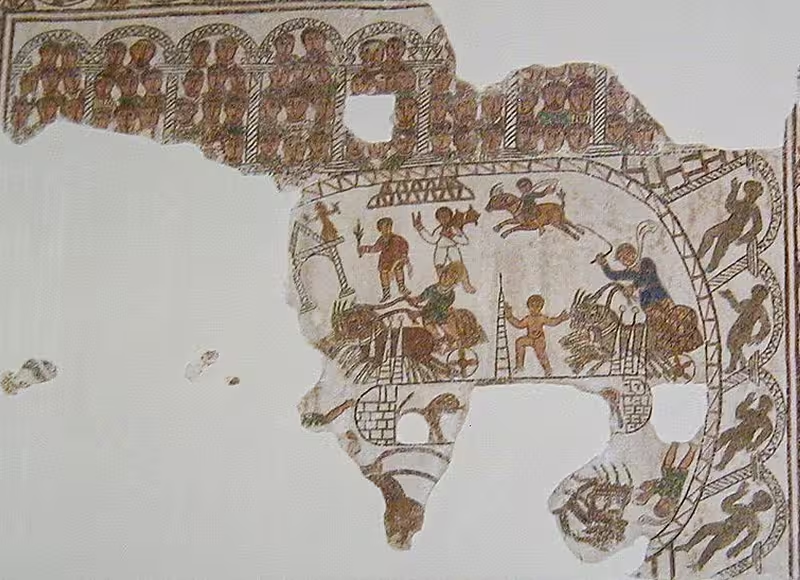
As long as an emperor reigned from Constantinople, there remained a built-in reason to keep the races running, even as, from the seventh century onward, they grew steadily less frequent and more ceremonial, a shadow of their earlier civic vitality but never entirely extinguished until the Fourth Crusade.
Why the Hippodrome mattered
In most of the Roman and Byzantine world, the emperor was a distant, half-mythical figure, encountered by ordinary people rarely if ever. The Hippodrome was the great exception. From the Kathisma, the emperor sat in full public view of tens of thousands of his subjects, and the crowd, in turn, was permitted a kind of collective voice — cheering, jeering, and, through organized chants, occasionally making direct political demands of the man on the throne. No other setting in the empire brought ruler and ruled into such sustained, reciprocal, and occasionally dangerous contact.
This made the Hippodrome far more than an entertainment venue — it was a genuine instrument of governance. Emperors used it to display military triumphs, crown co-emperors, receive foreign envoys, and celebrate the anniversary of the city’s own founding. But the same qualities that made it useful for building legitimacy made it equally useful for destroying an enemy’s. As later sections make clear, the Hippodrome’s crowds, and its central stage, were put to work just as often to humiliate the emperor’s rivals as to celebrate his friends.
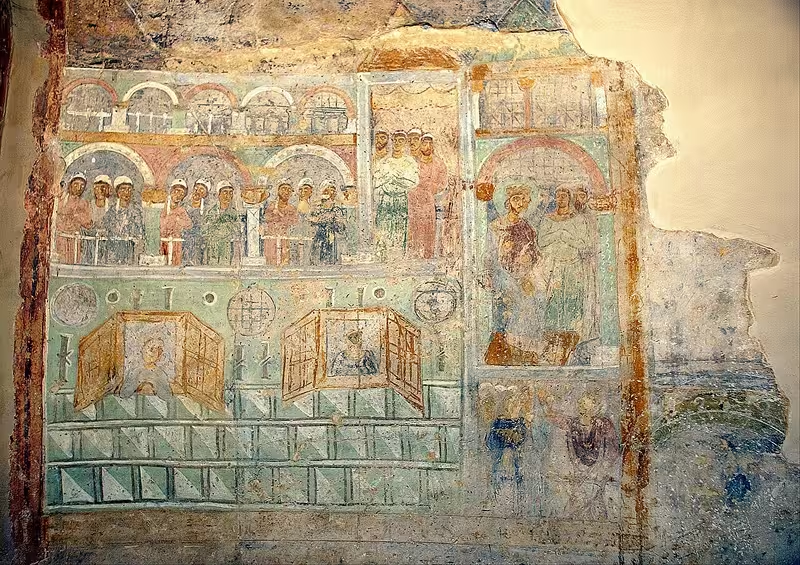
The Hippodrome’s fame also outgrew the building itself, becoming part of Byzantium’s wider cultural imagination. When crusaders finally sacked the spina’s ancient bronzes in 1204, the eyewitness historian Niketas Choniates wrote with real anguish at watching statues centuries old melted down for coin, treating their destruction as a wound to civilization itself rather than mere plunder. The Hippodrome’s symbolic reach extended well beyond the city’s walls, too: an eleventh-century fresco in Kyiv’s Cathedral of Saint Sophia depicts Constantinople’s chariot races in loving detail, evidence that the Hippodrome had become a byword for imperial splendor as far away as Kievan Rus, whose own rulers modeled their court culture self-consciously on Constantinople’s example.
Architecture and decoration
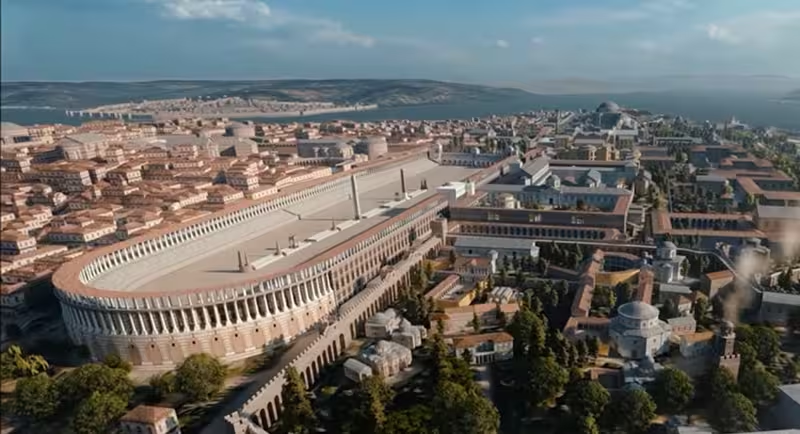
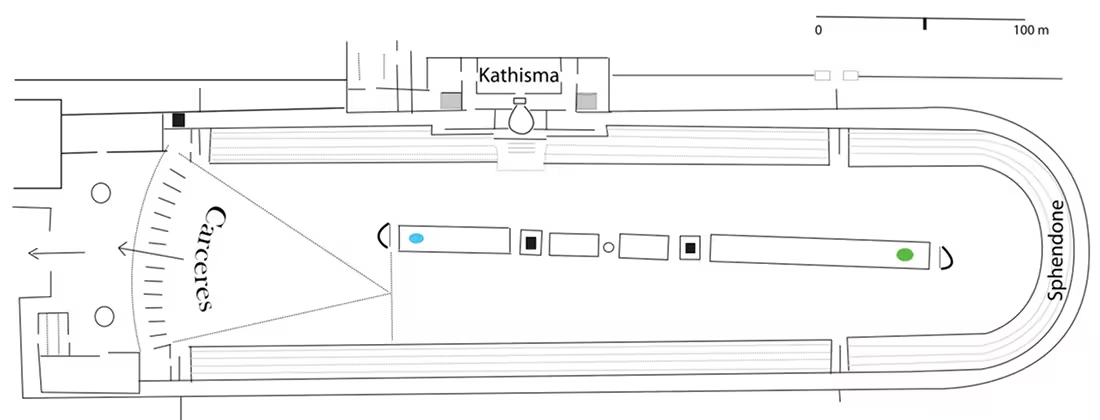
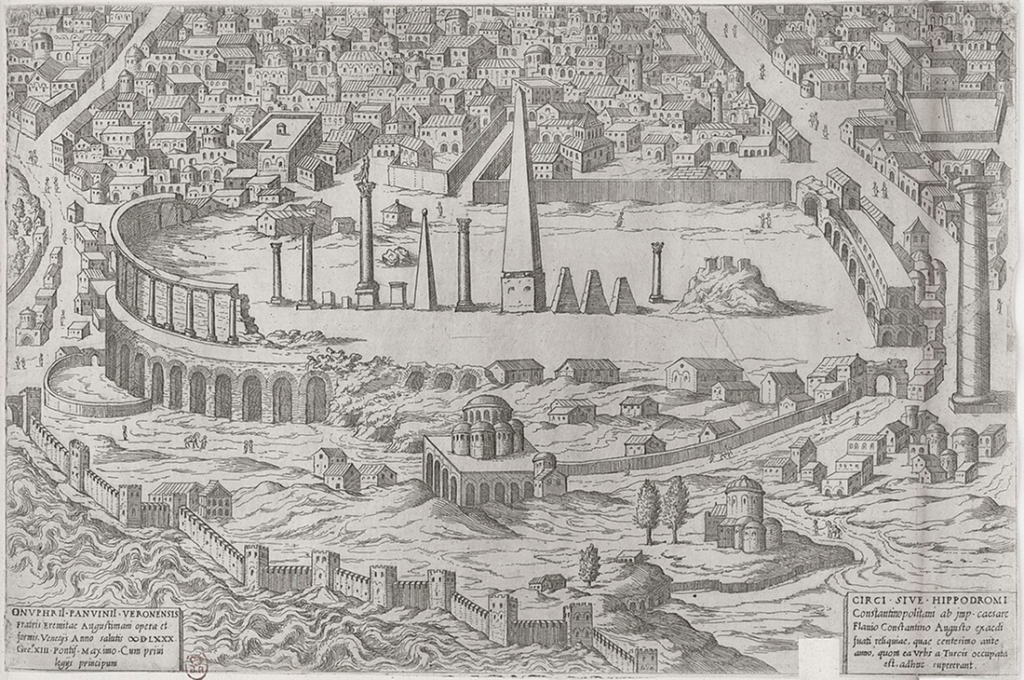
The Hippodrome of Constantinople followed the standard Roman circus plan: a long U-shaped track, rounded at one end and squared off with starting gates at the other, wrapped by tiered seating. At the curved southern end stood the Sphendone, a massive substructure of vaults built to carry the seating up the natural slope toward the sea — the single largest surviving physical remnant of the building today. Running down the center of the track was the spina, a long barrier around which the chariots raced, and it was here that Constantine and his successors assembled one of the most extraordinary collections of looted antiquity anywhere in the ancient world.
The Kathisma and the Palace Connection
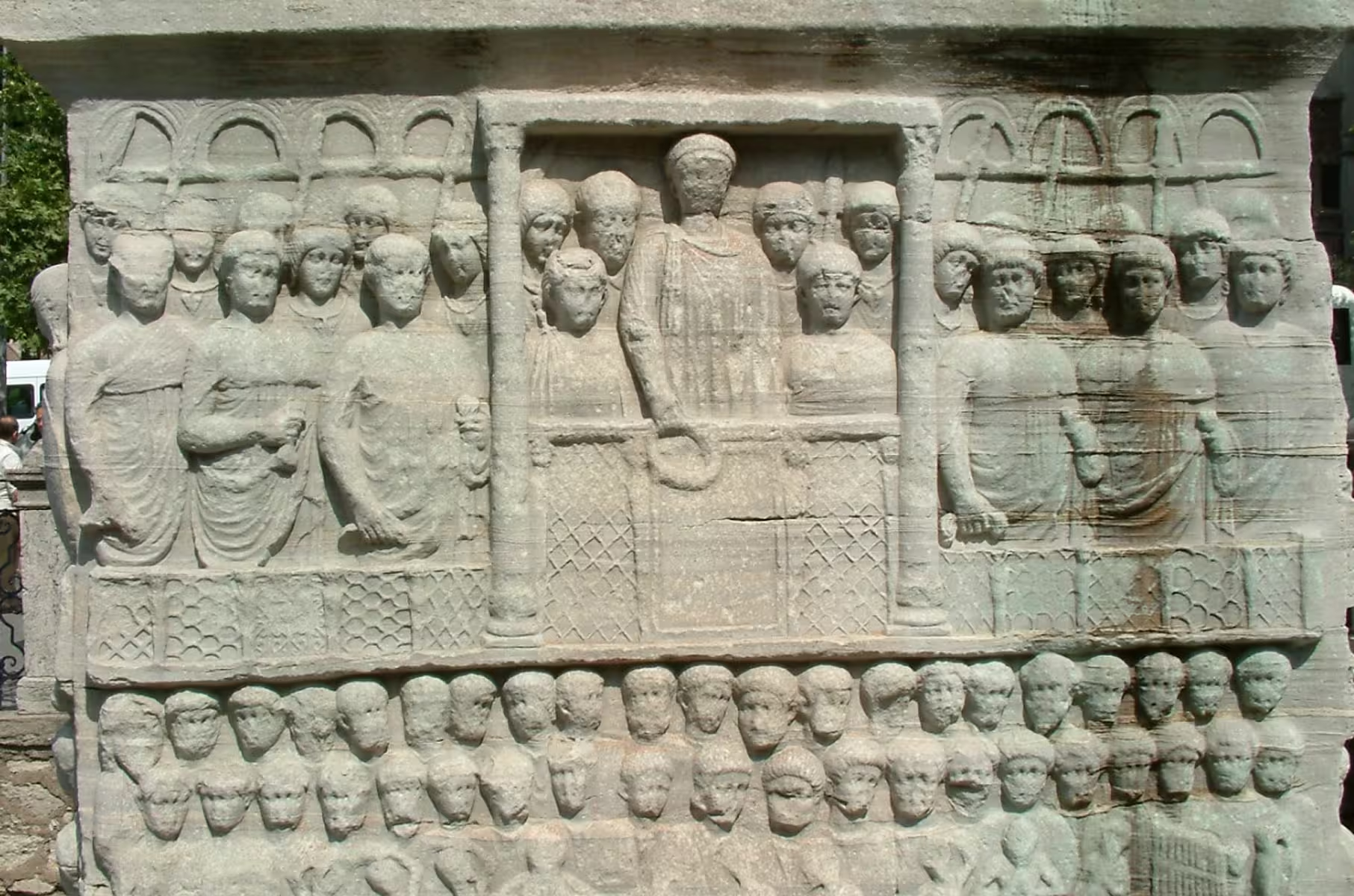
The emperor’s box, the Kathisma, stood at the eastern curve of the track and connected directly to the Great Palace complex through a private passage accessible only to the emperor and his household.
This was a deliberate piece of architectural theater: the ruler could move from the sealed, sacred interior of his palace directly into public view above the roaring crowd, appearing and disappearing almost as if by divine will, with no need to walk through the city at all.
The Spina: A museum of looted antiquity
Constantine and later emperors stripped monuments from across the empire and beyond to decorate the spina, turning it into a running display of Rome’s — and Byzantium’s — claim to universal power. Three of these survive in place today:
- The Serpent Column, a bronze monument of three intertwined snakes originally dedicated at Delphi in 479/478 BCE from melted-down Persian weapons, celebrating the Greek victory at Plataea — brought to Constantinople by Constantine himself.
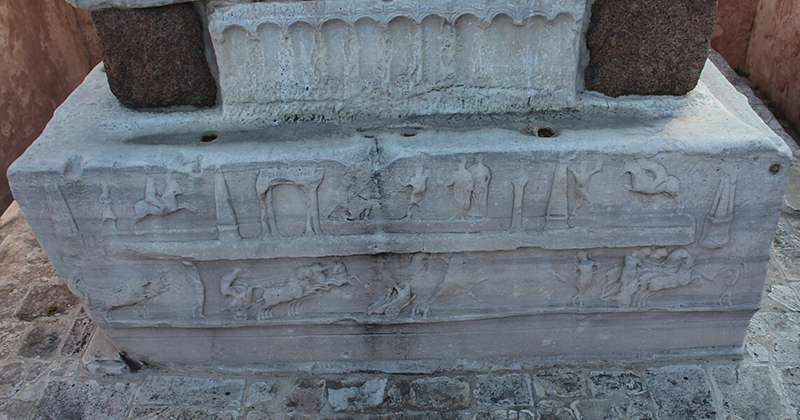
- The Obelisk of Theodosius, an Egyptian granite obelisk carved around 1500 BCE for Pharaoh Thutmose III at Karnak, erected on the spina by Theodosius I in 390. Its marble base carries relief carvings of Theodosius and his family watching the races from the Kathisma — a rare surviving image of the Hippodrome actually in use.
- The Walled Obelisk (also called the Column of Constantine Porphyrogenitus), originally covered in gilded bronze plating, now reduced to its stone core.
Other spina monuments did not survive. Four gilded bronze horses, of uncertain Greek or Roman origin, once stood atop the starting gates — they were looted during the Fourth Crusade in 1204 and now stand on the façade of St. Mark’s Basilica in Venice, the most famous single piece of Hippodrome decoration to survive anywhere. Statues of celebrated charioteers also lined the track; only the marble base of one, the early sixth-century racing star Porphyrius, survives today.
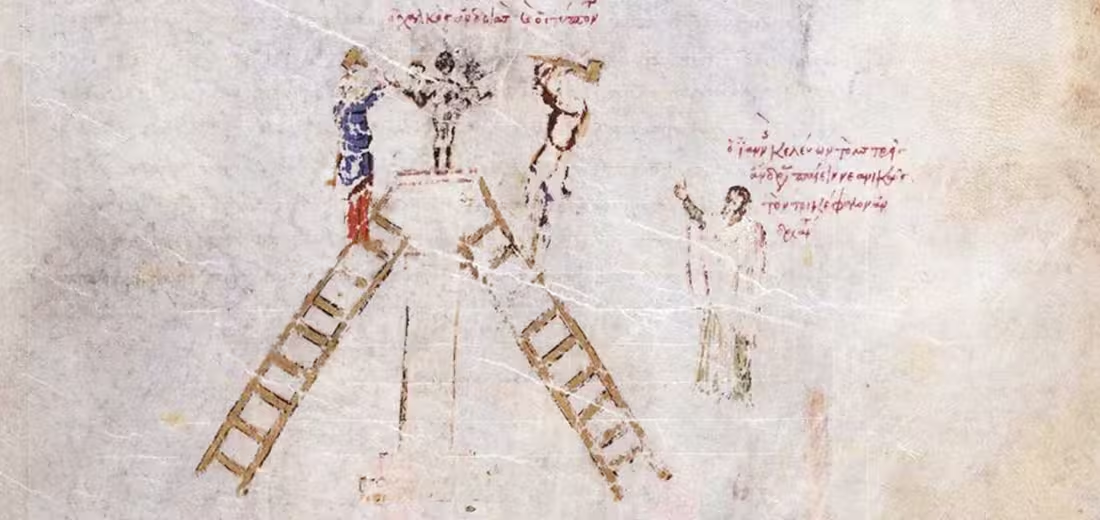
In an episode rapported by Byzantine chronicles, iconoclast Patriarch John VII Grammatikos, described in the sources as a practitioner of sorcery and dark art, sought to use sympathetic magic to protect the empire from a triple barbarian threat. He identified a ancient three-headed bronze statue standing in the Hippodrome of Constantinople and dispatched agents in secret to decapitate the statue’s three heads, believing this ritual action would bring about the simultaneous defeat and decapitation of the three barbarian kings.
See the splendid restitution of the Hippodrome of Constantinople on Byzantium 1200.
The Factions: Blues, Greens, and Circus politics
Chariot racing in Constantinople was organized around color-coded factions — originally four of them, the Blues (Venetoi), Greens (Prasinoi), Reds (Rousioi), and Whites (Leukoi), all inherited directly from Rome’s own circus factions and present, in some form, in hippodromes across the empire, not just Constantinople. By the fifth and sixth centuries the two smaller factions, the Reds and Whites, had been absorbed as junior partners into the Blues and Greens, each commanding fanatically loyal support across the city. These were not simple sports clubs. By the fifth and sixth centuries, the factions had become organized urban associations with real social and even military weight, capable of mustering armed men, influencing imperial politics, and — with troubling regularity — descending into open street violence between rival supporters. An emperor ignored faction sentiment at his peril, and several rulers actively cultivated one faction’s loyalty as a base of political support.
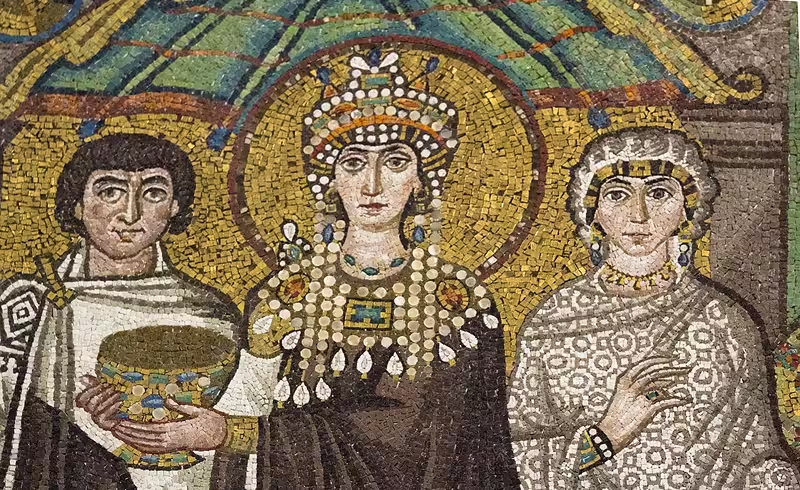
The factions’ reach extended well beyond the aristocracy — they shaped the fortunes of ordinary Constantinopolitans too, none more famously than the future Empress Theodora. Her father, Akakios, was the Green faction’s bear-keeper, responsible for the trained animals used in the entr’actes between races. When he died, Theodora’s mother petitioned the Greens to grant the vacant post to her new husband; the Greens’ choreographer refused and gave the job elsewhere, humiliating the family before a packed Hippodrome crowd.
It was the rival Blues who took pity and appointed the stepfather instead — and Theodora, raised thereafter in Blue patronage, remained closely associated with that faction for the rest of her life, including through the Nika Riots two decades later.
The Nika Riots of 532
No single event defines the factions’ power and the Hippodrome’s political danger more than the Nika Riots. What began as ordinary factional unrest between Blues and Greens over the handling of convicted rioters escalated, within days, into a full-scale revolt against Emperor Justinian I himself — the two normally hostile factions briefly uniting under the shared chant of “Nika!” (“Conquer!”), besieging the emperor in his own palace and attempting to crown a rival, Hypatius, in his place.
Justinian reportedly considered fleeing the city. According to the historian Procopius, it was his wife, the Empress Theodora, who persuaded him to stand and fight rather than run, famously declaring that the imperial purple made a fine burial shroud. Justinian’s general Belisarius — the same general who would later celebrate his own triumph on this very spot — led troops into the Hippodrome itself, where the rebels had gathered, and massacred them where they stood. Estimates of the dead run into the tens of thousands, among the bloodiest single episodes of political violence anywhere in Byzantine history, and it happened entirely within the walls of the arena built to entertain the city.
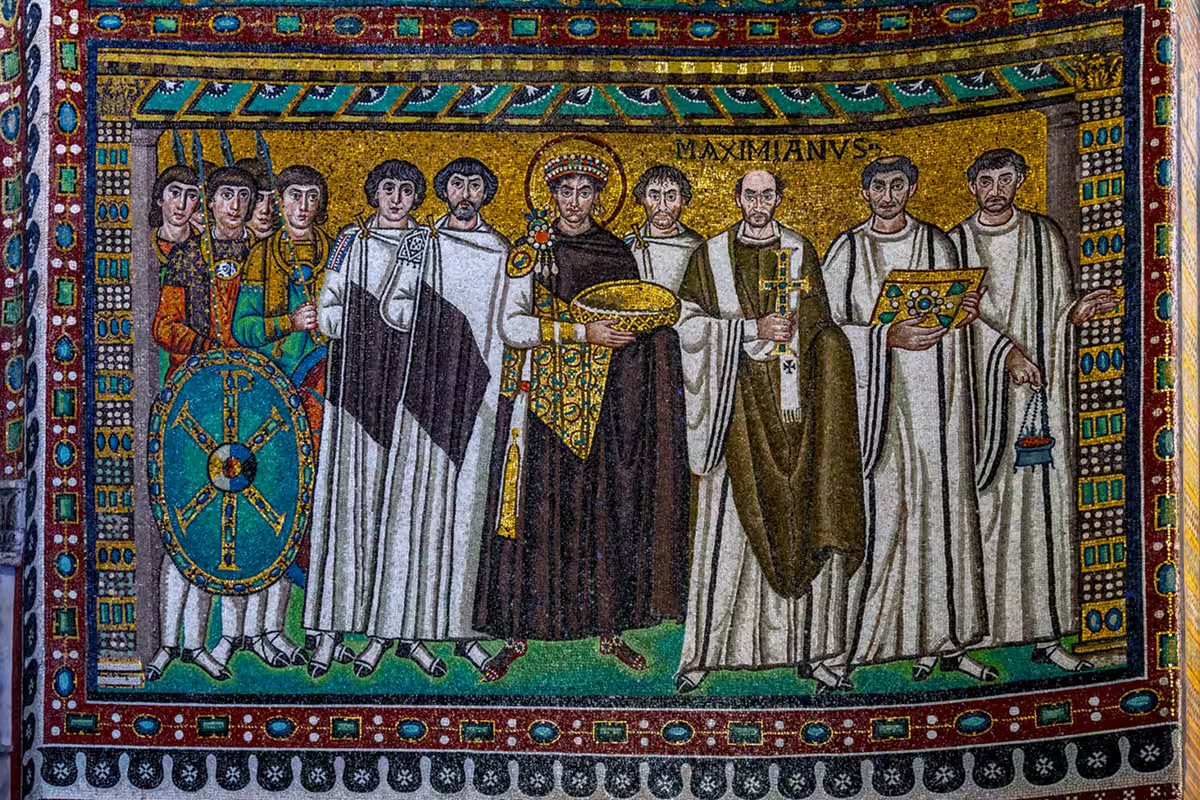
Faction power did not last forever. The brutal crackdown that ended the Nika Riots in 532 dealt the Blues and Greens a blow from which their independent street power never fully recovered, and as chariot racing itself grew less frequent from the seventh century onward, the factions’ role shrank correspondingly. By the tenth century, as recorded in Constantine VII Porphyrogennetos’s Book of Ceremonies, the Blues and Greens survived mainly as formal, choreographed bodies performing ritual acclamations at coronations and imperial ceremonies — their once-dangerous capacity for organized street violence reduced, over the centuries, to a scripted, largely decorative role in the choreography of Byzantine court life.
A day at the Hippodrome: Ritual, race, and spectacle
Chariot racing was not a constant, everyday occurrence — race days were tied to a fixed ceremonial calendar rather than staged on a whim. The most important fixture was 11 May, the anniversary of the city’s own dedication in 330, when races were held annually in Constantine’s honor; other race days marked imperial anniversaries, the acclamation of a new emperor or co-emperor, victories, and major state occasions. In the earliest centuries, the consular games — tied to the ancient Roman office of consul, which Constantinople preserved as an honorary title — provided another recurring occasion, until the office itself faded into obsolescence in the sixth century. This was deliberate scarcity: a race day at the Hippodrome was an event precisely because it did not happen every week, giving each one real ceremonial weight.
The day itself followed a fixed and highly choreographed ritual, much of it recorded in exacting detail in the tenth-century Book of Ceremonies compiled under Constantine VII Porphyrogennetos. The emperor’s arrival was the central act: he processed from the Great Palace through the private passage into the Kathisma, appearing above the crowd at a precise, ritually determined moment rather than simply taking his seat. As he appeared, the organized factions — by this point performing as much a ceremonial as a partisan role — led the crowd in formal chants and acclamations, scripted exchanges of praise between the assembled people and their ruler that functioned as a kind of public liturgy of loyalty, rehearsing the emperor’s titles and virtues in a call-and-response the entire Hippodrome could join.
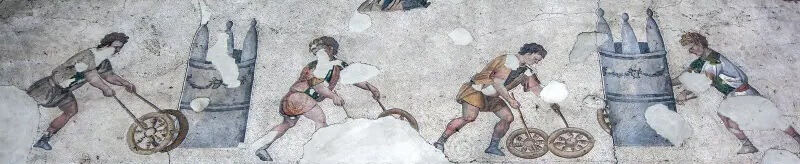
Once racing began, a full day’s program could include anywhere from eight to as many as twenty-four individual races, each a grueling seven laps around the spina at speeds that could approach 60 kilometers per hour on the straights — genuinely dangerous, with crashes (known in the Roman tradition as naufragia, “shipwrecks”) a constant risk for the four-horse teams and their drivers. Spectators tracked each race’s progress by way of two sets of mechanical lap-counters mounted on the spina, one shaped as dolphins that tipped forward to release water, the other as eggs lowered one by one — both borrowed directly from the Circus Maximus in Rome.
Between races, the crowd was kept entertained by mimes, acrobats, trained-animal displays, and musicians, turning a full day at the Hippodrome into something closer to a rolling festival than a single sporting fixture, often spilling out afterward into the colonnaded streets, taverns, and the nearby Baths of Zeuxippus long after the last race had finished.
The spina itself added to the spectacle even when no race was underway. Beyond the obelisks and the Serpent Column, thirteenth-century eyewitness Robert of Clari described a menagerie of bronze marvels lining the barrier: a life-sized elephant with a trunk that appeared to move, a colossal statue of Hercules attributed to the ancient sculptor Lysippos, a bronze eagle whose outstretched wings, pierced with holes, let sunlight through to mark the hours like a sundial, and a giant female figure holding a full-sized horse. Whether or not races were actually running, the Hippodrome’s central barrier offered visitors a walk through what amounted to an open-air museum of antiquity — one more reason the arena’s destruction in 1204 struck contemporaries as a loss of civilization, not merely of sport.
Parades of power: Triumphs, humiliations, and executions
More than any race, it is the Hippodrome’s role as a stage for raw political power that defines its place in Byzantine history. Emperors used it to display their triumphs — and, just as deliberately, to destroy their enemies in full public view.
Triumphs brought captured enemies and plundered treasure directly before the Hippodrome crowd. The general Belisarius celebrated his conquest of the Vandal kingdom in 534 with a procession that paraded the defeated Vandal king Gelimer and his treasury through the city — one of the last processions in the old Roman triumphal tradition. Nearly a century later, in 629, Heraclius returned to the capital in triumph after recovering the True Cross from the Persians, a procession that framed his war against Persia as nothing less than a Christian crusade before the relic was carried on to Jerusalem. The tradition endured, in modified form, for centuries afterward: in 971, John I Tzimiskes marked his victory over Bulgaria and Kievan Rus’ with a procession in which the icon of the Theotokos, not the emperor himself, rode in the lead chariot, while Tzimiskes followed on horseback and the defeated Bulgarian tsar’s regalia was displayed to the crowd — a calculated gesture of Christian humility rather than personal glory. Basil II staged a further triumph in 1019 after completing the conquest of Bulgaria, and the tradition persisted, in increasingly ceremonial form, into the reign of Manuel I Komnenos in the twelfth century, among the last emperors to formally celebrate a victory in the old triumphal manner before the custom faded into smaller, less theatrical ceremonial entries.
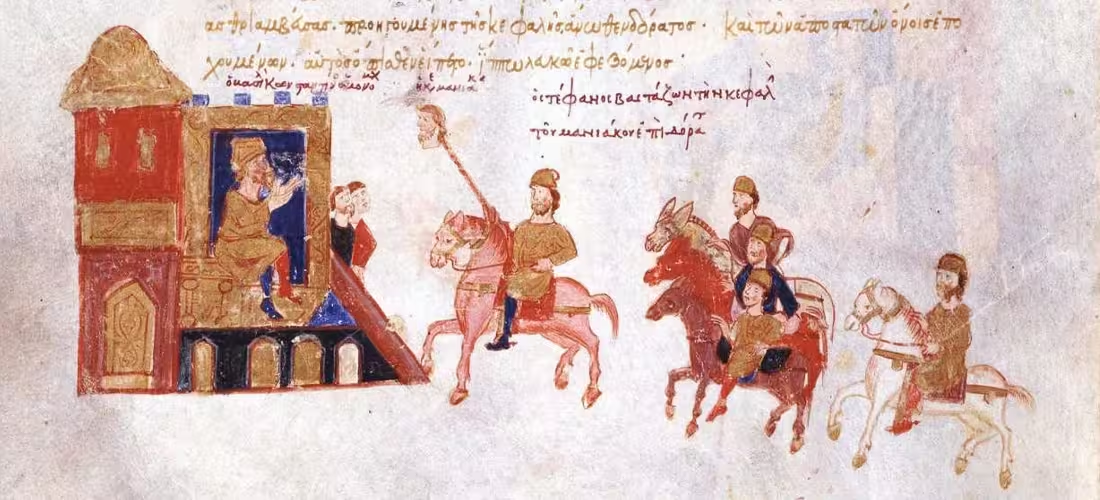
Humiliation and execution of rivals followed the same logic in reverse. After the failed usurpation of Artabasdos against Constantine V in the 740s, the defeated rebel and his sons were publicly blinded in the Hippodrome; his ally, the deposed Patriarch Anastasios, was whipped and paraded backward on a donkey around the track. Decades later, in 767, another patriarch — Constantine II, implicated in a plot against the same emperor — was paraded through the Hippodrome before being beheaded. Centuries later, in 1043, the general George Maniakes met a similar fate in death as in disgrace: having rebelled against Constantine IX Monomachos, he was killed in battle near Thessaloniki, and his severed head was carried back to Constantinople on a pike and displayed atop the Hippodrome, while his captured partisans were paraded through the streets and the arena itself mounted backward on donkeys, heads shaved and marked as traitors, for the crowd’s ridicule. The arena’s combination of a massive crowd and total imperial control made it the ideal setting whenever a ruler needed to make an example of someone.
That same logic was turned against the church itself during the eighth-century Iconoclast persecutions. Around 765–766, Constantine V — determined to break the monastic opposition to his ban on religious images — had monks who refused to comply forced to walk around the Hippodrome track paired hand-in-hand with nuns, a public violation of their vows staged specifically to humiliate them before a jeering crowd. It was public theater weaponized against religious dissent, using the same stage and the same crowd that, on other days, cheered chariots and emperors alike.
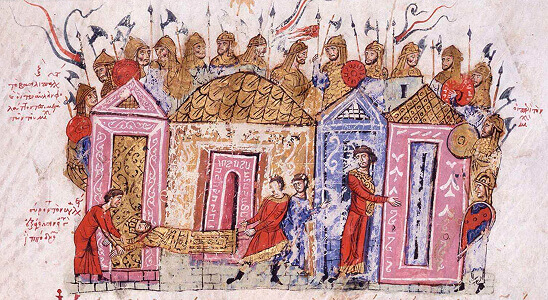
Even emperors themselves were not safe from the arena’s darker use. On Christmas Day 820, Emperor Leo V was hacked to death by conspirators inside the palace chapel; but his mutilated corpse was subjected to a final indignity meant to erase any trace of imperial dignity from the fallen ruler.
“They tied a rope around the ankles of the corpse and dragged him along the ground from the palace chapel through the Skyla and into the Hippodrome, throwing his lifeless body down to be mocked by the vulgar crowd before disposing of it.”
Teophanes Continuatus
In 1185, the deeply unpopular Andronikos I Komnenos — the last Komnenian emperor, whose reign had descended into terror against the aristocracy — was seized by a mob after being overthrown, savagely mutilated over several days, and finally killed by the crowd in the Hippodrome, his corpse strung up for public display. It stands as perhaps the single most brutal illustration of how completely the Hippodrome could turn from a stage of imperial glory into one of imperial destruction.
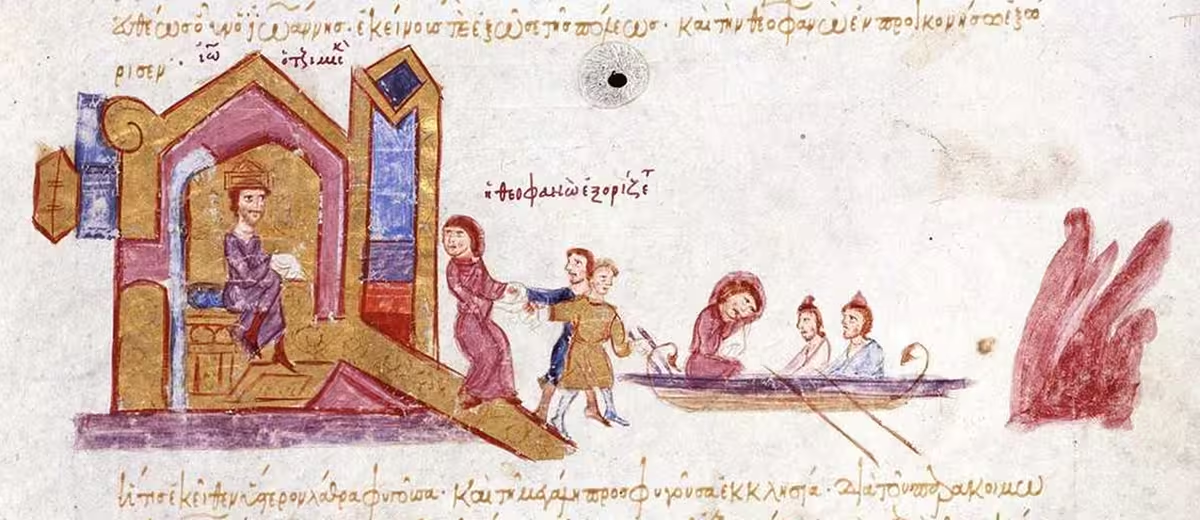
Other Events: Not every use of the Hippodrome’s political theater was so grim. As a ceremonial stage, it also hosted moments of individual heroism staged for maximum public effect. According to the historian John Skylitzes, an envoy from the Arab Caliphate arrived in Constantinople with a boastful warrior, who proved his horseman skills in the hippodrome brandishing two lances, and challenging any Byzantine to single combat. Outraged by the arrogance, Theodore Krateros – a court eunuch and cleric – stepped forward to defend the empire’s honor. Granting his request, the emperor watched from the imperial box in the Hippodrome as Krateros charges out on horseback and uses his single lance to unseat the Arab champion, throwing him to the ground before a cheering crowd.
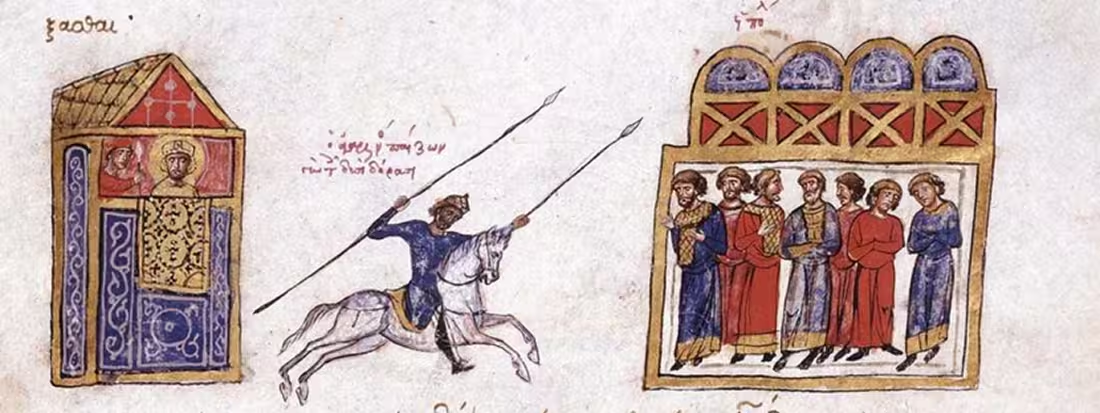
Miniature from the Skylitzes manuscript, 12th century. The Arab boasts in the Hippodrome before Emperor Theophilus in the kathisma. 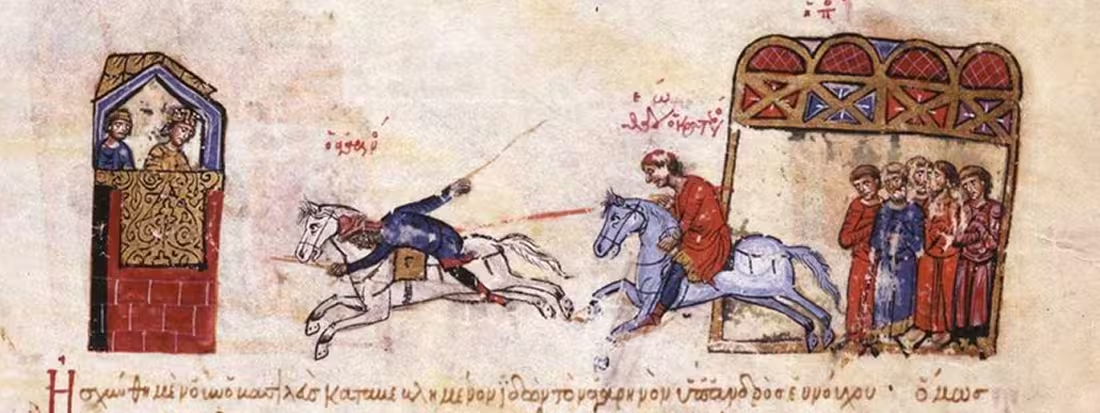
Eunuch Theodore Krateros defeats him with his single lance before the cheering crowd.
Centuries later, the Komnenian emperors of the twelfth century staged a more deliberate version of the same idea, importing Western-style jousting tournaments into the Hippodrome as a fashionable court entertainment — a sign of how thoroughly the arena’s ceremonial function could adapt to changing tastes even as its original purpose, chariot racing, slowly faded.
Decline: The sack of 1204 and the fall into ruin
The Fourth Crusade and the Sack of 1204
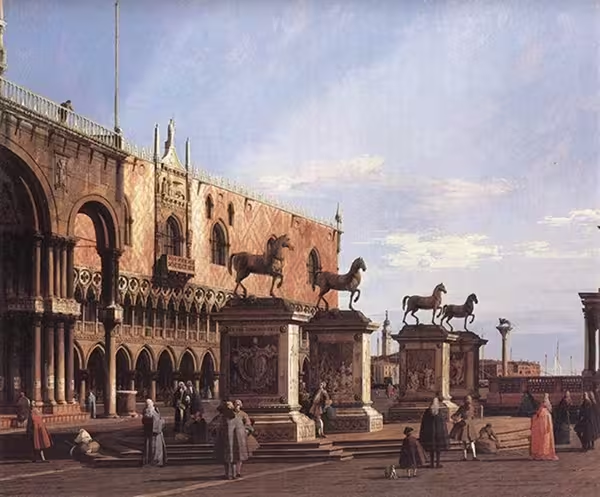
The Hippodrome’s long decline began in earnest with the Fourth Crusade’s capture of Constantinople in 1204. Crusader accounts describe the spina’s ancient bronzes as a source of wonder even as they were systematically stripped: statues were melted down for their metal, and the famous gilded bronze horses were shipped off to Venice, where they remain today.
The building was never destroyed outright, but its function as an active racing venue effectively ended here — Byzantine Constantinople never fully recovered the population, wealth, or civic confidence needed to sustain chariot racing at its old scale, even after the city’s Byzantine recovery in 1261.
From Racetrack to At Meydanı
By the time the Ottomans took the city in 1453, the Hippodrome had not functioned as a racecourse for two and a half centuries. The Ottomans had no tradition of chariot racing and never rebuilt the structure, but — crucially — they also never fully built over the open space itself. It survived as an open public square known as At Meydanı (“Horse Square”), used for markets, festivals, military assemblies, and public gatherings, including a famously lavish fifteen-day circumcision festival for the sons of Sultan Ahmed III in 1720.
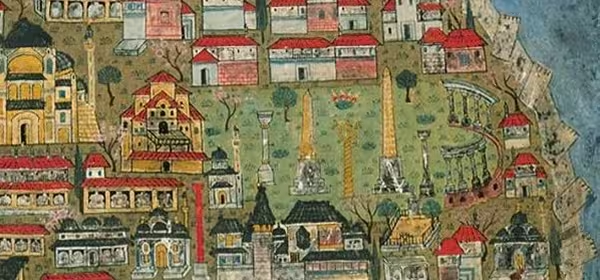
Stone from the Hippodrome’s ruined structure was gradually quarried for other Ottoman building projects nearby, including the Sultan Ahmed Mosque (the “Blue Mosque”), built directly alongside the old site in the early seventeenth century, and Ibrahim Pasha’s palace, built on part of the site itself in the 1520s.
What Survives Today
The Hippodrome has never been systematically excavated, so what survives is fragmentary and, for the most part, still buried beneath modern Istanbul. Above ground, the three spina monuments described earlier — the Serpent Column, the Obelisk of Theodosius, and the Walled Obelisk — still stand roughly in their original positions, now set within the landscaped public square of Sultanahmet.
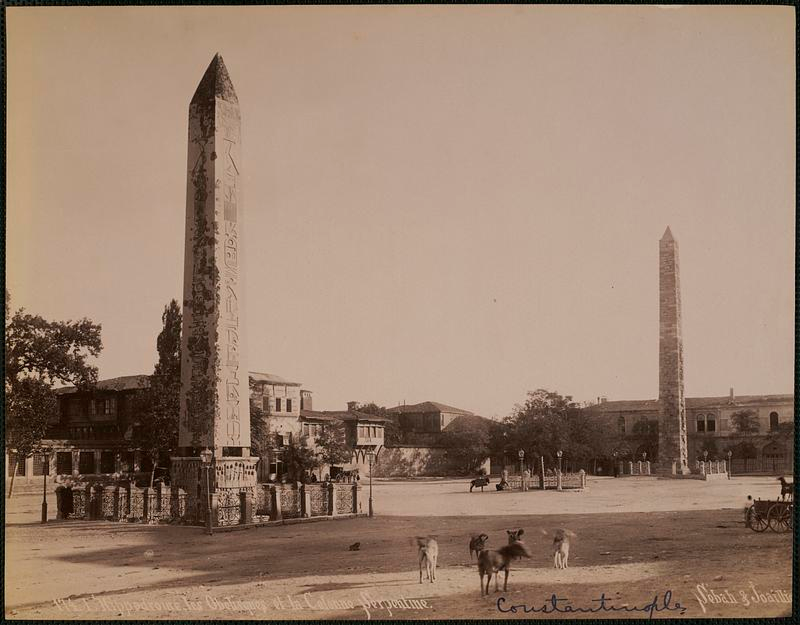
View of the obelisks and the Serpentine column, between 1889 and 1900. 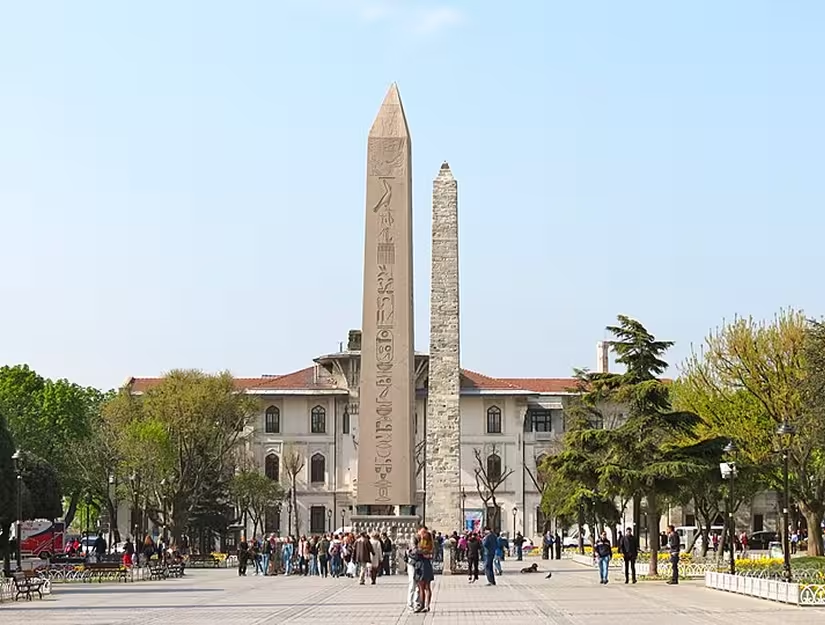
Modern view of the Tutmosis and walled obelisks.
The Sphendone’s massive vaulted substructure survives at the square’s southern end, partly visible where later housing was cleared in the 1980s. Occasional construction work has turned up further traces — a 1993 excavation for a public toilet near the Blue Mosque, for instance, uncovered several rows of original seating and columns — but no comprehensive archaeological study of the site has ever been undertaken, leaving most of the ancient arena’s footprint unexplored beneath the modern city.
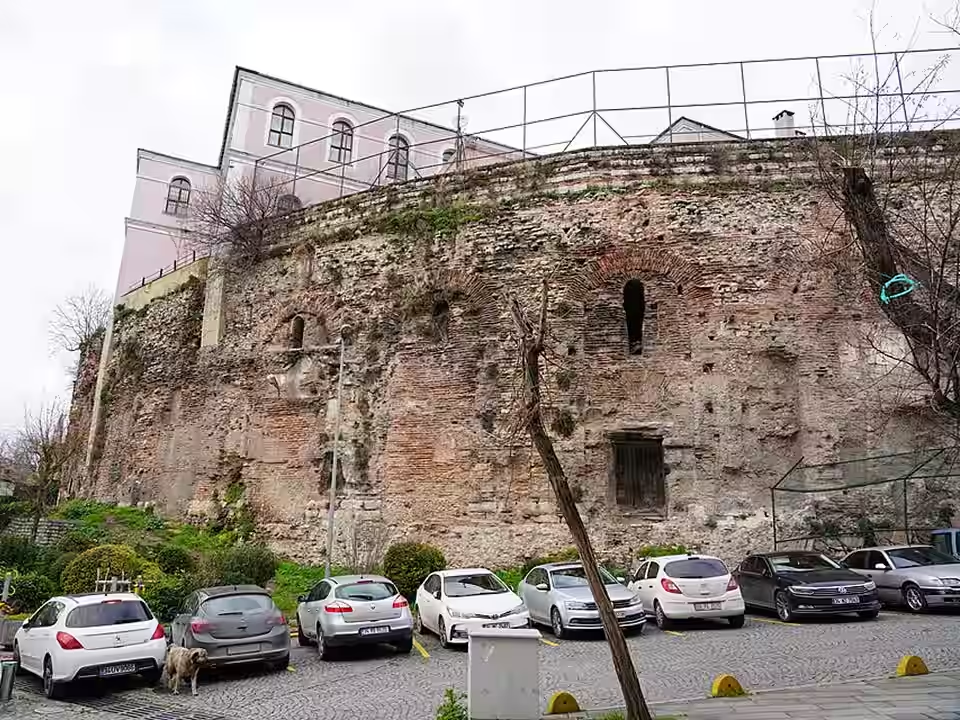
Part of the spendhone, credits Ray Swi hymn, CC by-SA 2.0 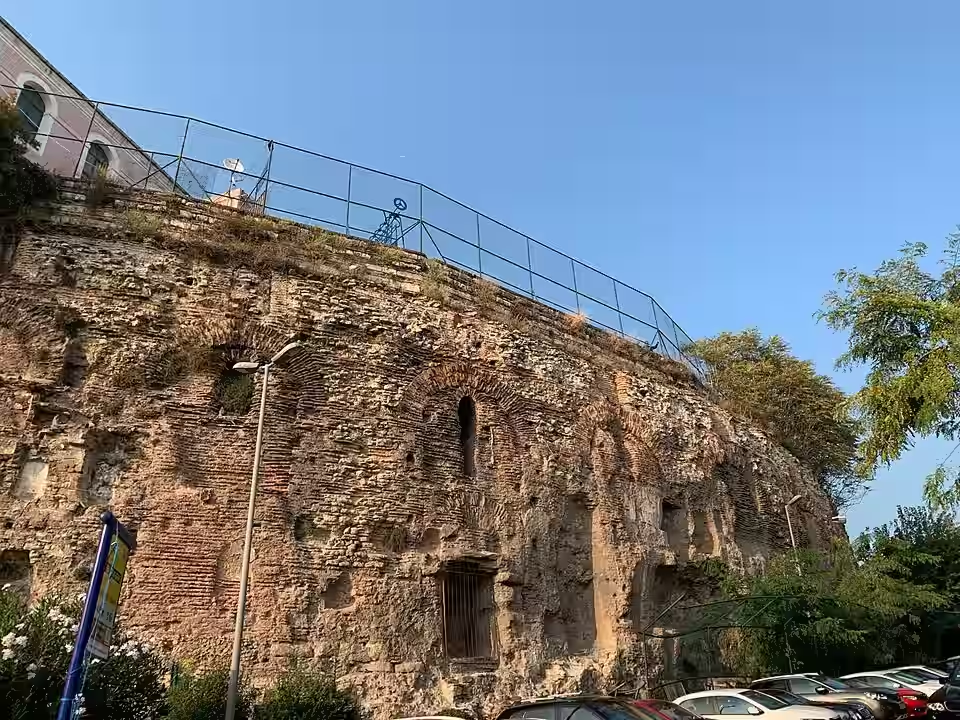
Part of the spendhone, credits Robot8a, CC by-SA 4.0
What is known archaeologically comes from a patchwork of separate, targeted digs rather than one continuous study. The first serious campaigns came in the interwar period: between 1927 and 1928, a British Academy team led by Stanley Casson, David Talbot Rice, G. F. Hudson, and A. H. M. Jones excavated near the western end of the Hippodrome, uncovering remains of the adjacent Baths of Zeuxippus along with sections of the arena itself, while the German archaeologist Theodor Wiegand and the Swiss scholar Ernest Mamboury separately mapped the palace quarter between the Hippodrome and the Sea of Marmara through the early 1930s. Further excavation in 1950, prompted by the foundations of a new law court, uncovered rows of original seating under the direction of the Istanbul Archaeological Museum, and the Sphendone’s substructure became more visible in the 1980s when later housing built against it was cleared. A 1993 excavation for a public building near the Blue Mosque turned up further rows of seating and columns, and restoration work at the former Ibrahim Pasha Palace between 2012 and 2014 uncovered a vaulted section of the Hippodrome’s western tiers, now incorporated into the building’s museum displays. Each campaign has added detail, but the great majority of the ancient arena’s footprint remains unexplored beneath the modern city.
Visiting Today
The former Hippodrome is now Istanbul’s Sultanahmet Square, a free, open public space at the heart of the historic peninsula, within a short walk of Hagia Sophia and the Blue Mosque. The three surviving spina monuments can be viewed at any time, and information panels around the square help visitors trace the outline of the original track, though very little of the arena’s original scale is intuitively obvious without some knowledge of what once stood there.
Frequently Asked Questions
What was the Hippodrome of Constantinople used for?
Primarily chariot racing, but also imperial coronations, military triumphs, public executions, and the ritual humiliation of political and religious opponents — making it as much a political stage as a sporting venue.
What were the Nika Riots?
A 532 CE uprising that began as factional unrest in the Hippodrome and escalated into an attempt to overthrow Emperor Justinian I. Justinian’s forces, led by Belisarius, suppressed it with a massacre inside the Hippodrome itself, killing tens of thousands.
What was the Kathisma?
The emperor’s private viewing box, connected directly to the Great Palace by a secure passage, allowing the emperor to appear before the Hippodrome crowd without passing through the city itself.
What happened to the Hippodrome’s statues and monuments?
Many were looted or melted down during the Fourth Crusade’s sack of Constantinople in 1204, including four gilded bronze horses now displayed on St. Mark’s Basilica in Venice. Three monuments — the Serpent Column, the Obelisk of Theodosius, and the Walled Obelisk — still stand on the site today.
Does the Hippodrome of Constantinople still exist?
Not as a functioning structure. Its site survives as Istanbul’s Sultanahmet Square, with three original spina monuments and the substructure of the Sphendone still visible; the rest lies unexcavated beneath the modern city.
Why was the Hippodrome connected to the Great Palace?
So the emperor could move directly and securely between his residence and public view of the Hippodrome crowd via the Kathisma, reinforcing his status as a figure who appeared to the people on his own terms, from a position of controlled, elevated visibility.
Sources
- Procopius, History of the Wars, Book I (on the Nika Riots).
- Michael Psellos, Chronographia — on the revolt and death of George Maniakes.
- John Skylitzes, Synopsis of Histories, trans. John Wortley (Cambridge: Cambridge University Press, 2010) — on Theodore Krateros, George Maniakes, and Leo V.
- Robert of Clari, La Conquête de Constantinople (on the 1204 sack).
- Jonathan Bardill, “The Hippodrome of Constantinople,” in Encyclopaedia Romana, University of Chicago.
- “The Hippodrome of Constantinople,” World History Encyclopedia.
- Jonathan Bardill, “Archaeologists and Excavations in the Hippodrome,” in Hippodrom/Atmeydanı: A Stage for Istanbul’s History, ed. Brigitte Pitarakis (Istanbul: Pera Müzesi Yayınları, 2010).
- Gilbert Dagron, L’hippodrome de Constantinople: Jeux, peuple et politique (Paris: Gallimard, 2011).
- “The underground remains of the Hippodrome of Constantinople,” Turkish Archaeological News.