
Byzantine Thessaloniki: A Complete Visitor’s Guide to the UNESCO Monuments
No city outside Istanbul preserves Byzantine history as completely as Thessaloniki. For most of its existence, it was the second city of the empire — a major port, a military stronghold, the burial place of saints, and a centre of artistic production that rivalled Constantinople itself. Today, fifteen of its Byzantine monuments are listed as UNESCO World Heritage Sites, and unlike in Istanbul, they have not been buried under later centuries of building: the churches of Thessaloniki are still standing, their mosaics and frescoes largely intact, in the streets of a living city.
Compact and walkable, Thessaloniki rewards even a short visit. The Byzantine monuments are concentrated in two areas: the lower city, where the great churches cluster around the ancient Roman core; and Ano Poli, the upper neighbourhood whose lanes, walls, and hilltop monasteries preserve the texture of a late Byzantine city more vividly than almost anywhere else in the world.
Quick facts about Thessaloniki
Founded: 315 BC by Cassander of Macedon
Byzantine significance: undisputed second city of the empire from the 7th century onwards — rivalled only by Constantinople itself
Fell to the Ottomans: 1430 — twenty-three years before Constantinople
UNESCO monuments: 15 listed since 1988
Getting there: Thessaloniki Airport (SKG); train from Athens (~4.5 hours)
Best time to visit: April–June and September–October
Time needed: Two days for the main monuments; three if you want to take it slowly
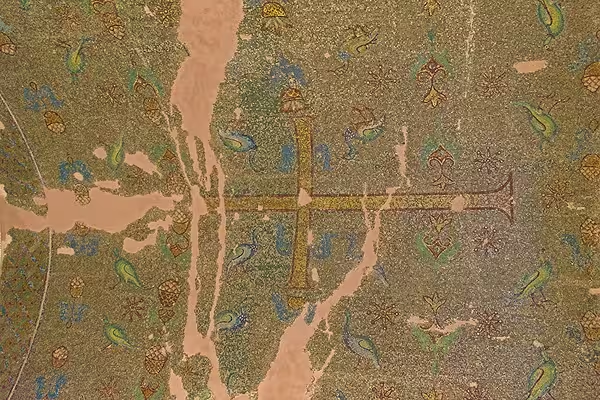
The Empire’s Second City
Thessaloniki owed its importance above all to geography. Positioned at the junction of the Via Egnatia — the great Roman road connecting Constantinople to the Adriatic — and the route south into Greece, it was the empire’s indispensable gateway to the west. Whatever happened in the Balkans, happened through Thessaloniki.
That strategic position made it a target. In the 6th and 7th centuries, waves of Avars and Slavs besieged the city repeatedly, and its survival — against considerable odds — was attributed to the miraculous intervention of its patron saint, Demetrios. The accounts collected in the Miracles of Saint Demetrios are among the most vivid documents of early Byzantine life, and the cult of Demetrios shaped the city’s identity for the rest of its Byzantine existence: the great basilica dedicated to him became the spiritual heart of Thessaloniki in a way that had no real parallel elsewhere in the empire.
The city’s later history is equally eventful. In 1185 the Normans of Sicily sacked it with a ferocity that shocked Christendom — witnessed and recorded by the archbishop Eustathios in one of the most gripping eyewitness accounts to survive from the medieval world. After 1204 it became the capital of a Latin kingdom. In the 14th century, a radical popular movement known as the Zealots seized control and held the city as a revolutionary commune for seven years. And through it all, Thessaloniki remained a centre of artistic production: in the 13th and 14th centuries the city gave rise to the Macedonian School of painting, whose masters — above all Michael Astrapas and Eutychios → — produced frescoes of extraordinary power across the city and the wider Balkans.
To explore the full history — the emperors, the sieges, the saints — read our dedicated page on Thessaloniki as the second heart of the Byzantine Empire →
The Unmissables
The Rotunda
The oldest surviving church in Thessaloniki, and one of the oldest in the world. The building began as a Roman mausoleum commissioned by the emperor Galerius around 306 CE — a vast circular drum of brick and concrete, intended to receive his remains. He died before it was completed, and within decades the structure had been converted into a Christian church, its pagan purpose quietly abandoned. A sanctuary was added on the eastern side, and the interior was covered with mosaics that rank among the supreme achievements of early Byzantine art.
The mosaics survive in the dome and the lower register of the walls. In the dome, against a gold ground that once depicted Christ in glory at its apex, stand rows of early Christian martyrs — each posed frontally before an elaborate jewelled architecture of extraordinary fantasy, rendered with a precision and richness that has no parallel in surviving early Byzantine art. The figures are hieratic but not lifeless; the architectural backdrops shimmer with gold, peacock colours, and inlaid gems. They date to around 450 CE and have never been surpassed.
The building’s exterior — a minaret from its Ottoman period still standing against the drum — is a compressed history of the city in stone: Roman core, Byzantine church, Ottoman mosque, modern monument.
Read the full story of the Rotunda — from Roman mausoleum to one of the world’s oldest churches →
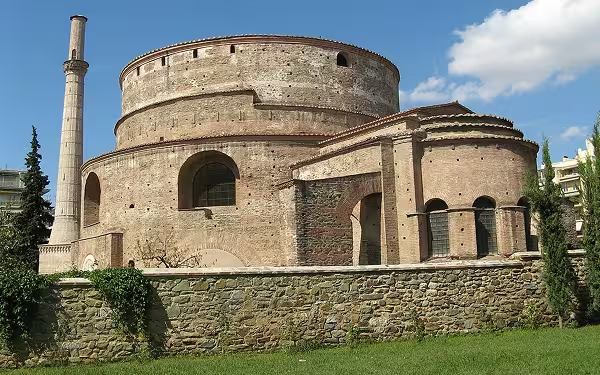
Rotunda of Saint George, © Filip Maljkovic, CC-by-SA 2.0 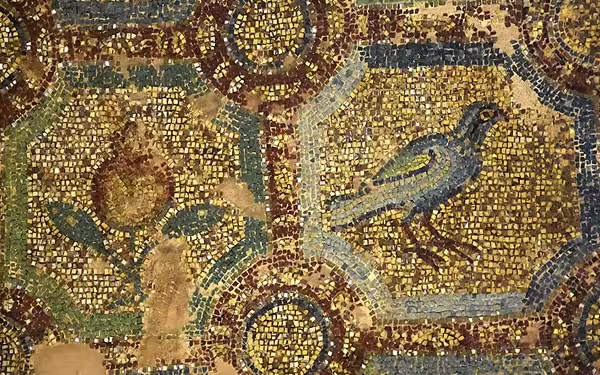
Mosaics in the Rotunda, © Phryrexian, CC-by-SA 4.0
Church of Saint Demetrios
The largest church in Greece and the spiritual heart of Thessaloniki. Built in the 5th century over the site where the city’s patron saint was martyred, it was rebuilt after a catastrophic fire in the 7th century and again — almost entirely — after the great Thessaloniki fire of 1917, which gutted the interior. What you see today is largely a 20th-century reconstruction of the original basilica, faithful in form but stripped of the richness it once had.
What survived the fire makes the visit unmissable. Set into the piers flanking the nave, a series of small mosaic panels — dating from the 5th to the 7th century — are among the earliest Byzantine mosaics anywhere in the world. They show Saint Demetrios with donors, bishops, and children, rendered in a style of quiet intimacy quite different from the monumental programmes of Ravenna or the Rotunda. These are private offerings, votive images made by individuals seeking the saint’s protection, and they carry an immediacy that larger programmes often lack. The crypt beneath the apse, where Demetrios is said to have been imprisoned and martyred, is also open to visitors.
For a full account of the mosaics — their history, iconography, and what was lost in 1917 — discover the mosaics of Saint Demetrios in detail →
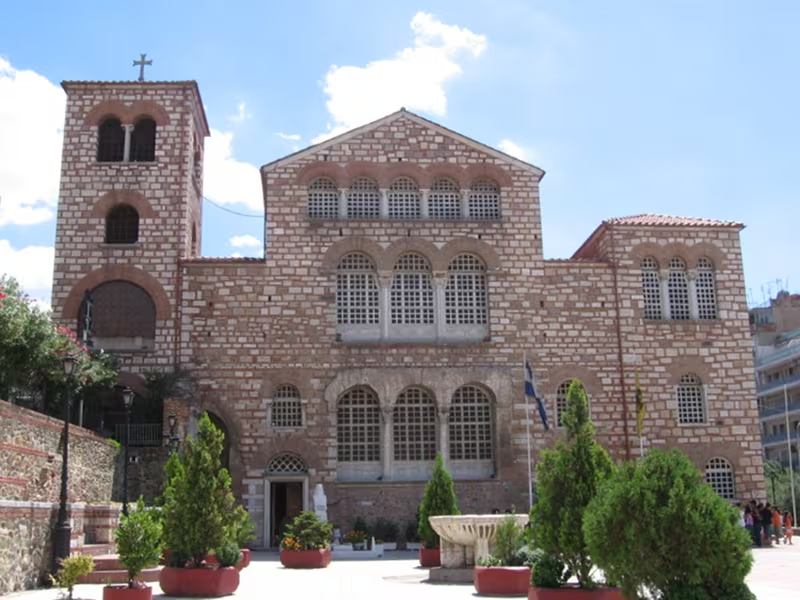
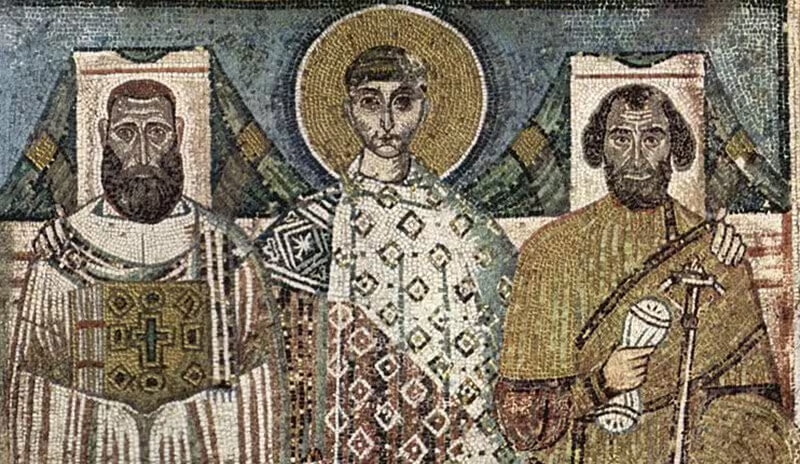
Osios David (Latomos Monastery)
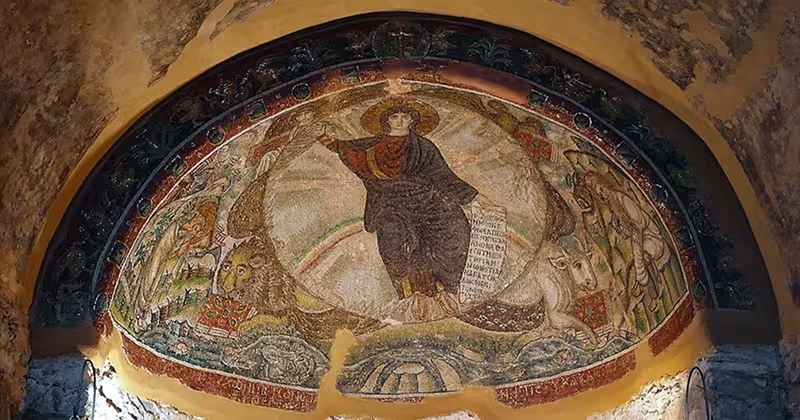
Easy to walk past, impossible to forget. Tucked into the lanes of Ano Poli, the chapel of Osios David is one of the smallest monuments in this guide and contains one of the most extraordinary works of art in the Byzantine world.
The apse mosaic dates to the late 5th century and depicts a theophany — a vision of the divine — of unusual iconographic complexity. At its centre, a young, beardless Christ sits within a luminous mandorla, surrounded by the symbols of the four evangelists. The prophets Ezekiel and Habakkuk appear at the sides, overwhelmed by what they witness. The image of a beardless Christ is itself remarkable — a survival of an early Christian iconographic tradition that would later be almost entirely displaced by the bearded Pantokrator — and the quality of the workmanship, the luminosity of the gold ground, and the expressive force of the figures place it among the finest mosaics to survive from the early Byzantine world.
The mosaic owes its survival to concealment. When the building was converted to a mosque during the Ottoman period, the apse was plastered over, and the mosaic lay hidden for centuries. It was rediscovered only in 1921. That accident of preservation makes it, in some ways, the most precious thing in Thessaloniki.
Church of the Holy Apostles
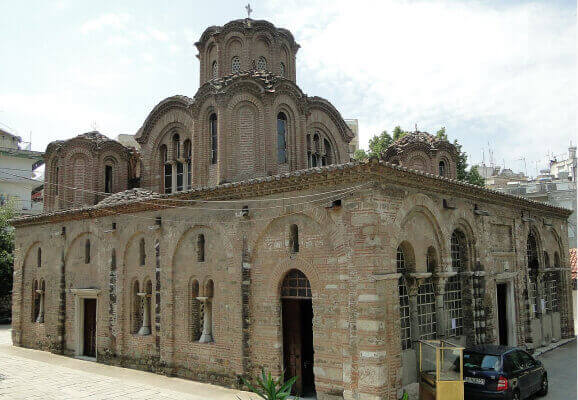
Built in the 1310s under Patriarch Niphon I of Constantinople, the Church of the Holy Apostles represents the Palaiologan period at its most accomplished — and makes an essential counterpart to the early Byzantine monuments elsewhere in the city.
The exterior alone is worth the visit. The facades are covered in elaborate decorative brickwork — geometric patterns, interlocking meanders, blind arcading — that transforms the building’s surface into something closer to textile than masonry. It is one of the most ornate Byzantine exteriors surviving anywhere in the world.
Inside, the programme of mosaics and frescoes is equally remarkable. The mosaics occupy the vaults and upper registers, depicting scenes from the life of Christ in the Palaiologan style: more expressive, more spatially aware, more emotionally immediate than the hieratic programmes of earlier centuries. The Transfiguration and the Washing of Feet are among the finest panels. The frescoes in the lower registers complete the decorative scheme, and together they illustrate precisely why the Palaiologan period — impoverished, politically diminished, artistically extraordinary — occupies such a distinctive place in Byzantine cultural history.
For a full account of the church and its decoration, read our dedicated article →
Museum of Byzantine Culture
Maybe the finest of all dedicated Byzantine museums in the world. Opened in 1994 in a purpose-built building near the waterfront — itself an elegant piece of architecture, long and low, its galleries organized around a sequence of light-filled courtyards — and awarded the European Museum of the Year prize in 2005, it remains the essential complement to any visit to the monuments.
The collection moves chronologically from early Christian Thessaloniki through to the eve of the Ottoman conquest, and the presentation is exceptional: objects are given space and context, and the sequence allows you to watch Byzantine art and material culture evolve across eleven centuries. Highlights include early Christian funerary assemblages of remarkable richness, Byzantine jewellery and textiles, a substantial icon collection, and — most unusually — frescoes removed from churches for preservation, displayed here in reconstructed environments that give a sense of how painted interiors once looked.
After a morning in the churches of the lower city or Ano Poli, the museum offers the ideal place to slow down, look closely, and understand what you have been seeing. Reserve at least two hours; three is better.
The Lower City
The Byzantine monuments of the lower city cluster within easy walking distance of one another, concentrated in the area between the ancient Roman core and the waterfront. The Rotunda and Saint Demetrios — covered among the unmissables above — are both here; the sites below complete the picture.
Hagia Sophia
Not to be confused with its far more famous namesake in Istanbul, Thessaloniki’s Hagia Sophia is a significant monument in its own right — and one that repays careful attention. Built in the late 7th or early 8th century, it represents an important transitional moment in Byzantine architectural history: a cross-domed basilica that bridges the early Christian basilica form and the cross-in-square plan that would become standard in the middle Byzantine period.
The interior mosaics are the main draw. The dome carries a magnificent Ascension of Christ — Christ enthroned in glory within a mandorla, surrounded by angels and apostles — dating to the 9th century, after the end of iconoclasm, when the prohibition on figural art was lifted and churches across the empire were re-decorated. The apse mosaic of the Virgin and Child replaced an earlier cross installed during the iconoclast period; the sequence of cross, then Virgin, preserves in stone the fault line that ran through Byzantine religious life for over a century.
Panagia Acheiropoietos
One of the oldest continuously used churches in the world. Built in the mid-5th century — contemporary with the earliest mosaics of the Rotunda and Saint Demetrios — it is a three-aisled basilica of great spatial serenity, its colonnaded nave largely intact after fifteen centuries. The name, meaning “not made by human hands,” refers to a legendary icon of the Virgin once housed here.
The original figural mosaics were destroyed during iconoclasm, but the decorative programme that survives in the arch soffits — intricate geometric and floral patterns in rich colours — is worth examining closely. More than the mosaics, it is the building itself that rewards a visit: the proportions, the quality of the light, and the sensation of standing in a space that has been in continuous Christian use since the 5th century.
Panagia Chalkeon
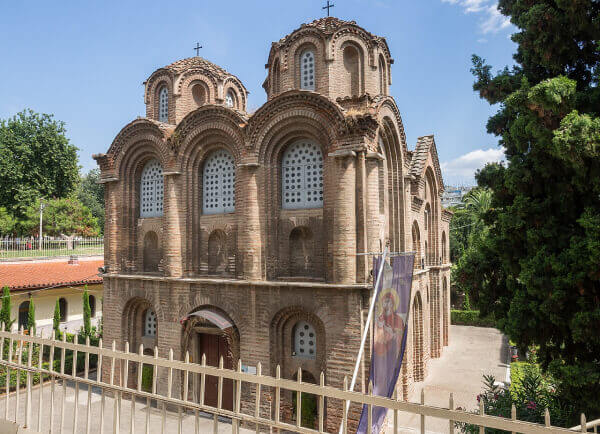
The “Church of the Coppersmiths” — named for the metalworkers’ quarter it once served — is one of the best-preserved examples of middle Byzantine architecture in Thessaloniki, built in 1028 as recorded in an inscription above the entrance. A compact cross-in-square church with a distinctive exterior of decorative brickwork, it sits in the middle of a busy pedestrian square in a way that makes the contrast between Byzantine and modern Thessaloniki particularly vivid. The interior retains frescoes of the middle Byzantine period. For more information, read our article about the Panagia Chalkeon →
The Galerius Complex
At the heart of the lower city stand the remains of the Roman imperial precinct built by the emperor Galerius in the early 4th century: a triumphal arch, a palace, a hippodrome, and the Rotunda — conceived together as a monumental ensemble. The Byzantines did not demolish this inheritance; they absorbed it. The Rotunda became a church. The arch — known today as the Kamara, a Thessaloniki landmark — remained standing, its relief sculptures of Roman military campaigns slowly losing their original meaning as the centuries passed. The palace ruins, partially excavated beneath and around Navarino Square, show a complex still in use into the early Byzantine period before the city grew around and over it.
Walking through this part of the lower city, the layering is visible everywhere: Roman foundations, Byzantine churches, Ottoman minarets, modern apartment blocks. Thessaloniki did not replace its past — it accumulated it.
Ano Poli
Rising steeply above the lower city, Ano Poli — the upper town — is the best-preserved Ottoman-era neighbourhood in Thessaloniki, but its roots are Byzantine. The lanes, the hilltop monasteries, the long stretches of wall running along the ridge: this is where the texture of the late Byzantine city survives most vividly, away from the traffic and commercial bustle below. Plan a half-day at minimum; the climb is steep but the reward is considerable.
Byzantine Walls
The walls of Thessaloniki run for several kilometres along the northern and eastern edges of the city, and constitute some of the best-preserved late antique fortifications in the Balkans. Built and rebuilt from the 4th century onwards, they incorporate towers of different periods, the most impressive stretch passing through Ano Poli where several survive to their full height. The Trigonion Tower and the Chain Tower (Alysida) are the most visited — the chain in the latter’s name once stretched across the harbour to control maritime access, a reminder that Thessaloniki’s defences were as much naval as they were terrestrial. At the northeastern corner, the Heptapyrgio — the “seven-tower” fortress, known in Turkish as Yedi Kule — forms the most concentrated section of the fortifications and offers the best views over the city and the Thermaic Gulf; it served as a prison well into the 20th century. Climbing the towers costs little time and repays it generously.
The White Tower, Thessaloniki’s most recognisable landmark on the waterfront, is not Byzantine — it was built by the Ottomans in the 16th century, probably on the site of an earlier Byzantine tower where the sea walls once met the water. It is worth visiting for its history and the views from the top, but it belongs to a different chapter of the city’s story.
Church of Saint Nicholas Orphanos
The least visited of Thessaloniki’s great Byzantine churches, and in some ways the most rewarding. A small, single-nave church built in the early 14th century, its modest exterior gives no indication of what is inside: a complete cycle of frescoes covering every surface of the interior, among the finest surviving examples of Palaiologan painting in the city. The figures are expressive and spatially confident — characteristic of the Macedonian School at its height — and the programme is exceptionally well preserved. If you have time for only one church in Ano Poli beyond the unmissables, make it this one.
Vlatades Monastery

Founded in the 1350s by two brothers, Dorotheos and Markos Vlatadon, this is the only functioning monastery remaining within the old city. The church itself is modest, but the complex — a quiet courtyard, a garden, views stretching south over the city and the Thermaic Gulf — offers a stillness that contrasts sharply with the monuments below. Tradition holds that Saint Paul preached on this hill during his visit to Thessaloniki in the 1st century, long before the city became Byzantine.
Read our article to know more about the monastery and its history →
Church of Saint Panteleimon
A 14th-century cross-in-square church with five domes and elaborate decorative brickwork that makes it one of the most photogenic exteriors in Ano Poli. Discover its architecture and frescoes more in depth in our dedicated article →
Also worth seeking out: the Church of Saint Catherine, a late 13th-century cross-in-square church with fine brickwork and original frescoes; the Church of Prophet Elijah, a large 14th-century foundation believed to have been an imperial monastery, with a distinctive three-apsed plan; the Chapel of the Transfiguration (Metamorphosis), a small Byzantine chapel included in the UNESCO listing; and the Byzantine Baths, a partially preserved public bath complex that offers a glimpse of Byzantine civic life beyond the churches.
Practical Tips
Getting there
Thessaloniki is served by its own international airport (SKG), with direct flights from many European cities. From Athens, the high-speed train takes around 4.5 hours and arrives in the city centre; it is the most comfortable option if travelling within Greece.
Getting around
The lower city monuments are within easy walking distance of one another and of the main hotels. Ano Poli is a different matter — the climb from the lower city is steep, and the lanes are not always straightforward to navigate. The simplest approach is to take a taxi up and walk down, which also means you see the neighbourhood at its best, descending through the lanes with the city opening up below you. The UNESCO monument route marked by the municipality connects all 15 sites and is a useful orientation tool.
When to go
April–June and September–October offer the best conditions: warm enough to walk comfortably, without the heat and crowds of July and August. Spring is particularly good for Ano Poli, when the neighbourhood is at its most pleasant.
Dress code
Most of the Byzantine churches in Thessaloniki remain active Orthodox parishes. Visitors should cover shoulders and knees; some churches ask women to cover their hair. A scarf kept in a bag solves the problem at every site.
Opening hours and tickets
Opening hours vary and can be irregular — some churches close for a midday break, and Monday closures are common for museums. Check ahead before planning a tight itinerary. The Museum of Byzantine Culture charges an entry fee and is worth booking time for; most churches are free or request a small donation.
Suggested itinerary
Two days is the natural rhythm. Spend the first in the lower city: the Rotunda, Saint Demetrios, Hagia Sophia, Panagia Acheiropoietos, and Panagia Chalkeon are all within a compact area. Devote the second day to Ano Poli and end at the Museum of Byzantine Culture in the late afternoon. If you have a third day, use it to revisit the monuments that made the strongest impression — Thessaloniki rewards a slower pace.
Frequently Asked Questions
How many Byzantine monuments are there in Thessaloniki?
Fifteen are listed as UNESCO World Heritage Sites, making Thessaloniki one of the most important concentrations of Byzantine heritage in the world. Beyond the UNESCO list, further Byzantine remains — fragments of buildings, archaeological traces, reused spolia — are woven into the fabric of the city.
How does Thessaloniki compare to Istanbul for Byzantine history?
The two cities are complementary rather than comparable. Istanbul has the grand set pieces — Hagia Sophia, the Chora mosaics — but much of the Byzantine layer is buried, converted, or inaccessible. Thessaloniki’s monuments are more numerous, less crowded, and often better preserved; the texture of the late Byzantine city survives more completely here, particularly in Ano Poli. For anyone serious about Byzantine history, both are essential.
How long do you need to visit the Byzantine monuments?
Two days is the natural minimum: one for the lower city, one for Ano Poli and the Museum of Byzantine Culture. Three days allows a more relaxed pace and time to revisit the monuments that made the strongest impression.
Is Hagia Sophia in Thessaloniki connected to Hagia Sophia in Istanbul?
They share a name — both dedicated to the Holy Wisdom — and both are Byzantine churches, but they are entirely separate buildings of different periods. Istanbul’s Hagia Sophia was built by Justinian in the 6th century and is far larger. Thessaloniki’s dates to the 8th century and is significant in its own right, particularly for its post-iconoclast mosaics.
Are Thessaloniki’s Byzantine churches free to visit?
Most churches are free to enter or request a small voluntary donation. The Museum of Byzantine Culture charges an entry fee and is well worth it. Some sites may have restricted hours or occasional closures — it is worth checking ahead for the smaller churches in Ano Poli.
What is the single most important Byzantine monument in Thessaloniki?
It depends what you are looking for. Saint Demetrios is the most historically significant — the city’s patron basilica, inseparable from Thessaloniki’s Byzantine identity. The Rotunda has the finest mosaics. Osios David is the most surprising. If you can only choose one, Hagia Sophia of Constantinople aside, the Rotunda offers the most concentrated encounter with early Byzantine art anywhere in Greece.