The Vlatades Monastery of Thessaloniki
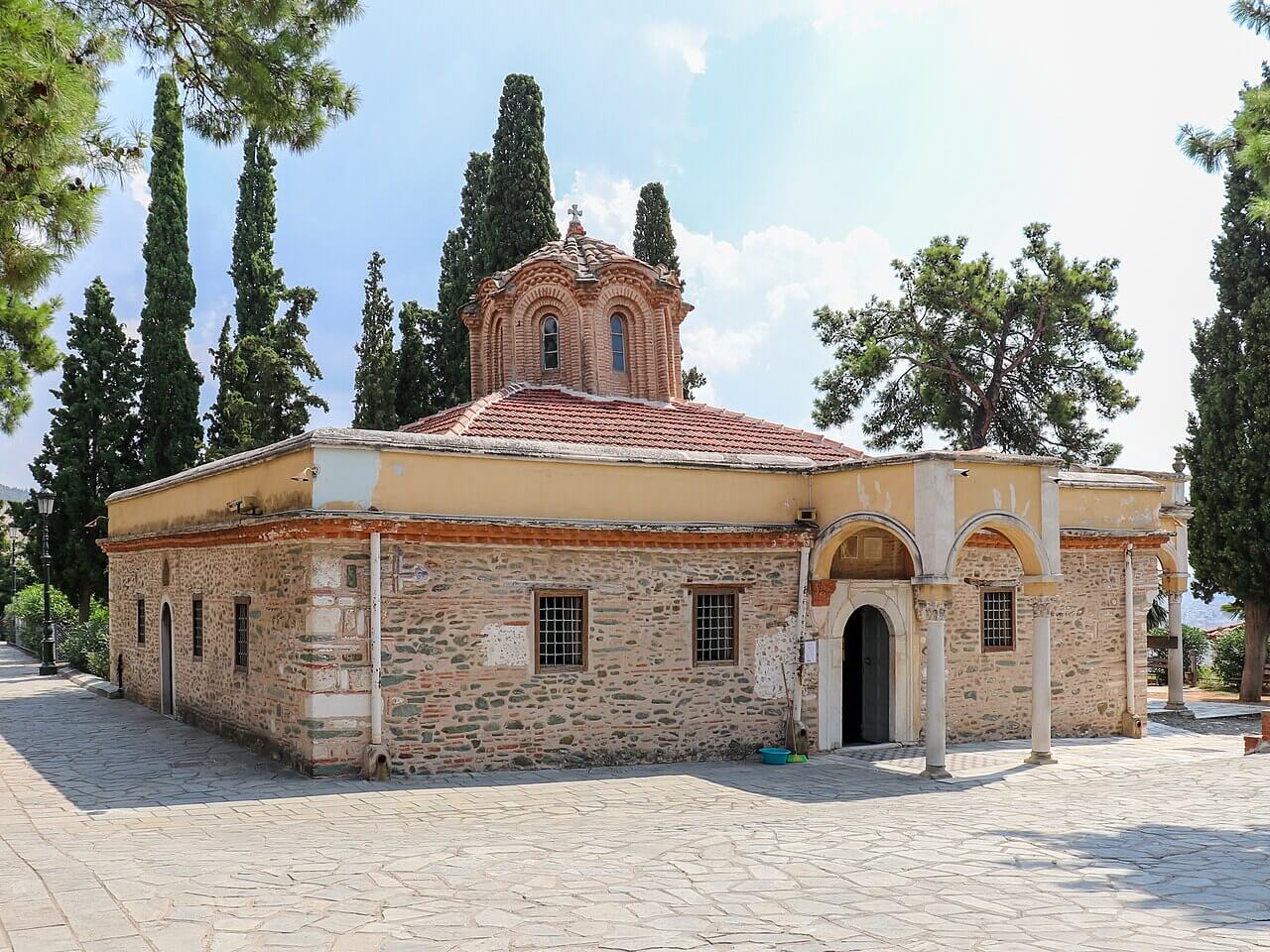
The Vlatades Monastery (or Moni Vlatadon – Μονή Βλατάδων in modern Greek) is a Byzantine-era monastery located in Thessaloniki, Greece. It is currently under the direct jurisdiction of the Ecumenical Patriarch of Constantinople. Since 1988, the monastery has been listed as a UNESCO World Heritage site under the designation “Paleochristian and Byzantine Monuments of Thessaloniki.”
Planning to see it in person? It is an easy stop on any walking tour of the city’s monuments — see our complete visitor guide to Byzantine Thessaloniki.
History of the Vlatades monastery.
The monastery was founded by Dorotheos Vlatis, a disciple of Gregory Palamas and the metropolitan of Thessaloniki, sometime between 1351 and 1371. Originally dedicated to Christ Pantokrator, the monastery is now dedicated to the Transfiguration.
Following the fall of Thessaloniki to the Turks, the monastery was likely briefly occupied, as evidenced by the hammering of the frescoes in the katholikon (main church). This was done to improve adhesion for plaster when the church was converted into a mosque. However, in 1446, a firman (decree) from Sultan Mehmed II granted the monastery special privileges, allowing it to prosper during the Ottoman period. During this time, the monastery maintained several metochia (dependencies) in Thessaloniki and its surrounding areas.
Architecture and decoration of the church.
The katholikon of the Vlatades Monastery features a rare variation of the cross-in-square architectural plan, where the dome is not supported by columns but by the walls of the sanctuary and two pillars on the western side. This unusual feature is thought to result from the reuse of foundations from an earlier church that predated the monastery’s establishment.
The monastery was originally dedicated to Christ Pantokrator before its rededication to the Transfiguration. The structural constraints imposed by the pre-existing building drastically altered the standard internal flow of a Late Byzantine cross-in-square template, forcing the architects to anchor the heavy, ten-sided brick dome directly onto the eastern sanctuary masonry and two thick western stone piers. This design choice sacrificed the airy, open naos typically created by slender columns, yielding a more compartmentalized interior space.
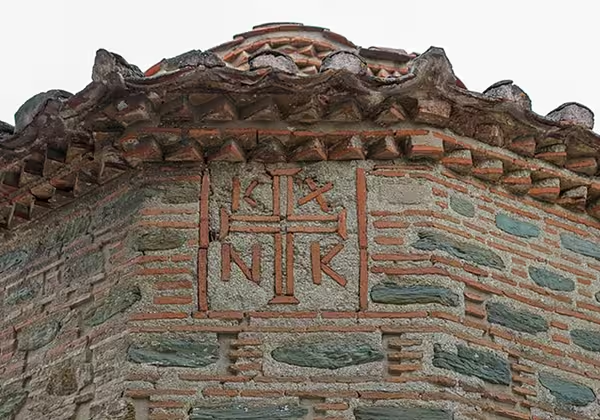
Architectural excavations have further revealed that this core layout is enveloped on three sides by a wide ambulatory (or peristyle) that terminates at the eastern end into two flanking side-chapels. The external masonry reflects classic Palaiologan construction techniques, consisting of alternating bands of natural stone rubble and brickwork, with decorative ceramic accents focused exclusively on the central sanctuary apse.
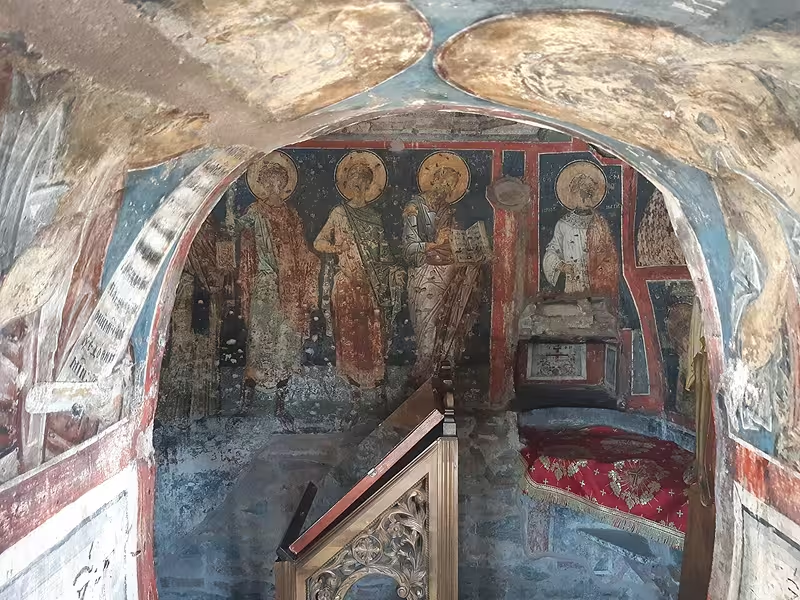
The surviving frescoes in the nave and on the eastern wall of the western portico reveal a rich iconographic program. The dome features a depiction of Christ Pantokrator surrounded by angelic hosts and prophets.
The intrados of the arches is adorned with scenes from the Dodekaorton (Twelve Great Feasts), while the walls are decorated with frescoes of saints, primarily monks and hermits.
In the ambulatory, military saints are depicted in the lower register, while miracles of Christ appear in the upper register.
These frescoes have been dated to the 1360s-1380s, largely due to the presence of Gregory Palamas in a passage between the nave and the narthex. Palamas’ death in 1359 offers a terminus post quem for the decoration. The inclusion of a second fresco of Palamas in the southern chapel further attests to the monastery’s close association with the Hesychast movement, of which Palamas was a central figure.
The icons in the Monastery’s museum.
The museum at the Vlatades Monastery houses an exceptional collection of sacred Christian art and artifacts, featuring rare portable icons dating from the 12th to the 19th centuries, historic ecclesiastical silver, and early-printed liturgical books. It is also highly regarded for its preservation of precious religious manuscripts and codices, some of which date back to the 10th century, making it a critical repository of Byzantine and post-Byzantine monastic heritage.
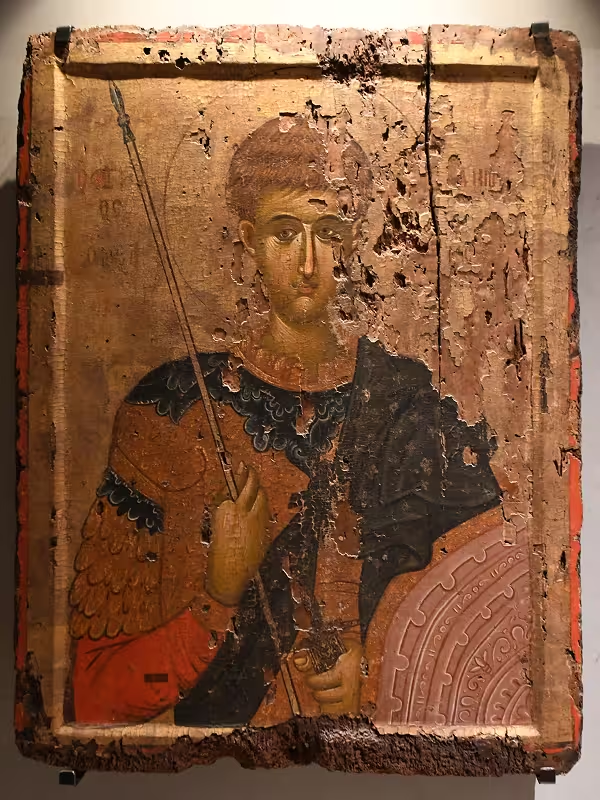
Agios Dimitrios icon, 14th century. ©Herbert Frank, CC-by-SA 2.0 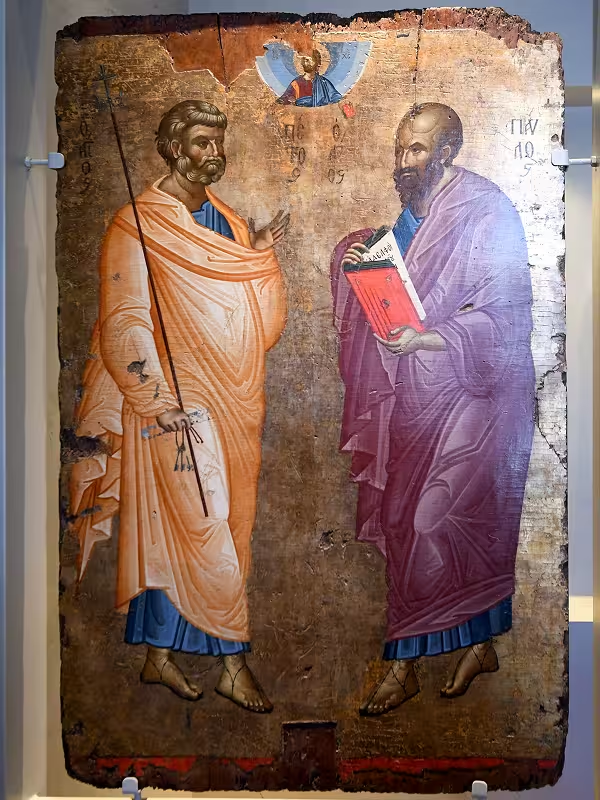
Apostels Peter and Paul, 14th century, originally in Agios Georgios church in Kolindros. © Herbert Frank, CC-by-SA 2.0 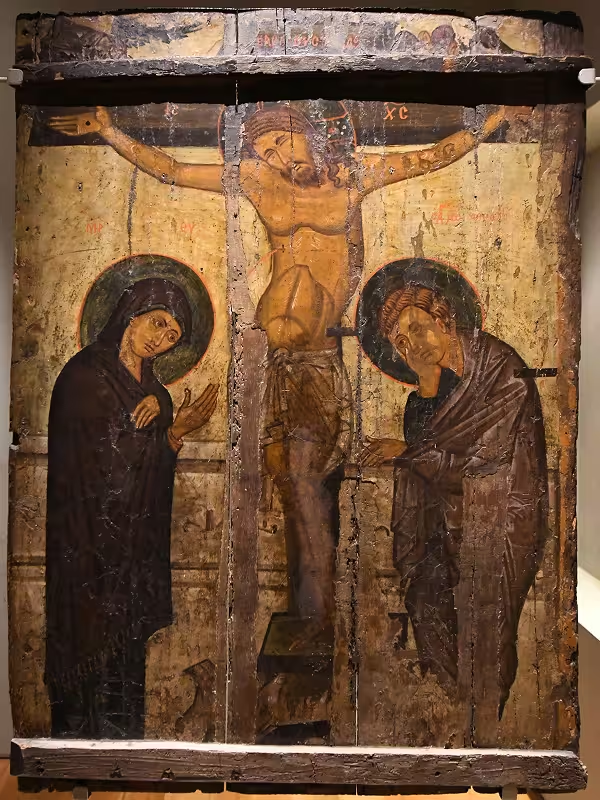
Icon of the Crucifixion, 15th century, originally from Panagia Acheiropoitos Church, Thessaloniki. © Herbert Frank, CC-by-SA 2.0
Cover photography credits: Stolbovsky, CC BY-SA 3.0