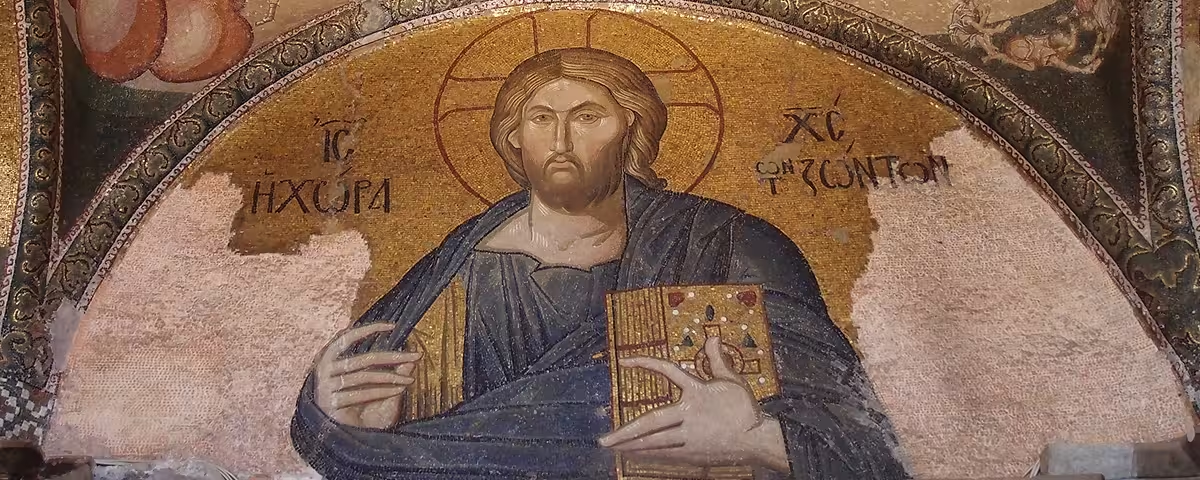
Christ Pantocrator: The Ruler of All
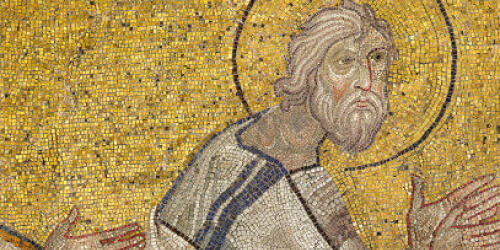
No image is more immediately associated with Byzantium than the Christ Pantocrator: the frontal, bearded Christ, his right hand raised in blessing, the Gospel book held in his left, his gaze meeting the viewer with a gravity that is neither entirely stern nor entirely gentle. It is the central image of Byzantine icons and of Byzantine art as a whole — yet the Pantocrator was never confined to painted panels. The same figure looked down from the domes of churches, filled the golden apses of Norman Sicily, circulated on gold coins and lead seals, and was carved in ivory and steatite. For more than a thousand years, wherever the Byzantine world left its mark, the Ruler of All was watching.
What is the Christ Pantocrator?
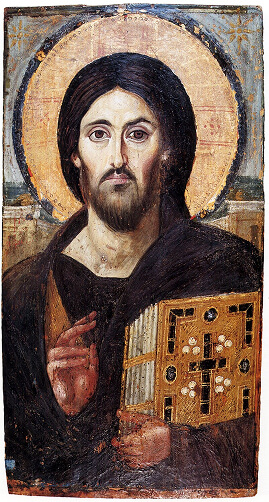
The Christ Pantocrator is the principal iconographic type of Christ in Byzantine art, depicting him frontally, in half or full length, blessing with his right hand and holding the book of the Gospels in his left. The Greek word Pantokratōr means “Ruler of All” or “Almighty.” The type asserts, in a single image, the two natures of Christ — fully God and fully man — presenting him at once as teacher, judge, and sovereign of the universe. The oldest surviving example, a 6th-century panel preserved at Saint Catherine’s Monastery in Sinai, is also the oldest known icon of Christ.
Origins and meaning of the name
The title Pantokratōr is older than the image. It appears in the Septuagint, the Greek translation of the Hebrew Bible, where it renders divine names such as Sabaoth (“Lord of Hosts”) and El Shaddai (“the Almighty”). Early Christianity inherited the word: it occurs in the New Testament, above all in the Book of Revelation, and entered the creed itself — “I believe in one God, the Father Almighty,” Pantokratora in the Greek. Applied to Christ, the title made a precise theological claim: the Son shares fully in the omnipotence of the Father.
The image took shape more slowly. Early Christian art had experimented with many faces of Christ — the youthful, beardless Good Shepherd, the philosopher-teacher, the wonder-worker. The mature Pantocrator type, with its long hair, short beard, and solemn frontality, drew on the visual language of authority that late antique viewers knew best: the imperial portrait and the image of the enthroned philosopher-god. By the 6th century the type had stabilized, and after the crisis of Iconoclasm it became canonical. To paint Christ at all was, for the defenders of icons, to proclaim the reality of the Incarnation — God had become visible man, and could therefore be depicted. The Pantocrator, the most complete image of Christ’s dual nature, became the keystone of the entire Byzantine image system.
The Sinai icon: the oldest Pantocrator
The history of the type effectively begins with a single, astonishing survivor. The Christ Pantocrator of Saint Catherine’s Monastery in Sinai, painted in encaustic — pigments bound in hot wax, the technique of the Greco-Roman portrait tradition — is generally dated to the 6th century and attributed to a Constantinopolitan workshop, perhaps sent as an imperial gift when Justinian fortified the monastery. Because Sinai lay beyond the reach of the iconoclast emperors after the Arab conquests, its icons escaped the destruction that annihilated almost all early panel painting. The image remained hidden in plain sight for centuries under later overpainting, and only its cleaning in 1962 revealed the original — instantly recognized as one of the most important works in all of Byzantine art.
What makes the Sinai Christ unforgettable is its face. The two halves are deliberately different. On the side of the blessing hand, the features are calm, regular, serene; on the side of the Gospel book, the eye is larger and darker, the brow raised, the expression severe. Seen whole, the face seems to shift as one looks at it — merciful and judging at once. Most scholars read this asymmetry as a visual theology: the two natures of Christ, human and divine, or his double role as savior and judge, fused in a single countenance. Later Pantocrators softened or regularized the device, but the essential tension — majesty tempered by compassion — remained the emotional core of the type for a millennium.
Description of the iconographic type
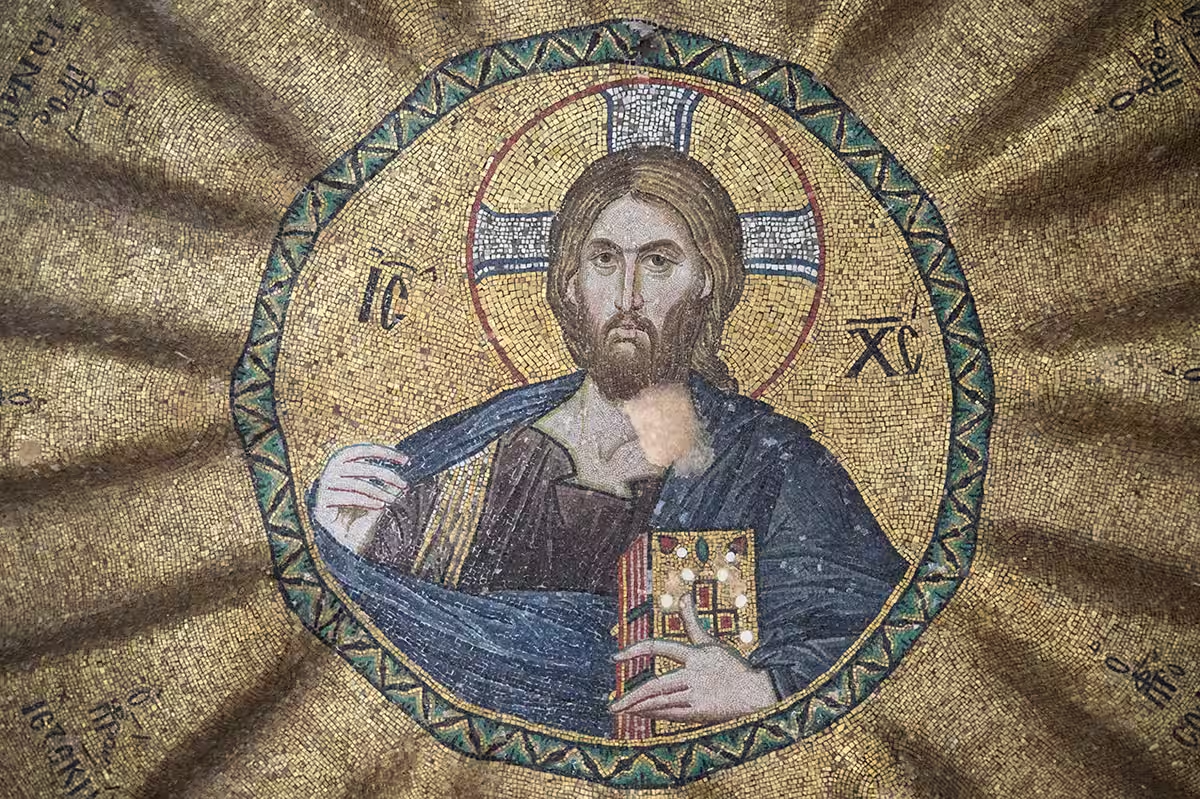
The classic Pantocrator follows a formula that Byzantine painters repeated with extraordinary fidelity. Christ appears frontally, usually in bust form, against a gold ground. His right hand blesses, the fingers forming the letters IC XC — the abbreviation of Iēsous Christos that also flanks his head in the field of the image. His left hand holds the Gospel, sometimes closed and studded with gems, sometimes open on a text such as “I am the light of the world.” He wears a purple-blue tunic (chiton) and mantle (himation), the colors themselves carrying meaning: purple for divinity and kingship, blue for humanity. Behind his head, the halo is inscribed with a cross — a nimbus reserved for Christ alone; in later icons the three visible arms of the cross carry the letters ho ōn, “He Who Is,” the name God speaks to Moses from the burning bush.
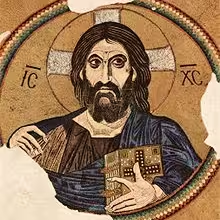
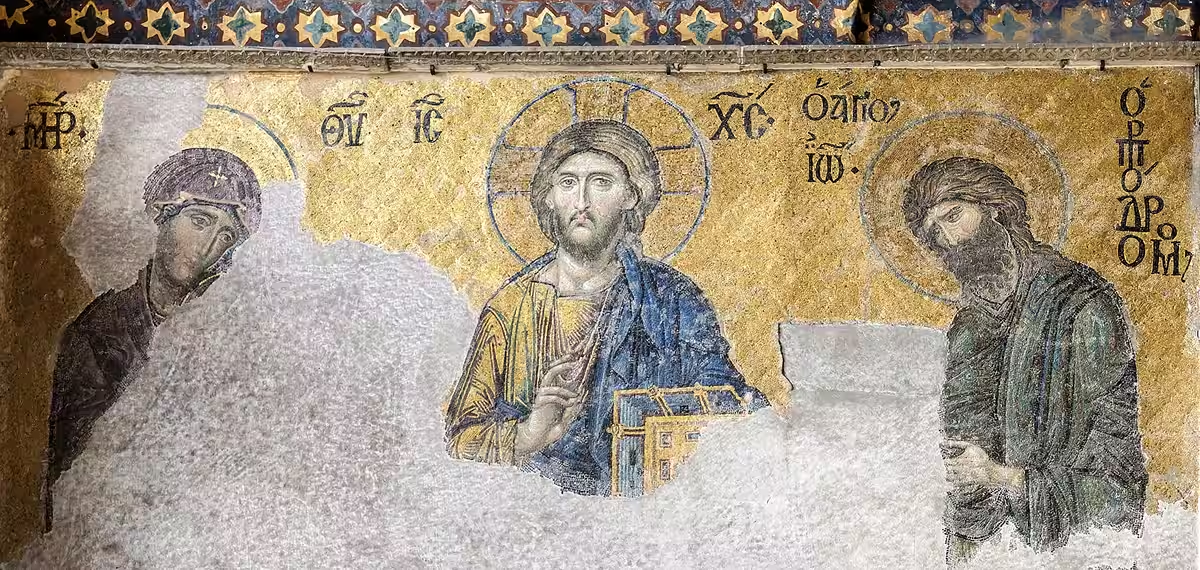
Within the fixed formula, variation was possible and meaningful. The Pantocrator could be shown in bust, standing full-length, or enthroned in majesty. The expression ranged from the almost tender to the terrifying — the 11th-century dome mosaic at Daphni, near Athens, shows a Christ of such severity that art historians have described him as a judge before whom the whole church stands trial. A gentler, more humanized Pantocrator returned in the Palaiologan period, exemplified by the mosaic Deesis of Hagia Sophia. The type’s power lay precisely in this narrow expressive bandwidth: always the same Christ, yet never quite the same gaze.
The Pantocrator across media: icons, coins, and seals
The Pantocrator was never only a panel painting. It was the image of Christ that Byzantium carried in its pocket, sealed its letters with, and wore around its neck.
Its most consequential migration came in the 690s, when Emperor Justinian II placed the bust of the Pantocrator on the gold solidus — the first time the face of Christ ever appeared on a coin. The inscription named Christ Rex Regnantium, “King of those who rule,” while the emperor, relegated to the reverse, styled himself servus Christi, “servant of Christ.” It was a revolution in imperial imagery: the true sovereign of the empire was now the one on the obverse.
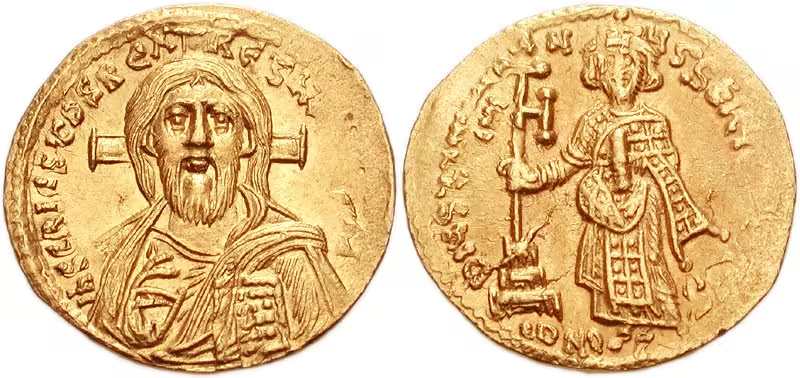
During his second reign (705–711), Justinian introduced a different Christ — short-haired, curly-bearded, drawing on an alternative “Semitic” portrait tradition — evidence that even at this date the image of Christ was not yet fixed. Iconoclasm swept Christ from the coinage altogether, replacing him with the cross; his return on the gold of Michael III after 843 announced the Triumph of Orthodoxy as clearly as any council decree. From then until the fall of Constantinople in 1453, the Pantocrator — in bust or enthroned — remained the near-constant face of the Byzantine gold coinage.
The same image spread across the minor arts. Lead seals of emperors, patriarchs, and officials bore the Pantocrator by the thousands, making it perhaps the most widely reproduced image of the medieval world. Ivory carvers of the Macedonian period set the enthroned Christ at the center of triptychs; steatite icons, like the fine 14th-century example now in the Metropolitan Museum, made the image portable and personal; enamellers gave the Pantocrator the central place in the Pala d’Oro of Venice, assembled largely from Byzantine spoils. Each medium translated the same theology: wherever a Byzantine looked — a coin in the hand, a seal on a document, an icon by the bed — the Ruler of All looked back.
The Pantocrator in the dome
After Iconoclasm, Byzantine church decoration crystallized into a coherent system, and the Pantocrator claimed its summit. In the classic Middle Byzantine scheme, the church was understood as an image of the cosmos: the dome was heaven, and from its center the Pantocrator — usually in bust, encircled by angels or prophets — surveyed the congregation below. The hierarchy descended from him: the Virgin in the apse, the feasts of Christ’s life on the vaults and squinches, the saints on the lower walls. As Otto Demus showed in a classic study, the system made the building itself a single icon, with the Pantocrator as its eye.
The great surviving examples define the type for modern viewers. The dome of Daphni (ca. 1100) holds the severest of all Pantocrators, dark-browed and colossal. At Hosios Loukas, a monumental Pantocrator mosaic greets the visitor over the entrance to the katholikon. In churches without a dome, the image moved to the apse: at Cefalù in Norman Sicily (1148), Greek mosaicists set a Pantocrator of extraordinary nobility in the conch, his mantle a cascade of gold, the open Gospel in his hand bilingual in Greek and Latin. Monreale and the Cappella Palatina in Palermo repeated the formula on an even grander scale. In monumental painting, fresco Pantocrators crowned village churches from Cappadocia to the Balkans — and late Byzantine masters gave the type some of its final masterpieces, as in the mosaics of the Panagia Paregoritissa in Arta. In Constantinople itself, the most beloved surviving Pantocrator is not in a dome at all: the Deesis mosaic in the south gallery of Hagia Sophia, usually dated around 1261, where Christ — flanked by the Virgin and John the Baptist intervening for humankind — wears an expression of melancholy gentleness that stands at the opposite pole from Daphni.
Pantokrator of Daphni 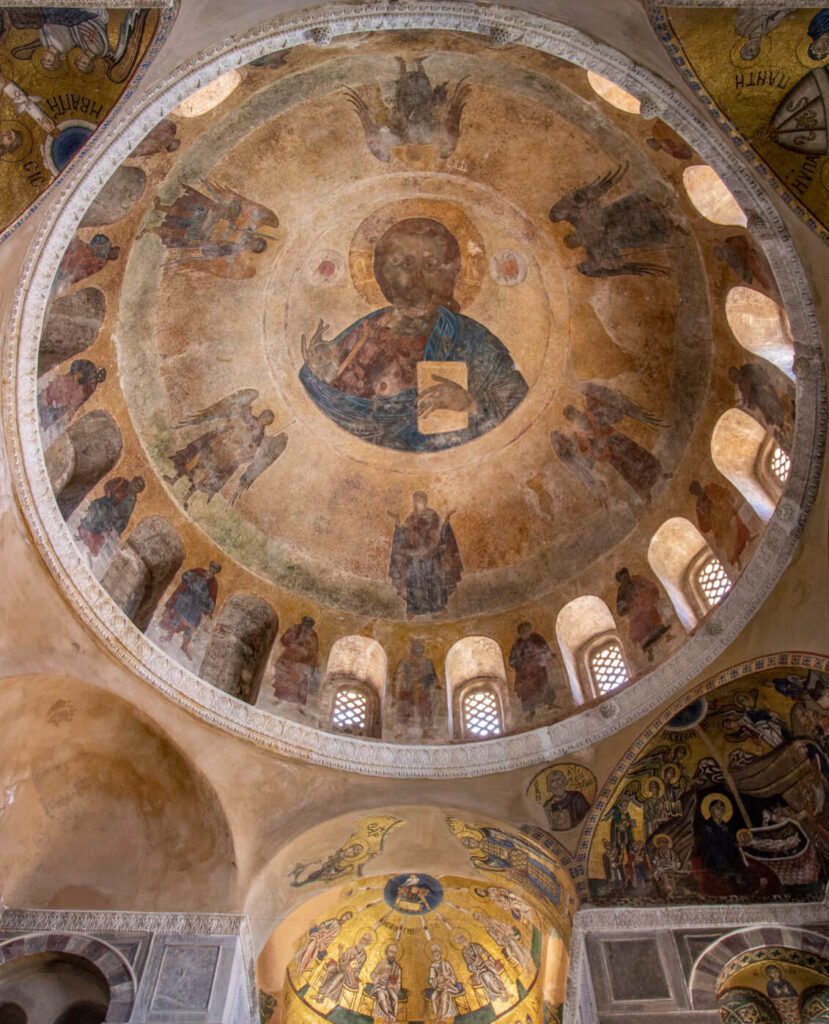
Pantokrator of Hosios Loukas 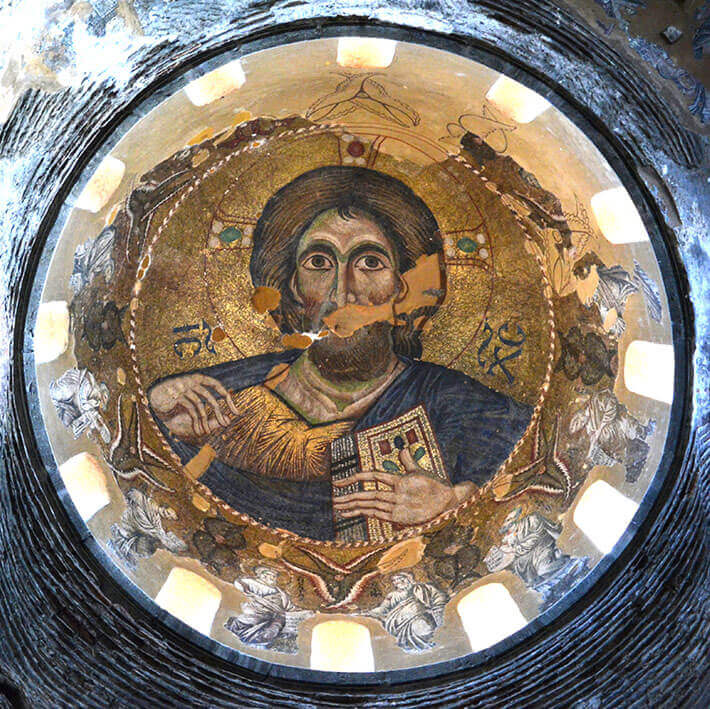
Dome of the Panagia Paregoritissa, Arta, Greece
Variants and related types
Byzantine art developed the Pantocrator into a family of related images. The enthroned Pantocrator set the same figure on a jeweled throne, the composition of imperial audience halls transposed to heaven; it appears on coins, in apses, and in panels such as the mosaic above the imperial door of Hagia Sophia — and in the mosaic of Zoe Porphyrogenita, where emperors present their gifts to the enthroned Christ.
In the Deesis, the Pantocrator becomes the center of a plea: the Virgin — in the same praying pose as the Hagiosoritissa — and John the Baptist flank him as intercessors for humanity, a composition that came to crown the templon screens of Byzantine churches.
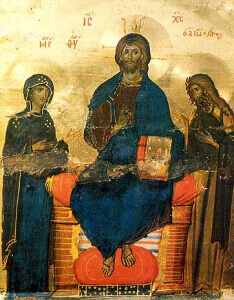
Other images of Christ answer the Pantocrator rather than repeat it. Christ Emmanuel shows the Lord as a child or youth, the Incarnation foreseen; the Ancient of Days shows him white-haired, eternity made visible. Both were understood not as different persons but as different aspects of the same Christ whom the Pantocrator presented in majesty. Together with the Marian types — the Hodegetria above all — these images formed the fixed constellation at the heart of Orthodox iconography.
Influence and legacy
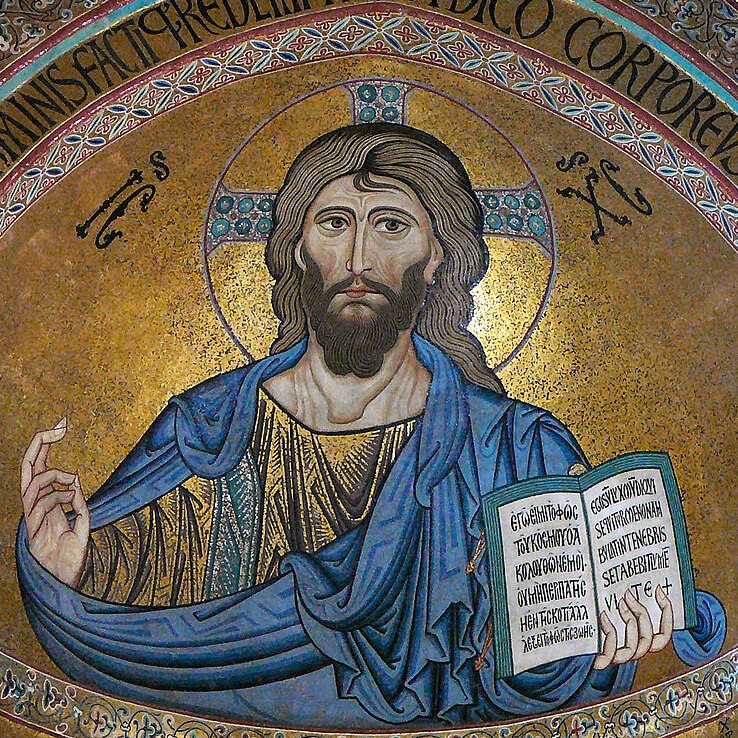
The Pantocrator travelled wherever Byzantine art did, and further. Norman Sicily gave it its most spectacular western setting; Venice absorbed it through San Marco; the Slavic world received it with conversion itself. In Russia the type produced masterpieces of its own — none greater than the Saviour of Andrei Rublev (ca. 1400), a fragmentary panel from Zvenigorod whose quiet, humane Christ is unthinkable without four centuries of Byzantine Pantocrators, yet unmistakably new. Byzantine artists working abroad, and the local schools they trained, carried the formula from Serbia to Crete; post-Byzantine icon painters codified it in manuals that are still followed.
The image never stopped being made. Every Orthodox church built today still sets a Pantocrator in its dome; icon workshops from Athos to America still paint the bust with the blessing hand and the Gospel. And beyond the Church, the Sinai Christ and the Cefalù apse have become, for millions of museum visitors and travellers, the very face of Byzantium — the image through which an empire that fell more than five centuries ago still meets our gaze.
Few images in world art have held one composition, one meaning, and one authority for so long. The Pantocrator outlasted the empire that created it precisely because it was never merely imperial: it is the icon of a claim — that the Ruler of All has a human face — which Byzantine art spent eleven centuries learning to paint.
Frequently asked questions about the Christ Pantocrator
What does “Pantocrator” mean?
Pantokratōr is Greek for “Ruler of All” or “Almighty.” The title comes from the Septuagint, where it translates Hebrew names of God, and passed into the creed (“the Father Almighty”). Applied to Christ in images, it proclaims that the Son shares the full sovereignty of God.
Why are the two halves of the Sinai Christ’s face different?
The asymmetry is deliberate. The calm side, above the blessing hand, is usually read as Christ the merciful savior; the severe side, above the Gospel, as Christ the judge. Together they express the double nature — human and divine — at the heart of the icon’s theology.
What does Christ hold in the Pantocrator icon?
The book of the Gospels, either closed and jeweled or open on a short text such as “I am the light of the world.” His right hand forms a blessing whose finger positions spell IC XC, the Greek abbreviation of “Jesus Christ.”
Why is the Pantocrator painted in church domes?
In the Middle Byzantine decorative system the church represented the cosmos: the dome stood for heaven, so the Pantocrator occupied its summit, overseeing the Virgin in the apse, the feast scenes on the vaults, and the saints below. The whole building became a single ordered image with Christ at its head.
What is the oldest image of the Christ Pantocrator?
The encaustic icon at Saint Catherine’s Monastery in Sinai, dated to the 6th century, is both the oldest surviving Pantocrator and the oldest known panel icon of Christ. It escaped the destruction of Iconoclasm because Sinai lay outside imperial control.
Sources and further reading
- Kurt Weitzmann, The Monastery of Saint Catherine at Mount Sinai: The Icons, vol. I: From the Sixth to the Tenth Century, Princeton University Press, 1976.
- Manolis Chatzidakis, “An Encaustic Icon of Christ at Sinai,” The Art Bulletin 49 (1967), pp. 197–208.
- Otto Demus, Byzantine Mosaic Decoration: Aspects of Monumental Art in Byzantium, London, 1948.
- James D. Breckenridge, The Numismatic Iconography of Justinian II, American Numismatic Society, 1959.
- Hans Belting, Likeness and Presence: A History of the Image before the Era of Art, University of Chicago Press, 1994.
- Helen C. Evans and William D. Wixom (eds.), The Glory of Byzantium, The Metropolitan Museum of Art, 1997. Free on MetPublications
- Alexander Kazhdan (ed.), The Oxford Dictionary of Byzantium, Oxford University Press, 1991 — entry “Pantokrator.”
Cover image (Christ Pantokrator mosaic in the Chora Church, Istanbul): © Guildhem Vellut, CC by-SA 2.0