The Fall of Constantinople (1453): The siege that ended Byzantium
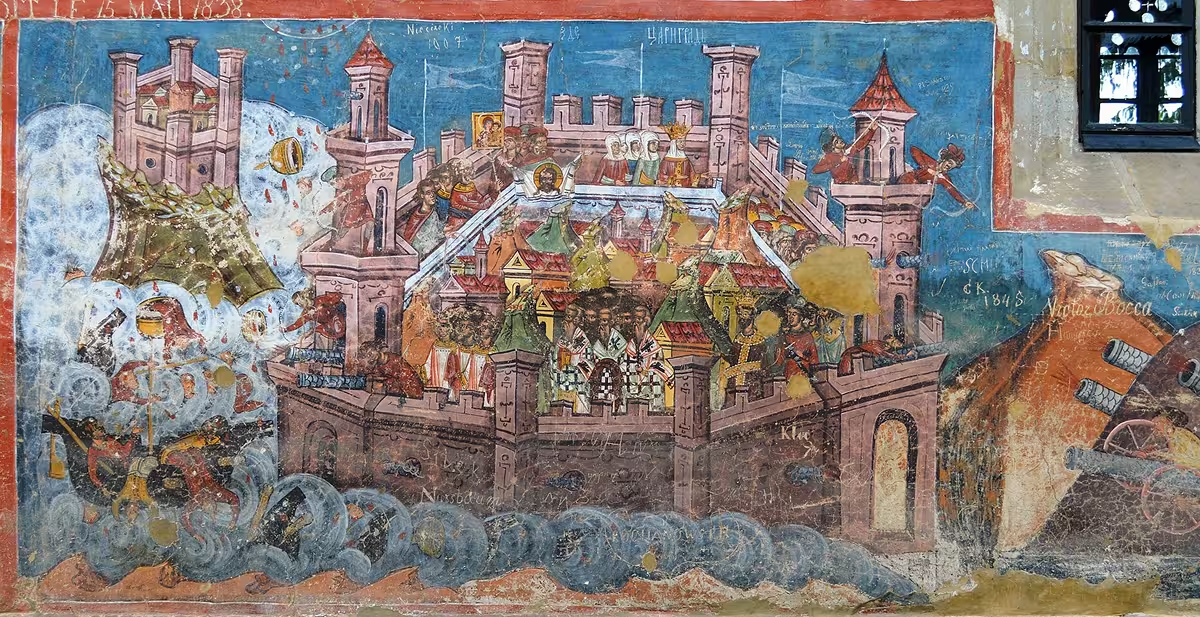
Before dawn on 29 May 1453, after fifty-three days of siege, the cannon of Sultan Mehmed II fell silent and the trumpets sounded for the final assault. By midday the last Roman emperor lay dead among his soldiers, the imperial banner had fallen from the towers, and an empire that traced an unbroken line back to ancient Rome — more than eleven centuries of history — had come to an end. The Fall of Constantinople was not merely the capture of a city. It was the extinction of the Roman state, the end of the Byzantine empire that had survived for more than a millenium, the rise of a new Ottoman superpower astride two continents, and one of the rare dates that historians use to mark the boundary between the medieval and the modern world.
Yet to understand why 1453 still echoes today, we have to begin much earlier — with a city that, for a thousand years, almost nobody could take.
What was the Fall of Constantinople in 1453?
The Fall of Constantinople was the capture of the Byzantine capital by the Ottoman Empire on 29 May 1453, ending a siege that had begun on 6 April. It snuffed out the Byzantine (Eastern Roman) Empire, the last living fragment of the Roman world, and turned Constantinople into the capital of an expanding Ottoman state. The event sent shockwaves through Christendom and the Islamic world alike, reshaping trade, religion, scholarship, and the balance of power. Its repercussions — from the flight of Greek scholars to the West, to Russia’s claim to be a “Third Rome,” to the status of the Hagia Sophia today — are still being felt in the twenty-first century.
A city that had never been taken
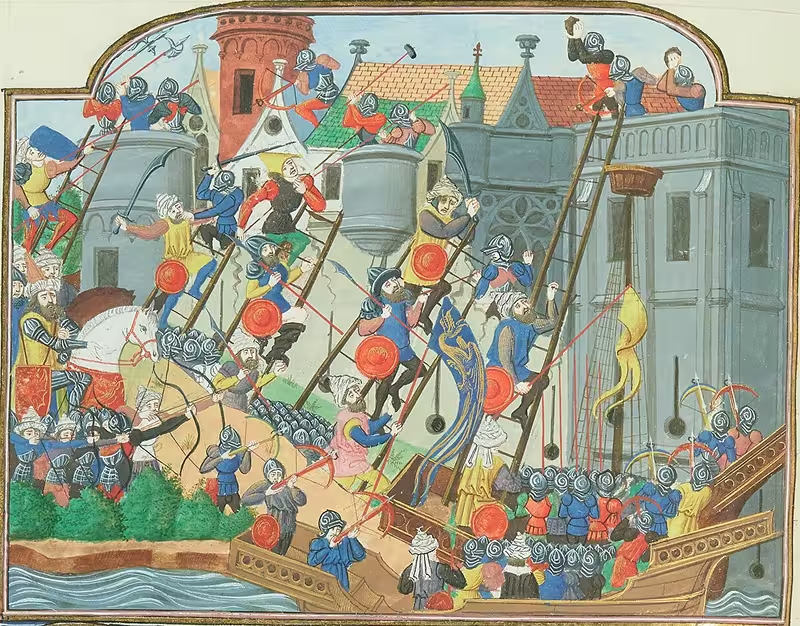
For most of its history, Constantinople was considered the best-defended city on earth. Founded by the Emperor Constantine the Great in 330 on the easily defensible promontory between the Sea of Marmara and the inlet of the Golden Horn, it was protected on its landward side by the colossal Theodosian Walls, a triple line of fortifications raised in the 5th century. Behind a wide moat rose an outer wall, then an inner wall studded with ninety-six towers more than eighteen metres high. For a thousand years, this barrier turned back every army that dared approach it.
The roll of failed sieges reads like a catalogue of the great powers of the medieval world. In 626 a combined Avar and Persian host besieged the city in vain. The Arabs tried twice — a long blockade in 674–678, and a massive land-and-sea assault in 717–718 — and both times were broken, in part by the Byzantines’ terrifying secret weapon, Greek fire, a flammable liquid sprayed from siphons that burned even on water. The Rus and the Bulgars came and went. Time and again, the walls held.
There was only one great exception, and it was a Christian one: in 1204 the knights of the Fourth Crusade stormed the city and sacked it (a story told in our companion article). That catastrophe shattered Byzantine power, ending the era known as the middle Byzantine period and opened the long twilight known as the late Byzantine period; although a Greek dynasty recovered the capital in 1261, the empire never regained its former strength.
The Turks at the gates: a methodical preparation
The Ottomans knew how hard the prize would be to win, because they had already failed to take it. Sultan Bayezid I blockaded Constantinople for years (1394–1402) and built the fortress of Anadolu Hisarı on the Asian shore of the Bosphorus to tighten his grip; only the catastrophic Ottoman defeat by Timur at Ankara in 1402 saved the city. A generation later, in 1422, Sultan Murad II besieged Constantinople again but could not break the walls without a proper siege train, and a revolt in Anatolia forced him to withdraw.
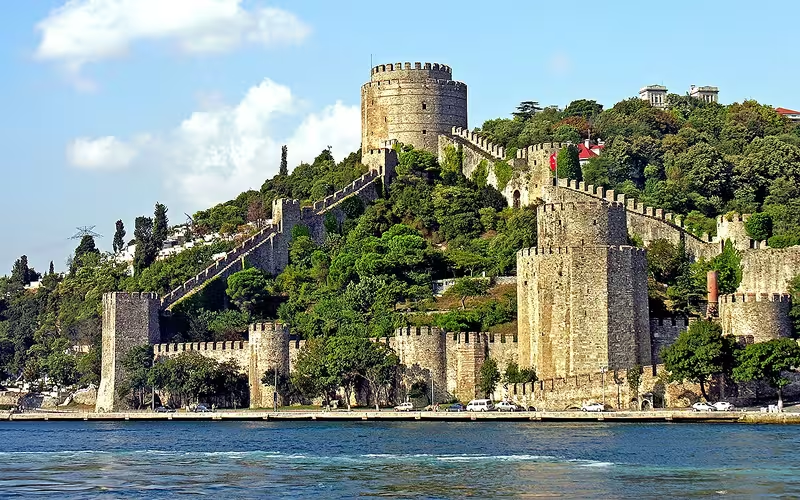
Mehmed II learned from these failures. Rather than rush, he prepared with chilling thoroughness. In 1452 he built Rumeli Hisarı on the European shore, directly opposite his great-grandfather’s fortress — the two strongholds together sealing the Bosphorus. The locals nicknamed it Boğazkesen, “the throat-cutter,” for it could now strangle any ship trying to reach the city from the Black Sea. He assembled an enormous army, built a fleet to challenge Byzantine command of the waters, and commissioned a revolution in artillery. By the spring of 1453, the city that had never been taken faced an enemy who had planned for nothing less than its conquest.
Two rulers, two worlds
The siege of 1453 was also a duel between two very different men, each embodying the trajectory of his people: one defending a dying world with dignity, the other building a new empire with ferocious energy.
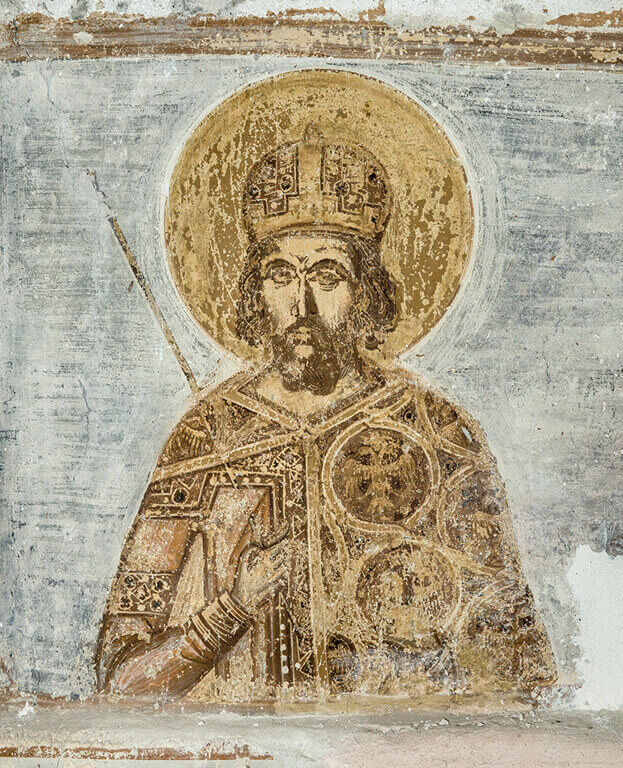
Constantine XI Palaiologos — the last emperor
Born in 1405, Constantine XI Palaiologos was a son of the Emperor Manuel II and, before he ever wore the imperial purple, a capable and energetic soldier. As Despot of the Morea (the Byzantine principality in the Peloponnese), he reconquered much of the peninsula from its Latin lords and rebuilt the great Hexamilion wall across the Isthmus of Corinth. When he became emperor in 1449, he was crowned not in the Hagia Sophia but far away at Mistra, in part because the bitter dispute over union with the Roman Church made a coronation by the patriarch in Constantinople politically impossible.
Contemporaries remembered Constantine as brave, honourable, and stubbornly devoted to his doomed inheritance. Offered his life by Mehmed if he surrendered the city, he refused. According to tradition, in the final hours he cast aside the imperial regalia so that he might die as an ordinary soldier, and vanished into the fighting. He left no confirmed grave — only a legend.
Mehmed II — the young conqueror
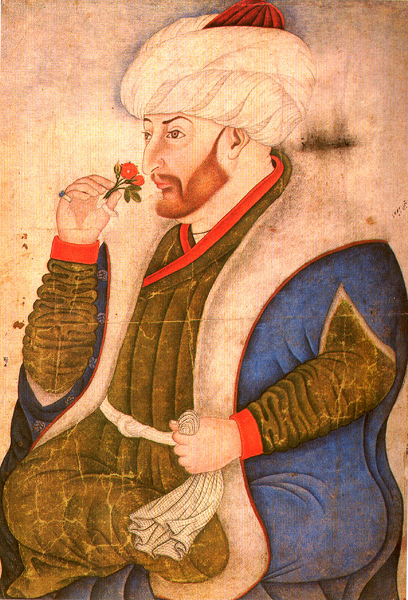
His adversary was a man of a different temper entirely. Mehmed II, born in 1432, had come to the throne for the second time in 1451, still in his late teens. Some sources suggest his mother may have been of slave origin, possibly Greek or Albanian.
He was formidably educated — reputedly fluent or conversant in several languages, including Greek — and steeped in the histories of Alexander the Great and the Caesars, whose universal empires he consciously sought to rival. Cultured and curious, he would later sit for the Venetian painter Gentile Bellini; ruthless and calculating, he was capable of acts of startling cruelty.
For Mehmed, Constantinople was not a vanity project but a strategic necessity and a sacred ambition. The Christian city sat like a wedge between the European and Asian halves of his realm, and a long Islamic tradition held that its conqueror would be specially blessed. Taking it would transform a powerful sultanate into a world empire — and earn him the title by which history knows him: Fatih, “the Conqueror.”
A civilisation saving its soul
Behind the two rulers stood two peoples in opposite moods. The Ottomans were a young power on the ascent, confident, expanding, and confident that history was moving their way. The Byzantines, by contrast, had lived for decades under the shadow of an ending. They knew their empire was dying; the only questions were when, and what could be saved.
This melancholy awareness gave the empire’s final centuries a strange brilliance. The so-called Palaiologan Renaissance saw a flowering of art, theology, and classical scholarship even as the state crumbled. Scholars such as George Gemistos Plethon revived the study of Plato; manuscripts of ancient authors were copied, debated, and treasured. Crucially, learned Greeks had already begun carrying their books and their knowledge westward — to Italy in particular — long before the final siege. In a very real sense, the Byzantines spent their last years saving what they believed mattered most about their civilisation, so that it might outlive the city itself. It did.
Why did Byzantium and the Ottomans go to war?
The clash of 1453 was not a sudden eruption but the culmination of long-building pressures — strategic, dynastic, and religious.
Strategy. The most basic cause was geography. An independent Christian Constantinople in the middle of Ottoman territory was an intolerable anomaly to a young, ambitious sultan bent on welding his lands into a single empire. As long as the city stood free, it could serve as a base for a Western crusade or a refuge for Mehmed’s rivals. Its conquest was, for him, the logical first act of his reign.
A fatal miscalculation. The immediate spark came from Byzantine diplomacy. Constantinople was holding an Ottoman prince, Orhan Çelebi, a potential claimant to the Ottoman throne, and the sultan paid a subsidy to keep him quietly in custody. When Constantine’s ministers, hoping for leverage, threatened to release Orhan unless the payments were increased, they handed Mehmed exactly the pretext he wanted. He stopped the payments, built his throat-cutting fortress, and prepared for war.
A divided faith. Constantinople’s last hope was military aid from the Catholic West — but the price was religious submission. At the Council of Florence in 1439, Byzantine envoys had agreed to a union of the Orthodox and Roman churches under the Pope. The union was deeply resented at home, where many Byzantines preferred independence under any terms. The grand duke Loukas Notaras is famously reported to have said that he would rather see “the turban of the Turks” in the city than “the Latin mitre.” The union split Byzantine society and never delivered the help it promised.
The empty horizon. Western Christendom, for its part, was distracted, divided, and exhausted by failed crusading. The last great effort, the Crusade of Varna in 1444, had ended in catastrophic defeat at Ottoman hands. The Italian maritime republics were rivals more interested in their trading privileges than in a costly war: Venice hesitated, and the Genoese of Galata, the colony just across the Golden Horn, tried to stay officially neutral. A few hundred foreign volunteers came; no army did. When the siege began, Constantinople stood, for all practical purposes, alone.
Orban’s monster cannon
The decisive innovation of the siege was gunpowder artillery on a scale the world had never seen. A cannon-founder named Orban — Hungarian or Transylvanian by origin — first offered his services to Constantine XI; when the impoverished emperor could not pay, he took his designs to the sultan, who funded him without hesitation.
Orban cast a series of enormous bronze bombards. The largest, according to contemporary accounts, was roughly eight metres long and could hurl a stone ball weighing over 250 kilograms more than a mile. So vast was it that teams of oxen and hundreds of men were needed to drag it into position, and it could be fired only a handful of times a day, cooling and reloading between shots. But its effect — physical and psychological — was shattering. For the first time, the legendary Theodosian Walls could be smashed faster than the defenders could rebuild them.
For a thousand years the walls had defied every army. Gunpowder changed the arithmetic of the siege in a single generation.
The walls and the defenders
The defence of Constantinople in 1453 was an act of almost suicidal courage. Against Mehmed’s host, Constantine could muster only some 7,000 to 8,000 men — including perhaps 2,000 foreign volunteers, chiefly Genoese and Venetians — to hold roughly twenty kilometres of walls. The most important of the foreigners was the Genoese captain Giovanni Giustiniani Longo, an acknowledged master of siege defence, to whom Constantine entrusted the vulnerable land walls.
Mehmed’s army was many times larger. Its true size is still debated: modern historians generally estimate 60,000 to 80,000 fighting men, supported by a fleet of well over a hundred ships, while contemporary chroniclers inflated the number to 100,000 or more. At its core stood the Janissaries, the sultan’s elite professional infantry. Whatever the precise figures, the defenders were outnumbered by something close to ten to one.
The siege: fifty-three days
The siege opened on 6 April 1453. Day after day, Orban’s guns thundered against the land walls while the garrison toiled through the nights to fill the breaches with rubble, earth, and timber — a desperate race between cannon and shovel that the defenders, astonishingly, kept winning for weeks. Beneath the walls, Ottoman miners dug tunnels to collapse the fortifications, and Byzantine counter-miners fought them in the dark with smoke and fire.
At sea, a great chain stretched across the mouth of the Golden Horn kept the Ottoman fleet out of the city’s sheltered northern harbour. On 20 April, a small squadron of Christian ships — Genoese galleys and a Byzantine vessel laden with grain — fought its way through the entire Ottoman navy and reached the city, an electrifying triumph that lifted the defenders’ spirits and humiliated the sultan.
Mehmed’s answer was one of the most audacious strokes of the whole campaign. Unable to break the chain, on the night of 22 April he had some seventy ships dragged overland on greased wooden rollers — up and over the hill behind Genoese Galata and down into the Golden Horn, bypassing the chain entirely.
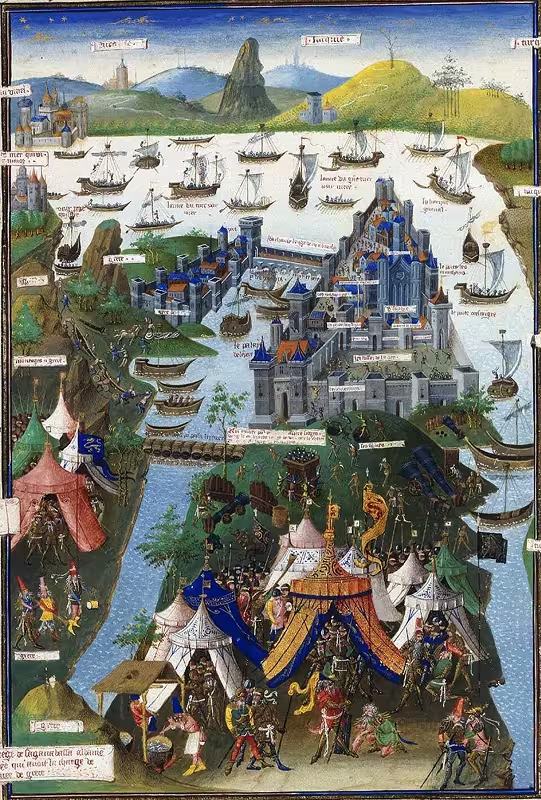
Overnight the defenders found an enemy fleet inside their inner harbour, and the already-thin garrison had to stretch to cover the sea walls as well as the land. As May wore on, food ran short, omens multiplied — a lunar eclipse, a strange fog, a glow seen over the dome of the Hagia Sophia — and a sense of approaching doom settled over the exhausted city.
The final assault, 29 May 1453
By late May, with his troops growing restless and rumours of a relieving Western fleet in the air, Mehmed resolved on an all-out assault. After a day of rest and prayer, the attack came in the small hours of 29 May, launched in three successive waves. First the expendable irregulars, the bashi-bazouks; then the disciplined Anatolian regulars; and finally, when the defenders were spent, the dreaded Janissaries.
Two strokes of misfortune broke the defence at the critical moment. The commander Giustiniani was gravely wounded and carried from the walls; seeing their leader gone, his men wavered. At nearly the same time, a small postern gate called the Kerkoporta was reportedly found unbarred, and Ottoman soldiers poured through to raise their banners on the towers above. The cry that the city was taken spread panic; the line collapsed, and the Janissaries surged over the ramparts in a flood.
Emperor Constantine XI, refusing to flee, is said to have flung off his imperial insignia and charged into the press of battle, dying sword in hand among his soldiers. His body was never identified with certainty — a fact that gave rise to the haunting Greek legend of the “marble emperor,” turned to stone by an angel and waiting to be woken to reclaim the city. By midday on 29 May 1453, the eleven-hundred-year-old Roman Empire was no more.
The conquest and the Hagia Sophia
By the custom of the age, a city taken by storm was given over to its conquerors, and three days of plunder followed — though Mehmed, who intended to make Constantinople his own capital, is said to have moved quickly to halt the destruction and restore order. The terrified population that had crowded into the Hagia Sophia, praying for a miracle, was taken captive.
Mehmed rode to the great church — the supreme sanctuary of Eastern Christianity for nine hundred years — and ordered it converted into a mosque, a Muslim prayer offered beneath its vast dome that very week. He set about repopulating and rebuilding the half-empty city, resettling people from across his domains and proclaiming it his capital. The grand duke Loukas Notaras, who had preferred the turban to the mitre, was executed soon after. Constantinople — increasingly called Istanbul — would remain the heart of the Ottoman Empire for nearly five centuries.
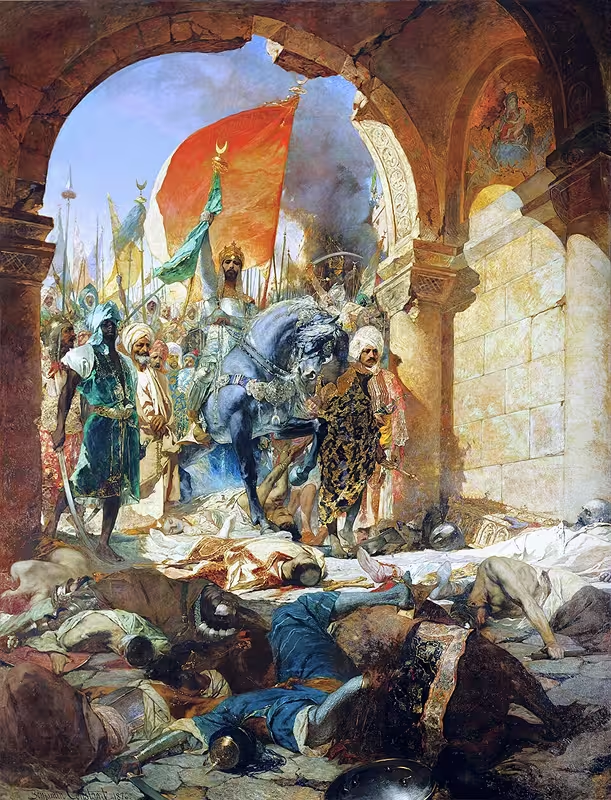
The Entry of Mehmed II into Constantinople by Benjamin Constant, 1876 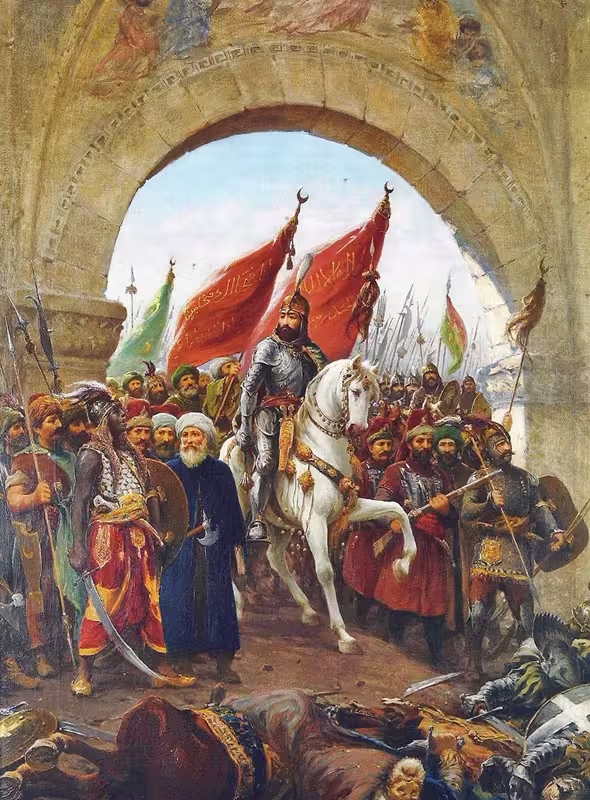
The same theme by Fausto Zonaro, end 19th century.
Repercussions and Echoes
Few events of the second millennium cast a longer shadow than the fall of Constantinople. Its consequences rippled outward across politics, religion, scholarship, and trade — and many of them are still alive today.
The end of the Roman Empire — and its last embers
With Constantine’s death, the Roman state founded by Augustus and refounded on the Bosphorus by Constantine the Great finally ended. But Byzantium did not vanish in a single day. A handful of fragments outlived the capital: the Despotate of the Morea, ruled by Constantine’s brothers, held out until 1460; the Empire of Trebizond on the Black Sea, a Byzantine offshoot, survived until 1461; and the small Principality of Theodoro in the Crimean mountains clung on until 1475. For a few more years, scattered embers of the Roman world still glowed before the Ottomans extinguished them one by one.
Scholars, manuscripts, and the Renaissance
Among the most celebrated consequences was the westward flight of Greek scholars carrying the manuscripts of classical antiquity. Some, like Bessarion — a Byzantine churchman who became a Roman cardinal — had settled in Italy before the fall; after 1453 the trickle of émigrés grew. Bessarion sheltered fellow refugees and, in 1468, donated his magnificent library of Greek manuscripts to Venice, where it became the core of the Biblioteca Marciana. Teachers such as John Argyropoulos, Theodore Gaza, and Constantine Lascaris taught Greek in Florence, Rome, and beyond, deepening the West’s access to Plato, Aristotle, and the Greek sciences.
It would be a mistake, though, to call 1453 “the cause” of the Renaissance. The revival of learning was already well under way in Italy, fuelled by native humanists and by earlier teachers such as Manuel Chrysoloras (who taught Greek in Florence around 1397). The fall of Constantinople is best understood as a powerful accelerant — a stream of scholars, books, and prestige poured into a fire that was already burning.
New calls for crusade
In the West, news of the fall provoked horror and a fresh burst of crusading rhetoric. Pope Nicholas V issued a crusade bull within months, and his successor Pius II — himself a humanist scholar — made the recovery of Constantinople the great cause of his pontificate. In 1459 he summoned Europe’s princes to the Congress of Mantua to plan a crusade, but the kings and republics, absorbed in their own quarrels, would not commit. In 1464 Pius travelled to Ancona to lead the expedition in person and died there, waiting for an army that never assembled. Apart from local successes such as the defence of Belgrade in 1456, the dream of retaking the city quietly died.
Trade, the Ottoman superpower, and the Age of Exploration
The conquest confirmed the Ottomans as a Mediterranean superpower controlling the historic crossroads between Europe and Asia. Western Europeans, facing a powerful new gatekeeper on the eastern trade routes, had fresh incentive to seek their own sea-paths to the spices and silks of the East. This pressure is often linked to the great voyages that followed — Vasco da Gama’s passage to India, Columbus’s crossing of the Atlantic in 1492 — though here too the causes were many, and European ambition and technology were already pushing outward before 1453.
Moscow, the “Third Rome”
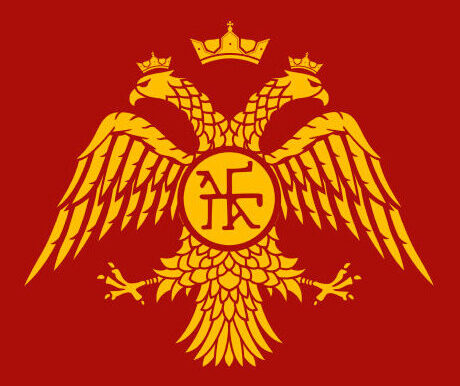
As the most powerful Orthodox state left standing, the Grand Duchy of Moscow claimed the fallen empire’s mantle. In 1472 Grand Prince Ivan III married Sophia Palaiologina, a niece of the last emperor, adopted the Byzantine double-headed eagle as his emblem, and took up the title tsar (Caesar). Russian churchmen proclaimed Moscow the “Third Rome” — heir to Rome and Constantinople, the last guardian of true Christianity. The idea ran deep: for centuries Russian rulers dreamed of liberating Tsargrad (Constantinople) and restoring the cross to the Hagia Sophia. Catherine the Great’s “Greek Plan” in the 18th century and the secret Allied promise of Constantinople to Russia in 1915 were distant descendants of the conviction born in 1453 — and echoes of the “Third Rome” idea still surface in Russian political rhetoric today.
The Greek dream: the marble emperor and the Megali Idea
For the Greek world, the fall became the defining wound of national memory. Folk tradition held that Constantine XI slept as the “marble emperor,” awaiting the day he would rise to drive out the conquerors and reclaim the city. Centuries later, after Greece won its independence, that longing crystallised into the Megali Idea (“Great Idea”) — the dream of reuniting the Greek lands and even recovering Constantinople itself. It drove Greek policy for generations and culminated in the disastrous Greco-Turkish War of 1919–1922, whose collapse in the Asia Minor Catastrophe finally laid the dream to rest. To this day, some Greeks call the date a day of mourning, and Tuesday — the day the city fell — is still considered unlucky.
A wound that still resonates: the Hagia Sophia
Nowhere is the long echo of 1453 more visible than in the Hagia Sophia. A mosque from the day of the conquest, it was turned into a museum in 1934/35 by the secular Turkish Republic under Atatürk, a gesture of shared world heritage. Then, in July 2020, a Turkish court annulled that status and the building was reconverted into a mosque — a decision that drew worldwide attention and reignited old arguments between Turkey, Greece, and the Orthodox world. More than five and a half centuries later, the meaning of Constantinople’s fall is still being contested in courtrooms and headlines. It remains one of history’s great cultural fault-lines — the moment a Christian Roman capital became the Muslim heart of a new empire, and the world tilted on its axis.
Sources and further reading
- World History Encyclopedia — “1453: The Fall of Constantinople”
- Encyclopaedia Britannica — “Fall of Constantinople (1453)” — “Mehmed II” — “Hagia Sophia”
- Wikipedia — “Constantine XI Palaiologos”
- Contemporary eyewitness: Nicolò Barbaro, Diary of the Siege of Constantinople 1453
- Steven Runciman, The Fall of Constantinople 1453 (1965)
- Roger Crowley, 1453: The Holy War for Constantinople and the Clash of Islam and the West (2005)
- David Nicolle, John Haldon & Stephen Turnbull, The Fall of Constantinople: The Ottoman Conquest of Byzantium (2007)
- Jonathan Harris, The End of Byzantium (2010)
- Marios Philippides & Walter K. Hanak, The Siege and the Fall of Constantinople in 1453 (2011)



2 Comments