Mystras: A Complete Visitor’s Guide to the UNESCO Byzantine Ghost City
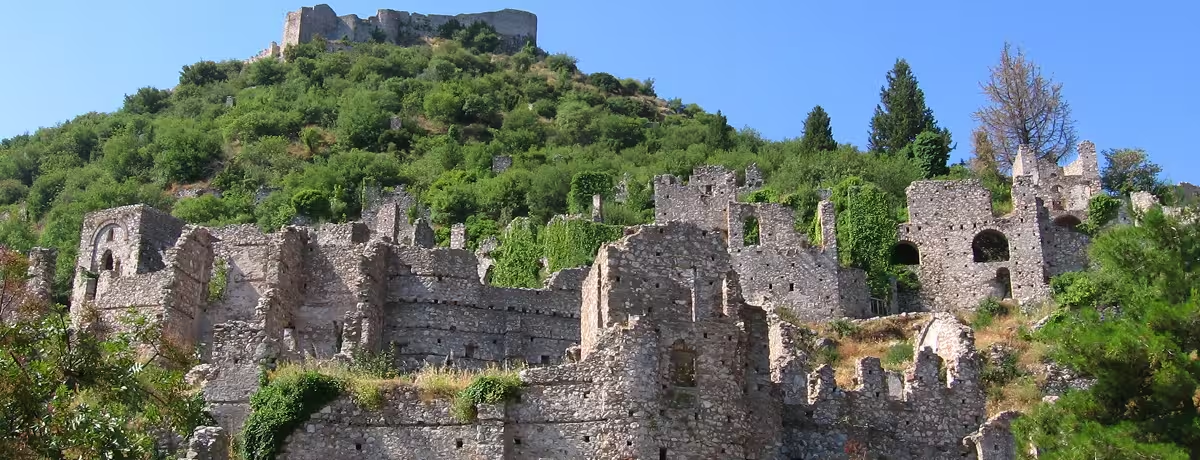
No other site conveys the texture of a late Byzantine city as completely as Mystras. Built on a spur of Mount Taygetos above the Evrotas valley, it was the last capital of the Byzantine Morea — seat of the Despotate that outlived Constantinople by seven years — and, unlike Istanbul or Thessaloniki, it was never rebuilt over. Abandoned in stages after 1825 and finally emptied in 1953, Mystras survives as an entire hillside of palaces, painted churches, and monasteries frozen at the moment the Byzantine world ended: a genuine ghost city, not a metaphorical one.
The site is compact but steep, rising some 370 metres from the Lower Town to the Frankish castle at its summit. Visiting means walking, often on uneven paving and loose stone, through a full cross-section of Palaiologan art and architecture — much of it, remarkably, still in its original setting.
Quick facts about Mystras
Founded: 1249, as a Frankish castle under William II of Villehardouin, Prince of Achaea
Byzantine significance: capital of the Despotate of the Morea from 1349; power base of Constantine XI Palaiologos, the last Byzantine emperor, before his accession in 1449
Fell to the Ottomans: 1460, surrendered without resistance by the last despot, Demetrios Palaiologos
Final abandonment: the town survived, reduced, until 1953, when remaining properties were expropriated and the site became purely archaeological
UNESCO listing: 1989
Getting there: around 7 km from modern Sparta; roughly 3–3.5 hours by car or bus from Athens
Best time to visit: April–June and September–October — the site is steep, largely unshaded, and punishing in midsummer heat
Time needed: half a day minimum for a focused visit to both the Lower and Upper Town; a full day if you want to see the frescoes properly and add the archaeological museum
A capital in exile
From a Frankish castle to a Byzantine city
Mystras began as a Frankish castle, not a Byzantine city. In 1249, William II of Villehardouin fortified the conical hill above the Evrotas valley — a natural stronghold chosen precisely because it stood apart from the exposed lowland town of Sparta. His triumph was short-lived. In 1259 he was captured by the Byzantines at the Battle of Pelagonia, and to buy his freedom he ceded Mystras and two other fortresses — Monemvasia and the fortresses of the Mani — to Emperor Michael VIII Palaiologos in 1262. The handover proved one of the most consequential ransom payments in Byzantine history: the Franks had built the castle, but the Byzantines would build the city.
Byzantine settlement followed almost immediately, as the population of the plain below relocated up the hillside for safety. In 1289, the seat of Byzantine government in the Peloponnese transferred from Monemvasia to Mystras, and by 1291–92 the Metropolis was already being enlarged under its second founder, Bishop Nikephoros Moschopoulos — a sign the settlement was rapidly outgrowing its original garrison function.
The capital of the Despotate of Morea
The decisive transformation came in 1349, when Emperor John VI Kantakouzenos created the Despotate of the Morea and installed his son Manuel Kantakouzenos as its first despot. From this point Mystras was not merely a provincial capital but the seat of a semi-autonomous appanage ruled by a close relative of the reigning emperor — a pattern that continued, under the rival Palaiologos dynasty from 1383, until the despotate’s end in 1460. It’s worth being precise here: Mystras was the senior capital throughout, but in the final decades, when the territory was periodically divided between co-ruling despot brothers, junior seats existed elsewhere in the Morea — Glarentza, Kalavryta, Elis, Patras, Leontari — for whichever brother did not hold Mystras itself. The city’s primacy was never seriously contested.
Despite the empire’s contraction elsewhere, the fifteenth century was a golden age for Mystras. Emperor Manuel II Palaiologos himself spent long periods here in 1408 and 1415, personally overseeing the palace’s final architectural phase — a long three-storey range on the northwest combining Byzantine and Western elements, crowned by a Golden Throne Room lit by a double row of windows and heated by eight fireplaces. The philosopher Georgios Gemistos Plethon (c. 1355–1452) taught at the Vrontochion monastery and later independently, reviving Platonic and Neoplatonic thought among a circle that included the future cardinal Bessarion and the historian Laonikos Chalkokondyles. Plethon’s presence at the Council of Ferrara–Florence in 1438–39 helped carry Byzantine Platonism to Italian humanists, giving Mystras a real, traceable line into the Italian Renaissance.
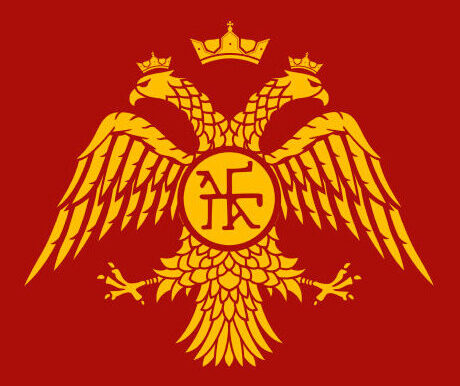
The despotate’s final decades were dominated by the brothers Theodore II, Constantine, Demetrios, and Thomas Palaiologos, sons of Manuel II. Constantine, who governed at Mystras, was proclaimed emperor there after the death of his brother John VIII in 1448 — the succession was handled from the Morea rather than Constantinople, an arrangement that reflects how far power had migrated from the capital by that point. Popular tradition places his coronation on a specific spot in the Metropolis, marked today by a marble floor slab carved with the Palaiologan double-headed eagle. It’s a striking detail and worth knowing before a visit — but the scholarly literature treats the association with real caution: the physical and documentary evidence for that specific location and date doesn’t hold up, and the connection may be a later tradition rather than a recorded fact. Constantine XI left for Constantinople in 1449 and died defending its walls in 1453, the last Roman emperor.
Mystras under the Ottomans
Mystras outlived Constantinople by seven years. Demetrios Palaiologos, the last despot, surrendered the city to Mehmed II in 1460 without resistance — his brother Thomas fled instead. Under Ottoman rule the town continued to be inhabited, prospering as a silk-producing centre during a period of Venetian control between 1687 and 1715. Its end came in the nineteenth century: in 1825, during the Greek War of Independence, Egyptian forces under Ibrahim Pasha massacred the population and burned the town. The devastation was severe enough that King Otto decided against rebuilding, founding modern Sparta nearby in 1834 and encouraging the resettlement of Mystras’s survivors there. A residual population held on beneath the ruins until 1953, when the remaining properties were expropriated and the site’s transformation from living town to archaeological monument was complete.
The Unmissables
Palace of the Despots
The only surviving Byzantine palace complex in Greece, and — after 42 years of restoration — newly reopened to the public in May 2026, making this one of the most current reasons to visit the site right now. Dominating the natural plateau of the Upper Town, the palace is not a single building but an accretion of four or five distinct phases, begun under Frankish or early Byzantine governors and completed under successive despots. The earliest surviving wing, a two-storey structure with semicircular arched windows, dates to the turn of the fourteenth century under Andronikos II; a second wing, built under the first despot Manuel Kantakouzenos in the mid-fourteenth century, shows architectural similarities to contemporary Venetian houses. The final and most ambitious phase — the long, three-storey range on the northwest — is attributed to Manuel II Palaiologos, who is recorded staying at Mystras for extended periods in 1408 and 1415. Its uppermost floor held the Golden Throne Room: a vast ceremonial hall, heated by eight ground-floor fireplaces and lit by two tiers of windows, with a balcony from which the despot addressed the city below.
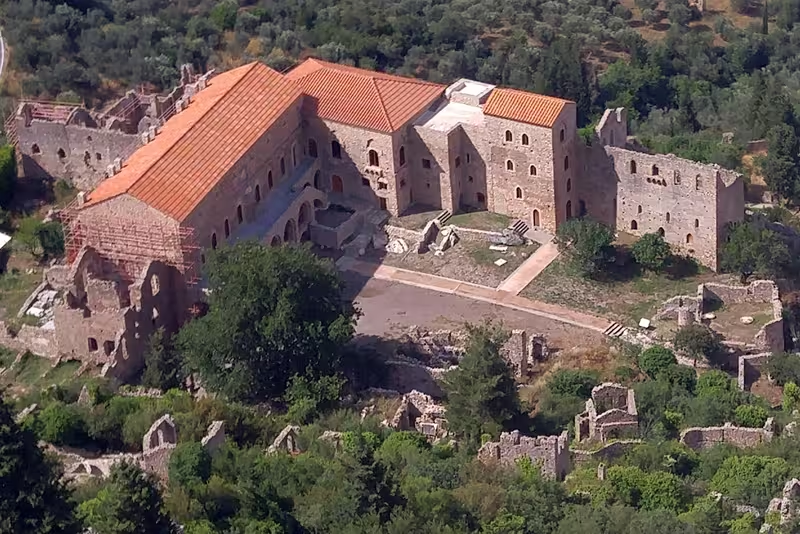
Despot’s palace seen from the upper city. © Gregor Hagedorn, CC by-SA 4.0 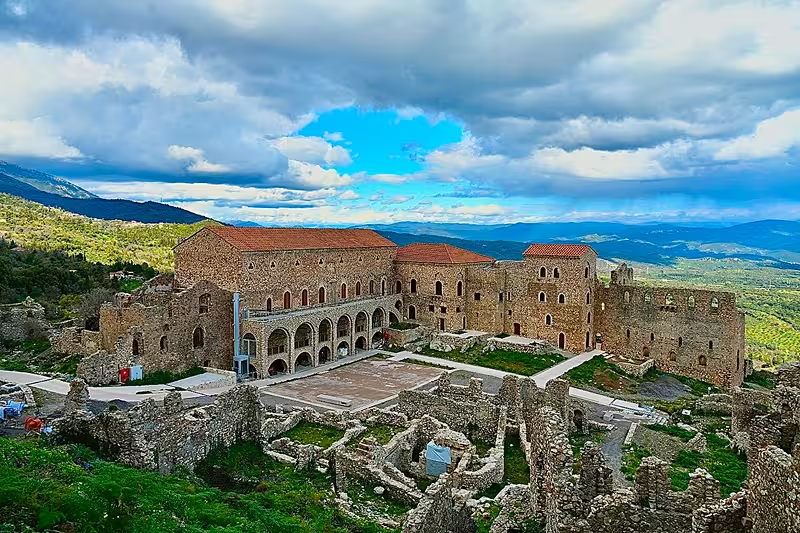
© Apaleutos25, CC by-SA 4.0
The 2026 reopening includes a permanent exhibition on the imperial families of Mystras and a temporary display of reconstructed Palaiologan court costume, made by the nuns of the Pantanassa Monastery in collaboration with the Greek National Opera’s costume department — a rare case of the site’s living monastic community contributing directly to its historical presentation.
The Metropolis (Agios Demetrios)
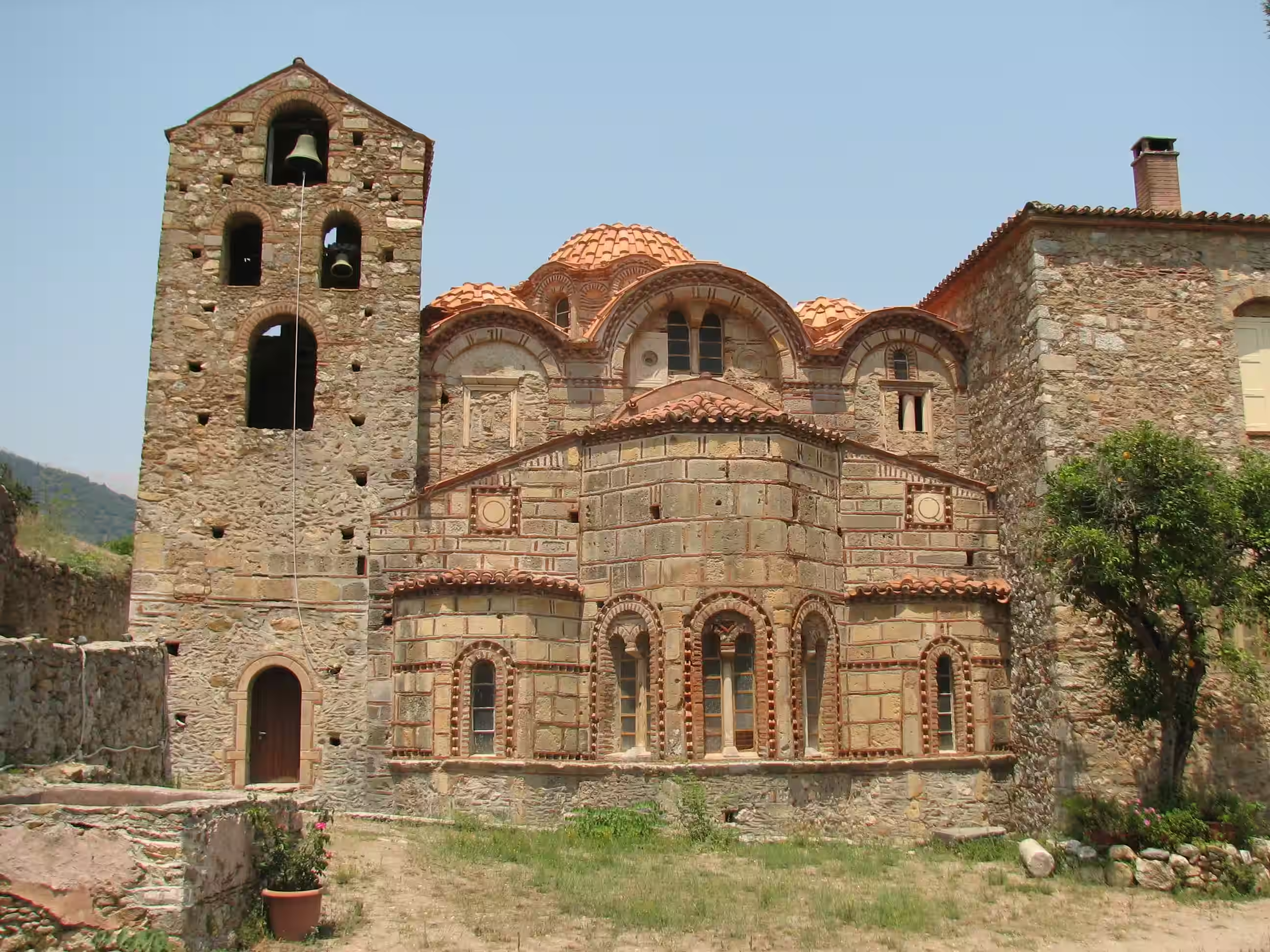
The oldest church in Mystras and, for most of the city’s history, its religious centre. Founded immediately after the Byzantine takeover of 1262 by the first bishop, Eugenios, and enlarged from 1291–92 under his successor Nikephoros Moschopoulos, it began as a wooden-roofed, three-aisled basilica and was later converted — in the first half of the fifteenth century, under Metropolitan Matthew — into the distinctive two-storey “Mystras type” of church: a basilica at ground level with a cross-in-square church and galleries above, a form designed so that the despot and his court could follow the liturgy from an elevated gallery in the manner of the imperial rite of Constantinople in Hagia Sophia.
The interior frescoes, dating mainly to the late thirteenth and early fourteenth centuries, cover the Cycle of the Life, Passion, and Resurrection of Christ, with a Second Coming in the narthex. The famous marble floor slab bearing the Palaiologan double-headed eagle — popularly associated with Constantine XI’s coronation — sits at the centre of the nave; see the caveat above about how firmly that tradition is actually supported. A small museum attached to the church holds sculpture, manuscripts, and Byzantine relics gathered from across the site and the wider region.
Peribleptos Monastery
Probably founded in the mid-fourteenth century by Manuel Kantakouzenos, the first despot, and named after one of the most celebrated monasteries of Constantinople. Peribleptos is built directly into a cliff face, its structure partly supported by the rock itself — the so-called “Mystras style,” a fortress-like architectural idiom shared by several of the city’s monastic churches.
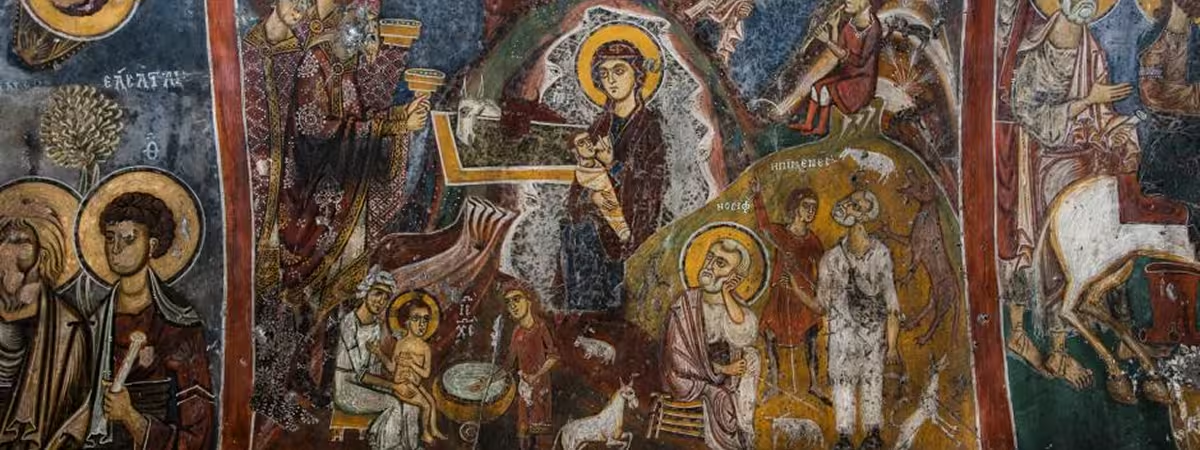
Its interior holds one of the most important surviving cycles of late Byzantine painting anywhere: frescoes dated between 1348 and 1380, focused on the life of the Virgin, including apocryphal scenes from her childhood rarely depicted elsewhere.
The dome carries a Pantokrator surrounded by prophets and apostles; the narrative scenes — the Nativity, the Transfiguration, the Descent from the Cross — are painted with an intimacy and fluency characteristic of the finest Palaiologan work. Because the church was never significantly altered or rebuilt, this cycle survives with a completeness that is genuinely rare for the period.
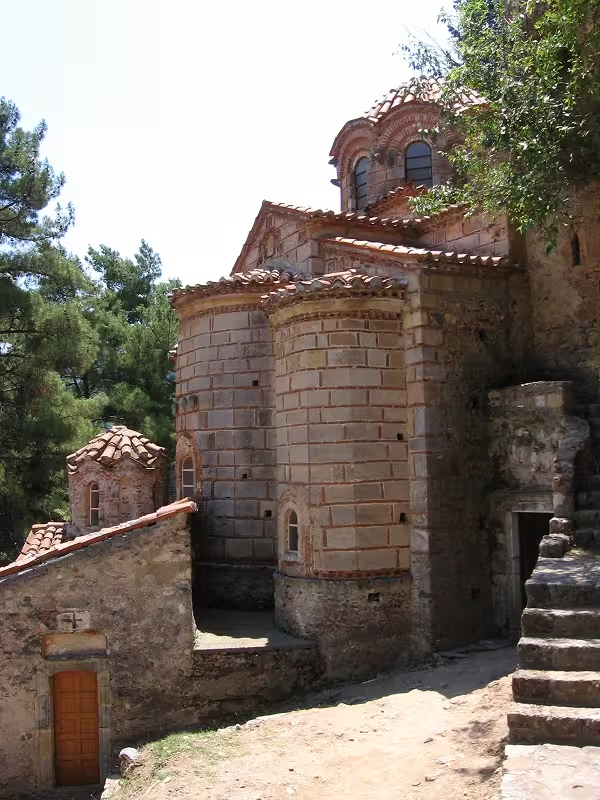
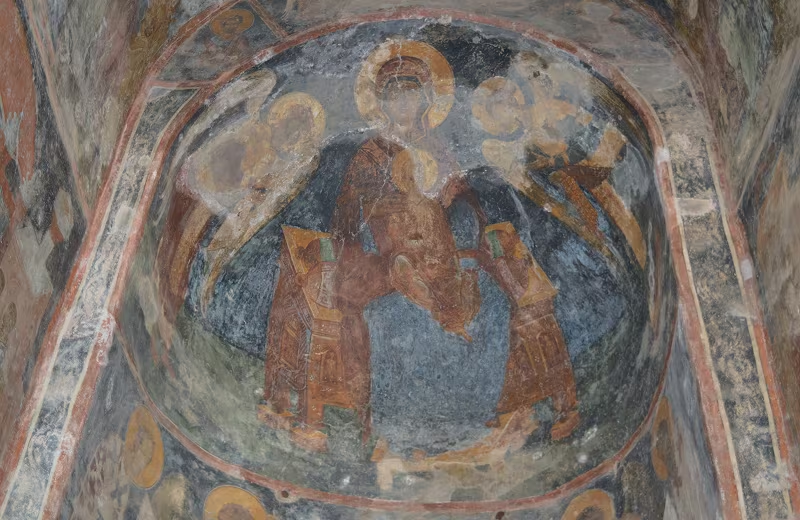
Theotokos with Christ and angels in the apse. © Byzantine World 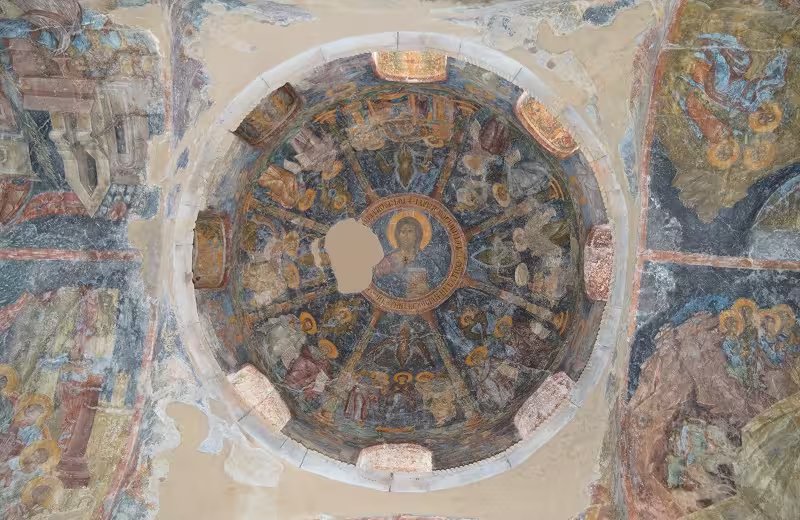
Dome with Christ Pantocrator and saints.
© Byzantine World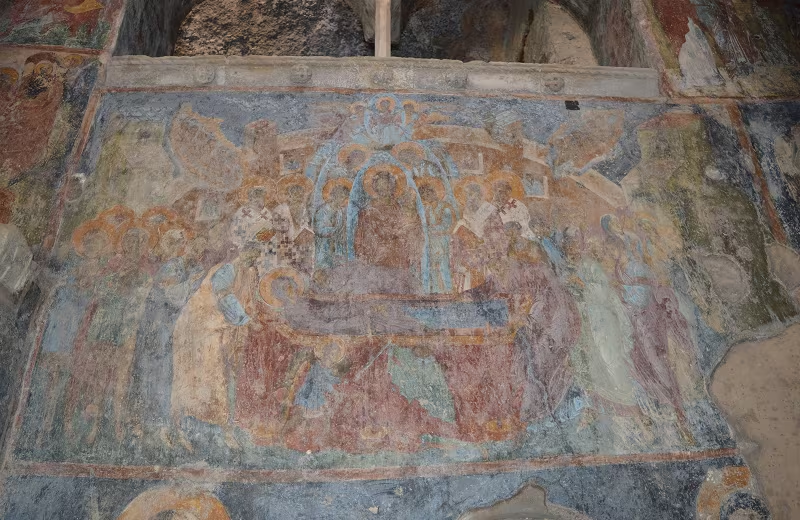
Koimesis – the Dormition of the Virgin.
© Byzantine World
Pantanassa Monastery
The last great ecclesiastical building of Byzantine Mystras — and the only monastery on the site still inhabited today, home to a small community of Orthodox nuns. It was founded not by a member of the imperial family but by John Frankopoulos (Ioannes Phrangopoulos), a high-ranking court official holding the titles of protostrator and mesazon under the despotate, and was dedicated in September 1428, making it the last major Byzantine monument raised in the city before its fall.
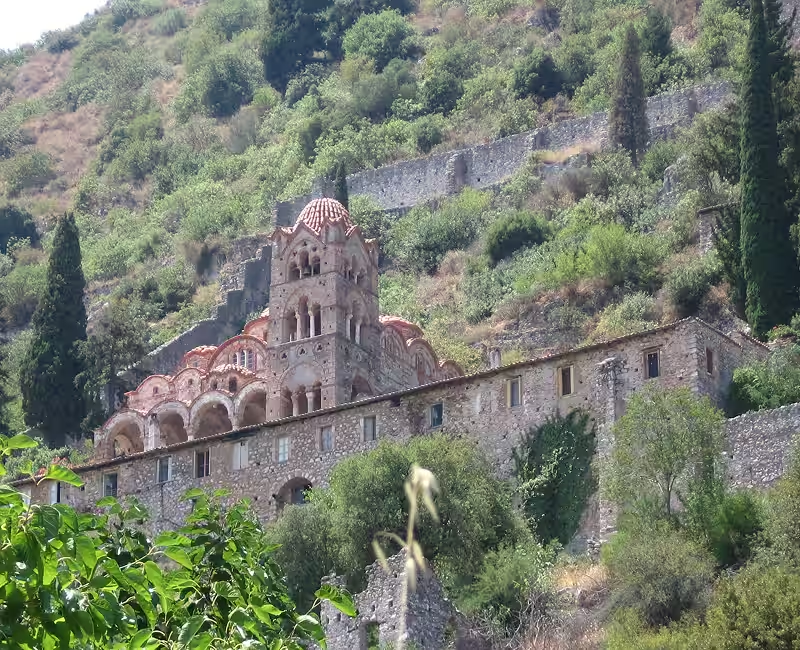
Architecturally, Pantanassa follows the “Mystras type” pioneered at the Afentiko, but with distinctly Western touches — pointed arches, decorative festoons on the apses, and a prominent bell tower reflecting Frankish influence, a reminder of how thoroughly Byzantine and Latin architectural vocabularies had mixed in the Morea by the fifteenth century. The upper-floor frescoes date to the mid-fifteenth century, among the last painted under Byzantine rule anywhere; the ground-floor paintings are a later, seventeenth-century layer. The interior is unusually rich in colour even by Mystras standards — marble floors, painted galleries, and domes that together make it one of the most rewarding interiors on the site.
The nuns maintain the surrounding garden and terrace, from which the views over the Evrotas valley are among the best in Mystras.
The Lower Town
The Lower Town (Kato Chora) clusters around the Metropolis and holds the bulk of Mystras’s monastic architecture, connected by a network of paved lanes descending the hillside.
Hodigitria Monastery (Afentiko)
The katholikon of the monastery, dedicated to the Panagia Hodegetria and known as the Afentiko, is a five-domed basilica with marble-clad walls whose architectural formula — a basilica below, a cross-in-square church with galleries above — became the template for the later “Mystras type” seen at the Metropolis and Pantanassa. Chapels were added to the narthex in subsequent building phases. Inside, the painted decoration is well preserved and some splendid examples of Palaiologan art, as well as the funerary frescoes of the founder Pachomios and the despot Theodore I Palaiologos, who passed in 1407.
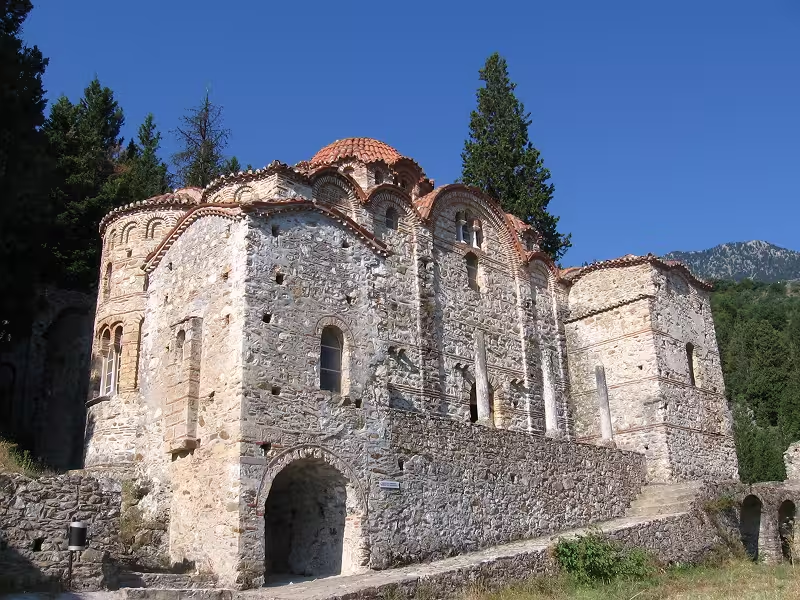
Agioi Theodoroi (Brontochion)
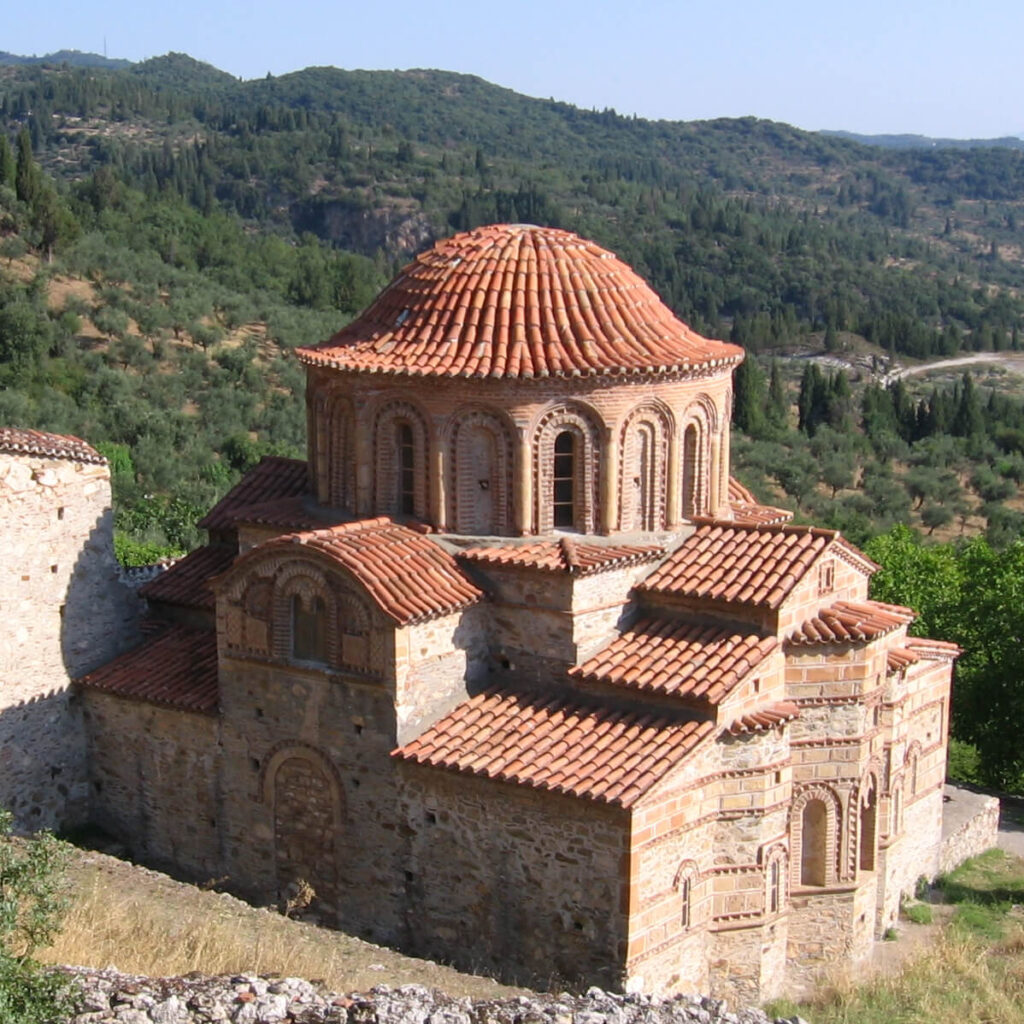
Believed to be the oldest surviving church on the site, built before 1296 in an octagonal plan modelled on the Monastery of Osios Loukas in Boeotia. Its dome is unusually large for a Mystras church, and two chapels added to its western side include the tomb of a member of the Palaiologos family.
Interior frescoes, though less complete than those at Peribleptos or Pantanassa, include depictions connected to the imperial family.
Evangelistria
A small chapel-scale church whose modest size belies the quality of what remains of its decoration — a useful stop for visitors who want to see Mystras painting outside the three or four headline monuments, without the crowds those might draw.
The Chapels of the Lower Town
Beyond the major monasteries, Mystras preserves a scatter of small private chapels, most of them built and maintained by individual noble families as household or funerary churches rather than public foundations. Three worth naming: Ai-Yannakis (Agios Ioannis), near the Marmara entrance in the Lower Town, preserves some frescoes from the late 14th century; Saint Christopher, also close to the Marmara gate, standing near the Laskaris House, also houses paintings from the 14th century; and Saint Georges, near Peribleptos, described in the literature as a private chapel preserved essentially intact since Byzantine times, probably dates back to the second half of the 14th century. None of these rival the major churches for fresco cycles, but together they illustrate something the headline monuments don’t: that Mystras’ religious landscape wasn’t only imperial and monastic — the city’s leading families built and worshipped in their own small foundations too.
The Houses: Laskaris, Frangopoulos, and Krevata
Byzantine domestic architecture survives almost nowhere else as legibly as it does at Mystras, which makes the houses — not just the churches and palace — a genuine point of distinction for this guide. The Laskaris House, near the Marmara entrance in the Lower Town, and the Frangopoulos House, sited between Peribleptos and Pantanassa, are both early fifteenth-century buildings named for the families traditionally associated with them (Laskaris being a well-known imperial-adjacent surname; Frangopoulos being the family of Pantanassa’s founder, John Frankopoulos). Both use the same solution to the steep terrain: a vaulted substructure — cisterns, stables, storerooms — creating a level platform for a single large main room above, fronted by a balcony and heated by a rear fireplace. A third house, known as the Krevata House, stands in the same Marmara-gate cluster as the Laskaris House. Worth noting that some scholars argue that the houses’ current appareance owes a great deal to 1930s restoration choices made under Anastasios Orlandos.
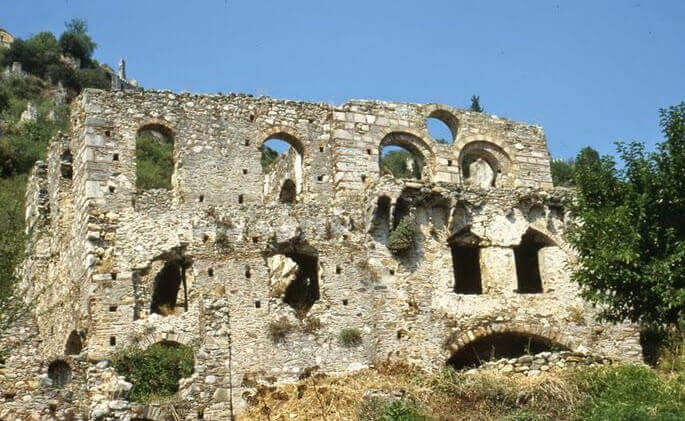
Ruins of the Laskaris house in Mystras, 14th century. 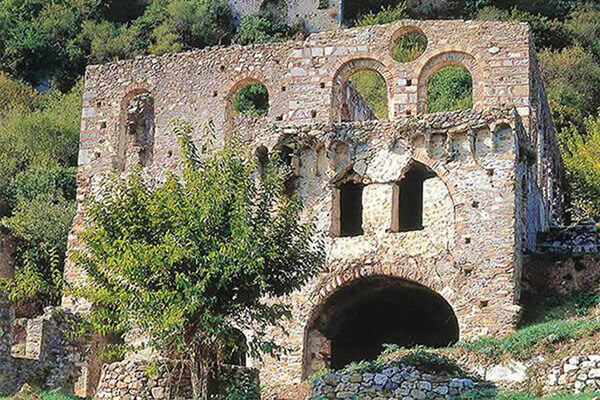
Ruins of the Frangoupoulos mansion, 15th century.
The Upper Town and the Castle
The Palataki
“Palataki” (literally “little palace”), near the 17th century church of Agios Nikolaos, is one of the oldest noble mansions in the upper city. It features a tower that may have been connected in the 15th century to another large edifice to create a single complex.
Hagia Sophia
Not to be confused with its far more famous namesakes in Istanbul or Thessaloniki.
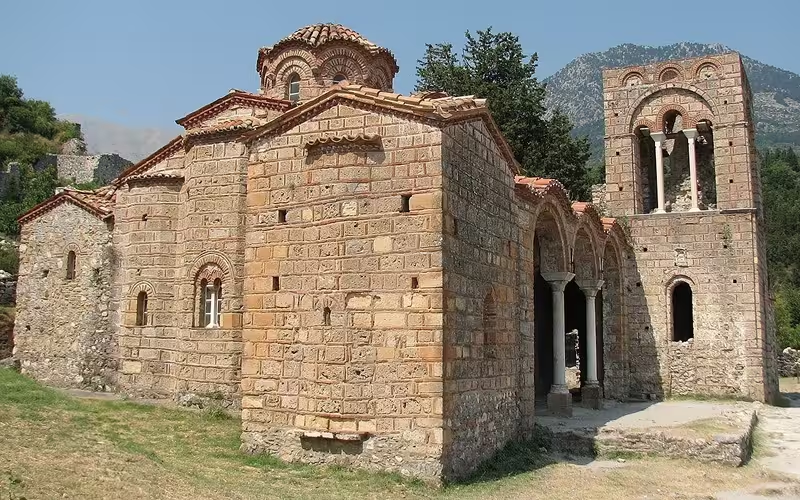
Mystras’s Hagia Sophia was built around 1350 by Manuel Kantakouzenos as the katholikon of the Monastery of Christos Zoodotes (“Christ the Giver of Life”) and served as the palace’s own church — its monograms, preserved on marble plaques, identify him as founder. A cross-domed building with a two-storey porch and a bell tower of the same period, it holds fragmentary frescoes dating to around 1350, including sections of notable quality despite the losses over the centuries. It was reconsecrated as a working church when Greece gained independence, after a period of Ottoman use.
The Frankish Castle
Crowning the hill above the palace, the castle William II Villehardouin built in 1249 remains substantially Frankish in its lower courses, though the Byzantines strengthened and adapted it after 1262. It is not itself a showpiece of Byzantine architecture — its interest lies in what it explains about the site as a whole: Mystras exists because a Latin prince chose this hill for its defensibility, and everything built below the fortifications, across two centuries of Byzantine rule, grew up in the shelter of walls the Franks had raised first. The climb rewards visitors with the best overview of the entire site and sweeping views across the Laconian plain to modern Sparta and the Taygetos range.
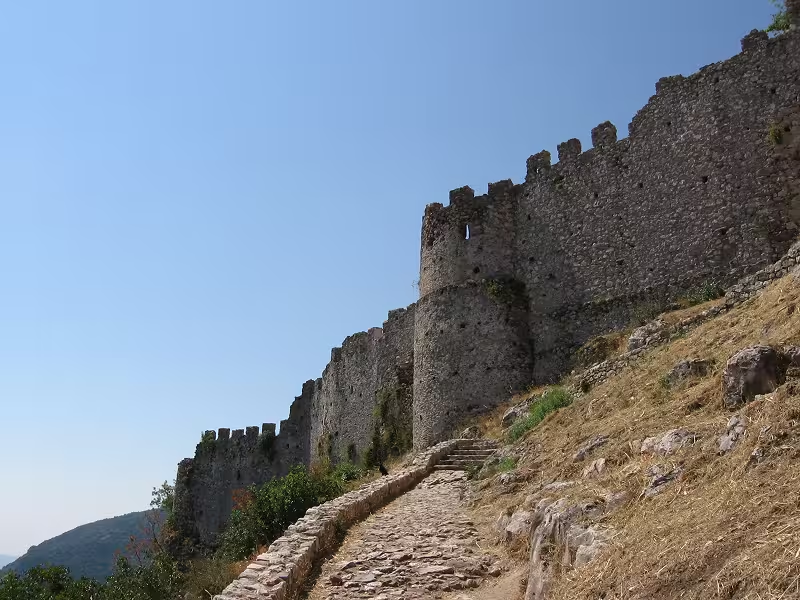
Exterior walls of the castle. © Byzantine World 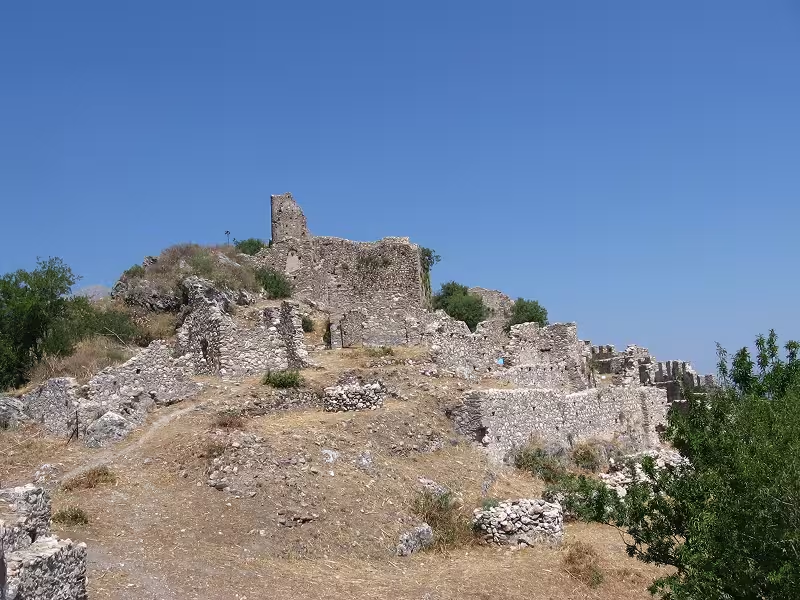
Interior of the castle. © Byzantine World
The castle chapel
The citadel at the summit had its own small chapel, associated with the donjon area that housed the governor’s — later the castellan’s — residence. It’s a modest structure, unnamed in most sources beyond “the castle chapel,” but worth a mention precisely because it shows that the fortress functioned as a self-contained community, with its own resident garrison, governor, and place of worship, separate from the religious life of the town below. Some frescoes are preserved, dating back to the 13th century and ranking among the oldest of Mystras with those of the first phase of the Metropolis.
The Palataki
“Palataki” (literally “little palace”), near Agios Nikolaos, is one of the oldest noble mansions in the upper city. It features a tower that may have been connected in the 15th century to another large edifice to create a single complex.
Practical Tips
Getting there. Mystras sits about 7 km from Sparta, itself roughly 3–3.5 hours from Athens by car via the Moreas motorway, or by direct bus. There is no train service to Sparta. Most visitors base themselves in Sparta or the village of Neos Mystras, immediately below the site, and drive or taxi up.
Getting around. The archaeological site has two main entrances — Upper (near the castle and palace) and Lower (near the Metropolis) — connected by a paved but steep path through the site. Many visitors enter at one gate and exit at the other, arranging transport accordingly, rather than doubling back uphill. Solid, closed footwear is essential; the paving is uneven in places and can be slippery when worn smooth.
When to go. April–June and September–October offer the most comfortable conditions. The site has very little shade, and the climb from the Lower to the Upper Town is genuinely strenuous in summer heat — plan an early start if visiting between June and August.
Opening hours and tickets. Hours vary seasonally and have recently been extended — as of the 2026 season, the upper site remains open into the evening during summer months, so check current hours before planning a late-afternoon visit rather than assuming a standard closing time. A single ticket typically covers both the Upper and Lower Town sections plus the archaeological museum.
Dress code. Pantanassa remains an active convent, and modest dress — covered shoulders and knees — is expected, as at any working Orthodox church.
Suggested itinerary. A focused half-day covers the unmissables — Palace of the Despots, Metropolis, Peribleptos, Pantanassa. A full day allows time to add Vrontochion, Agioi Theodoroi, Hagia Sophia, and the climb to the castle, plus a proper visit to the archaeological museum near the Metropolis. Many visitors combine Mystras with a stop in modern Sparta, a short drive away.
Frequently Asked Questions
How long do you need to visit Mystras?
Half a day is enough for the main monuments — the Palace of the Despots, the Metropolis, Peribleptos, and Pantanassa. A full day allows a more complete visit, including the Lower Town’s smaller churches, the climb to the castle, and the archaeological museum.
Is Mystras difficult to walk?
Yes, more so than Istanbul’s or Thessaloniki’s Byzantine sites. The site occupies a steep hillside with paved but uneven paths, and there is little shade. Solid footwear and, in warmer months, an early start are strongly advised.
What’s the difference between Mystras and Sparta?
They are different places from different eras occupying the same valley. Ancient Sparta was the classical city-state; Mystras is a medieval Byzantine foundation on a nearby hillside, built from 1249. Modern Sparta, founded in 1834 by King Otto, was established on the site of the ancient city after Mystras was largely abandoned following its destruction in 1825.
Why was Mystras abandoned?
The city survived Ottoman rule as an inhabited town for centuries, but was devastated in 1825 when Egyptian forces under Ibrahim Pasha massacred its population during the Greek War of Independence. King Otto chose to found modern Sparta nearby rather than rebuild, and Mystras’s remaining population dwindled until the last properties were expropriated in 1953.
What is the single most important monument in Mystras?
It depends what you’re looking for. The Palace of the Despots is the most historically significant as the only surviving Byzantine palace in Greece, newly reopened after decades of restoration. Peribleptos holds the most complete cycle of late Byzantine fresco painting on the site. Pantanassa is the most beautiful interior, and the only monument still alive as a place of worship.
How does Mystras compare to Istanbul or Thessaloniki for Byzantine history?
Those two are living cities where Byzantium is one layer among many; Mystras is a single-period site frozen at the end of the empire, so the three are complementary rather than competing.
Sources
- UNESCO World Heritage Centre — Archaeological Site of Mystras
- Manolis Chatzidakis, Mystras: The Medieval City and the Castle
- Greek Ministry of Culture — announcement of the Palace of the Despots restoration and reopening, May 2026
- Khan Academy, “Late Byzantine secular architecture and urban planning” — Laskaris and Frangopoulos Houses
Cover image credits: Byzantine World.