Omorphi Ekklisia, Aegina: A complete Byzantine fresco Cycle painted under Frankish rule
Inside the modern town of Aegina, toward the district of Kypseli, a small barrel-vaulted church known simply as Omorphi Ekklisia — “the Beautiful Church” — holds one of the most complete surviving fresco cycles of the Middle Byzantine period anywhere on the island. Built shortly before the Fourth Crusade reached the Aegean, it was renovated in 1289 by a donor who still, three generations into Frankish rule, chose to name the emperor and patriarch in Constantinople — a small but pointed act of allegiance carved in stone.
Location and history of Agioi Theodoroi – Omorphi Ekklisia
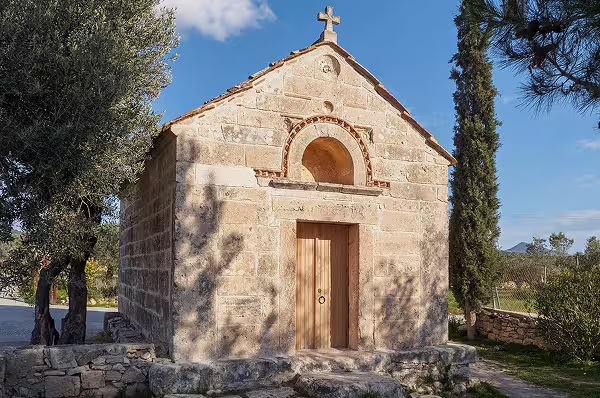
Omorphi Ekklisia — also known by its dedication, Agioi Theodoroi — stands within Aegina town itself, toward the district of Kypseli, rather than in the island’s rural interior or at Paliachora. Its architecture, which shows no trace of Western influence, points to construction in the late 12th century, in the final decades before the Fourth Crusade broke Byzantine authority across the Aegean and delivered Aegina, in practice, to the Frankish Duchy of Athens.
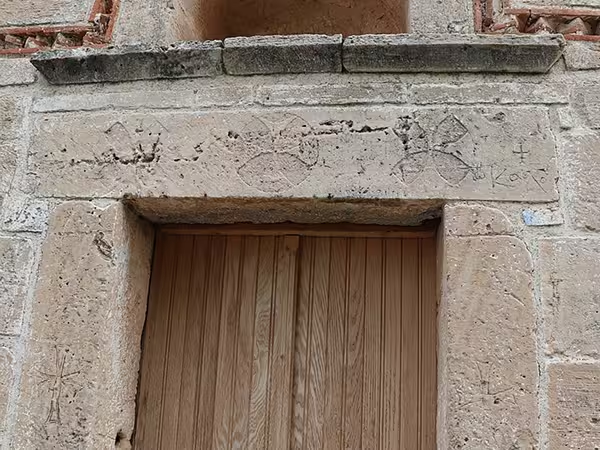
An inscription carved into the church’s west façade records a renovation carried out in 1289 — by which point the island had been under Frankish lordship for eighty-five years. The inscription names Emperor Andronikos II Palaiologos, ruling from Constantinople, and Patriarch Athanasios I: a striking choice, since neither man held any authority whatsoever over Frankish-ruled Aegina. Historians read this as evidence that the church’s donor belonged to an established Byzantine family with real ties to Constantinople, and possibly as a quiet gesture of political loyalty — even resistance — among Aegina’s old elite toward their new Frankish rulers. A graffito carved into the north stone frame of the entrance, together with a now-destroyed painted inscription once inside the church, connects the building to the Samalas or Zagomalas family.
Exterior and architecture
The church is simple and compact: a single, aisleless nave under a barrel vault, raised on a large podium. Its walls are built of large, dressed, square blocks of poros stone laid with thin joints — solid, careful construction with no decorative flourish and, notably, none of the pointed arches or Gothic detailing that Frankish patronage brought to other churches in the region during the same period. The building’s plainness on the outside is part of what makes its interior so unexpected.
Interior and wall paintings
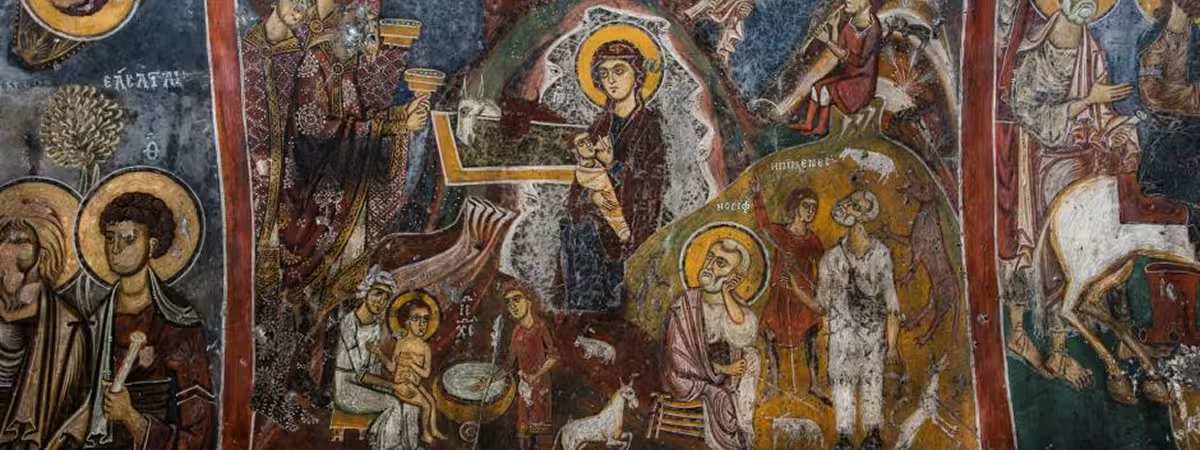
Omorphi Ekklisia’s interior is covered, almost floor to ceiling, in a Middle Byzantine fresco programme of real completeness. Fourteen scenes from the life of Christ run across the vault and upper walls — but, notably, without two of the subjects nearly always included in cycles of this kind: the Baptism and Pentecost. The vault above the sanctuary is dominated by the Ascension, and the west wall above the entrance by the Crucifixion. In the apse, the Virgin Platytera stands between two archangels in the upper zone, with the hierarchs Basil the Great and John Chrysostom below her; the face of the triumphal arch carries the Preparation of the Throne above, and the Annunciation below, with the Archangel Gabriel and the Virgin set on opposite sides.
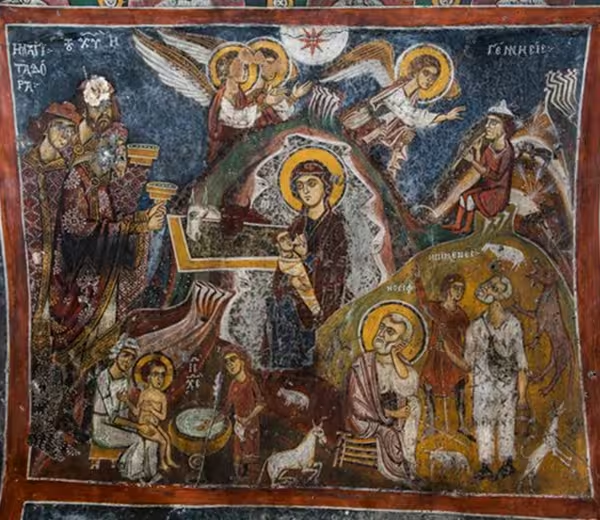
Nativity, 13th-century. 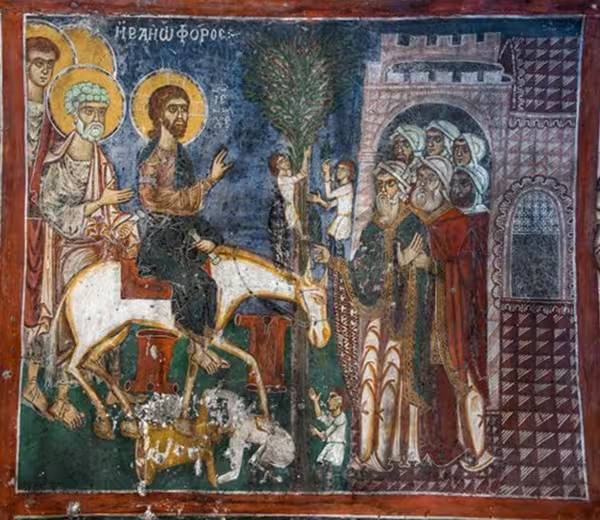
Entry of Christ into Jerusalem, 13th-century.
A broad band of floral ornament divides these central scenes from a cycle of the Twelve Great Feasts running around the barrel vault. On the south side, the lower zone shows the Nativity, the Entry into Jerusalem, and the Raising of Lazarus, with the Road to Calvary, the Betrayal, and the Last Supper above. The north side is dominated, across both zones, by the Resurrection, flanked below by the Transfiguration and the Lamentation, and above by the Presentation in the Temple and the Descent from the Cross. Along the base of the south, west, and north walls, a further register shows full-length standing saints.
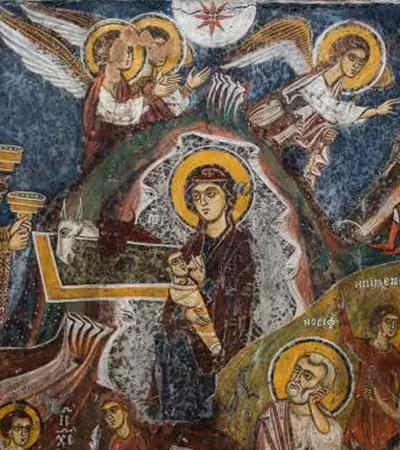
Several details make this cycle unusual. The narrative scenes are arranged in two rows down each side of the vault rather than in strict chronological order, and — as already noted — two of the subjects most consistently found in Byzantine church decoration, the Baptism and Pentecost, are missing entirely, a gap too significant to explain simply by shortage of wall space.
The church also preserves one of the very few surviving Middle Byzantine depictions of the Virgin Galaktotrophousa, the nursing Virgin — an image with roots in pre-Iconoclast Egyptian art, but which appears here in a form suited to its own period rather than as a direct revival.
Stylistically, the paintings are conservative and strongly linear, with dramatic, almost excessive expressiveness in the individual figures and only limited variation of colour — characteristics that, taken together, place Omorphi Ekklisia squarely within the conservative mainstream of wall painting produced across Frankish-ruled Greece in this period, work that specialists describe as standing deliberately apart from the artistic currents developing elsewhere in the Byzantine world at the same time.
Significance of the Omorphi Ekklisia
Omorphi Ekklisia matters for two distinct reasons that rarely come together in one small parish church. As a fresco cycle, it is unusually complete for its date and size, and its specific omissions and rare subjects — the missing Baptism and Pentecost, the scarce Galaktotrophousa — give art historians real material for reading theological anxieties of the period, particularly the debate over union with the Latin Church and the Filioque, directly off the walls. As a document, its 1289 inscription is a rare piece of testimony to how Aegina’s old Byzantine families navigated life under Frankish rule: not through open resistance, but through the quiet, durable act of carving an absent emperor’s name into their own parish church.
Frequently Asked Questions
Where is Omorphi Ekklisia on Aegina?
Inside Aegina town, toward the district of Kypseli — unlike most of the island’s other Byzantine churches, it is not at Paliachora or in the rural interior.
When was Omorphi Ekklisia built?
Its architecture points to the late 12th century, shortly before the Fourth Crusade. An inscription records a renovation in 1289, well into the period of Frankish rule over the island.
Why does the fresco cycle at Omorphi Ekklisia omit the Baptism and Pentecost?
Specialists connect the omission to theological tensions of the period over Church union with Rome and the Filioque clause, rather than to any shortage of wall space — both scenes are normally standard in cycles of this kind.
Who is named in the 1289 inscription at Omorphi Ekklisia?
Emperor Andronikos II Palaiologos and Patriarch Athanasios I of Constantinople — neither of whom had any authority over Aegina at the time, which was under Frankish rule.
Sources
- Charalambos Pennas, The Byzantine Aegina, Athens, 2004.
- Nikolaos Moutsopoulos, Η Παλιαχώρα της Αιγίνης. Ιστορική και μορφολογική εξέτασις των μνημείων, Athens, 1962.
- Nikolaos Nikoloudis, “Η Αίγινα κατά τον Μεσαίωνα και την Τουρκοκρατία,” Βυζαντινός Δόμος, 7 (1993–94), pp. 13–21.



One Comment