Byzantine News — 2026: The year’s Key Discoveries, Research and Exhibitions
Welcome to the Q4 2026 edition of Byzantine News, your quarterly round-up of the latest academic developments, archaeological discoveries, and major cultural events across the field of Byzantine studies.
The last quarter in review (October – December 2026)
Major Exhibitions
- Constantinople to Istanbul: One City, Two Empires
- Venue: Victoria and Albert Museum (V&A South Kensington), London, UK
- Dates: Opening November 7, 2026
- Details: A landmark exhibition spanning 1,600 years of art and design. It explores the artistic transition and continuity between the Byzantine Empire and the Ottoman era, featuring high-profile artifacts, icons, manuscripts, and liturgical items.
- Highlights: the Enkolpion of proedros Konstantios, the Vesolini casket and the Lincoln Typikon, three major treasures from the Middle Byzantine period in the British collectinos.
- Reimagined Byzantine Galleries at The Met
- Venue: The Metropolitan Museum of Art, New York, USA
- Dates: Ongoing throughout Autumn 2026
- Details: The Met’s newly reinstalled Byzantine Galleries showcase rare Late Antique and East Christian treasures, including the Attarouthi and Avar treasures, rotated manuscripts, and Coptic glass art.
- Exhibition of Returned Sacred Relics
- Venue: Museum of Byzantine Culture, Thessaloniki, Greece
- Dates: Running through November 5, 2026
- Details: Following a historic bilateral agreement between Greece and Bulgaria, 48 stolen medieval and Byzantine religious treasures (including manuscript illuminations, icons, and sacred vessels) are being showcased at the museum before returning permanently to their home monasteries.
- Exhibition of Returned Sacred Relics
- Venue: Museum of Byzantine Culture, Thessaloniki, Greece
- Dates: Running through November 5, 2026
- Details: Following a historic bilateral agreement between Greece and Bulgaria, 48 stolen medieval and Byzantine religious treasures (including manuscript illuminations, icons, and sacred vessels) are being showcased at the museum before returning permanently to their home monasteries.
- Exhibition: Tracing Byzantium. Fragments of the Greek Middle Ages
- Dates: June 11, 2026 – May 2, 2027 (Active throughout October–December 2026)
- Location: Papyrus Museum of the Austrian National Library, Vienna, Austriq
- Details: Organized to mark the 25th International Congress of Byzantine Studies, this temporary exhibition showcases physical written artifacts, rare manuscript fragments, papyri, and documents revealing daily life, religion, and culture across the Byzantine Empire.
- Exhibition:Divine Thresholds: Icons and the Orthodox Christian World
- Dates: October 10 – November 28, 2026
- Location: Hellenic Museum, Melbourne, Australia
- Details: Featuring over 130 Orthodox Christian icons, religious objects, and liturgical works, this temporary display explores the evolution of Byzantine sacred art and its enduring stylistic legacy in the post-Byzantine Mediterranean.
Conferences, Study days & Congresses
- 52nd Annual Byzantine Studies Conference (BSC)
- Venue: University of Notre Dame, South Bend, Indiana, USA
- Dates: October 22–25, 2026
- Details: Organized by the Byzantine Studies Association of North America (BSANA), this is North America’s premier gathering for Byzantine studies. The 2026 conference opens with the annual Mathews Byzantine Lecture delivered by Juan Signes Codoñer.
- Excavating Antioch: The Archaeology of an Ancient City
- Venue: Princeton University / East of Byzantium (Hybrid/Online)
- Dates: Monthly sessions throughout October, November, and December 2026
- Key Lectures:
- October 2: Artifact reconstructions from the 1930s Princeton Antioch excavations.
- November 6: Public spaces and urban transformations in Late Antique Antioch.
- December 4: Historiographical perspectives on medieval Armenian art with Ivan Foletti.
- Threads of Knowledge: Weaving and Textiles in the Middle Ages
- Venue: Barnard College, New York City, USA
- Dates: December 4–5, 2026
- Details: Focuses on the production, trade, and social life of textiles across Late Antiquity, Byzantium, and the Renaissance Mediterranean.
Study Days and Conferences
- Study Day: Byzantium’s Capital: Constantinople, the New Rome, the Queen of Cities
- Date: October 28, 2026
- Location: London Art History Society, London (and online)
- Details: A full-day lecture series tracing the development of Constantinople from its founding by Constantine the Great to its final artistic period, covering the Iconoclastic era, the Komnenian renaissance, and everyday life in Byzantium.
- Lecture: Building Byzantine Britain
- Date: October 15, 2026
- Location: London
- Details: A public talk organized by Pints of Knowledge examining the historical, cultural, and material connections between post-Roman Britain and the Byzantine world.
- Curator Talk: Online Curator Talk: Constantinople to Istanbul
- Date: November 5, 2026
- Location: Online (Victoria and Albert Museum)
- Details: A preview presentation by the V&A curatorial team highlighting key Byzantine artifacts featured in the exhibition, including the 11th-century Enkolpion of Constantinos.
- 14th International Symposium: Days of Justinian I
- Dates: October 30 – November 1, 2026
- Location: Skopje
- Details: An annual international conference focusing on Byzantine history, art, and archaeology. It features a thematic focus on medieval borders and includes guided excursions to key Byzantine sites in North Macedonia.
The past quarter in review (Q3)
25th International Congress of Byzantine Studies opens in Vienna
From August 24 to 29, 2026, the University of Vienna hosts the 25th International Congress of Byzantine Studies (ICBS). Placed under the honorary patronage of Federal President Dr. Alexander Van der Bellen, this milestone gathering centers on the theme “Byzantium Beyond Byzantium”.
Organized every five years since its inaugural meeting in Bucharest in 1924, the ICBS is the world’s premier academic convention dedicated to Eastern Roman history, art, and culture. Up to 1,500 scholars from over 50 countries gather in Vienna to present hundreds of papers exploring trade networks, manuscript transmission, cross-cultural diplomacy, and material culture.
Key Highlights of the 2026 Congress:
- Academic panels: Hundreds of presentations addressing microstructures, mobility, and the global legacy of the Byzantine Empire.
- Exhibitions & Cultural links: Collaborations with the Austrian National Library and municipal museums to showcase Austrian-Byzantine heritage to a broader audience.
- Networking events: Receptions and thematic roundtables facilitating international exchange among researchers.
Read more: ICBS 2026 – Byzantium Beyond Byzantium
“Spurensuche Byzanz” exhibition unveiled in Vienna.
To coincide with the global gathering of Byzantinists, the Papyrusmuseum of the Austrian National Library presents the special exhibition “In Search of Byzantium: Fragments of the Greek Middle Ages” – (“Spurensuche Byzanz: Fragmente des Griechischen Mittelalters”). Curated by Dr. Krystina Kubina and Dr. Giulia Rossetto, the display showcases rare papyrological fragments, liturgical texts, and secular documents from the Greek Middle Ages, illustrating daily life and scholarly transmission across the empire.
Read more: Exhibition “Spurensuche Byzanz Fragmente des Griechischen Mittelalters“
Record Byzantine gold treasure recovered off the Mljet Coast
Archaeologists from the Croatian Conservation Institute and Stanford University have concluded an 11-year underwater excavation campaign off the coast of Mljet, Croatia, revealing a major 7th- to 8th-century CE shipwreck.
The expedition yielded an unprecedented hoard of luxury imperial goods and coinage submerged in the Adriatic Sea: ceremonial gold belt components set with pearls, rubies, and emeralds; excellent-grade solidi struck under the Heraclian dynasty; amphorae and ceramic tableware providing context for Adriatic maritime routes.
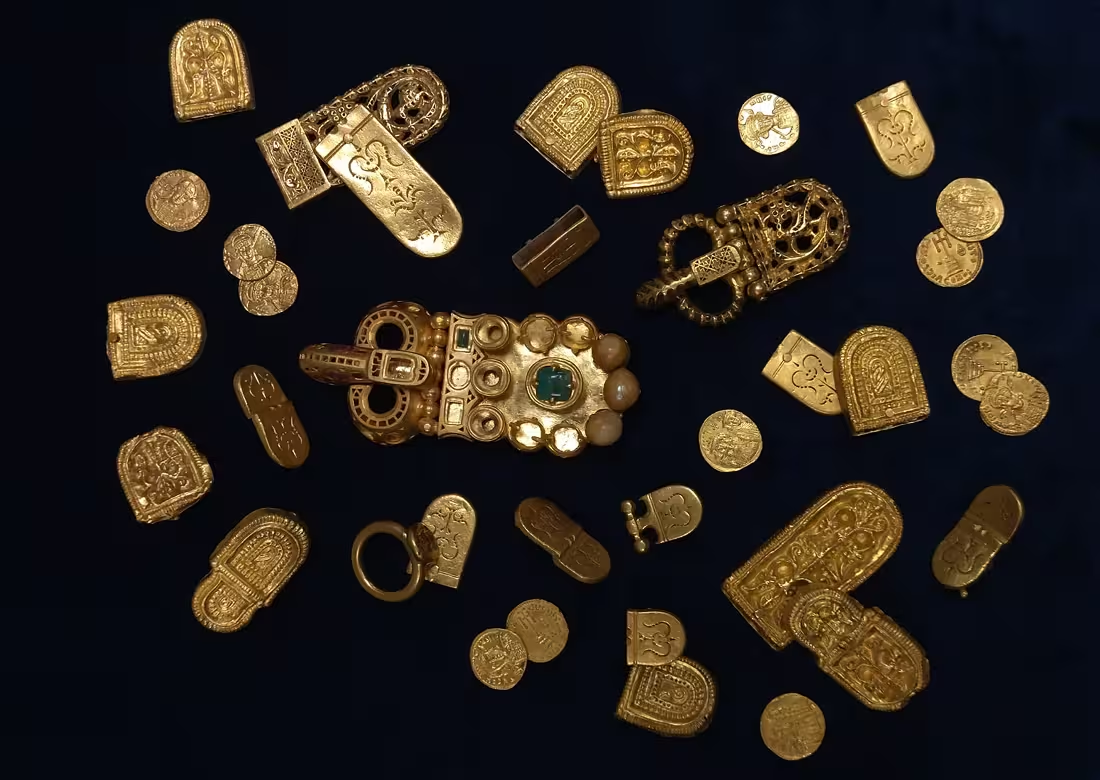
Researchers suggest the presence of high-status personal regalia indicates the ship carried a senior Byzantine envoy or imperial magistrate traveling through the region.
Read the full article: Record Byzantine gold treasure discovered off Mljet Coast
Mudbrick Byzantine settlement discovered in Egypt’s Western Desert
Archaeologists excavating in Egypt’s western desert oases have uncovered a well-preserved mudbrick city dating to the mid-Byzantine period. The site features residential quarters, civic infrastructure, and early Christian liturgical spaces.
The discovery offers fresh evidence regarding the administrative reach and economic vitality of Byzantine Egypt during Late Antiquity, highlighting the diverse cultural interactions within the southern frontier oases.
For continuous updates and upcoming academic conferences, visit the Byzantine World Homepage.
Sources