The Sack of Constantinople (1204): How the Fourth Crusade shattered Byzantium
In the spring of 1204, the greatest Christian city on earth was stormed, looted, and burned — not by an invading Muslim army, but by a crusader host that had set out to recover Jerusalem. For three days, Western knights and Venetian sailors ransacked Constantinople, the capital of the Byzantine Empire, stripping its churches of relics, melting its bronzes for coin, and scattering a thousand years of accumulated treasure. The Sack of Constantinople in 1204 was one of the most shocking betrayals of the Middle Ages, and Byzantium never fully recovered from it.
What was the Sack of Constantinople in 1204?
The Sack of Constantinople was the capture and pillaging of the Byzantine capital by the armies of the Fourth Crusade between 12 and 15 April 1204. A campaign launched by Pope Innocent III to retake the Holy Land was diverted, step by step, into an assault on the largest Christian city in the world. The crusaders installed a Latin (Western, Catholic) emperor on the Byzantine throne and carved the empire’s lands among themselves and the Republic of Venice. Byzantium fragmented into rival successor states and, although a Greek dynasty would recover the city in 1261, it returned a diminished, impoverished power — a wound that many historians regard as the true beginning of the long decline that ended at the hands of the Ottomans in 1453.
The queen of cities: why Constantinople was the ultimate prize
To grasp the scale of the catastrophe, one must understand what Constantinople was in the year 1200. After the long recovery and brilliance of the Middle Byzantine period, it was, quite simply, the richest and most populous Christian city in the world — perhaps half a million people behind its impregnable walls, at a time when Paris or London counted only tens of thousands. It was the great clearing-house of Mediterranean trade, where the silks, spices, and gold of East and West changed hands.
Above all, it was a treasury of the sacred. Constantinople held the densest concentration of holy relics in Christendom — fragments of the True Cross, the Crown of Thorns, the relics of countless saints — alongside ancient bronzes, gold mosaics, and the accumulated art of nine centuries. For Western Christians, raised to revere such relics, the city was both an object of awe and, fatally, of covetousness. The wealth that made Constantinople glorious also made it a temptation no debt-ridden army could easily resist.
The Fourth Crusade: a holy war that lost its way
Pope Innocent III proclaimed the Fourth Crusade in 1198, with a clear strategic target: rather than march overland, the crusaders would strike at Egypt, the heart of Muslim power, and from there liberate Jerusalem. To move an army by sea, the crusade’s leaders needed ships on a vast scale — and only one power in the Mediterranean could supply them.
A crusade in debt to Venice
In 1201, the crusade’s envoys signed a fateful contract with the Republic of Venice and its formidable, aged, and blind doge, Enrico Dandolo. Venice agreed to build and crew a fleet to transport some 33,500 men in exchange for roughly 85,000 silver marks — suspending much of its ordinary commerce to do so. But when far fewer crusaders than expected actually arrived at Venice in 1202, the army could not pay what it owed. The crusade began deep in debt before it had loosed a single arrow at an enemy of the faith.
The detour to Zara
To work off the debt, Dandolo proposed that the crusaders help Venice recapture Zara (modern Zadar, in Croatia), a rebellious port under the protection of the Catholic king of Hungary. In November 1202 the crusaders besieged and sacked Zara — a Christian city. Pope Innocent III was appalled and excommunicated the participants, though he soon lifted the sentence on the crusaders to keep the expedition alive. The campaign to liberate Jerusalem had already turned its swords against fellow Christians; it would soon do so again, on a far greater scale.
A prince’s dangerous promise
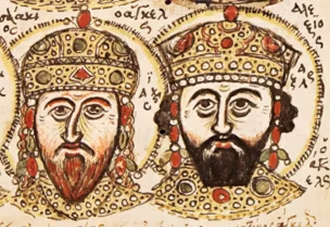
At Zara, the crusaders received a tempting offer. Alexios Angelos, son of the deposed and blinded Byzantine emperor Isaac II, asked them to restore his father to the throne in Constantinople. In return he promised a staggering reward: 200,000 silver marks, provisions, an army of 10,000 men to join the crusade, and — most enticing of all to the Pope — the submission of the Orthodox Church to Rome. To a host mired in debt, the offer seemed providential. The leaders agreed to divert to Constantinople, telling themselves it was a brief detour that would fund the true crusade. It was the point of no return.
The first siege of 1203 and the puppet emperor
The crusader fleet reached Constantinople in June 1203. In July, after assaults on the sea walls and the harbour, the reigning usurper Alexios III fled the city with the treasury. The blind Isaac II was restored, and his son was crowned co-emperor as Alexios IV on 1 August 1203. But the young emperor had promised what he could not possibly deliver. The imperial coffers were empty; to raise funds he taxed his people harshly and even melted down church plate, alienating both the populace and the clergy. Anti-Latin feeling boiled over as Western soldiers lingered outside the walls and a great fire — set during a brawl between Latins and Greeks — devastated swaths of the city.
The Sack of Constantinople, April 1204
From broken promises to open war
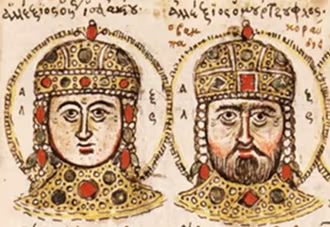
In late January 1204, a palace coup swept away the discredited dynasty. A nobleman from the Doukas family, Alexios — nicknamed Mourtzouphlos for his heavy, joined eyebrows — seized power as Alexios V, and in February the imprisoned Alexios IV was strangled. The new emperor repudiated his predecessor’s debts and prepared the city to fight. For the crusaders, the murder of their patron removed the last pretence of alliance. Unpaid, encamped before a hostile city, and urged on by clergy who painted the “schismatic” Greeks as enemies of the true Church, the leaders resolved to take Constantinople by force.
In March 1204 they signed the Partitio Romaniae, a treaty dividing the Byzantine Empire among themselves before the city had even fallen — a remarkable confession of intent.
A decisive assault on the sea walls
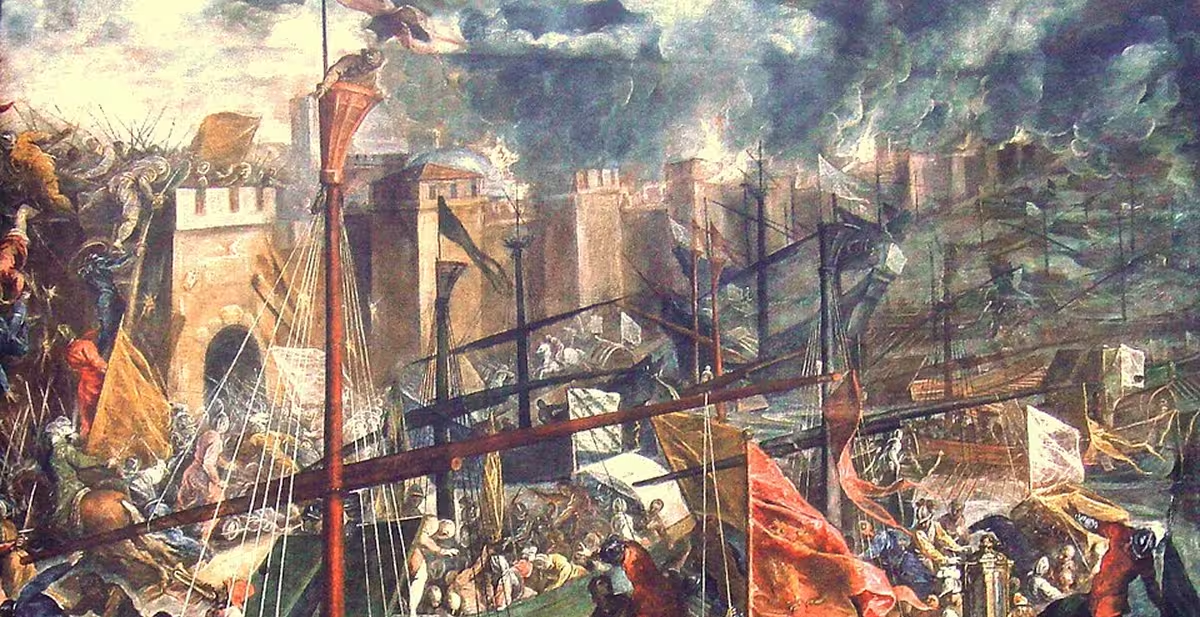
The decisive assault came from the Golden Horn, where the crusaders attacked the sea walls directly from their ships, having rigged “flying bridges” from the masts and yardarms of the Venetian galleys to reach the tops of the towers. A first attempt on 9 April failed: the wind worked against them, the ships could not press close enough to the walls, and the defenders beat back the men who did manage to land.
On 12 April, the conditions changed. A strong north wind drove the vessels hard against the fortifications, and two ships lashed together managed to grapple a tower and carry it. Close by, a band of knights broke through a walled-up postern gate and forced their way inside, and once a stretch of the wall was theirs, more attackers poured in behind them.
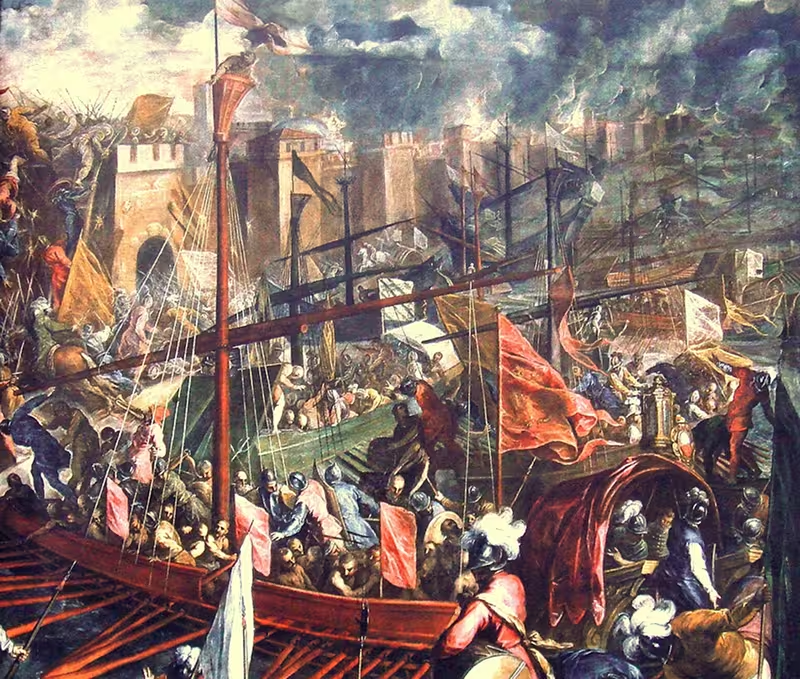
By the morning of 13 April, organised resistance had collapsed. Alexios V Mourtzouphlos, unable to rally the panicking populace, fled the city under cover of night, and with no emperor and no defence left to mount, Constantinople lay open to the victors.
Three days of plunder, 12–15 April 1204
What followed horrified even contemporaries. The plunder was not a brief outburst but a sanctioned, systematic affair: the leaders had agreed in advance how the spoils would be divided, and for three days in April 1204 the crusaders and Venetians stripped Constantinople with a ferocity rarely matched in the medieval world. Houses were ransacked, monasteries emptied, libraries scattered, and the inhabitants — fellow Christians — were robbed, beaten, and killed in the streets; women, including nuns, were assaulted, and those who could fled the city with whatever they could carry.
Nowhere was the desecration more shocking than in the Hagia Sophia, the holiest church in the Christian East. According to Choniates, soldiers hacked apart the great silver-and-gold altar to divide its fragments and drank wine from the consecrated vessels. They led mules and horses into the sanctuary to haul away the sacred ornaments, and when the animals slipped on the polished marble, they were butchered where they fell, fouling the floor with blood. A woman “of the streets” was seated on the patriarch’s throne, where she sang and danced to mock the rites of the Orthodox Church.
The greed reached even the dead. In the Church of the Holy Apostles, the imperial tombs were broken open and stripped of their treasures — the sepulchre of the great Justinian himself among them. Above all, the city’s incomparable hoard of holy relics was carried off, much of it by clergy who regarded the theft as a pious rescue; in the years that followed, fragments of the True Cross, the Crown of Thorns, and the bones of countless saints surfaced in the churches of France, Italy, and the Rhineland. Ancient bronze masterpieces that had stood for centuries were dragged down and melted for coin — an irreplaceable loss of the classical heritage Constantinople had preserved.
“Even the Saracens are merciful and kind compared with these men who bear the cross of Christ on their shoulders.” — Niketas Choniates, eyewitness
The exact death toll is unknown, and modern historians rightly warn that the figures in the chronicles are unreliable; the crusaders, after all, wanted a living, lootable city, not a graveyard. But the human and cultural devastation was beyond dispute. Even Pope Innocent III, who had launched the crusade, was appalled when he learned what his army had done, writing that the Latins had spared “neither religion, nor age, nor sex,” and had given themselves to plunder and bloodshed so that the Greeks now rightly “detest them more than dogs.” It was a self-inflicted wound at the very heart of Christendom — one that would never fully heal.
The spoils: relics, bronze, and the Horses of San Marco
The plunder of 1204 was perhaps the largest single transfer of wealth and sacred art in medieval history. Gold, silver, gemstones, silks, and above all relics — the most prized commodities of the age — flowed west to the churches and treasuries of Europe, where many remain to this day. The Crown of Thorns eventually reached Paris, where King Louis IX built the Sainte-Chapelle to house it. Countless ancient bronze statues that had adorned the city for centuries were melted down for coinage — an irreplaceable loss of classical art.
Venice, with its connoisseur’s eye, claimed the finest pieces, and much of its share can still be seen today clustered in and around the Basilica of St Mark. Embedded in the basilica’s southern corner stands the porphyry group of the Four Tetrarchs, four Roman emperors carved in deep purple stone, prised from a public square in Constantinople. Flanking the south façade are two richly carved marble pillars, long known as the Pilastri Acritani, now believed to have been wrenched from the Constantinopolitan church of St Polyeuktos.
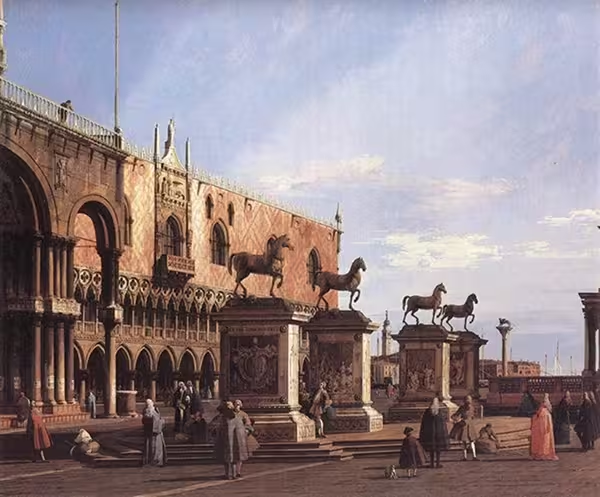
Inside, the Treasury of San Marco preserves one of the world’s greatest hoards of Byzantine goldsmithing — imperial chalices of agate and sardonyx, jewelled reliquaries, and enamelled icons — while the revered icon of the Madonna Nicopeia, once carried into battle before the Byzantine emperors, was taken in 1204 and is venerated in the basilica still. Even the dazzling Pala d’Oro, the basilica’s golden altarpiece, was enriched with Byzantine enamels in the aftermath of the sack.
But the most famous survivors are the four gilded bronze Horses of San Marco, carried off from the Hippodrome of Constantinople and set above the entrance of St Mark’s Basilica in Venice, where replicas still stand today. They remain the most visible monument to the sack — and an enduring symbol of Byzantium’s loss.
The aftermath: the Latin Empire and a fractured Byzantium
The sack opened an unstable era for the shattered lands of the Byzantine world — the Late Byzantine period.
On 16 May 1204, Baldwin of Flanders was crowned in the Hagia Sophia as the first emperor of the new Latin Empire of Constantinople. Under the Partitio Romaniae, Venice took roughly three-eighths of the city along with a chain of strategic ports and islands, and the doge styled himself “lord of a quarter and a half of the Roman Empire.”
Yet the Latin Empire was always brittle. Cobbled together from the lands carved up in the Partitio Romaniae, it was less a state than a patchwork of feudal crusader principalities — a Kingdom of Thessalonica, a Principality of Achaea in the Morea, a Duchy of Athens — loosely bound to the emperor in Constantinople, while Venice creamed off the richest ports and islands. From the outset it was poor, undermanned, and surrounded by enemies.
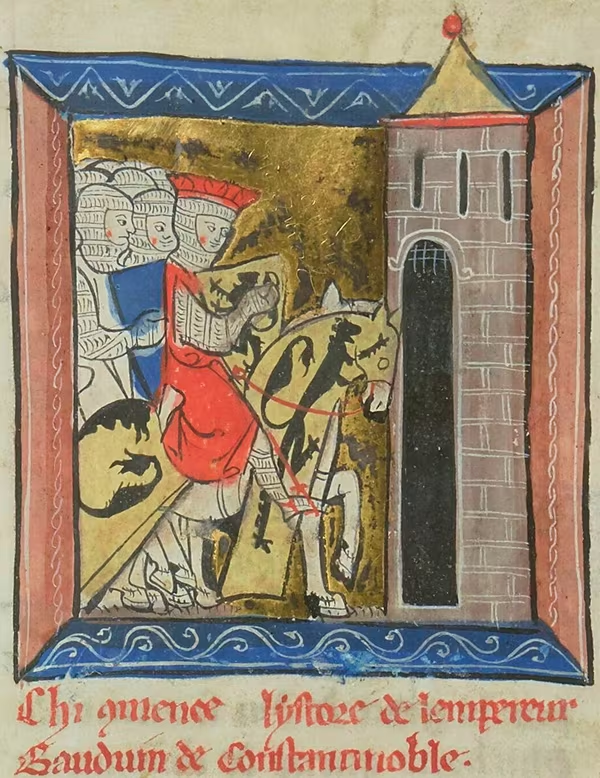
Its first emperor, Baldwin I, reigned barely a year before he was captured by the Bulgarians at the Battle of Adrianople in 1205 and died in their hands. His successors spent the following half-century fighting merely to survive, and grew so desperate for money that the last of them, Baldwin II, sold off the empire’s holiest relics — including the Crown of Thorns, bought by King Louis IX of France for the Sainte-Chapelle — and even stripped the lead from the palace roofs to settle his debts.
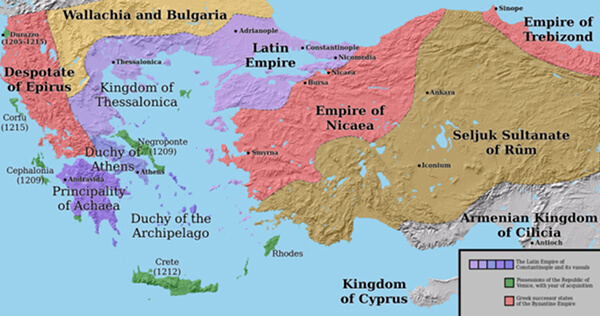
Meanwhile, Byzantine resistance regrouped in three successor states, each claiming the mantle of the fallen empire: the Empire of Nicaea in western Anatolia, the Despotate of Epirus centered around Arta in the west, and the Empire of Trebizond on the Black Sea, ruled by a branch of the old Komnenos dynasty.
Nicaea proved the strongest, and in 1261 its forces, under Michael VIII Palaiologos, recaptured Constantinople almost without a fight, restoring a Greek emperor to the throne. But the empire that returned was a shadow of its former self — territorially shrunken, economically broken, and increasingly dependent on the rival Italian merchant republics of Venice and Genoa. The Constantinople of 1261 could never again claim to be the richest and mightiest city in Christendom.
Repercussions and Echoes
The consequences of 1204 reached far beyond the medieval world, and some are still felt today.
A permanent rupture between East and West. The sack turned the slow estrangement of the Great Schism of 1054 into a deep and lasting wound. The desecration of Orthodox churches by Latin Christians left a mistrust between the Catholic and Orthodox worlds that endured for centuries — and helps explain why so many Byzantines, two and a half centuries later, preferred Ottoman rule to submission to Rome. The memory remained so raw that in 2001 Pope John Paul II expressed sorrow for the sack to the Orthodox Church, and in 2004, on the 800th anniversary, Ecumenical Patriarch Bartholomew accepted the apology — a measure of how long the echo of 1204 endured.
The fatal weakening of Byzantium. Many historians see 1204, not 1453, as the true turning point in the empire’s fall. The destruction of its wealth, fleet, and unity left the restored state too feeble to resist the rising Ottoman Turks in the centuries that followed. In this reading, the crusaders who claimed to defend Christendom helped clear the path for the Muslim conquest of Constantinople — a grim irony at the centre of the whole story.
The rise of Venice. For the Republic of Venice, the sack was a triumph. Its acquisitions in the Aegean and the eastern Mediterranean transformed it into a maritime empire and a dominant commercial power for centuries to come, shaping the politics of the region down to the early modern age.
A scattered cultural heritage. The relics, manuscripts, icons, and artworks carried off in 1204 still fill the cathedrals, treasuries, and museums of Europe — from the Horses of San Marco and the Pala d’Oro in Venice to Byzantine relics in the Sainte-Chapelle in Paris. They are at once preserved fragments of a lost civilisation and enduring reminders of how that civilisation was plundered — which is why the sack still stirs strong feeling today, and why, on its 800th anniversary, the papacy expressed its sorrow to the Orthodox Church.
Sources and further reading
World History Encyclopedia — “1204: The Sack of Constantinople”
Encyclopaedia Britannica — “Sack of Constantinople (1204)”
Select bibliography:
Geoffrey of Villehardouin, The Conquest of Constantinople (contemporary chronicle)
Niketas Choniates, O City of Byzantium (trans. H. J. Magoulias)
Donald E. Queller & Thomas F. Madden, The Fourth Crusade: The Conquest of Constantinople (2nd ed., 1997)
Michael Angold, The Fourth Crusade: Event and Context (2003)
Jonathan Phillips, The Fourth Crusade and the Sack of Constantinople (2004)
Steven Runciman, A History of the Crusades, Vol. III.



4 Comments