Byzantine Istanbul: Essential Site & Visitor Guide
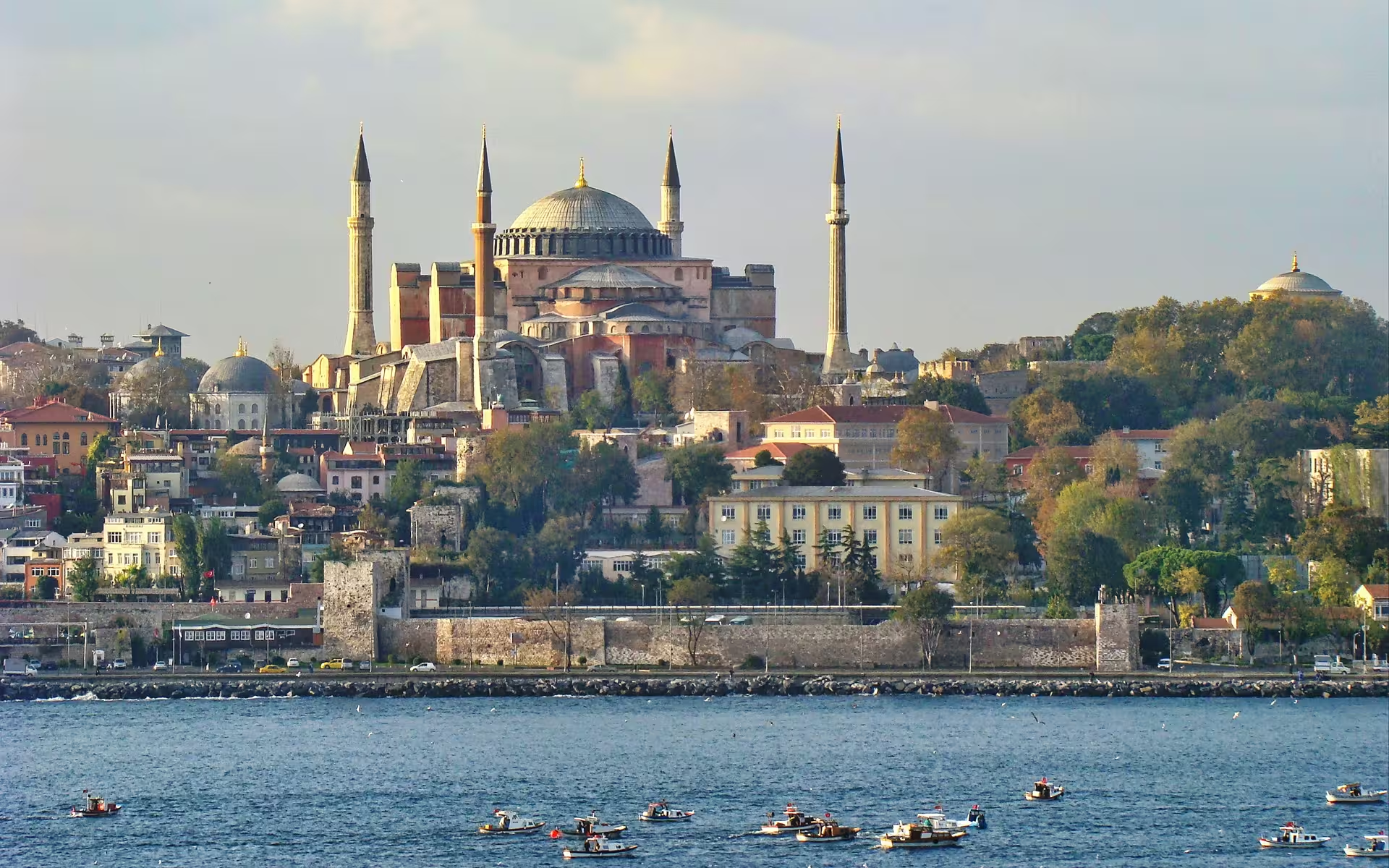
Beneath the minarets and modern streets of Istanbul lies the skeleton of Constantinople — making Byzantine Istanbul one of the most extraordinary heritage destinations in the world. Hagia Sophia still dominates the skyline. Ancient cisterns still hold water beneath the city’s feet. Several of the city’s interiors rank among the finest Byzantine mosaics surviving anywhere. Miles of land walls still trace the outline of a capital that was, for centuries, virtually unconquerable. The Byzantine empire may have fallen in 1453, but its greatest city never truly disappeared.
Constantinople
in Istanbul
This guide covers the essential Byzantine sites every visitor should know — from the unmissable landmarks of Sultanahmet to the lesser-known gems of Fatih and the Blachernae quarter. If you want to go further, our complete inventory of Byzantine monuments in Istanbul will catalogue every surviving remain across the city.
The Byzantine unmissables
Whatever your time in Istanbul, these five sites are non-negotiable.
Hagia Sophia
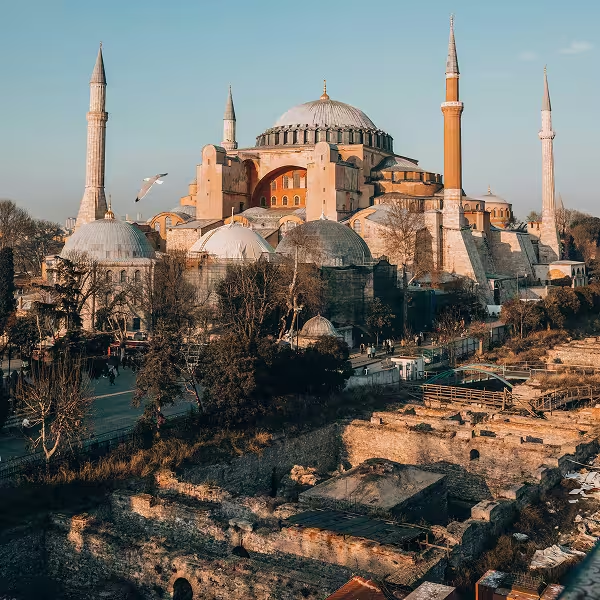
Built by Emperor Justinian I and completed in 537, Hagia Sophia is the supreme masterpiece of Byzantine architecture — and one of the greatest buildings ever constructed. Its vast dome, seemingly floating above the nave, redefined what was architecturally possible and remained the largest Christian cathedral in the world for nearly a thousand years.
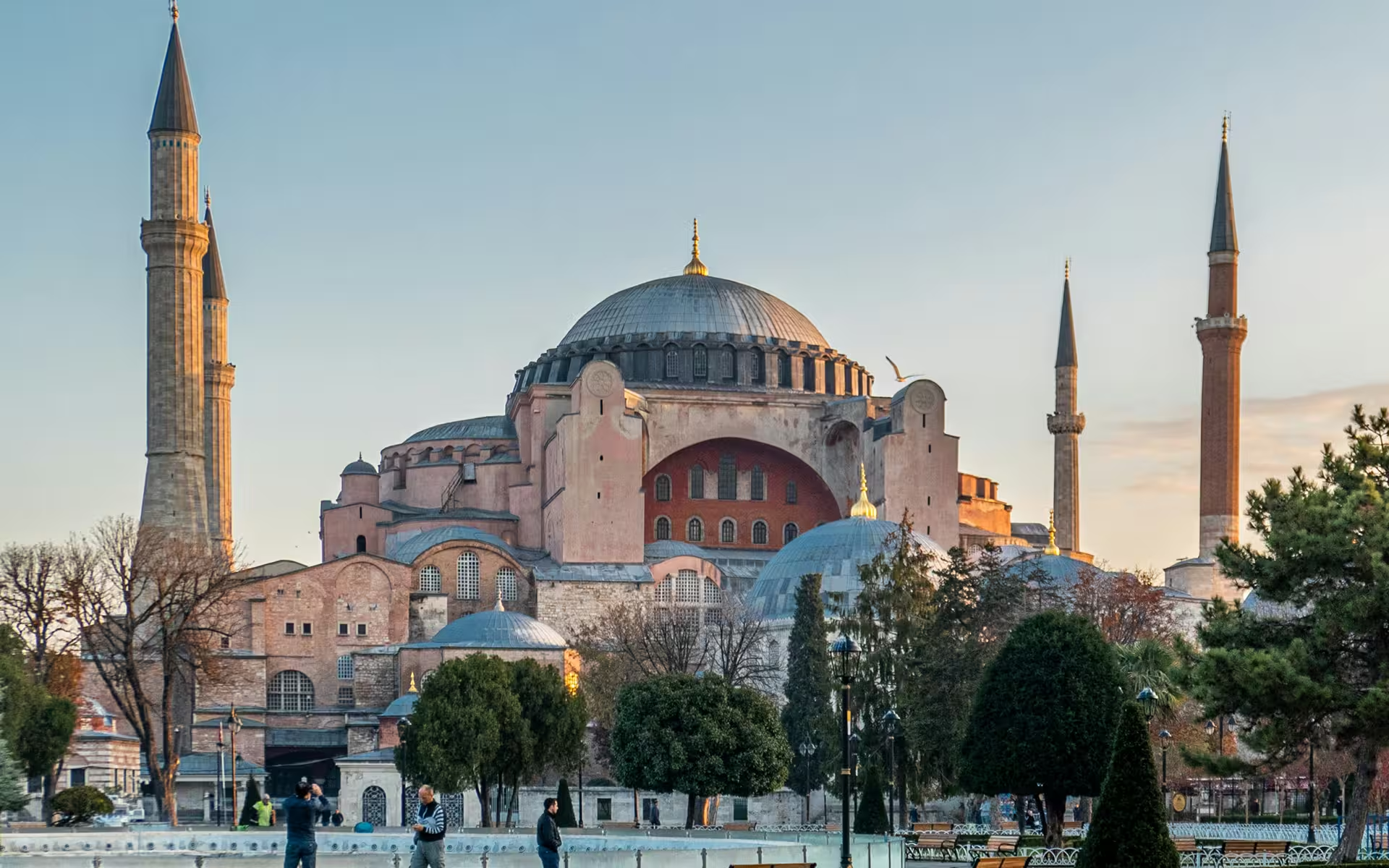
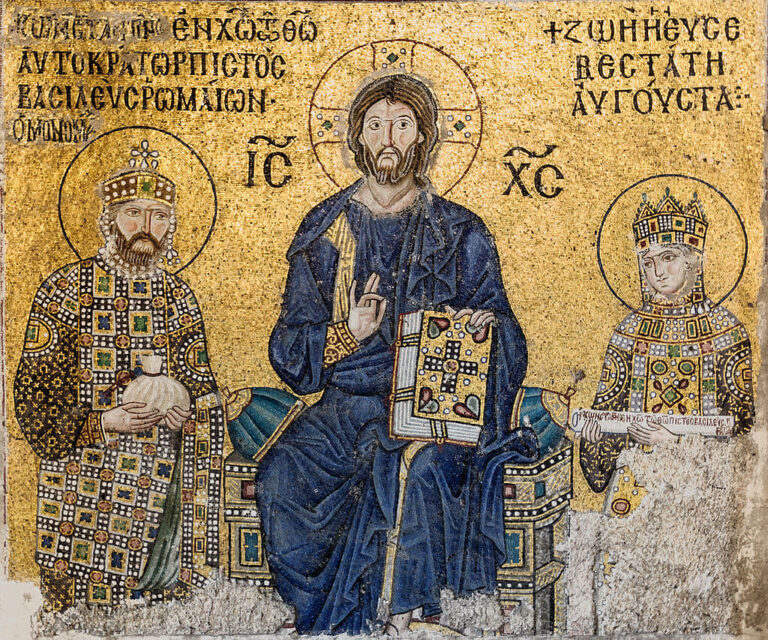
Hagia Sophia still preserves some of the greatest mosaics of the Byzantine world, along with much of its original decorative ornament.
Turned into a mosque in 1453, then into a museum in 1934, it was reconverted into a mosque in 2020. Now it is open to visitors outside prayer times, though some Byzantine mosaics are covered during prayers. No visit to Byzantine Istanbul is complete without it.
The Basilica Cistern
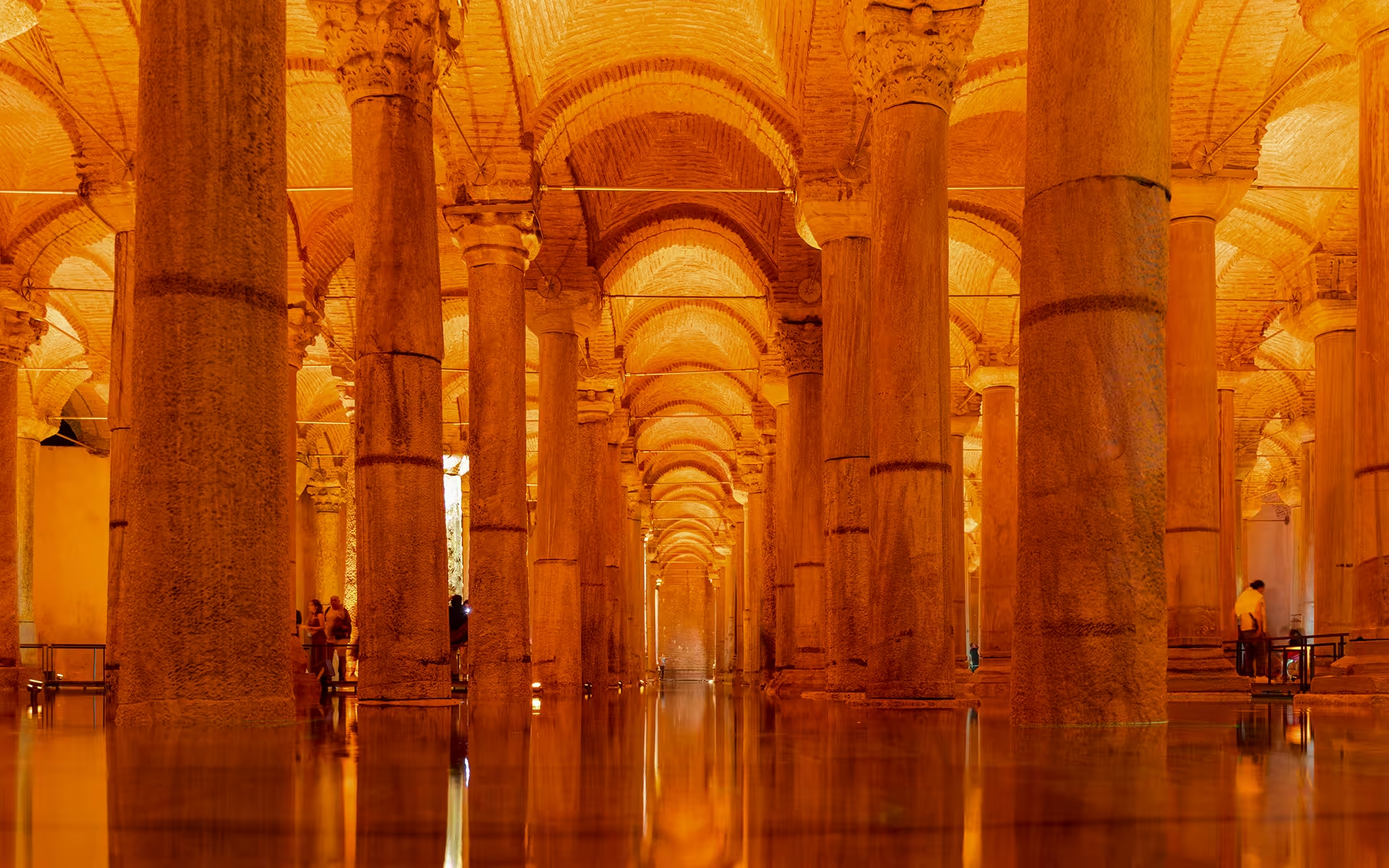
Also built under Justinian I in 532, the Basilica Cistern is one of the largest and best-preserved Byzantine cisterns in the world, capable of holding 80,000 cubic metres of water. Its 336 marble columns — many recycled from earlier Roman structures, including two bases carved with Medusa heads — create an otherworldly atmosphere beneath the city streets. Recently renovated with atmospheric lighting, it is one of the most memorable underground experiences in Istanbul.
Chora Church
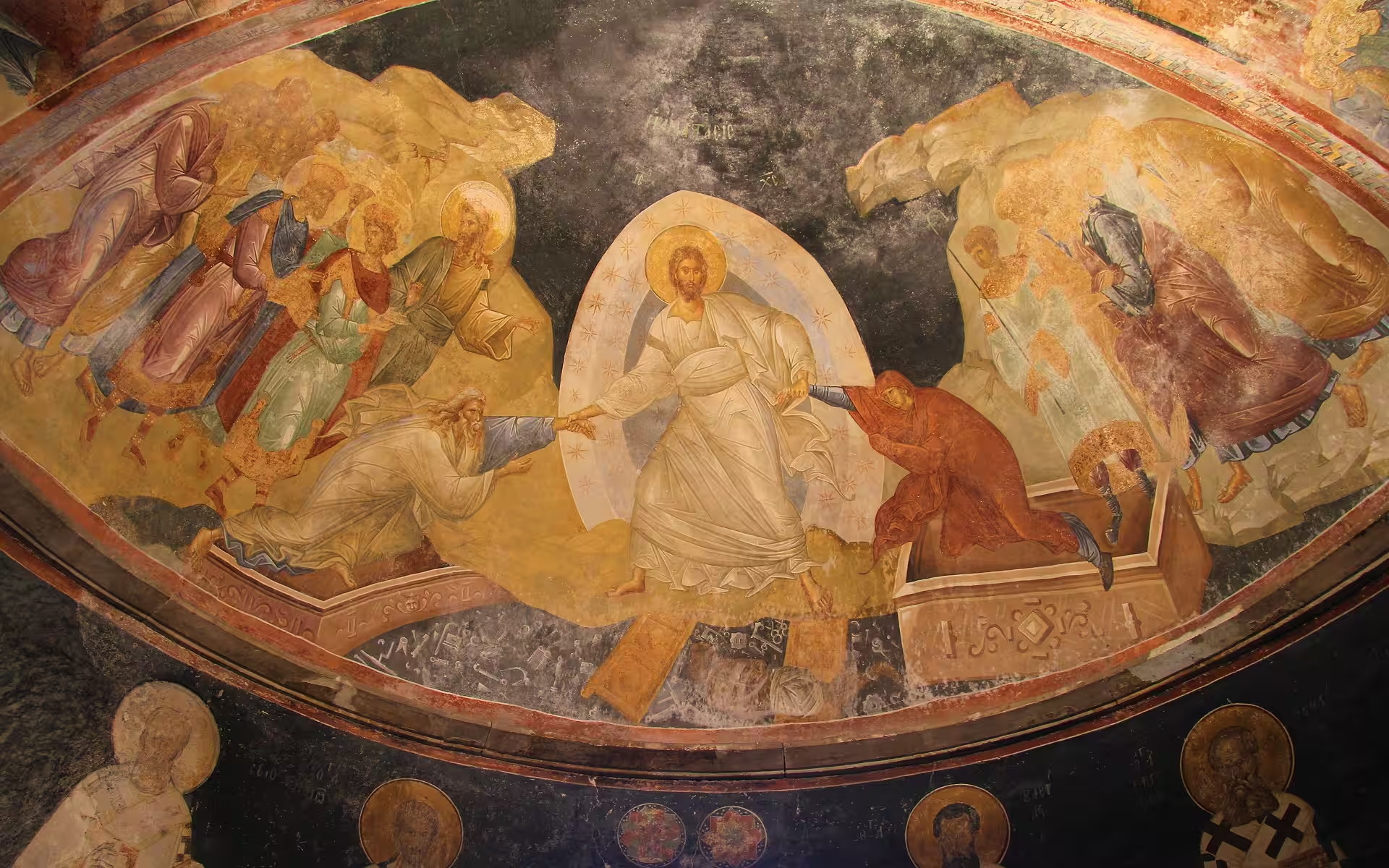
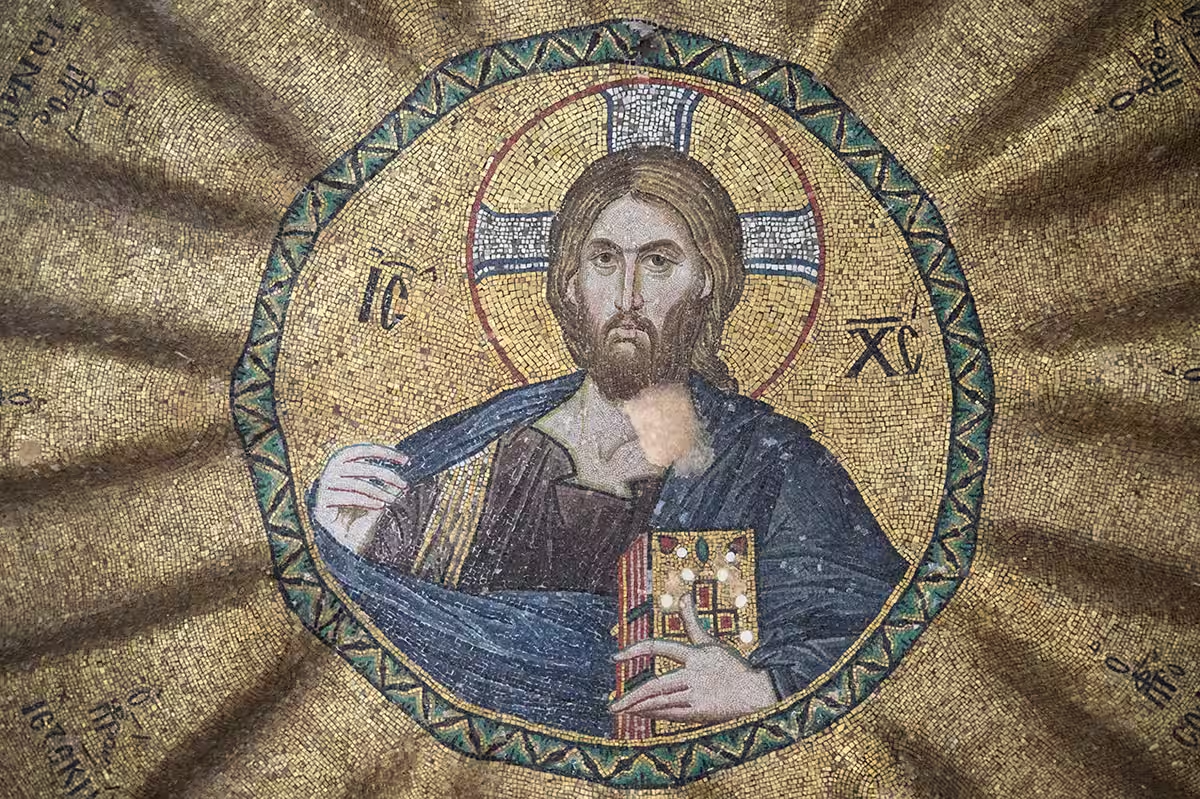
The Church of the Holy Saviour in Chora contains what many consider the finest surviving Byzantine mosaics and frescoes in the world, created during the Palaiologan Renaissance. Every surface of its narthex and parekklesion is covered with scenes of breathtaking beauty and narrative sophistication.
Like Hagia Sophia, Chora was reconverted into a mosque in 2020, so check current access conditions before visiting. It sits near the land walls at Edirnekapı, making it easy to combine with a visit to the Walls.
→ Explore the most complete surviving program of Palaiologan art
Hagia Irene
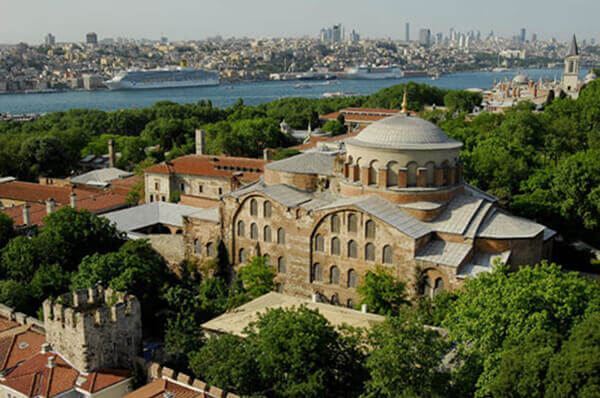
One of the oldest Byzantine churches in Istanbul, Hagia Irene predates Hagia Sophia and served as the city’s principal cathedral before its completion. Unlike almost every other Byzantine church in the city, it was never converted into a mosque — used instead as an arsenal, which paradoxically helped preserve its structure. Its austere interior is one of the most atmospheric in Istanbul, culminating in a rare surviving example of iconoclast art: a simple gold mosaic cross in the apse, a haunting reminder of the 8th-century controversy that shook the empire. Located inside the Topkapi Palace grounds, it is easy to combine with a visit to Hagia Sophia.
The Theodosian Walls
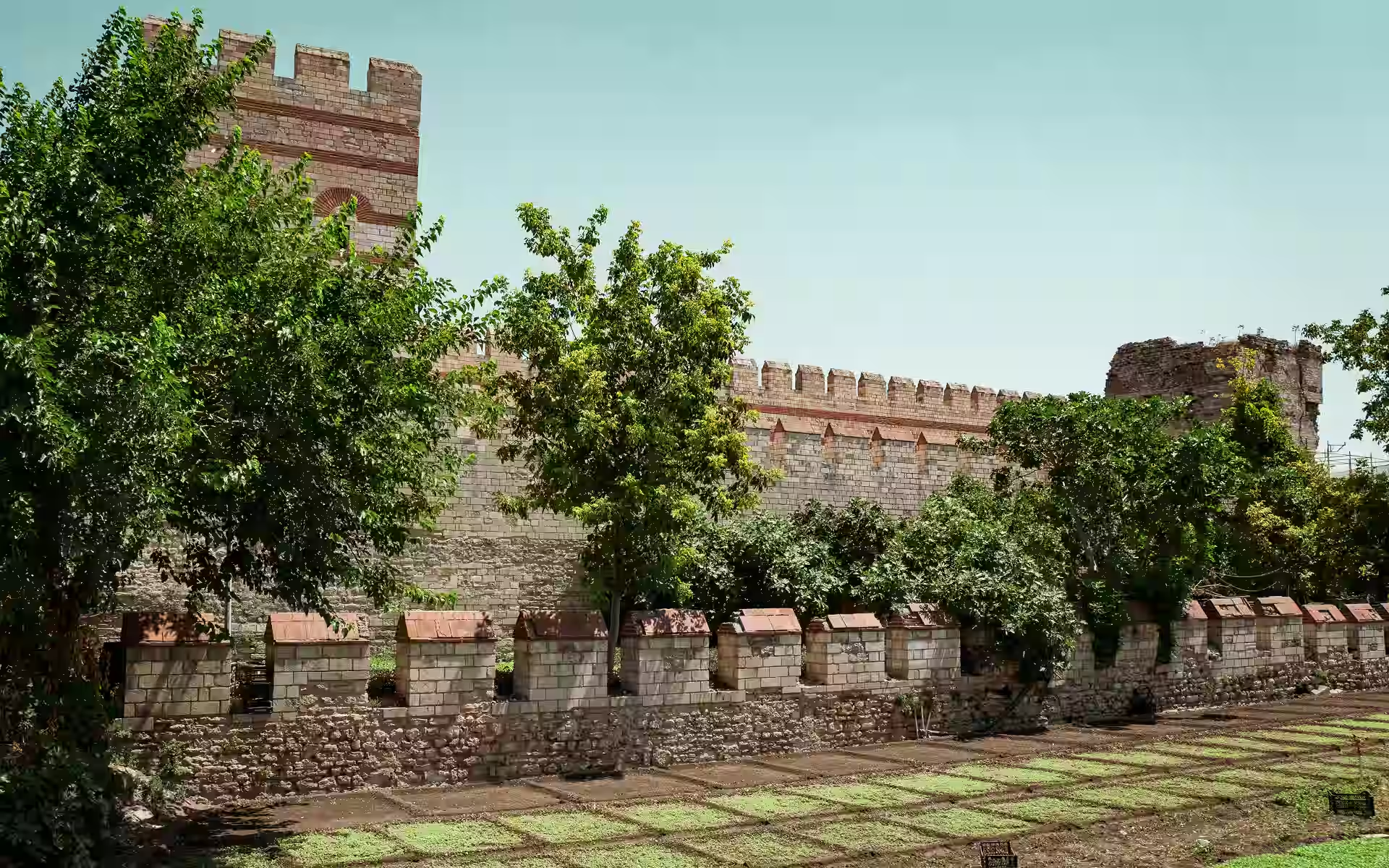
Stretching nearly 7 kilometres across the peninsula, the Theodosian Walls are one of the most impressive surviving examples of ancient military architecture in the world. Built under Emperor Theodosius II in the early 5th century, they protected Constantinople for over a thousand years before finally falling in 1453.
Large sections remain remarkably intact, and walking the walls — particularly around Edirnekapı and Yedikule — offers a visceral sense of the city’s Byzantine scale.
Sultanahmet — the Byzantine capital‘s heart
Sultanahmet was the civic and religious core of Constantinople. The Great Palace, the Hippodrome, Hagia Sophia, and the city’s most important churches all stood within walking distance of each other — and much of that concentration survives today. After visiting the unmissables, these are the sites that reward a slower exploration of the neighbourhood.
Little Hagia Sophia
Cofounded by Justinian I and his wife Theodora between 527 and 536, the Church of Saints Sergius and Bacchus is thought to be a direct prototype for Hagia Sophia, experimenting with the centralized domed plan that would culminate in the Great Church a few years later. Its interior retains beautiful marble columns and an inscribed frieze dedicating the church to the emperor and empress Theodora. Now an active mosque, it remains one of the most elegant and least crowded Byzantine buildings in the city.
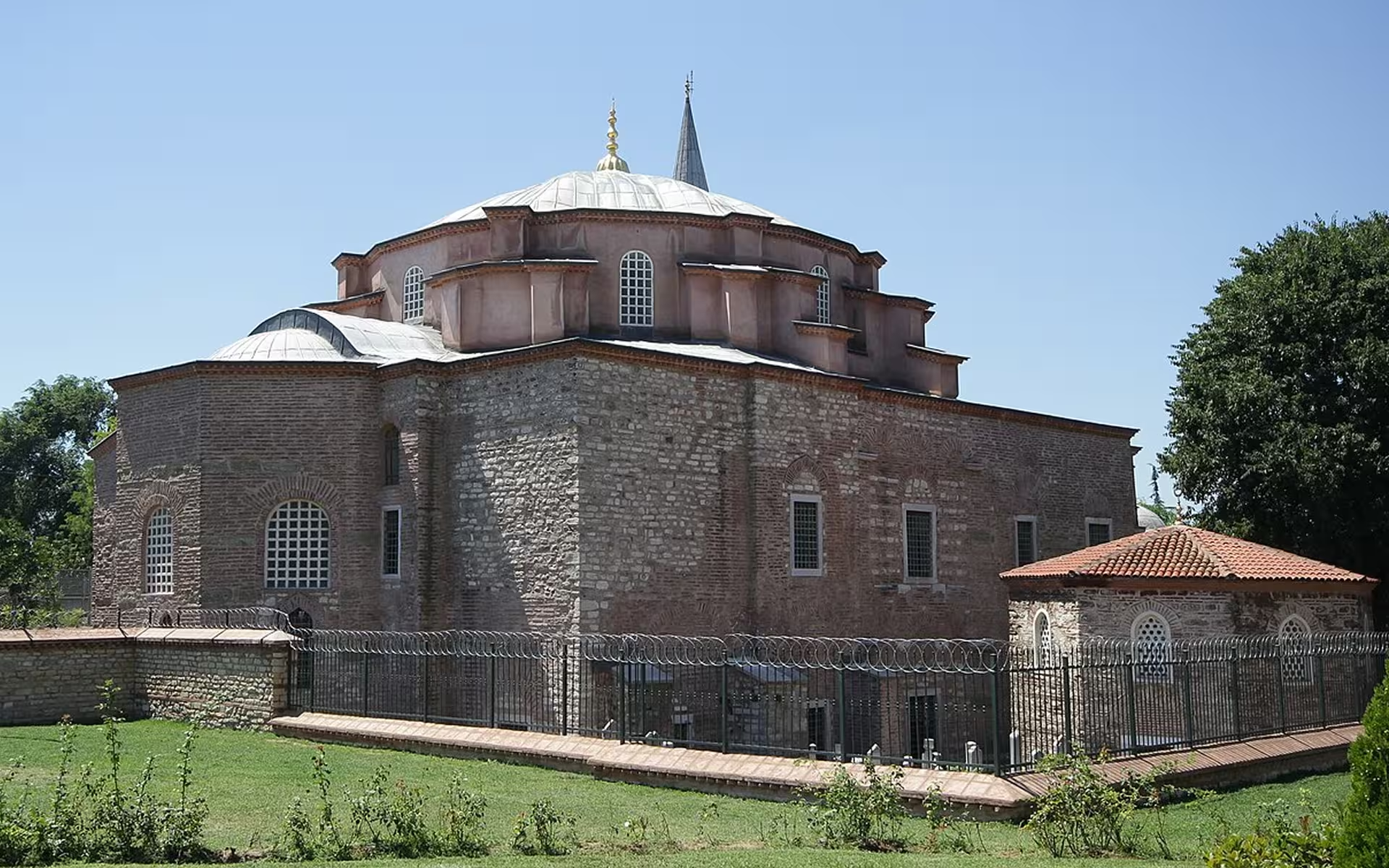
© Bollweevil, CC-by-SA 3.0
The Hippodrome
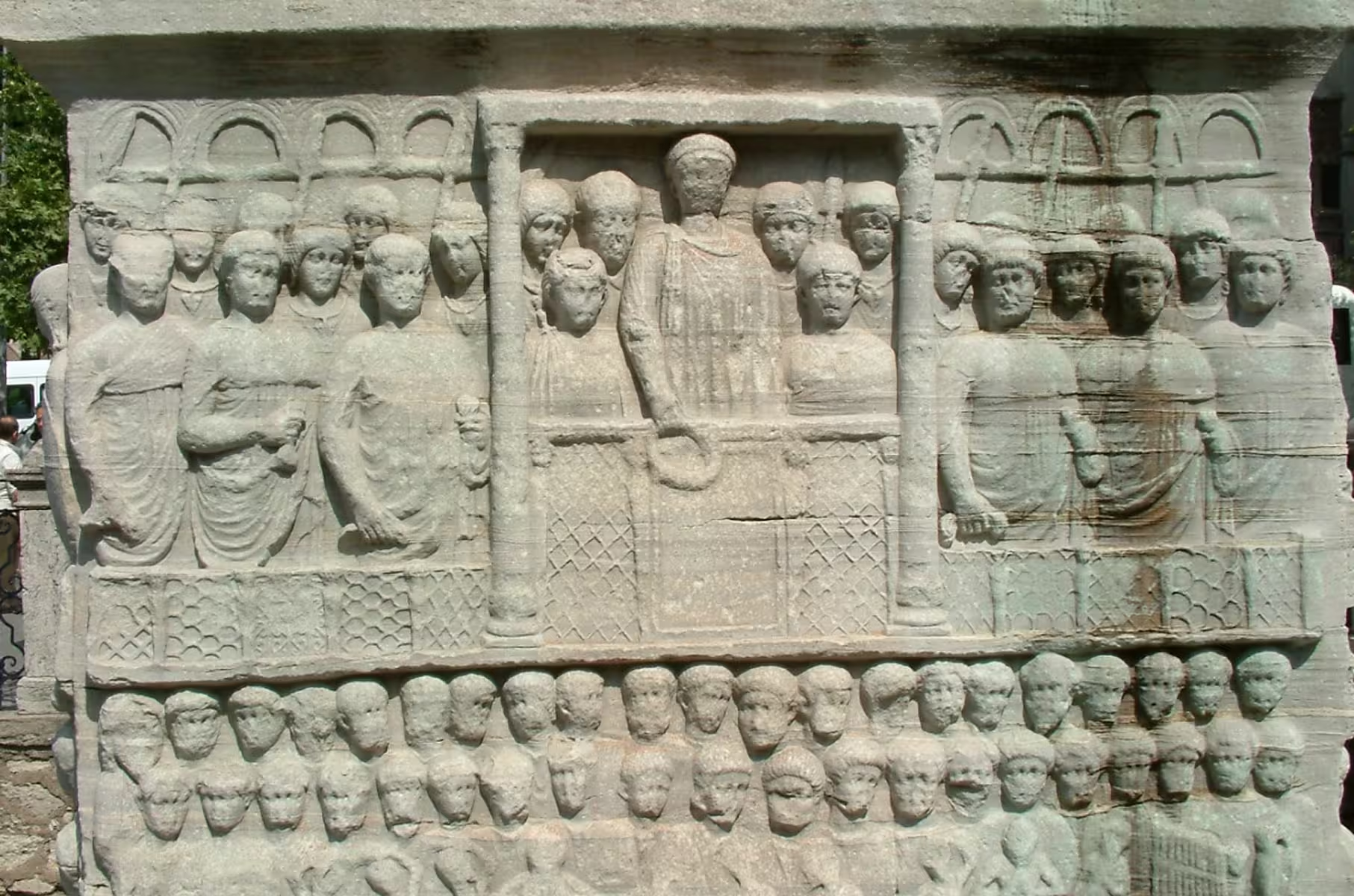
©Radomil talk, CC-by-SA 3.0
The Hippodrome was the beating heart of Byzantine public life — a vast chariot-racing stadium that could hold up to 100,000 spectators and doubled as the empire’s showcase for imperial ceremony and propaganda. Though the stadium itself has long disappeared beneath the modern square, its spina and three of its ancient monuments survive in place: the Egyptian Obelisk, the Serpentine Column, and the Column of Constantine. Walking among them today, it is easy to forget you are standing on what was once the most important public space in the medieval world.
The Great Palace
For nearly 700 years, the Great Palace was the epicentre of Byzantine imperial power — a vast complex of halls, churches, gardens, and ceremonial spaces stretching from the Hippodrome to the Sea of Marmara. Little survives above ground, but two remarkable remnants allow visitors to glimpse its former grandeur.
→ Read more about the history and layout of the Great Palace
The Great Palace Mosaic Museum
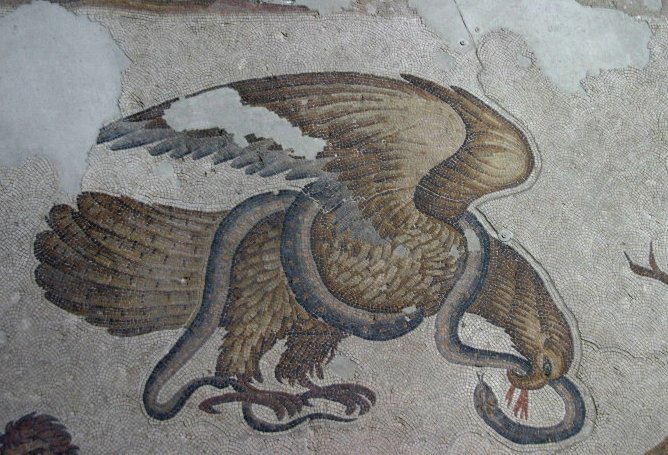
Hidden beneath a modest entrance near the Blue Mosque, this museum preserves a vast 6th-century mosaic pavement from the palace floors, depicting hunting scenes, pastoral life, mythological creatures, and children at play.
One of the finest surviving examples of early Byzantine secular art, it is consistently overlooked by visitors and deserves far more attention than it receives.
The Boukoleon Palace
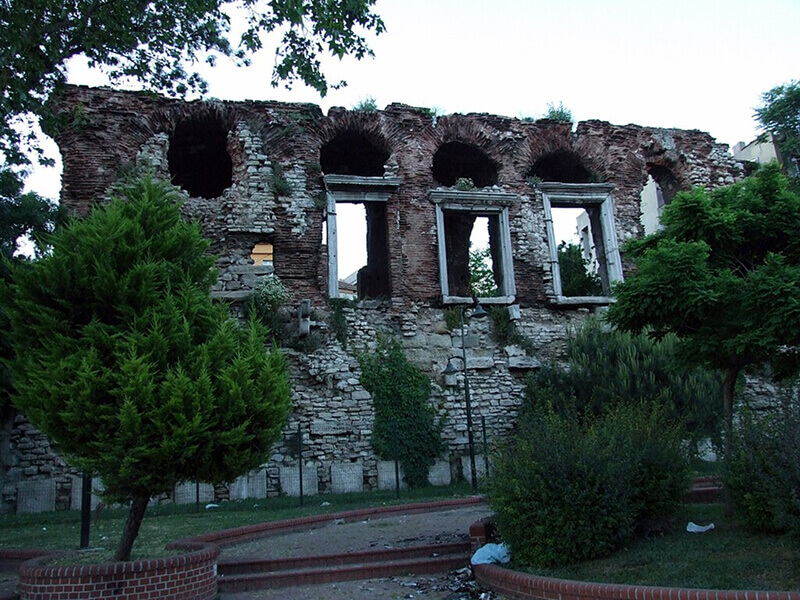
Stretching along the Sea of Marmara shore, the ruins of the Boukoleon are among the most evocative in Istanbul — three great marble-framed windows and a tower standing half-forgotten beside the railway line. Dating to the reign of Theophilos in the 9th century, it served as an imperial sea residence with its own private harbour.
Still in good condition in the 19th century, it was subsequently damaged by the construction of the railway. Recently restored and turned into an archaeological park, it remains one of the rare surviving examples of Byzantine imperial secular architecture still standing at scale.
→ Read more about Boukoleon palace and the other imperial palaces of Constantinople
Istanbul Archaeological Museum
Located just below Topkapi Palace, the Istanbul Archaeological Museum houses one of the most important Byzantine collections in the world, often overlooked by visitors rushing toward the Topkapi treasures above. Its Byzantine galleries contain sculpture, architectural fragments, sarcophagi, and objects spanning the full eleven centuries of the empire. Allow at least an hour to do justice to the Byzantine section alone.
Also worth seeking out
For those willing to search, Sultanahmet hides further Byzantine — and pre-Byzantine — traces: the Column of the Goths, a solitary granite column in the first courtyard of Topkapi Palace commemorating a 3rd-century Roman victory and among the oldest standing monuments in the city; the ruins of the Church of Saint Polyeuctus, once the grandest church in Constantinople before Hagia Sophia was built; scattered remains of the Palace of Antiochos; the outline of the Mese, the great colonnaded avenue that once ran from the Milion — the empire’s zero-point for all distances — through the heart of the city; and the Theodosius Cistern (Şerefiye Cistern).
Fatih
Beyond Sultanahmet, the historic peninsula’s central and western quarters preserve some of Constantinople’s most atmospheric Byzantine survivals, scattered among Ottoman neighbourhoods and rarely visited by tourists.
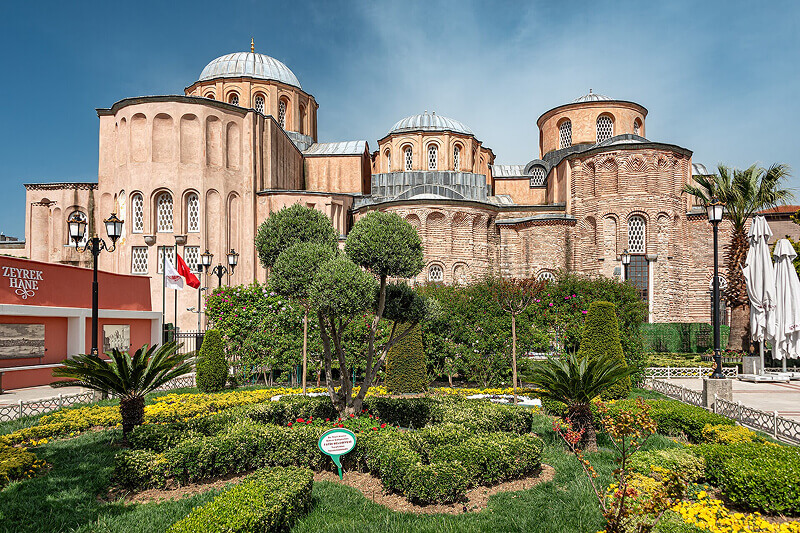
Pantokrator Monastery (Zeyrek Mosque)
The most important Byzantine monument in Istanbul after Hagia Sophia that most visitors never see. Built in the 1120s–1130s by Emperor John II Komnenos and his wife Eirene, the complex originally comprised three interconnected churches — the only surviving example of a multi-nave Byzantine church in the city.
The middle chapel served as an imperial mausoleum; John II, Manuel I, and other Komnenian emperors were buried here. The building functions today as a mosque, but its Byzantine structure is immediately legible: the blind arcading, the alternating brick-and-stone masonry, the spatial complexity of the three connected naves. The surrounding neighbourhood, tumbling down towards the Golden Horn, is one of the most evocative in the city.
→ Discover the second biggest Byzantine monument still standing in Istanbul after Hagia Sophia
Myrelaion (Bodrum Mosque)
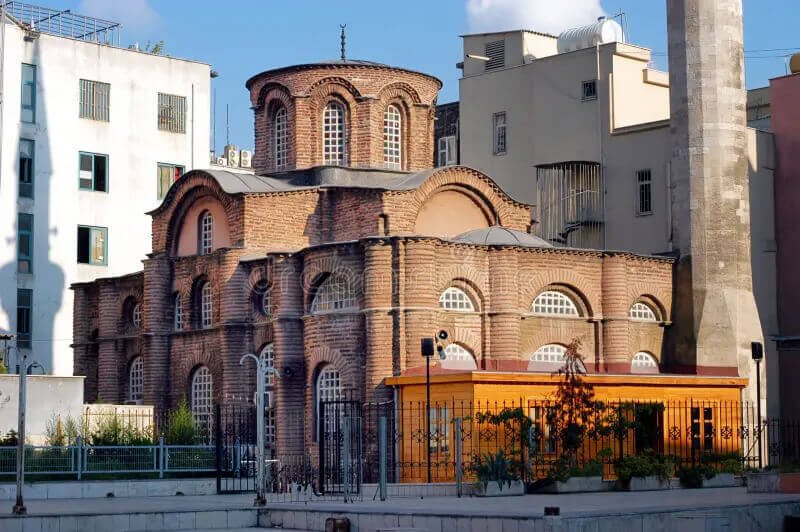
Built by Emperor Romanos I Lekapenos in the 920s, the Myrelaion stands on a striking substructure: a 5th-century vaulted rotunda that Romanos converted into a cistern to provide the foundations for his church above. He intended it as an imperial mausoleum, and his wife Theodora was buried here.
The church is now a mosque, but the Byzantine brickwork and the dramatic vaulted undercroft — visible from the street — make it one of the more rewarding lesser-known stops in the city.
Also worth seeking out
the Aqueduct of Valens, striding the district’s main ridge on 26-metre arches; the Column of Marcian, a 5th-century honorific column hidden in a quiet side street; the Church of Constantine Lips (Fenari Isa Mosque) and the Church of Christ Pantepoptes (Eski İmaret Mosque), both converted Byzantine churches with fine brickwork. Along the Golden Horn in Fener, Saint Mary of the Mongols — the only church in Istanbul never converted to a mosque — and Gül Camii, the Rose Mosque, whose name preserves the memory of the rose garlands decorating it on the night Constantinople fell.
Blachernae & the Land Walls
The northwestern corner of the historic peninsula — where the Theodosian Walls reach the Golden Horn — was among the most politically significant districts of late Byzantine Constantinople. From the 11th century onwards, the Blachernae Palace replaced the Great Palace as the principal imperial residence, and it was here that the last emperors of Byzantium ruled as the empire contracted around them.
The Theodosian Walls are covered among the unmissables above. Coming here to walk them, however, brings you naturally to several other sites worth seeking out.
Palace of the Porphyrogenitus (Tekfur Sarayı)
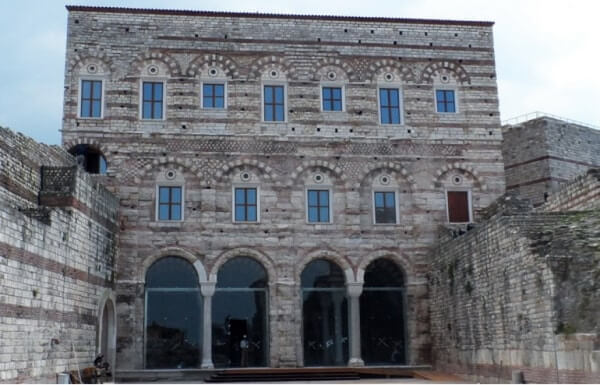
The best preserved surviving above-ground Byzantine palace facade in Istanbul, and one of the most visually striking Byzantine buildings anywhere. Built in the late 13th or early 14th century as an annex to the Blachernae Palace complex, its three-storey facade of alternating red brick and white stone — decorated with geometric patterns — represents Byzantine secular architecture at its most refined. Recently restored, it now houses a small museum. The palace stands directly against the Theodosian Walls, and the junction of the two structures is worth examining closely.
Blachernae Palace
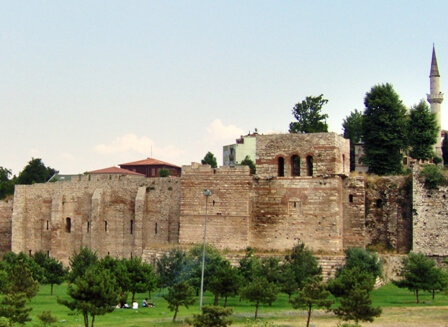
Little survives above ground of the palace that housed the Byzantine emperors for their final four centuries, but the fragmentary remains — a stretch of walled terracing, the so-called Prison of Anemas built into the walls, a few vaulted chambers — carry considerable historical weight.
This is where Alexios I Komnenos received the leaders of the First Crusade, where the Latin emperors held court after 1204, and where Constantine XI spent his last night before the fall of the city on 29 May 1453.
Also worth seeking out
the Golden Gate at the southern end of the walls, a triumphal triple arch in white marble built by Theodosius I and later incorporated into the Theodosian fortifications — the ceremonial entrance through which emperors entered Constantinople in triumph; and the Blachernae shrine, site of the most venerated icon of the Virgin in Constantinople, the Theotokos Blachernitissa, though the current structure is largely post-Byzantine.
Suggested Itinerary
The sites in this guide span the full breadth of the historic peninsula. Three days allows a comfortable pace; two is possible if you prioritise.
Day 1 — Sultanahmet
Start at Hagia Sophia as early as possible — the crowds build quickly. From there, the Basilica Cistern is a five-minute walk. Spend the middle of the day in the Sultanahmet core: the Hippodrome, Little Hagia Sophia, and the Great Palace sites (Mosaic Museum and Boukoleon). The Archaeological Museum rewards a full afternoon. End with Hagia Irene, which is quietest late in the day.
Day 2 — Fatih & Fener
Head up from Sultanahmet along the ridge to the Pantokrator Monastery — the Aqueduct of Valens is visible en route and worth a pause. Descend towards the Golden Horn via the Myrelaion, then follow the shore northwest through Balat to Fener: Saint Mary of the Mongols and Gül Camii are within easy walking distance of each other. The Column of Marcian fits naturally into a morning in Fatih if you have time.
Day 3 — Chora & the Land Walls
Begin at Chora Church (Kariye Mosque), ideally in the morning. Walk north along the walls to the Palace of the Porphyrogenitus and the Blachernae remains. If the Golden Gate interests you, it is at the far southern end of the walls — easiest reached by taxi rather than on foot.
Practical Tips
When to go
April–May and September–October offer the best combination of mild weather and manageable crowds. July and August are hot and busy; winter is quieter, with shorter opening hours at some sites.
Getting around
The historic peninsula is walkable in principle but hilly in practice. Sultanahmet is compact; Fatih and Fener involve more climbing. The Marmaray (metro) and tram T1 line connect the main hubs. For the land walls, a taxi to Edirnekapı or the Golden Gate saves considerable time.
Mosque etiquette
Many of Istanbul’s Byzantine churches function as mosques — including Hagia Sophia, Chora, Little Hagia Sophia, and the Pantokrator. Visitors should cover shoulders and knees; women are expected to cover their hair (scarves are usually available at the entrance). All mosques close to non-worshippers during the five daily prayers, which typically last 20–30 minutes.
Tickets & booking
Hagia Sophia is free to enter as a mosque. The Basilica Cistern should be booked in advance online, especially in high season. Chora Church and the Archaeological Museum charge entry fees; the Istanbul Museum Pass covers both and pays for itself quickly if you visit several state museums. The Palace of the Porphyrogenitus also has an entry fee.
A note on Yenikapı
Beneath the Yenikapı transport hub, excavated during the construction of the Marmaray tunnel, archaeologists uncovered the ancient harbour of Constantinople along with 37 Byzantine shipwrecks — one of the most significant Byzantine archaeological finds of recent decades. The site itself is not open to visitors, but the shipwrecks and thousands of recovered artefacts are displayed at the Istanbul Archaeological Museum, making it an essential stop for anyone serious about Byzantine history.


One Comment