Justinian I: The Byzantine Emperor who tried to restore Rome
No Byzantine ruler cast a longer shadow than Justinian I. In a reign of nearly forty years (527–565) he reconquered much of the lost Roman West, codified Roman law into a form that still underpins the legal systems of Europe, and raised Hagia Sophia, the greatest church of the age. He also survived a revolt that nearly cost him his throne and a plague that carried off a third of his capital. Brilliant, tireless, and endlessly ambitious, Justinian was the last emperor to rule a truly Mediterranean-wide Roman empire — and his reign is where the late Roman world becomes recognisably Byzantine.
Quick facts about Justinian
Reign: 527–565
Born: c. 482, in Illyria (the Balkans)
Empress: Theodora
Capital: Constantinople
Remembered for: the Corpus Juris Civilis, the reconquest of Africa and Italy, and Hagia Sophia.
From peasant to emperor
Justinian’s origins were humble. He was born around 482 at Tauresium, a village in the Latin-speaking Balkans (near modern Skopje, in North Macedonia), into a peasant family. His fortunes were made by his uncle Justin, an illiterate peasant who rose through the army to command the imperial guard and then, in 518, seized the throne itself as Justin I.
Justin summoned his nephew to Constantinople, gave him the education he had never had, adopted him, and groomed him as his heir. Justinian was effectively running the government for years before Justin’s death in 527 made him sole emperor.
At his side stood one of the most remarkable figures of the age: the empress Theodora. A former actress of low birth, she became Justinian’s trusted partner and co-ruler — he even had the marriage law changed so he could wed her — and her nerve would soon save his reign.
The Nika riots (532)
Five years into his reign, Justinian nearly lost everything. In January 532, anger over heavy taxation and the harshness of his ministers fused the two rival factions of the Hippodrome — the Blues and the Greens, normally bitter enemies — into a single furious mob. Their shared war-cry gave the revolt its name: Nika! — “Conquer!” For nearly a week the rioters held the streets, burned much of the ceremonial centre of the city, and proclaimed a rival emperor — Hypatius, a reluctant nobleman of the old senatorial aristocracy.
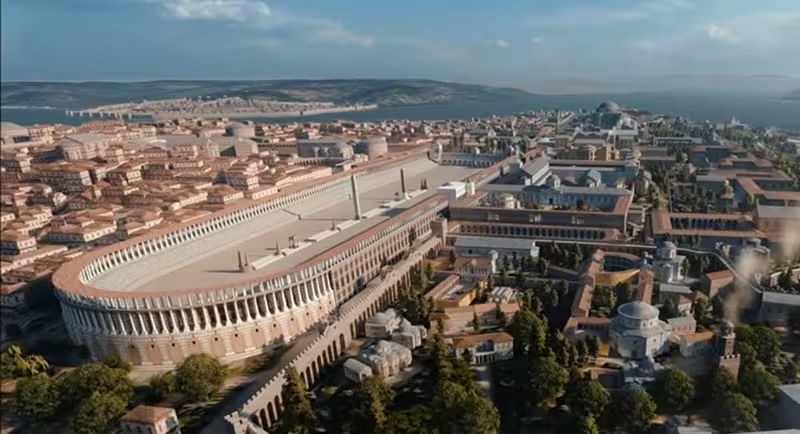
Besieged in the Great Palace, Justinian was on the point of fleeing when, according to the historian Procopius, Theodora stiffened his resolve, declaring that the imperial purple made a fine burial shroud. He stayed. His generals Belisarius and Mundus led their troops into the packed Hippodrome and cut the rioters down — some thirty thousand were killed. Justinian kept his throne, and the gutted heart of Constantinople gave him the opportunity to rebuild it more magnificently than ever.
The law of Justinian: the Corpus Juris Civilis
Justinian’s most enduring achievement was not a conquest or a building but a book. Roman law had grown into a vast, contradictory tangle over a thousand years. Justinian ordered it collected, pruned, and organised — a monumental task led by the jurist Tribonian. The result, later known as the Corpus Juris Civilis (“Body of Civil Law”), appeared in the 530s in several parts: the Codex (imperial statutes), the Digest (the distilled wisdom of the great jurists), the Institutes (a students’ textbook), and the Novellae (Justinian’s own new laws, most issued in Greek).
Its influence is hard to overstate — so much so that it deserves its own place in his legacy, below. Rediscovered in medieval Italy, it became the foundation of the civil-law tradition still followed across much of the world.
The reconquest of the West
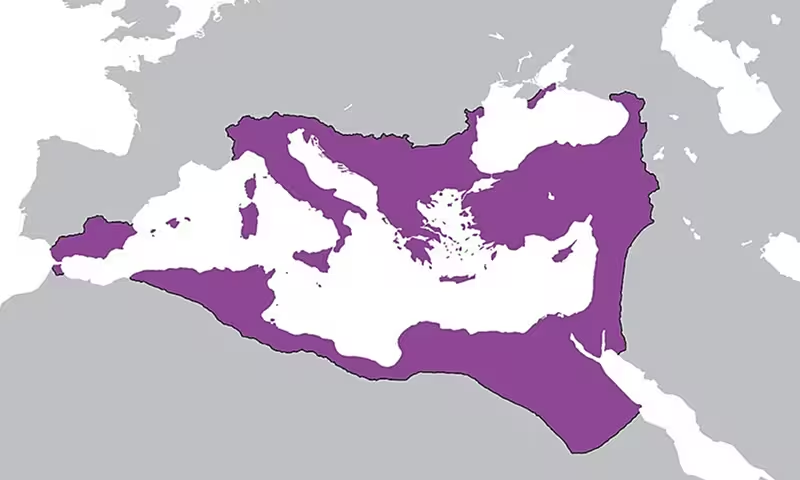
Justinian dreamed of a renovatio imperii — the restoration of the Roman Empire in the West, lost to Germanic kingdoms in the previous century. Through his brilliant generals he came remarkably close.
- North Africa (533–534): Belisarius destroyed the Vandal kingdom in a lightning campaign, restoring the wealthy provinces of Africa to Roman rule.
- Italy (535–554): the Gothic War against the Ostrogoths was longer and far more terrible. Belisarius took Rome and Ravenna, but the Goths rallied under Totila, and Italy was fought over, besieged, and devastated for two decades before the aged general Narses finally secured it.
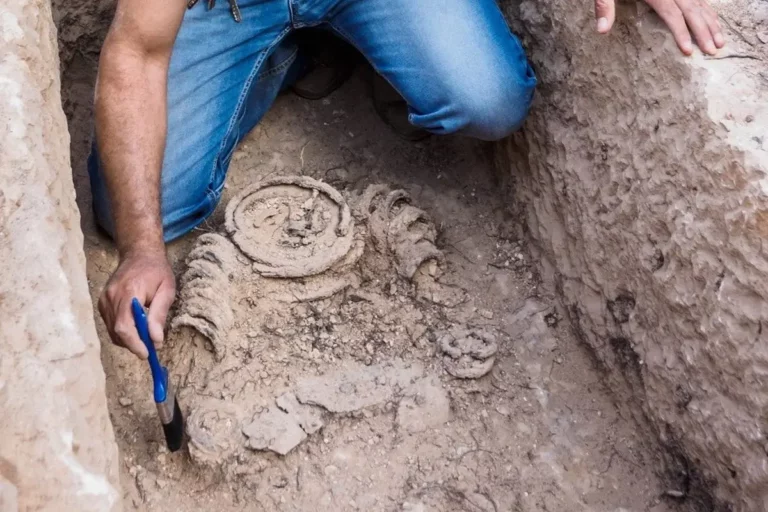
- Spain (c. 552): Roman forces seized a strip of the south-east from the Visigoths, creating the province of Spania — a Byzantine foothold whose traces are still being uncovered by archaeologists, as at the Castellum of Elo and its monastery.
At its height, Justinian’s empire once again ringed the Mediterranean — a “Roman lake,” and the imperial triumph was celebrated in art, above all in the Barberini Ivory, a diptych of a victorious emperor widely identified as Justinian and one of the masterpieces of Byzantine ivory-carving. But the conquests were overstretched and ruinously expensive, and Italy in particular had been wrecked by the very war that reclaimed it. Just three years after Justinian’s death, the Lombards poured into Italy and swept away much of what he had won.
The great builder
If the law was Justinian’s most lasting work and the reconquest his most spectacular, his building programme was the most visible — and the most far-reaching in its influence on the world’s architecture. His court historian Procopius devoted an entire book, On Buildings (De Aedificiis), to cataloguing it, from the capital to the desert frontiers. No emperor before or since built on such a scale.
The churches and monuments of Constantinople
The centrepiece was Hagia Sophia, rebuilt after the Nika fire and dedicated in 537 — the largest enclosed space in the world for nearly a thousand years, and the supreme achievement of Byzantine architecture.
It became one of the most important center of the Byzantine world and religion, surpassing even the great pilgrimage church of St Simeon Stylites in Syria, which had been the largest in Christendom since it was built under the emperor Zeno half a century earlier.
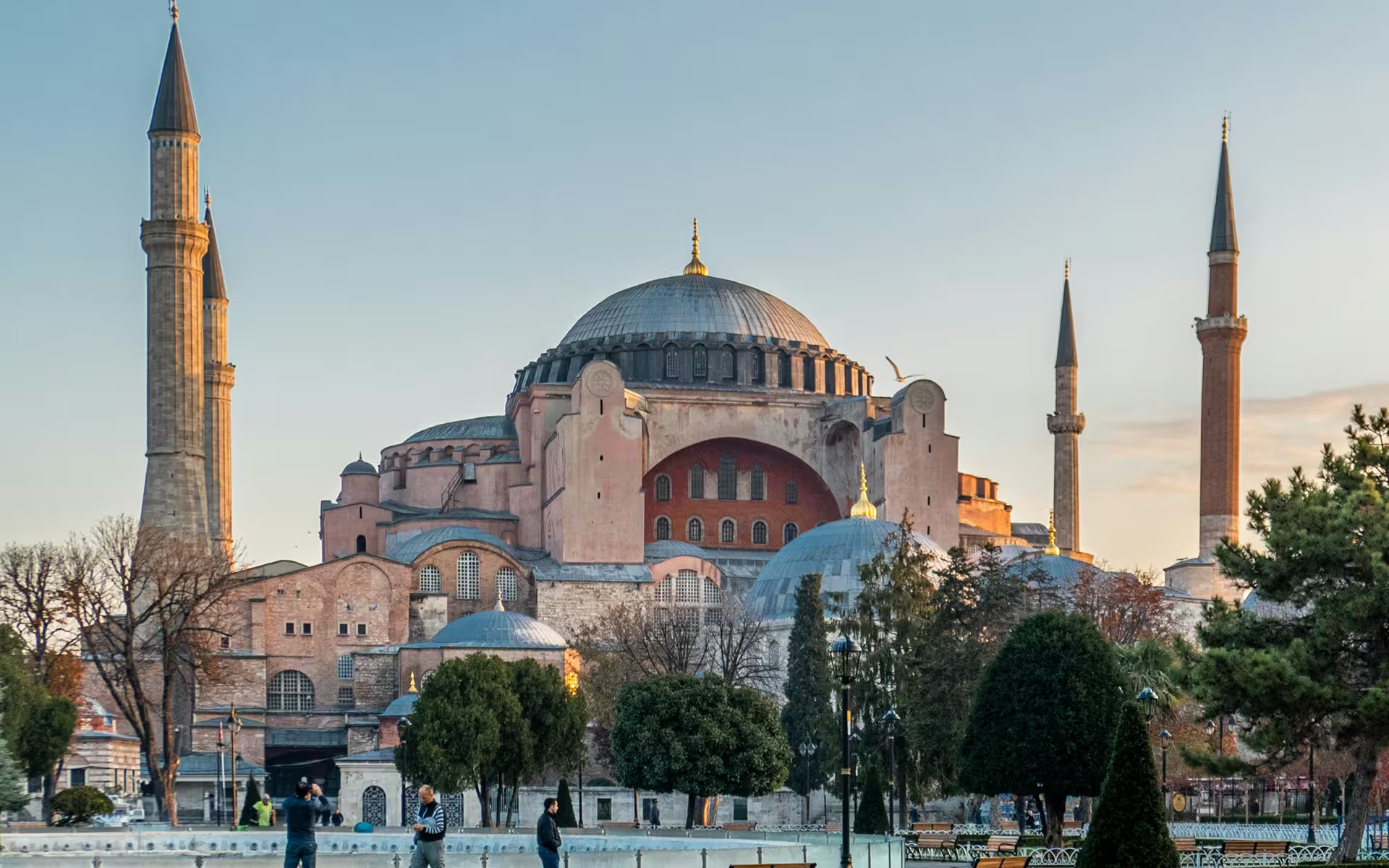
But Hagia Sophia did not stand alone. Justinian rebuilt the neighbouring Hagia Eirene, also burned in the riots; raised the exquisite domed church of Saints Sergius and Bacchus — the “Little Hagia Sophia,” a laboratory for the ideas realised in the great church; and secured the city’s water supply by enlarging the vast covered reservoir now known as the Basilica Cistern.
He also remade the ceremonial threshold of empire. The great bronze gatehouse of the palace, the Chalke, burned in the Nika revolt, was rebuilt and its ceiling sheathed in mosaics celebrating the triumphs of Belisarius — captured Vandal and Gothic kings led before Justinian and Theodora, ringed by a rejoicing Senate. And in the Augustaion, the ceremonial square between the palace and the cathedral, he raised the colossal Column of Justinian (c. 543): a towering shaft crowned by a bronze equestrian statue of the emperor in heroic armour, a globus cruciger in his left hand and his right flung out toward the East, commanding the Persians to keep the peace. It still stood when the Ottomans took the city in 1453; within a century the statue had been pulled down and melted for cannon, and the traveller Pierre Gilles, who saw the shattered fragments, marvelled that the emperor’s leg was taller than a man.
Above all, Justinian entirely rebuilt the Church of the Holy Apostles, the second church of the capital and the dynastic mausoleum of the emperors. His Holy Apostles was a cruciform, five-domed building that became one of the most influential designs in the history of architecture — the model, centuries later, for St Mark’s in Venice and St-Front in Périgueux, and an ancestor of countless Orthodox churches. It was here that Justinian himself would be buried. The church was demolished by the Ottomans after 1453 to make way for the Fatih Mosque, and survives now only in descriptions and its architectural progeny.
Beyond the capital
Justinian’s works ringed the whole empire:
- At Ephesus, he replaced the shrine over the tomb of St John the Evangelist with a monumental, six-domed Basilica of St John, one of the largest churches of its day — part of the city’s late flourishing before its long decline, told in our article on Byzantine Ephesus.
- At the foot of Mount Sinai, on the site traditionally identified as the Burning Bush, he founded and fortified the Monastery of St Catherine — which still stands, still inhabited: the best-preserved of all his churches, still holding a Justinianic mosaic of the Transfiguration among the finest in the Byzantine world.
- In Jerusalem, he built the enormous Nea Ekklesia of the Theotokos (dedicated 543), one of the great churches of the Holy Land.
- In the Balkans he raised the six-century Church of St Sophia at Serdica — the church that would eventually give the city of Sofia, the modern Bulgarian capital, its very name.
- Near his own birthplace he founded a brand-new city, Justiniana Prima (Caričin Grad, in modern Serbia), and had it raised to an archbishopric — a monument to his origins.
- Along the frontiers he threw up or rebuilt a chain of fortresses — most famously Dara on the Persian border — and refortified the Long Walls and the kastra of Thrace that screened the approaches to Constantinople, of the kind you can still see at Bizye (Vize).
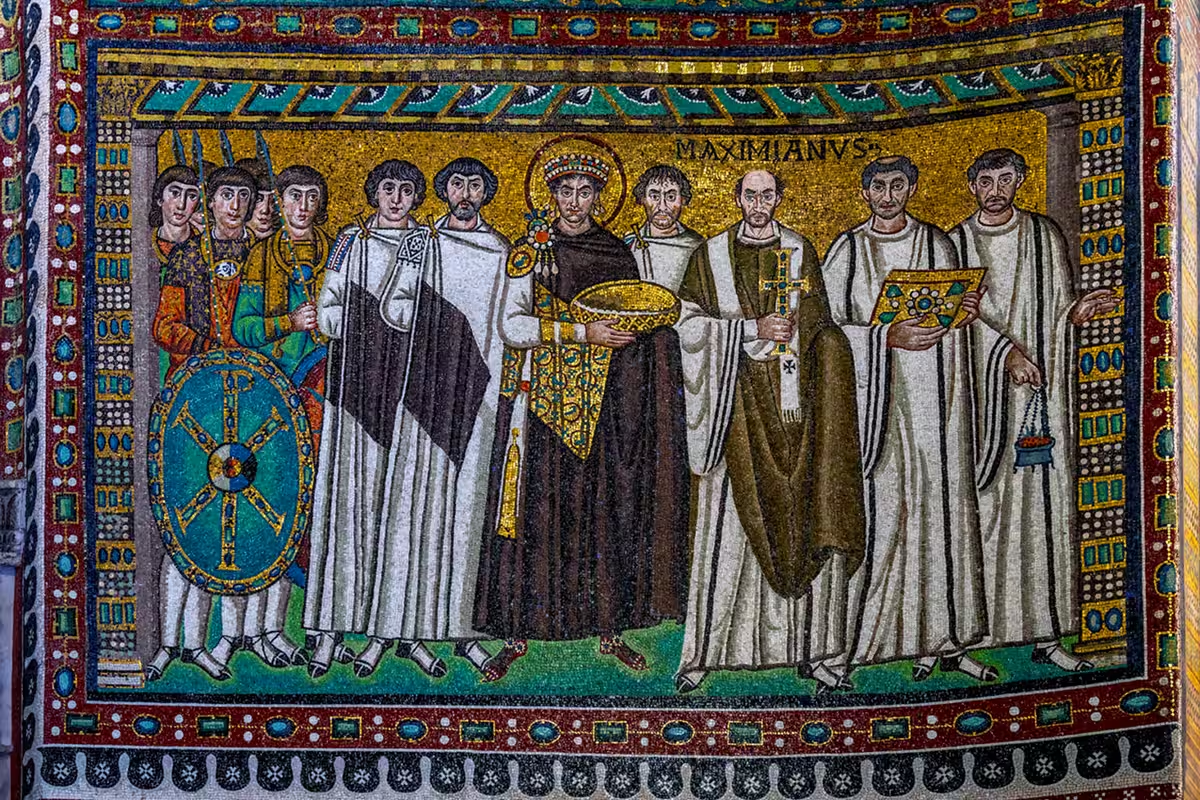
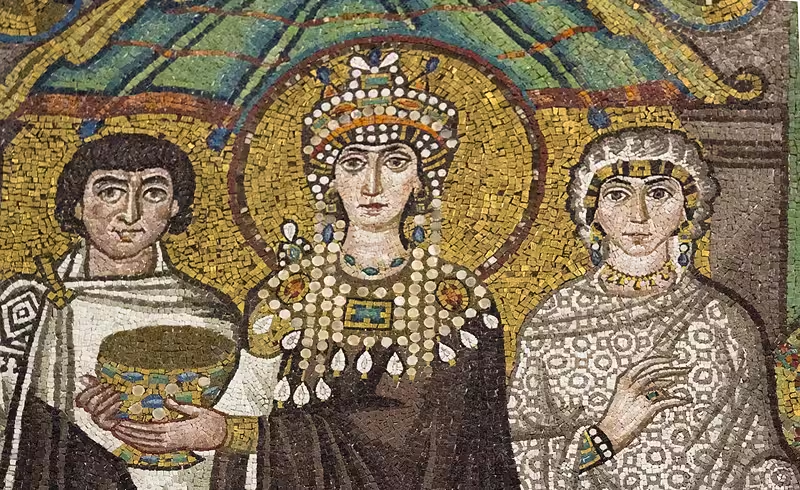
Even in the West, his age left masterpieces: the mosaics of San Vitale in Byzantine Ravenna, showing Justinian and Theodora in glittering procession toward the altar, remain the most famous images of the imperial couple and a highlight of Byzantine mosaic art.
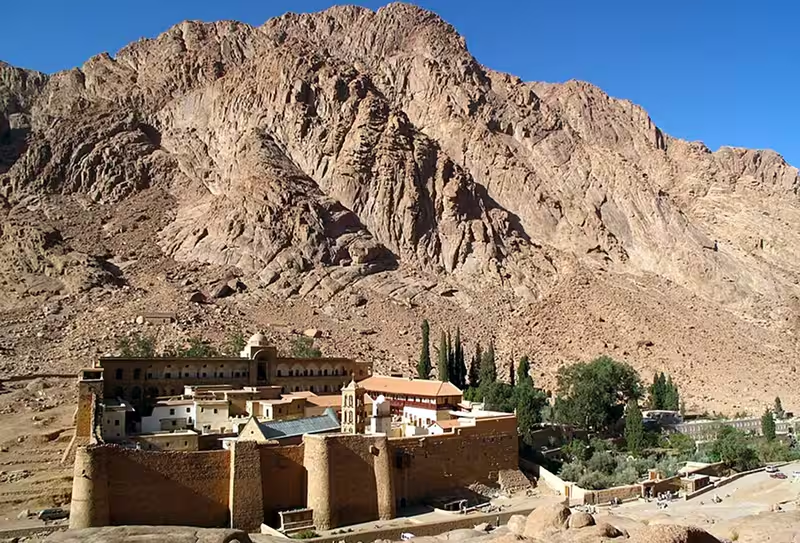
Saint Catherine monastery in the Sinai desert, built by Emperor Justinian. © Joonas Plaan, CC-by-SA 2.0 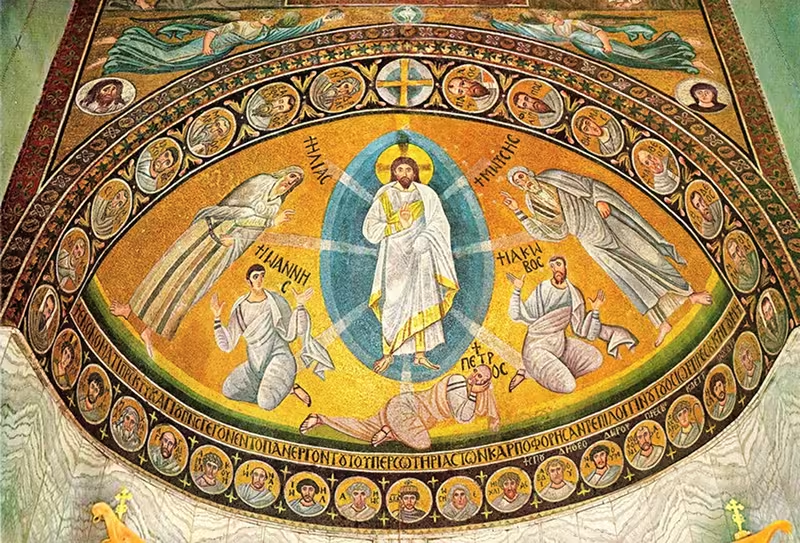
The Justinian apse mosaic of the Transfiguration at St Catherine’s monastery.
Life at court: where Justinian lived and how he ruled
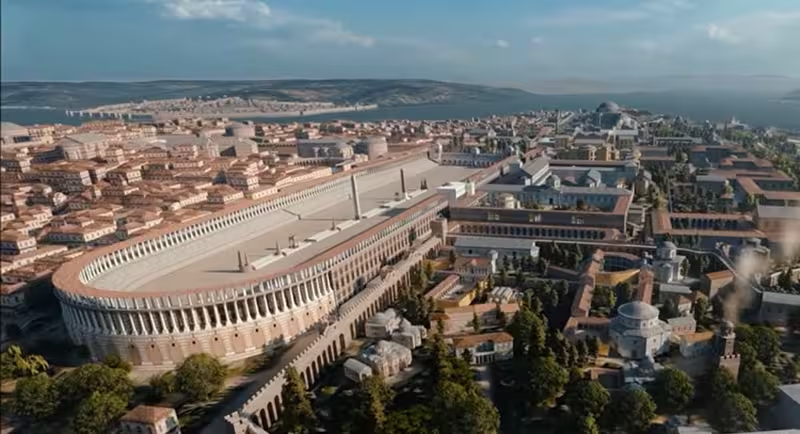
For all his armies and buildings, Justinian’s world was in practice a small and intensely ceremonial one, centred on the Great Palace of Constantinople — the sprawling complex of halls, courtyards, chapels and gardens that spread downhill from Hagia Sophia toward the sea. Its bronze Chalke gate opened onto the Augustaion, framed by the cathedral, the Senate house, and the palace; a private passage linked the palace directly to the imperial box, the kathisma, in the adjoining Hippodrome, so the emperor could appear before his people without ever leaving his own ground. Great receptions were staged in halls like the Magnaura, designed to overawe foreign envoys with the wealth and mystery of the empire.
The emperor’s life was governed by an elaborate rhythm of ceremony. Courtiers performed proskynesis — full prostration — before him; the circus factions greeted him with ritual acclamations at the Hippodrome; and on the great feasts he processed in state to Hagia Sophia, a living link between the earthly and heavenly courts. This choreography of power, later written down in the Book of Ceremonies, was already central to Justinian’s rule: to be Byzantine emperor was as much to embody a sacred office as to govern, as our article on imperial power in Byzantium explores.
Yet within this gilded formality Justinian was famously restless and hard-working. Even Procopius — who loathed him — admitted he slept little, ate sparingly, and worked deep into the night on law, theology, and administration, earning the nickname the “emperor who never sleeps.” He was unusually accessible, personally absorbed in doctrinal debate, and tireless in his correspondence. Theodora, meanwhile, kept her own apartments and her own court, received dignitaries in her own right, and pursued her own religious policy — a genuine partner in power rather than a consort in the shadows.
Faith and unity
Justinian saw himself as God’s deputy on earth, personally responsible for the unity of the Church as much as the state — his ideal was one empire, one law, one Church. In practice that unity was elusive, because Christianity was split. The council of Chalcedon (451) had defined Christ as one person in two natures, but the Miaphysite Christians of Egypt and Syria rejected that formula, and their opposition threatened to tear the eastern provinces from the empire.
Justinian spent much of his reign trying to heal the breach — and here the imperial couple worked, remarkably, on opposite sides. While Justinian upheld Chalcedon and sought a compromise formula acceptable to the Miaphysites, Theodora openly protected their persecuted clergy, sheltering exiled Miaphysite clergy in the palace and enabling the missionary Jacob Baradaeus to ordain a whole underground hierarchy — from which the Syriac (“Jacobite”) Church descends. Justinian’s greatest attempt at compromise, the condemnation of the so-called Three Chapters, was meant to conciliate the Miaphysites; instead it satisfied no one and provoked a crisis with the West, culminating in the Second Council of Constantinople (the Fifth Ecumenical Council) in 553, at which a browbeaten Pope Vigilius was eventually forced to concur.
Justinian’s religious zeal reshaped society in harder ways too. His law code legislated Christian morality and stripped legal rights from pagans, heretics, Samaritans, and Jews; he ordered forced baptisms, suppressed the last public paganism, and in 529 closed the ancient Neoplatonic Academy of Athens — a symbolic end to a thousand years of classical philosophy. This was the reign in which the Orthodox faith and the imperial state became, more than ever before, a single fabric. Devout to the end, Justinian spent his final years immersed in theology, and reportedly embraced a heterodox position (Aphthartodocetism) shortly before his death — but he died before he could impose it.
The plague of Justinian
In 541–542, catastrophe struck. The first recorded pandemic of bubonic plague — the “Plague of Justinian” — swept through the empire and into Constantinople, where eyewitnesses describe the dead beyond counting. It may have killed a third or more of the capital’s population, and it returned in waves for generations.
Justinian himself contracted the disease in 542 and, against the odds, survived — but while the emperor recovered, his empire did not. The plague drained it of people, soldiers, and tax revenue at the very moment his wars had stretched it thinnest. Many historians now see it as the hinge on which his reign turned — the point after which the grand design could no longer be sustained.
Death, tomb, and later fate
Justinian died on 14 November 565, having ruled for nearly four decades — an extraordinarily long reign for the age. He was laid to rest in a specially built mausoleum attached to the Church of the Holy Apostles, among the porphyry sarcophagi of the emperors, beside Theodora, who had died seventeen years before him.
His tomb did not rest in peace. When the Fourth Crusade sacked Constantinople in 1204, the Latin conquerors broke open the imperial mausolea in search of gold; the historian Niketas Choniates records that not even Justinian’s tomb was spared, and that when they prised it open they found the emperor’s body uncorrupted after six and a half centuries — a marvel that did nothing to stay their hands as they stripped it of its treasures. Two and a half centuries later, after 1453, the Ottomans demolished the Holy Apostles entirely to raise the Fatih Mosque on its site, and the imperial tombs were scattered. A handful of the great porphyry sarcophagi still stand today outside the Istanbul Archaeological Museums — anonymous, empty, mute survivors of the vanished mausoleum of the emperors.
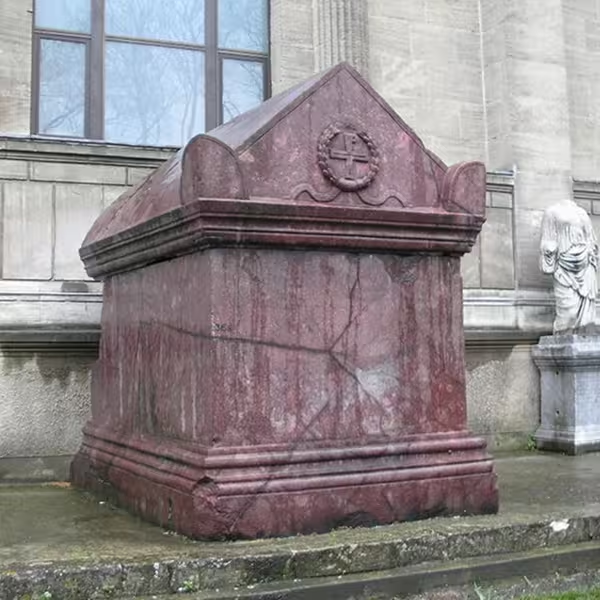
He left no children, and, characteristically, no clear arrangement for the succession. On his death his nephew Justin — son of his sister Vigilantia — moved swiftly and was proclaimed emperor as Justin II. He inherited a paradox: an empire vastly larger than the one Justinian had received, but exhausted, indebted, and dangerously over-extended. Within three years the Lombards overran much of Italy (568), the Persian war reignited, and the Balkans came under mounting pressure. The Justinianic dynasty would hold on until 602, but never again commanded the resources for Justinian’s kind of ambition.
Posterity: how Justinian was remembered
Few rulers have been so variously judged — and the argument began in his own lifetime. The same Procopius who praised his buildings also wrote a venomous Secret History depicting Justinian and Theodora as rapacious, even demonic tyrants. Yet the long verdict of history was largely one of greatness.
His deepest afterlife was in law. Forgotten in the West for centuries, the Digest was rediscovered in eleventh-century Italy and became the foundation stone of the medieval legal revival: the jurists of Bologna built a whole science upon it, and Justinian’s Corpus became the basis of the ius commune that shaped continental Europe and, through it, the great modern codifications down to the Napoleonic Code. For the medieval and early-modern world, Justinian was the lawgiver.
That is how the greatest poet of the Middle Ages saw him. In Dante’s Divine Comedy, Justinian is the sole speaker of an entire canto (Paradiso VI): from the Heaven of Mercury he recounts the flight of the Roman eagle across history and names himself the emperor who, moved by divine love, “took from the laws the excess and the vain” — the ruler remembered above all for perfecting Rome’s law. The Eastern Church went further still: it venerates Justinian as a saint, commemorating “the holy emperor Justinian” (with Theodora) on 14 November, the day of his death.
Modern historians remain divided — over whether his conquests were visionary or reckless, whether the plague or his own overreach did more harm — but none dispute the scale of the man. The dome of Hagia Sophia still stands; the walls of Sinai still hold; his law still speaks in the courts of Europe. Justinian set out to restore the old Roman world, and instead gave decisive shape to a new one — the empire we now call Byzantine, whose story truly begins with him and the Early Byzantine period.
Frequently asked questions
Who was Justinian I?
Justinian I (reigned 527–565) was a Byzantine (East Roman) emperor famous for reconquering much of the western Mediterranean, codifying Roman law in the Corpus Juris Civilis, and building Hagia Sophia. He is often considered the greatest of the early Byzantine emperors.
What is Justinian best known for?
Three things above all: his law code (the foundation of Europe’s civil-law tradition), his reconquest of North Africa and Italy, and the building of Hagia Sophia in Constantinople.
Who was Justinian’s wife?
The empress Theodora, a former actress who became his influential co-ruler and is credited with persuading him to stand firm during the Nika riots of 532.
What was the Plague of Justinian?
The first recorded bubonic-plague pandemic, which struck the empire in 541–542, killing perhaps a third of Constantinople’s population and recurring for generations — a major factor in the empire’s later weakness.
Was Justinian a Roman or a Byzantine emperor?
Both. He ruled the Eastern Roman Empire and considered himself a Roman emperor; historians call this later, Greek-speaking, Christian Roman state “Byzantine.” Justinian’s reign is often seen as the bridge between the two.
What did Justinian build?
Among much else: Hagia Sophia, Hagia Eirene, Saints Sergius and Bacchus, the rebuilt Church of the Holy Apostles, the Chalke gate and the Column of Justinian in Constantinople; the Basilica of St John at Ephesus; the Monastery of St Catherine at Sinai; the Nea Church in Jerusalem; the church of St Sophia at Serdica (Sofia); the new city of Justiniana Prima; and frontier fortresses such as Dara.
Where is Justinian buried?
He was buried in a mausoleum attached to the Church of the Holy Apostles in Constantinople. His tomb was plundered by the Fourth Crusade in 1204, and the church itself was demolished after 1453; the imperial sarcophagi were dispersed.
Who succeeded Justinian?
His nephew Justin II (reigned 565–578), as Justinian left no children. Justin inherited an over-extended empire and soon lost much of Italy to the Lombards.