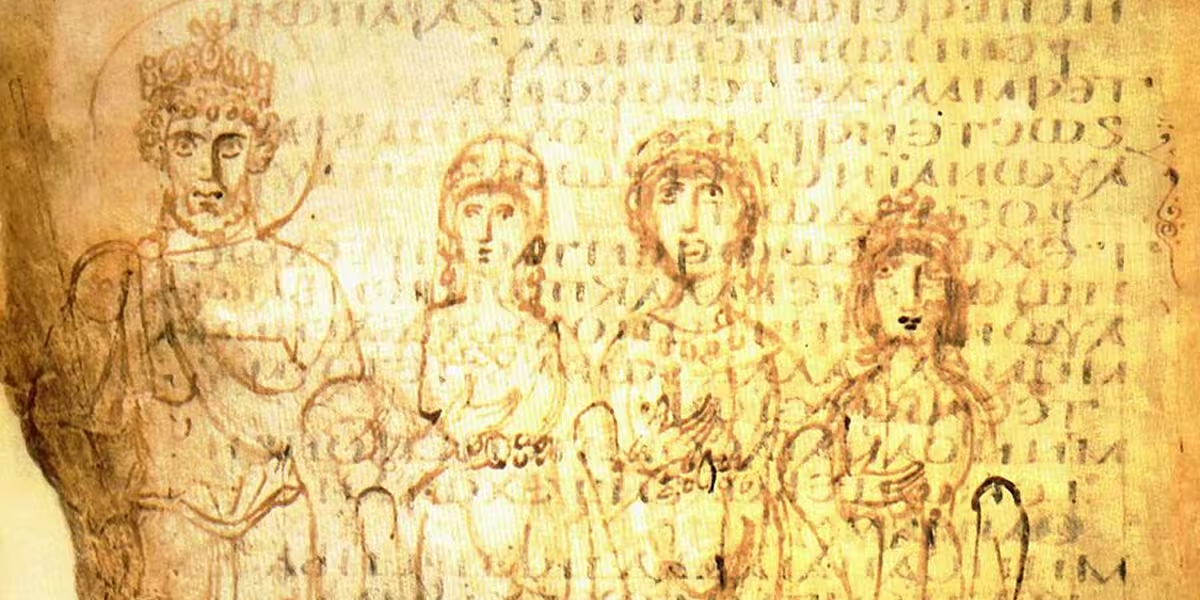
Heraclius: The Byzantine Emperor who defeated Persia, then lost it all to the Arabs
No Byzantine emperor’s reign contains a sharper turn than Heraclius’s. He took the throne of an empire on the verge of extinction — Persian armies camped across the water from Constantinople, Jerusalem sacked, Egypt lost, the treasury empty — and over the following two decades staged one of the most improbable military recoveries in Roman history, marching deep into the Persian heartland and bringing the four-century-old Sasanian Empire to the point of collapse. He returned the True Cross to Jerusalem in a triumph that Byzantines would remember for centuries. And then, in the last years of his life, a force almost nobody in Constantinople had heard of a decade earlier swept out of Arabia and took Syria, Palestine, and Egypt from him for good. Heraclius died having both saved Byzantium and watched it be cut in half — a reign that marks, as clearly as any single life can, the hinge between the late Roman world and medieval Byzantium.
Quick facts about Heraclius
Reign: 610–641
Born: c. 575, Cappadocia (family likely of Armenian origin)
Predecessor: Phocas (overthrown)
Dynasty founded: Heraclian
Remembered for: destroying the Sasanian Persian Empire as a military power, recovering the True Cross in 630, losing Syria, Palestine and Egypt to the Arab conquests, replacing Latin with Greek as the empire’s official administrative language.
The coup against Phocas
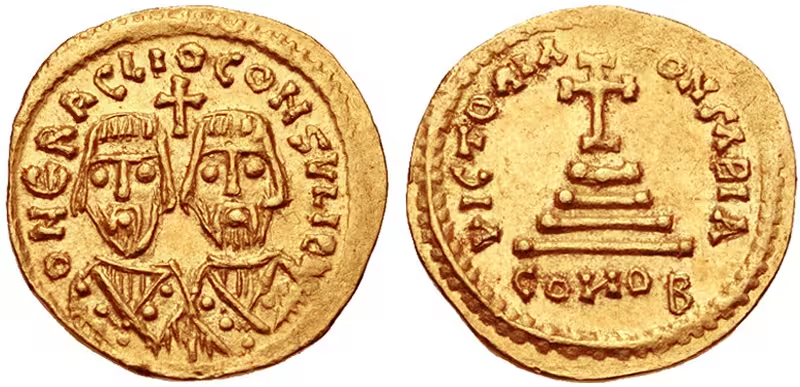
Heraclius was born around 575, the eldest son of Heraclius the Elder, a general whose family is generally, though not universally, believed to have been of Armenian origin from Cappadocia. His father’s decisive victories against a Persian-backed usurper in the 590s under Emperor Maurice earned him the exarchate — the military governorship — of Africa, based in Carthage, and it was there that the younger Heraclius grew into adulthood.
In 602, the general Phocas overthrew and murdered Maurice, seizing the throne through a mutiny of the Danube army. His eight-year reign was a catastrophe by nearly every account that survives: a reign of terror against the aristocracy, a collapsing eastern frontier as the Persian king Khosrow II used Maurice’s murder as pretext for full-scale war, and a steady loss of authority across the provinces. By 608, the Exarch of Africa had had enough. Heraclius the Elder began minting coins that omitted Phocas’s name entirely — an unmistakable declaration of rebellion — and dispatched his son at the head of a naval expedition toward Constantinople. Heraclius the Younger reached the capital in October 610, met little effective resistance, and had Phocas captured and executed. He was crowned emperor the same month, inheriting a throne that came with almost nothing worth ruling.
The empire in freefall, 610–622
It is difficult to overstate how close Byzantium came to simply ceasing to exist in Heraclius’s first decade on the throne, and understanding just how bad things got is essential to understanding why the recovery that followed felt, to contemporaries, like nothing short of a miracle. Khosrow II’s armies, already at war before Heraclius even took power, treated Phocas’s overthrow as an opportunity rather than a resolution. Antioch fell in 613. In 614, Persian forces sacked Jerusalem itself, massacring much of the population and — most damaging of all to Byzantine morale — seizing the relic of the True Cross and carrying it off to the Persian capital at Ctesiphon. By 619, Egypt, the empire’s essential grain-basket, was in Persian hands. Within a few more years, Persian forces had advanced all the way to Chalcedon, on the Asian shore directly opposite Constantinople — close enough that, on a clear day, the enemy camp could be seen from the walls of the capital.
Heraclius’s own response, in these earliest years, was not the decisive generalship he would later be famous for. Ancient sources — not always friendly ones, admittedly — record that he seriously considered abandoning Constantinople altogether and relocating the seat of empire to the relative safety of Carthage, where he had grown up. It reportedly took direct intervention from Patriarch Sergius I, who extracted an oath from the emperor in Hagia Sophia not to desert the city, to keep Heraclius in Constantinople at all. It is worth sitting with this for a moment: the man remembered by history as Byzantium’s great soldier-emperor spent his first decade in power looking, by most measures, like a man in over his head.
Character and the reforms that made recovery possible
What changed, starting around 622, was not simply Heraclius’s confidence but the entire machinery of the state underneath him — and understanding those changes matters more than any single battle, because they are what actually made the subsequent campaigns possible.
The most immediate problem was money: decades of warfare had emptied the treasury, and there was no way to fund a fresh army without new revenue. Heraclius solved this with Patriarch Sergius’s direct cooperation, in an arrangement that would have been unthinkable to most of his predecessors: the Church itself lent, and in significant part simply melted down, its own gold and silver plate to fund the army — an emergency measure that only makes sense against the backdrop of a state genuinely facing extinction, and one that also tightened the bond between emperor and Church at exactly the moment Heraclius needed the Patriarchate’s backing to hold the capital together in his absence.
Alongside the fiscal emergency came a quieter but longer-lasting shift: the gradual replacement of Latin by Greek as the actual working language of Byzantine administration, and the adoption of the Greek title Basileus — simply “king” or “emperor” — in place of the Latin Augustus that emperors had carried, at least formally, since the days of Augustus himself six centuries earlier. Latin had already been fading from daily administrative use for generations, particularly in the majority-Greek-speaking eastern provinces that were now virtually all that remained of the empire; Heraclius’s reign is generally treated by historians as the point where that long transition became official and permanent. It is one of the clearest single markers historians point to when explaining why we start calling the state “Byzantine” rather than simply “Roman” from roughly this period onward.
And Heraclius changed personally, too. The man who had reportedly wanted to flee to Carthage became, within a few years, an emperor who personally led his armies on campaign for years at a stretch — something no reigning emperor had done in generations — sharing his soldiers’ hardships directly rather than directing war from the palace. Whatever the precise mixture of religious conviction, genuine strategic talent, and sheer necessity behind the change, the soldier-emperor who marched into Persian Armenia in 622 was, by every account, a different man from the one who had governed Constantinople for the previous decade.
The counteroffensive, 622–627
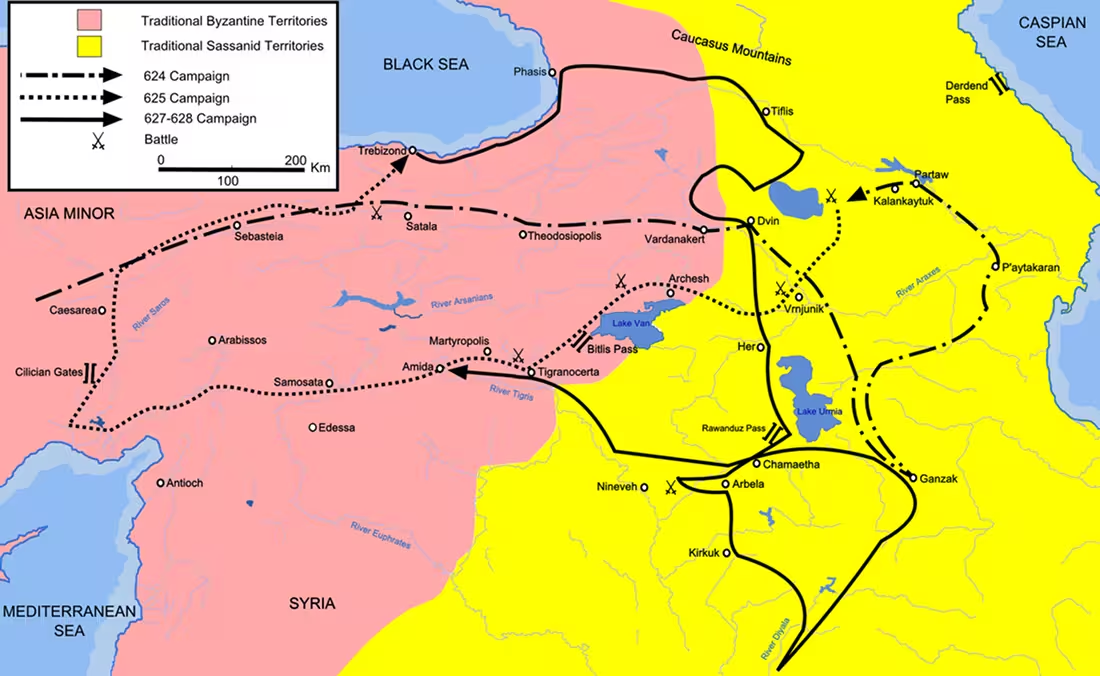
Beginning in 622, Heraclius took personal command of a rebuilt army and launched a series of campaigns into Persian Armenia and Asia Minor, deliberately avoiding a direct defense of the remaining Byzantine heartland in favor of striking at Persian territory itself — a strategic gamble, since it meant leaving Constantinople more exposed in the short term, but one aimed at forcing Khosrow II onto the back foot for the first time in the war. He secured a crucial alliance with the Gokturk Khaganate to the north, opening a second front against Persia’s Caucasian holdings, while methodically working through Persian Armenia and Media over several campaigning seasons.
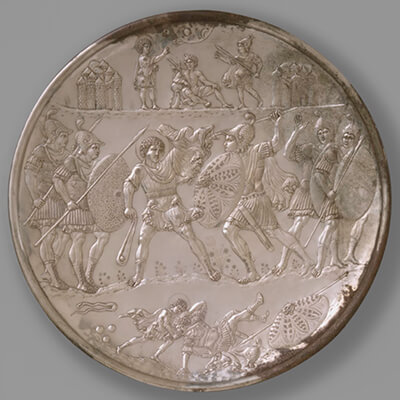
The decisive moment came in December 627 at the Battle of Nineveh, near the ruins of the ancient Assyrian capital, deep in the Persian heartland. Heraclius’s army broke the main Persian field force in a battle contemporary sources describe as ferociously fought, with Heraclius himself reportedly engaging the Persian general Razatis in single combat and killing him — an episode that Byzantine propagandists would soon compare directly to the biblical David’s defeat of Goliath. Heraclius, though he was not in a position to attack the Persian capital Ctesiphon, captured and plundered Dastagird, Khosrow II’s magnificent royal residence, acquiring immense wealth.
The military defeat, following on from years of failure and immense strain on Persian finances and manpower, triggered a political collapse inside Persia itself: Khosrow II was overthrown and executed by his own son within months, and the new Persian government sued for peace, agreeing to withdraw from all occupied Byzantine territory and return the True Cross.
The siege of Constantinople, 626
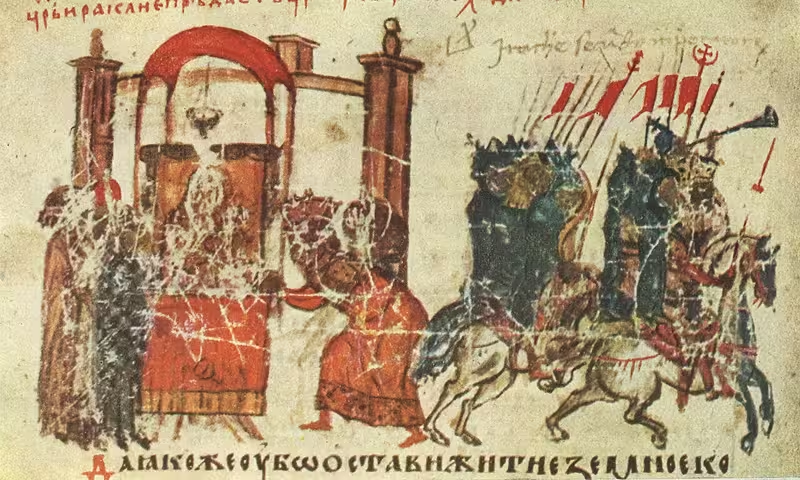
One of the most dramatic episodes of the entire war took place while Heraclius himself was hundreds of miles away — which is precisely what makes it such a striking story. In the summer of 626, while the emperor was campaigning in the east, a combined force of Avars, Slavs, and a Persian army under the general Shahrbaraz converged on Constantinople itself, aiming to take the capital in Heraclius’s absence and end the war in one stroke.
The city held. Command in Heraclius’s absence fell to Patriarch Sergius I and the general Bonus, and the defense became one of the defining moments in Byzantine religious memory: tradition holds that Sergius personally carried an icon of the Virgin Mary in procession along the walls, and that the failure of the siege — the Avar and Slav forces withdrew after a failed assault, unable to link up effectively with the Persian army stranded on the Asian shore without naval transport — was attributed directly to the Theotokos’s intervention. The Akathist Hymn, still sung in Orthodox liturgy today, is traditionally associated with the thanksgiving that followed. The siege is also credited with the origin of the veneration attached to the Church of Panagia Blachernai, and in its aftermath Heraclius extended the city’s fortifications to enclose the Blachernae district — previously left outside the walls — a stretch still known today as the Wall of Heraclius.
The return of the True Cross, 630
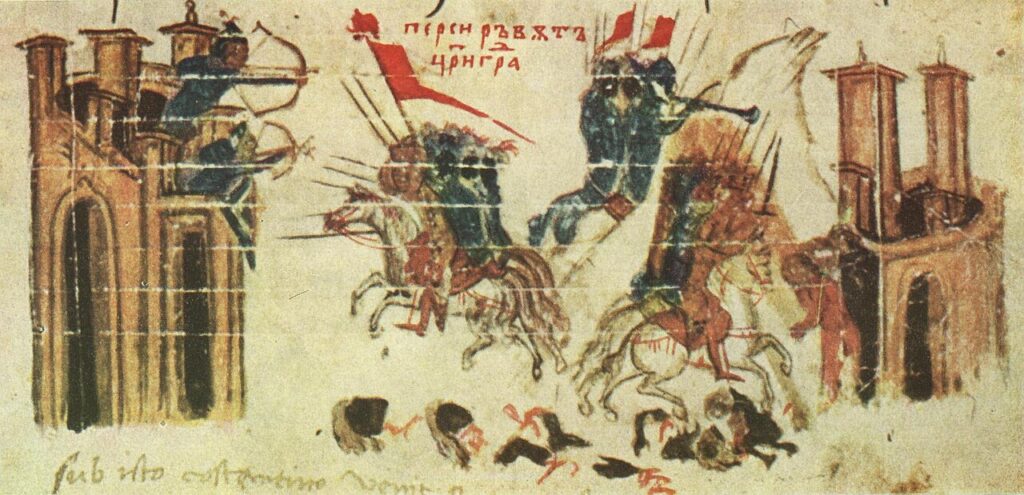
The religious and propaganda high point of the reign came in 630, when Heraclius personally carried the recovered relic of the True Cross into Jerusalem in a ceremony of restoration that Byzantine writers treated as the symbolic climax of the entire war.
A widely repeated tradition holds that Heraclius initially tried to enter the city on horseback in full imperial regalia, carrying the relic, only to find it had become miraculously too heavy to bear — and that it was only once he had dismounted, removed his crown, and approached on foot in plain dress that he was able to carry it through the gates. The scene became a popular subject in Christian art for centuries afterward, including in Armenia: the 7th-century Cathedral of Mren, built by Heraclius’s Armenian ally David Saharuni to commemorate the emperor’s 628 entry into the recovered territories, still preserves early frescoes of the True Cross’s return — you can read more about the deep ties between Byzantium and Armenia in this period in our article on the Armenians of the Byzantine world.
Religious policy: Monoenergism, Monothelitism, and the Ecthesis
Victory over Persia handed Heraclius a new and immediate problem: the reconquered provinces of Syria, Palestine, and Egypt were overwhelmingly populated by Christians who rejected the Chalcedonian formula on the nature of Christ affirmed at the Council of Chalcedon in 451, the same formula upheld by Constantinople and Rome. Reintegrating these provinces meant somehow bridging a theological divide that had already split the Church for nearly two centuries.
Working closely with Patriarch Sergius — the same figure who had helped save Constantinople in 626 and helped fund the war against Persia — Heraclius first backed a compromise doctrine known as Monoenergism, holding that Christ, while possessing two natures as Chalcedon required, acted through a single divine-human “energy.” It won early acceptance from the patriarchs of Antioch and Alexandria, but was firmly rejected by Sophronius, the influential patriarch-to-be of Jerusalem. Sergius responded by reformulating the compromise around a single divine-human will rather than a single energy — the doctrine that became known as Monothelitism — and this formula was issued as imperial law in the Ecthesis of 638, posted publicly in the narthex of Hagia Sophia. It fared no better in the long run: Rome rejected it outright within two years, and after the Monophysite provinces it had been designed to win over were lost to the Arab conquests anyway, the entire doctrine lost its political purpose and was formally condemned as heresy decades later, in 680–681, at the Third Council of Constantinople — alongside Sergius himself and Pope Honorius I, who had supported it.
The Martina marriage and its political cost
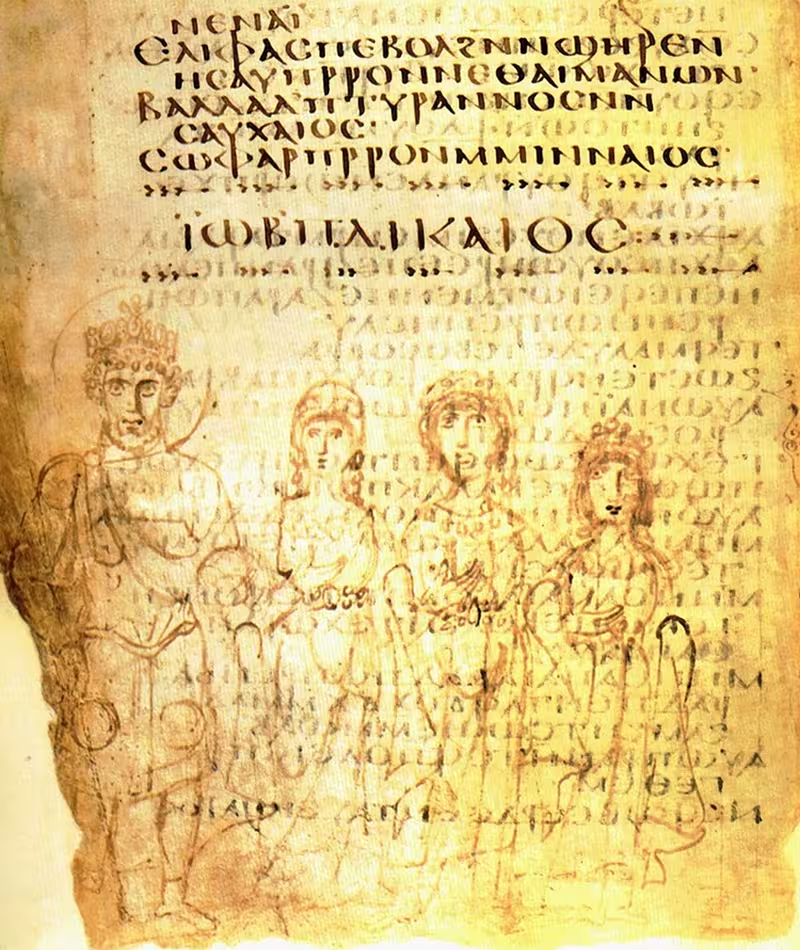
In 613, following the death of his first wife Eudokia, Heraclius married his own niece, Martina — a marriage well within the range of what Byzantine canon law and public opinion alike considered incestuous. Patriarch Sergius openly opposed the match, and it remained a lasting source of scandal throughout the reign. Later Byzantine chroniclers, writing with the comfortable benefit of hindsight, linked the marriage superstitiously to the disasters that followed: several of Martina and Heraclius’s children were born with visible disabilities, which contemporaries and later writers alike interpreted as divine punishment for the unlawful union, and the marriage’s unpopularity would resurface with real political consequences in the succession crisis that followed Heraclius’s death. It is worth reading this strand of the tradition with some caution — infant mortality and disability were common enough in any seventh-century family, imperial or otherwise — but the political reality of the marriage’s unpopularity, regardless of its causes, is well attested and mattered enormously for what came after.
An empire transformed: the shift to medieval Byzantium
It is easy to narrate Heraclius’s reign purely as a sequence of battles and treaties, but doing so misses what may be the reign’s most consequential legacy: the empire that emerged from it, even at its moment of triumph in 630, was already a fundamentally different society from the one Heraclius had inherited in 610 — and the process would only accelerate through his final years.
The physical destruction inflicted by fifteen years of Persian occupation and warfare was immense. Cities across Syria, Palestine, and Asia Minor that had thrived as centers of late antique urban civilization for centuries — with theaters, baths, and civic institutions inherited more or less intact from the Roman era — emerged from the war impoverished, depopulated, or simply gone. Antioch, one of the three or four greatest cities of the ancient Mediterranean world, never fully recovered its former scale. Combined with the demographic devastation of the Justinianic Plague that had already been recurring across the empire for nearly a century, and the effective severing of Egypt’s grain supply to Constantinople, the classical, densely urban civic culture that had defined the eastern Roman world for centuries was giving way to something leaner, more militarized, and more defensively organized — the recognizable beginnings of what historians call medieval Byzantium rather than late antique Rome.
Some historians have traditionally connected this same period to the earliest origins of the theme system — the later Byzantine practice of organizing the empire’s remaining Anatolian territory into military-administrative districts, each supporting a standing local army from its own land grants — though the precise dating and even the degree to which Heraclius personally initiated this system, as opposed to his successors gradually formalizing it over the following decades, remains genuinely debated among historians. What is not in doubt is the direction of travel: an empire that had governed the Mediterranean world in 610 through the machinery of the late Roman civil state was, by the time of Heraclius’s death in 641, already becoming the smaller, more militarized, more embattled state that would fight for its survival, in one form or another, for the next eight hundred years.
The Arab conquests and Heraclius’s final years
The final, bitter irony of Heraclius’s reign is that the empire he had just spent a quarter-century rebuilding, at ruinous cost to both Byzantium and Persia alike, had almost no capacity left to absorb a second existential shock — and one arrived within a handful of years of the True Cross’s triumphant return to Jerusalem. Following the death of the Prophet Muhammad in 632, Arab armies, unified for the first time under the new religious and political authority of Islam, began pushing north out of Arabia into a Syria and Palestine that Byzantium had only just reconquered from Persia and had barely begun to garrison or refortify.
The catastrophe came at the Battle of Yarmouk in 636, in the borderlands of modern Syria and Jordan, where a Byzantine army — itself only recently rebuilt and already strained by the Persian war and the ongoing religious reintegration of the reconquered provinces — suffered a decisive and irreversible defeat. Syria and Palestine fell to Arab control within a few years of the battle; Jerusalem itself, so recently the site of Heraclius’s greatest triumph, surrendered in 637. Egypt followed by 642, shortly after Heraclius’s own death. Byzantine historians would later record — whether literally true or not — that upon learning Syria was lost for good, Heraclius uttered a farewell to the province: “Peace unto thee, O Syria, and what an excellent country this is for the enemy.”
Heraclius spent his final years in declining health, reportedly suffering from chronic edema (dropsy), and — according to a detail preserved by several Byzantine sources — from a pronounced fear of open water that made him unwilling to cross the Bosphorus by ship, forcing his engineers to construct an improvised pontoon bridge of boats so the ailing emperor could travel between the Asian and European shores without setting foot on a vessel at sea. He died in Constantinople on 11 February 641, not many months after Yarmouk had made plain that the empire he had rebuilt at such cost was already being cut down again.
Succession crisis and legacy
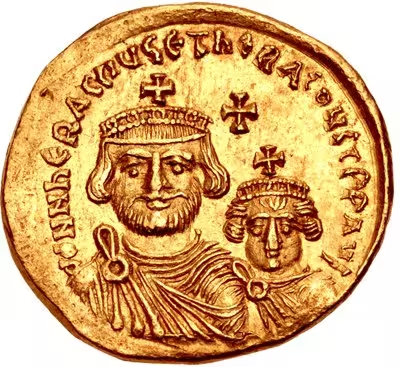
Heraclius’s death triggered exactly the kind of succession crisis his second marriage had long threatened. He left the throne jointly to Constantine III, his son by his first wife Eudokia, and Heraklonas, his son by Martina — an arrangement almost designed to produce conflict between the two branches of the family. Constantine III died within months, amid persistent (and never proven) rumors that Martina had poisoned him to clear the way for her own son. The resulting backlash against Martina’s faction was severe: Heraklonas was forced to abdicate before the year was out, and Martina and Heraklonas were both mutilated — she reportedly had her tongue cut out, he his nose — and exiled, clearing the way for Constantine III’s young son to take the throne as Constans II. The entire episode is a fairly direct illustration of just how politically toxic the Martina marriage had remained, more than two decades after it was first contracted.
Heraclius’s own legacy is correspondingly double-edged, and that duality is precisely what makes his reign so significant to historians of the transition from Rome to Byzantium. He is, by any reasonable measure, one of the most militarily accomplished emperors in Byzantine history — the man who took an empire on the brink of extinction and, through sheer force of reorganized will, broke a four-century-old rival empire in a single campaign. He is, simultaneously, the emperor under whom Byzantium’s Roman-era territorial reach in the Near East and North Africa began the process of permanent contraction that would define the empire’s entire remaining history. Founder of the Heraclian dynasty that would rule, with interruptions, for the rest of the seventh century, he is the figure historians most consistently point to when marking the moment the late Roman world gives way to medieval Byzantium — a state now speaking Greek as a matter of official policy, organized increasingly around military necessity rather than civic administration, and permanently smaller than the empire Justinian I had, only a lifetime earlier, spent a reign trying to restore in full.
Frequently asked questions
Who was Heraclius?
Heraclius (reigned 610–641) was a Byzantine emperor who overthrew the tyrannical usurper Phocas, rebuilt the empire’s military after near-total collapse, and destroyed the Sasanian Persian Empire’s ability to make war in a series of campaigns culminating in the 627 Battle of Nineveh — only to lose Syria, Palestine, and Egypt to the Arab conquests in the final years of his reign.
Why did Heraclius almost lose Constantinople before he even fought Persia?
He inherited an empire already collapsing under the usurper Phocas, and Persian forces exploited the chaos to seize Antioch, Jerusalem, and Egypt within his first decade, eventually reaching Chalcedon, directly opposite Constantinople. Heraclius reportedly considered abandoning the capital for Carthage before Patriarch Sergius persuaded him to stay.
What happened at the Battle of Nineveh?
In December 627, Heraclius’s army decisively defeated the main Persian field army deep in Persian territory. The defeat triggered the overthrow and execution of the Persian king Khosrow II by his own son within months, effectively ending the war in Byzantium’s favor.
Did Heraclius defend Constantinople himself during the 626 siege?
No — he was campaigning in the east at the time. The defense of the city against a combined Avar, Slav, and Persian assault was led by Patriarch Sergius I and the general Bonus, and Byzantine tradition credits the Virgin Mary’s intervention, commemorated in the Akathist Hymn, for the city’s survival.
What was the significance of the True Cross’s return to Jerusalem?
The relic had been seized by Persian forces during the sack of Jerusalem in 614. Heraclius personally restored it to the city in 630 in a ceremony that became the symbolic climax of the entire Persian war, widely commemorated afterward in Byzantine and Armenian art.
Why did Byzantium lose Syria and Egypt so soon after defeating Persia?
The empire was financially and militarily exhausted from the Persian war and had barely begun reintegrating the reconquered eastern provinces when Arab armies, newly unified under Islam, defeated a Byzantine army at the Battle of Yarmouk in 636. Syria and Palestine fell within a few years, and Egypt followed shortly after Heraclius’s death in 641.
What is Monothelitism and why did Heraclius promote it?
Monothelitism was a compromise doctrine, developed with Patriarch Sergius, holding that Christ possessed a single divine-human will. Heraclius promoted it to try to reconcile Chalcedonian Byzantium with the Monophysite populations of the reconquered eastern provinces, but it was rejected by Rome and later condemned as heresy in 680–681.
Sources & further reading
- Walter E. Kaegi, Heraclius, Emperor of Byzantium (Cambridge University Press, 2003)
- James Howard-Johnston, Witnesses to a World Crisis: Historians and Histories of the Middle East in the Seventh Century (Oxford University Press, 2010)
- Theophanes the Confessor, Chronographia
- Sebeos (attrib.), History of Heraclius
- Steven H. Wander, “The Cyprus Plates: The Story of David and Goliath,” Metropolitan Museum Journal 8 (1973)