
Basil II: The Soldier Emperor who brought Byzantium to its Medieval Peak
No Byzantine ruler spent so much of his life at war as Basil II. For nearly fifty years — first as a sidelined boy-emperor, then as an absolute autocrat who never once left his soldiers for the comforts of Constantinople — Basil crushed the aristocracy that had humiliated his childhood, annihilated an independent Bulgarian state that had defied Byzantium for three centuries, and filled the imperial treasury with more gold than it had ever held before or would hold again. He built almost nothing for himself, married no one, and died planning one more campaign. When he was laid to rest, the empire he left behind stretched further than at any point since the age of Justinian — and it began falling apart within a single generation of his death.
Quick facts
Born: c. 958, Constantinople
Reign: 976–1025 (sole rule)
Regents: Nikephoros II Phokas, John I Tzimiskes
Co-emperor: Constantine VIII
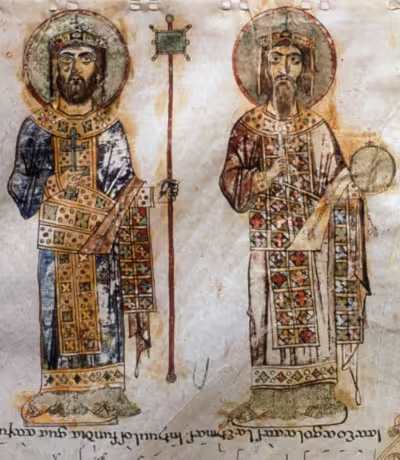
The dynastic prelude: a boyhood under the shadow of usurpers
The fragility of the Macedonian line
The legitimizing framework of the Macedonian dynasty did not guarantee political security, and by 963 it had already failed once in living memory. When Emperor Romanos II died suddenly that year — probably no older than twenty-six, and widely rumored to have been poisoned by his own wife — his sons, the five-year-old Basil II and his three-year-old brother Constantine VIII, were proclaimed co-emperors. In practice this meant nothing at all. A five-year-old cannot lead an army, sit in judgment, or command the loyalty of a general, and Byzantium in the tenth century was a state that ran on exactly those things. Real power passed first to a court eunuch, Joseph Bringas, and then, within months, to the one institution capable of actually defending the throne: the army.
The era of the soldier-regents
The empress mother Theophano — herself a figure of obscure, possibly tavern-keeping origins who had married into the purple — moved quickly to secure her sons’ survival, and did so by marrying the empire’s most celebrated general, Nikephoros II Phokas, within months of her first husband’s death. Nikephoros became senior emperor in 963, ruling in the boys’ name while campaigning relentlessly against the Arabs in the east. It did not end well. By 969 Theophano had taken Nikephoros’s own brilliant subordinate, John Tzimiskes, as a lover, and together they staged one of the most notorious murders in Byzantine history: Tzimiskes and his accomplices were smuggled into the Great Palace by night, past a locked door Theophano had left open for them, and hacked Nikephoros to death in his own bedchamber as he prayed.
The murder briefly threatened Tzimiskes’s own claim to the throne. Patriarch Polyeuktos refused to crown him until he had performed public penance, reversed Nikephoros’s unpopular church policies, and — pointedly — exiled Theophano, the woman who had made his coup possible, to a convent on the island of Prinkipo (and, when she tried to slip back into the city, to a far more distant monastery in Armenia). To cement his own legitimacy, Tzimiskes then married Theodora, a daughter of Constantine VII and so the boy-emperors’ aunt.
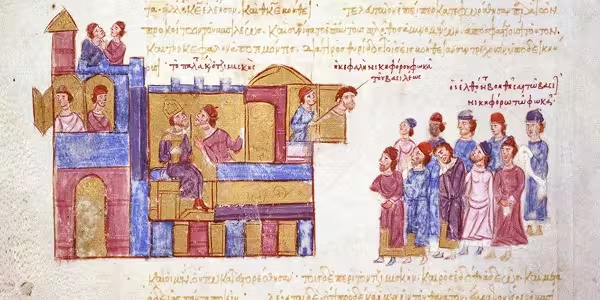
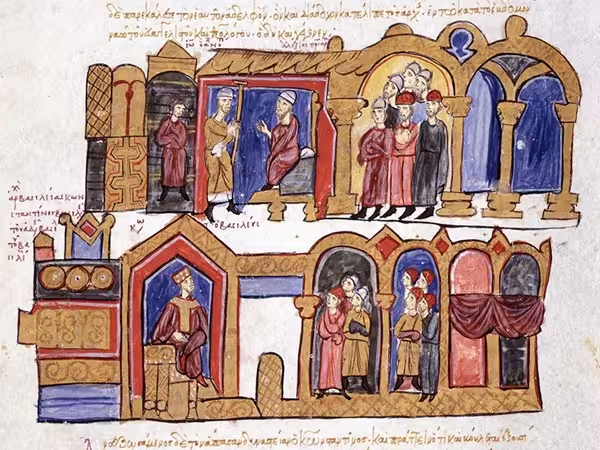
Miniature from the illuminated Madrid Skylitzes manuscript depicting the Tzimiskes coup orchestrated by Empress Theophano, and the display of Nikephoros II Phokas’s head from the palace windows. 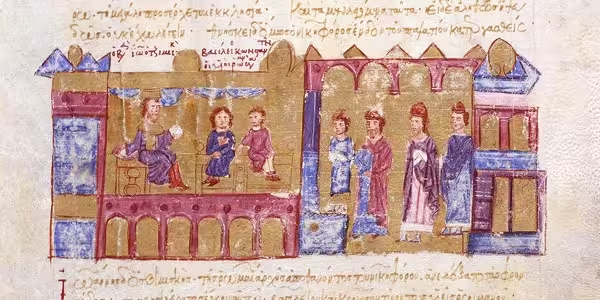
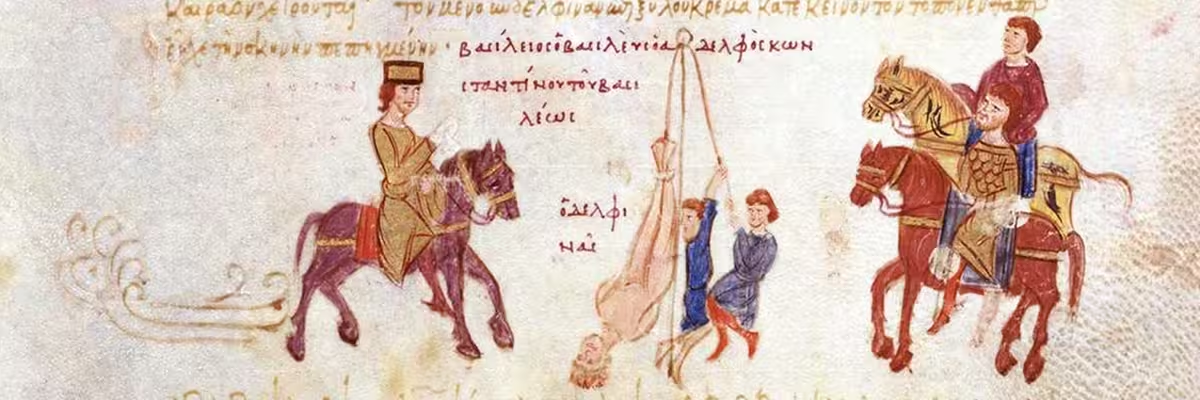
Emperor John Tzimiskes declares himself co-emperor of Basil and Konstantinos (depicted next to him), recognizing their rights to the throne. Courtiers and senators stand on the right to swear allegiance.
For the length of his reign, Basil and Constantine VIII were pushed almost entirely out of view: contemporary evidence shows Basil appearing on only a single issue of gold coinage in this whole period, and on no imperial seals at all. When Tzimiskes died in 976 — by some accounts poisoned in turn — the eighteen-year-old Basil II finally moved to claim genuine power. One of his very first acts was to have his exiled mother Theophano brought back to Constantinople.
Two soldier-emperors in thirteen years, one of them murdered in his own bed by his wife and his own protégé, both of them ruling in a child’s name while that child had no real say in his own empire — this was the political education Basil II actually received. It is not hard to see, in the secretive, deeply distrustful autocrat he became, a young man who had watched at close range exactly how easily a general with the right allies could take everything, and who resolved never to let it happen to him.
The Macedonian dynasty, ancestors to nieces
The genealogy below sets out the blood line Basil II belonged to — and, alongside it, exactly where the two outsider soldier-emperors inserted themselves into that family by marriage. Solid lines mark parent-child descent; dashed lines mark marriage. Basil II’s own generation is highlighted.
The Macedonian dynasty from Basil I to the death of Theodora in 1056, with the two non-dynastic soldier-emperors who governed in Basil II’s name shown by marriage.

The soldier who never married: Basil’s character and court
It is easy, reading only of sieges and blindings, to lose sight of Basil the man — and Byzantine writers themselves struggled with the contradiction between the youth they remembered and the ruler he became. The historian Michael Psellos, writing a generation later, records that the young Basil who emerged from the regency of Phokas and Tzimiskes was, if anything, expected to be a disappointment: a pleasure-loving, indecisive prince with little apparent interest in government. The trauma of the Skleros and Phokas rebellions burned that man away. Psellos describes an almost total transformation — the same emperor who had once diverted himself with racing and hunting became, virtually overnight, ascetic, secretive, and consumed by the business of war.
What followed was one of the strangest courts in Byzantine history, precisely because it barely functioned as a court at all. Basil spent the overwhelming majority of his reign on campaign, not in the Great Palace. He wore plain military dress rather than imperial silks, ate the same rations as his soldiers, and had no patience for the elaborate ceremonial that structured the reigns of most of his predecessors and successors.
Where an emperor like Justinian I filled his days with theological correspondence, legal reform, and architectural ambition, Basil filled his with drilling and marching. Contemporaries who disliked him — and there were many among the aristocracy he spent decades grinding down — mocked him as uncultured and indifferent to learning; even sympathetic sources admit he had little taste for rhetoric or philosophy, the two things a well-bred Byzantine elite prized above almost everything else.
He never married, and, as far as the sources record, kept no acknowledged mistress or favourite in the manner common among Roman and Byzantine rulers alike. Whether this reflects genuine indifference, a Diocletian-style logic that dynastic sentiment was a liability in a state he ruled by will alone, or simply the fact that he spent almost no time anywhere a marriage might have been arranged, is impossible to say — but the effect on the empire’s future was catastrophic, as the final section of this article makes clear.
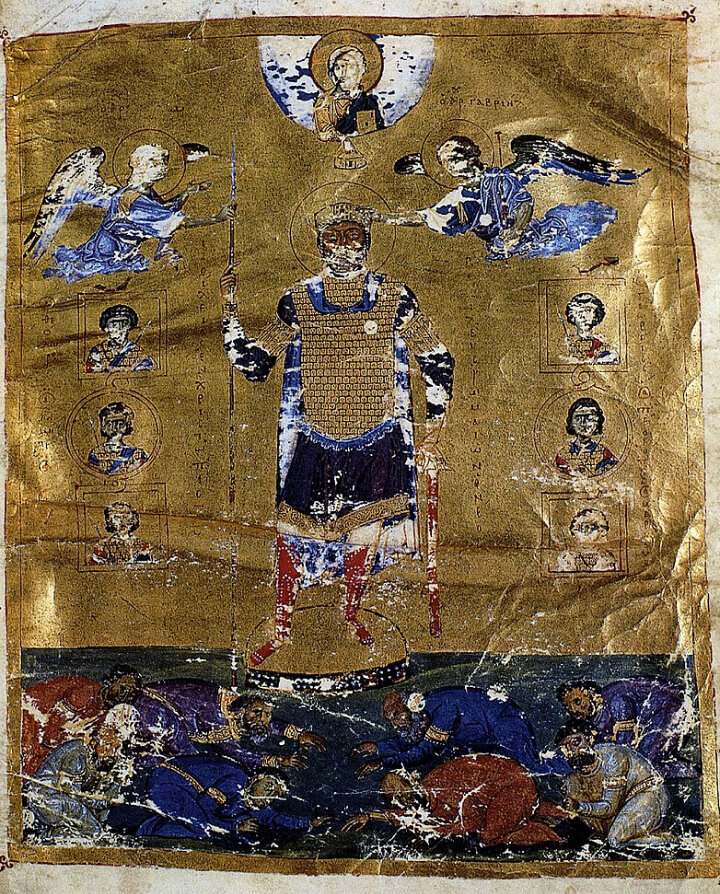
The one place his private self does survive is not a building but a book: the illuminated Psalter he commissioned for his own devotional use, discussed in full below, whose frontispiece shows him not enthroned in imperial splendor but standing in armor among soldier-saints, a spear in hand — the image, evidently, by which he wanted history to remember him.
Crushing the magnates and the rise of the Varangian Guard
The rebellion of the Anatolian aristocracy
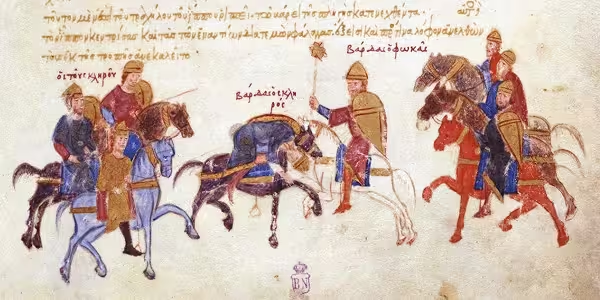
The early years of Basil II’s adult reign were pushed to the brink of collapse by civil war. The Dynatoi — the wealthy, powerful provincial families of Anatolia — openly challenged the central authority of the young emperor. Led by the elite generals Bardas Skleros and Bardas Phokas, these military factions launched successive, highly destructive rebellions that mobilized provincial armies against Constantinople. The civil wars dragged on intermittently for over a decade, and at their lowest point demonstrated something genuinely alarming: the military aristocracy possessed the wealth and regional loyalty to challenge, and potentially overthrow, the legitimate Macedonian dynasty outright.
Basil did not fight this war alone. In the decisive campaign of 989 against Bardas Phokas, he was reinforced by some twelve thousand Georgian troops sent by David III Kuropalates of Tao — an alliance that not only helped save Basil’s throne but would draw the empire deeper into Caucasian politics for the rest of the reign, since David’s death some years later left his territories to Basil by testament, adding swathes of the Armenian and Georgian highlands to imperial control. It is a reminder that Basil’s wars were never confined to the Balkans: on his eastern flank he was, simultaneously, absorbing one of the largest peacetime territorial gains any Byzantine emperor achieved without a major battle.
The Rus’ alliance and the 6,000 Norsemen
Faced with the imminent military threat of Bardas Phokas in 988, Basil II turned to foreign diplomacy. He negotiated a landmark alliance with Prince Vladimir I of Kiev. In exchange for crucial military aid, Basil made an unprecedented concession: he promised the hand of his purple-born sister, Anna Porphyrogenita, in marriage to a pagan ruler — a step so far outside Byzantine convention that Anna herself is said to have wept at the prospect of marrying a “barbarian.”
In return, Vladimir agreed to convert to Orthodox Christianity — initiating the Christianization of the Kievan Rus’ — and dispatched an elite force of 6,000 Scandinavian and Rus’ warriors to Constantinople. Basil used this fierce mercenary force to crush the rebel armies at the Battles of Chrysopolis and Abydos. Recognizing the value of these foreign troops, who owed absolute loyalty directly to the emperor rather than the Anatolian aristocracy, Basil institutionalized them as the permanent Varangian Guard — securing, for the first time, a reliable military shield that answered to the throne alone.
The Bulgarian campaigns: strategy, attrition, and subjugation
Decades of border warfare
With his domestic position secured, Basil turned to the Balkan Peninsula, where Tsar Samuel had built a powerful, independent Bulgarian state that consistently threatened Roman territories in Greece and Thrace. Abandoning the erratic, high-risk deep raids favored by his predecessors, Basil implemented a systematic strategy of attrition: methodical seasonal campaigns designed to capture key fortresses, cut supply lines, and isolate Bulgarian populations one region at a time.
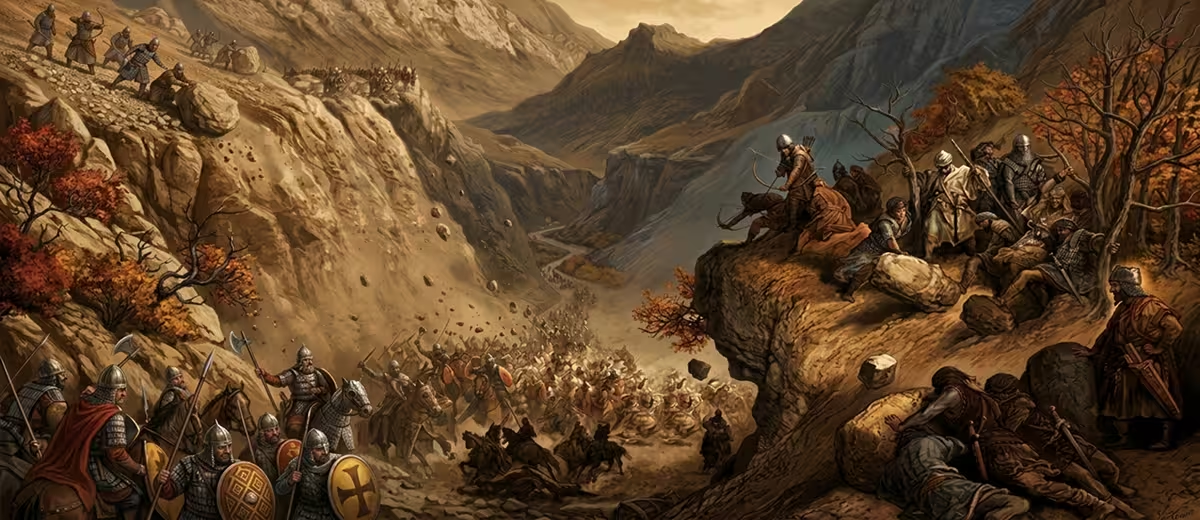
It was not a smooth war. In 986, in one of the sharpest reversals of his career, Basil personally led a large army to besiege Serdica (modern Sofia) — and was forced into a humiliating retreat that ended in a devastating ambush at the Gates of Trajan, where he only escaped with his life thanks to the Varangian Guard cutting a path out for him. It is worth pausing on this: the emperor remembered as the Bulgar-Slayer began his war against Bulgaria with a near-catastrophic defeat, and needed roughly three more decades of grinding, unglamorous campaigning to turn that humiliation into total conquest. Along the way, diplomacy could be as devious as the fighting — at one point Basil tried to lure Samuel’s brother Aaron into defection by offering him marriage to the same sister, Anna, who had been promised to Vladimir of Kiev; when Aaron discovered the “bride” being sent to him was an impostor, the scheme collapsed. This grueling war of fortresses, punctuated by failure, treachery, and slow recovery, wore down Bulgarian resistance over a span of three decades.
The Battle of Kleidion and the epithet
The decisive turning point came in July 1014 at the Battle of Kleidion. Deployed in a narrow mountain pass, Samuel’s forces blocked the advancing Roman army. Basil dispatched a detachment under the general Nikephoros Xiphias to execute a difficult outflanking maneuver over the mountains, catching the Bulgarians from the rear. The result was a total Roman victory and the capture of thousands of Bulgarian soldiers.
To break the political and psychological will of the Bulgarian state, Basil ordered the mass blinding of the prisoners, dividing them into groups of one hundred and leaving a single, one-eyed soldier to guide each group back to their Tsar. Ancient sources put the number of the blinded anywhere from eight to fifteen thousand — a figure modern historians treat with real skepticism, since removing that many men from combat would almost certainly have ended Bulgarian resistance outright, and yet Samuel’s forces fought on for four more years. Whatever the true scale, the story that Tsar Samuel collapsed with a fatal stroke on seeing his ruined army passed quickly into legend. By 1018, the remaining Bulgarian resistance collapsed, and the region was fully absorbed into the imperial theme system. This victory secured the Danube as the empire’s European frontier and earned Basil, in the centuries that followed, the epithet Boulgaroktonos — the Bulgar-Slayer.
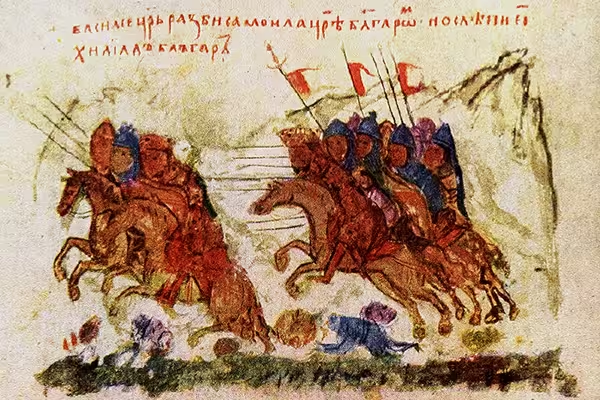
14th-century miniature from the Manasses Chronicle depicting the Battle of Kleidion in 1014. 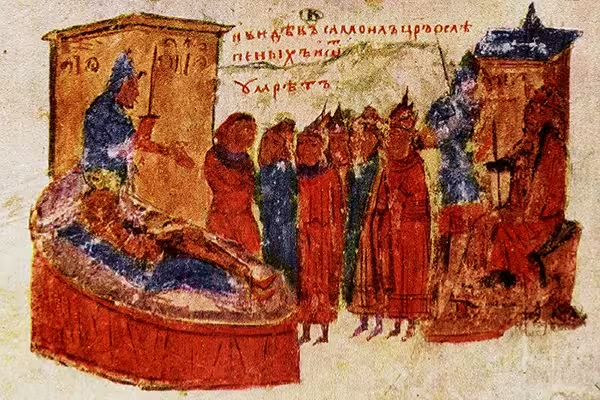
From the same manuscript today in Vatican, the Tsar Samuel of Bulgaria dies at the view of his blinded soldiers.
The fiscal weapon: protecting the peasantry to fund the state
The Allelengyon decree
Basil understood that military supremacy depended entirely on stable fiscal administration. In 1002, he introduced the Allelengyon (mutual guarantee) decree, a radical reform targeting the economic base of the provincial magnates. The law mandated that the wealthy Dynatoi were legally responsible for paying the tax arrears of the impoverished peasants within their districts. If a smallholder abandoned their land or fell into poverty, the neighboring aristocratic estate was forced to absorb the tax burden owed to the state.
Economic neutralization of the Dynatoi
The Allelengyon served a dual purpose. Economically, it prevented the wealthy aristocracy from exploiting peasant debt to buy up small family farms, keeping the free peasant tax base intact. Structurally, it protected the traditional recruitment pools for the provincial armies, which relied on land-owning smallholders. The law checked the growth of autonomous aristocratic estates while channeling vast wealth directly into the state.
By the time of Basil’s death, these aggressive fiscal policies had accumulated a reserve of some 200,000 pounds of gold — roughly 14.4 million gold nomismata — within the vaults of the imperial palace, a sum so vast that an eleventh-century Arab chronicler reported it with open astonishment.
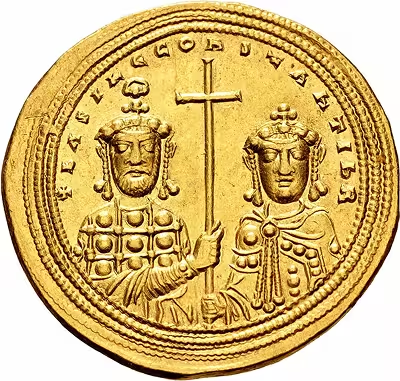
Patron of war and faith: Basil’s architecture and the imperial Psalter
Infrastructure over innovation
Basil II’s approach to architecture reflected his pragmatic, austere character. While previous emperors expended vast state resources constructing luxurious palaces or highly ornate chapels, Basil prioritized practical public works. His architectural commissions focused almost entirely on defensive infrastructure: strengthening collapsing military fortresses along the expanding frontiers, rebuilding damaged sea walls around the capital, and repairing the city’s aqueduct network to secure the water supply of Constantinople.
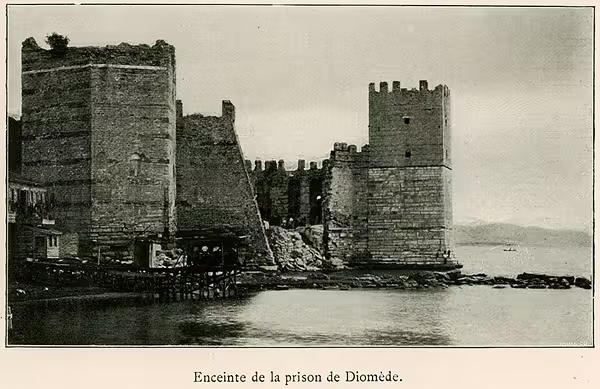
Most of that work survives only as a line in a chronicle — but not all of it. A series of earthquakes during Basil’s reign damaged the Theodosian Land Walls, and the repairs are still visible today on Tower 1 of the walls, beside the First Military Gate near Yedikule, where a Greek inscription running across the façade reads: “Tower of Basil and Constantine, faithful Emperors in Christ, pious Kings of the Romans.”
The same dedication is traditionally associated with the nearby Marble Tower (Mermer Kule), the fortified tower standing where the land walls meet the sea walls of the Marmara.
Unlike the Hagia Sophia repair or the Psalter, this is not a case of literary testimony alone: it is Basil’s name, cut into stone, still standing in Istanbul — arguably the single most concrete (in every sense) surviving trace of his reign.
The repair of Hagia Sophia and Trdat
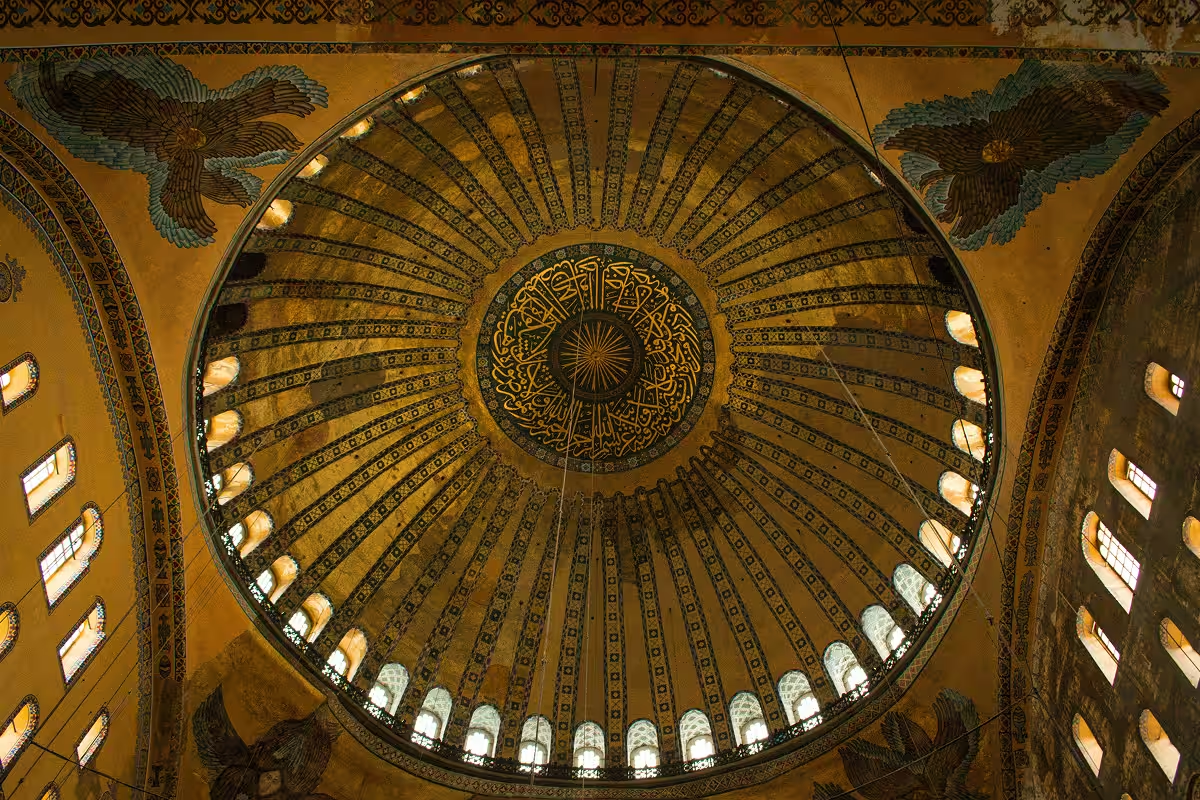
In October 989, a severe earthquake struck Constantinople, causing the collapse of the western arch and a significant portion of the great dome of Hagia Sophia. Recognizing the political and religious necessity of restoring the imperial cathedral, Basil commissioned Trdat the Architect — the celebrated master builder of the Bagratid Kingdom of Armenia, whose earlier work you can read about in our article on the Armenians of the Byzantine world.
Trdat brought advanced architectural techniques to the capital, executing a highly successful structural restoration that required four years of intensive scaffolding and engineering work. The repaired dome, reinforced by Trdat’s precise calculations, stabilized the monumental structure for centuries to come.
The Basil II Psalter
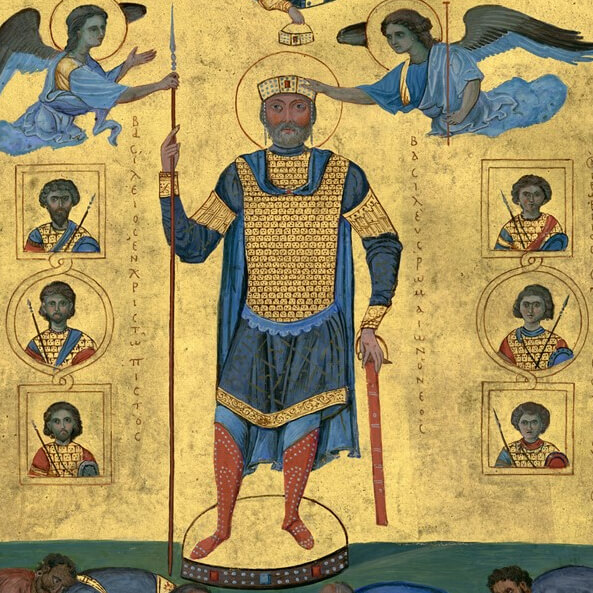
Detail of a replica of the famous frontispiece of the Psalter featuring Basil II.
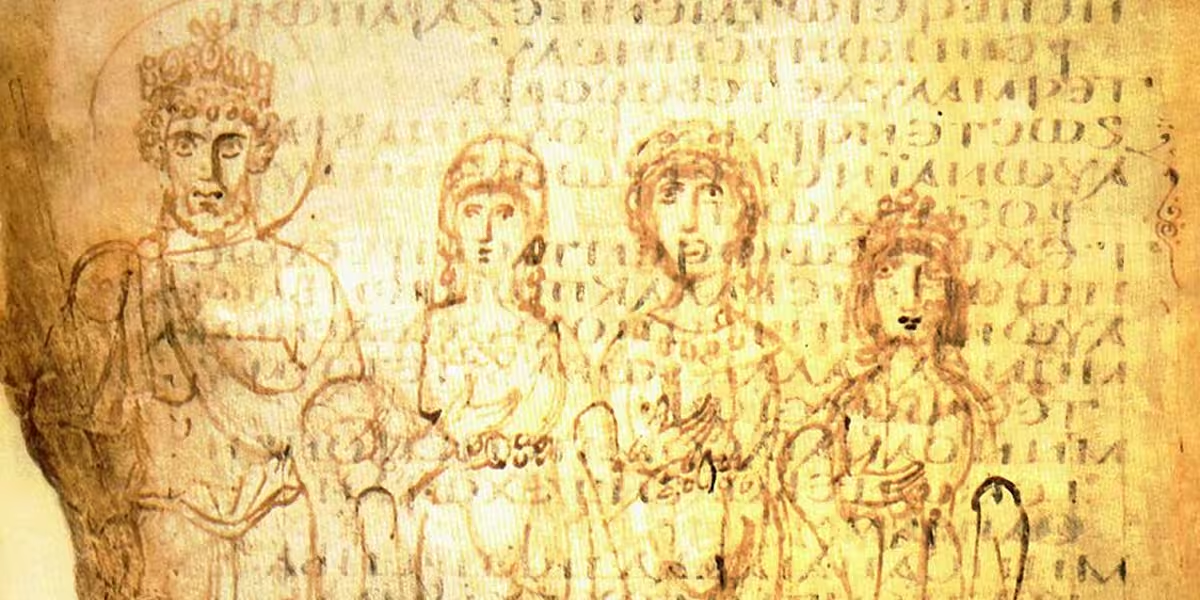
Basil’s one truly personal commission was not a building but a book. The lavishly illuminated Basil II Psalter — today held in the Biblioteca Marciana in Venice (MS gr. Z.17) — was produced in Constantinople for the emperor’s own devotional use in the early eleventh century. Its celebrated frontispiece breaks entirely with the tradition of imperial portraiture: rather than the enthroned, richly robed figure typical of Byzantine ruler imagery, Basil appears standing in full military dress, crowned by Christ from above and flanked by a company of warrior saints, with the prostrate figures of his defeated enemies beneath his feet. It is the closest thing we have to a self-portrait of how Basil wanted to be remembered — not as a patron of art or theology, but as God’s soldier. Unlike his fortress repairs and aqueducts, the Psalter was never meant for public display; it remains one of the finest surviving examples of middle Byzantine manuscript illumination.
The Menologion of Basil II
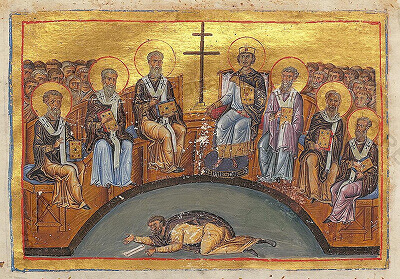
Basil’s other great personal commission was, like the Psalter, a book rather than a building — and a far larger one. The Menologion of Basil II (Vatican Library, MS gr. 1613), compiled in Constantinople around the year 1000, is technically a synaxarion: a liturgical calendar pairing a short saint’s-day reading with a full-page miniature, covering the first half of the Byzantine church year from September to February. What survives runs to 430 miniatures across 272 folios, painted by eight different artists — Pantoleon, who appears to have led the workshop, together with Georgios, Michael the Younger, Michael of Blachernai, Simeon, Simeon of Blachernai, Menas, and Nestor, each identified by name in the margin of his own work, an unusual practice for the period. Read for their sheer scale and cost, the illuminations mark a high point of the so-called Macedonian Renaissance in painting, with a naturalism of gesture, drapery, and architectural setting that self-consciously revives classical models.
Read for their content, they are not purely devotional: saints and archangels are repeatedly shown in military dress, standing guard over Constantinople, and several miniatures depict recent events — an earthquake, a Bulgarian raid — folded directly into the sacred calendar. It is difficult not to see the same instinct at work here as in the Psalter frontispiece: even Basil’s most lavish religious commission doubles as a defense of the empire wrapped in the language of sainthood. You can explore the manuscript in full in our dedicated piece on the Menologion of Basil II.
Monastic and liturgical shifts
In the cultural sphere, Basil directed his personal patronage toward the growing monastic communities on Mount Athos. He issued imperial decrees and provided financial support to the Great Lavra monastery, donating precious caskets, religious relics, and land grants. During this period, the empire witnessed a broader shift away from massive basilica-style designs toward compact, cross-in-square monastic churches — a form well-suited to the centralized, disciplined religious life favored by the emperor.
Death, the Hebdomon tomb, and the fate of the imperial body
The soldier’s final choice
Basil II died in December 1025 while actively planning an ambitious expedition to recapture Sicily from the Fatimid Caliphate. Breaking with centuries of Macedonian dynasty tradition, he explicitly refused to be buried alongside his ancestors inside the Church of the Holy Apostles. Instead, he ordered his successors to bury him in the Church of St. John the Evangelist at the Hebdomon, a suburb located outside the city walls. The choice was deeply symbolic: the church sat directly adjacent to the military parade grounds and barracks where the imperial armies assembled, ensuring the emperor remained among his soldiers even in death.
The lost verse inscription
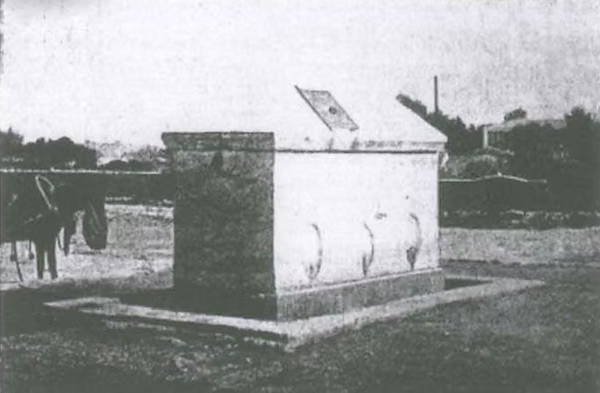
His resting place was marked by a famous, self-authored verse epitaph carved into a plain white Proconnesian marble sarcophagus. The inscription emphasized his lifelong dedication to the defense of the state, noting that from the moment the King of Heaven called him to the throne, he lived in perpetual vigilance. It contrasted his resting place with the grand urban mausolea of past emperors, declaring that he chose to rest among his troops because, in his own words, “nobody saw my spear at rest” while danger threatened the borders of Rome — a line that stands as one of the most quietly devastating epitaphs any Byzantine ruler left behind.
Desecration and the rescue at Selymbria
The original monument did not survive the crises of the thirteenth century. In 1204, the armies of the Fourth Crusade sacked Constantinople, and the imperial tombs at the Hebdomon were broken open and stripped of their treasures along with the rest of the city’s mausolea; Basil’s was not spared. The church itself fell into ruin and disuse in the decades that followed.
When Nicaean forces under Michael VIII Palaiologos recaptured Constantinople in 1261, soldiers operating in the city’s suburbs are said to have rediscovered the remains at the ruined Hebdomon site and, recognizing the surviving verse inscription, identified them as Basil II’s. Michael VIII ordered the bones treated with reverence: wrapped in silk, placed in a new casket, and translated to the Roman-controlled suburb of Selymbria (modern Silivri), where they were reburied in the Monastery of the Savior Christ.
The lost tomb of Selymbria
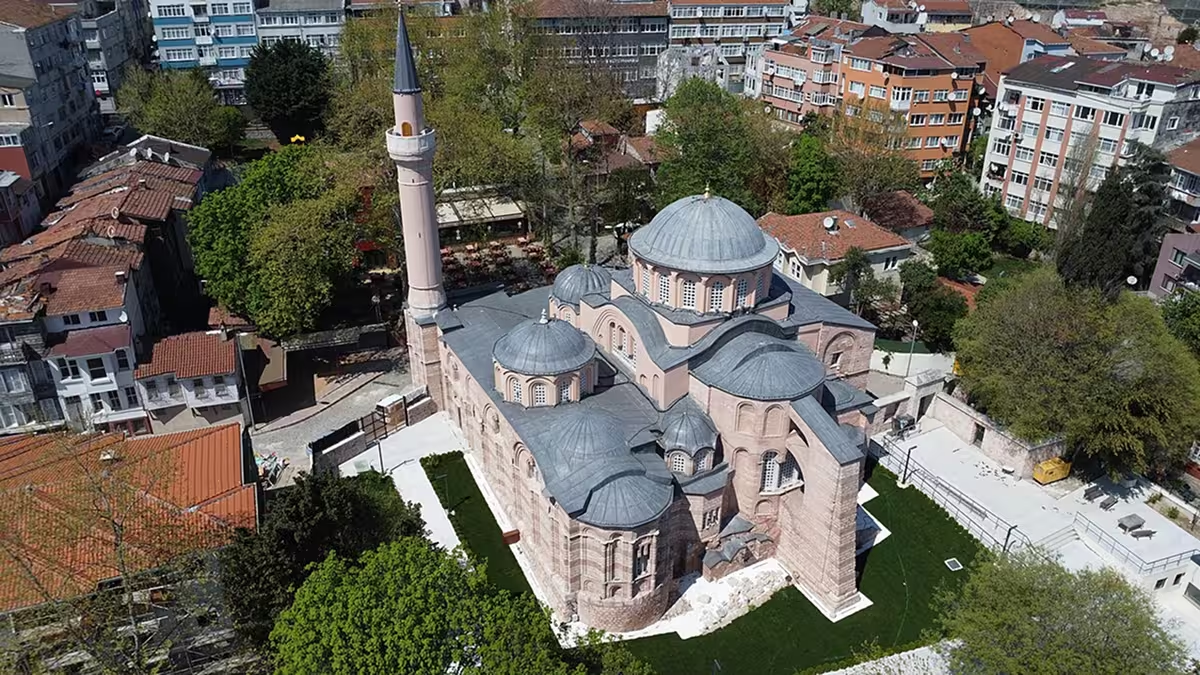
The secondary monument soon became entangled in the political conflicts of the late empire. In 1282, Michael VIII Palaiologos himself died in Thrace; because he had forced an unpopular religious union with the Papacy at the Council of Lyon, the anti-Unionist clergy of Constantinople refused his body a Christian burial within the capital. His son, Andronikos II, had Michael’s corpse quietly moved to the same monastery in Selymbria, to rest beside the casket of Basil II. The monastic complex is attested in records into the late fifteenth century, but during the subsequent centuries of Ottoman rule and modern urbanization it was entirely dismantled. Today, no trace of the structure, Michael VIII’s monument, or Basil II’s secondary casket remains — the emperor’s final resting place is lost to history.
The failed succession and geopolitical legacy
The institutional power vacuum
Throughout his 49-year reign, Basil II remained unmarried and childless, having devoted himself entirely to the administration of the state. This choice proved catastrophic for the long-term stability of the dynasty.
Upon his death, sole power passed directly to his elderly brother, Constantine VIII, who lacked administrative talent and interest in governance. Constantine’s short, negligent reign initiated a rapid cycle of court intrigue, weak rulers, and political marriages that destabilized the central government and systematically dismantled Basil’s bureaucratic checks on the aristocracy. Within fifty years of his death, the empire suffered the severe defeat of Manzikert in 1071 and lost its core Anatolian territories in the subsequent decade.
Historiography and nationalist mythmaking
The historical memory of Basil II evolved significantly over the centuries. In the immediate post-Byzantine era, historians like John Skylitzes and Michael Psellos recorded his reign as a peak of imperial strength, though they noted his harshness and disdain for the intellectual classes.
In the nineteenth and twentieth centuries, his image was heavily weaponized during the nationalist conflicts in the Balkans. Modern Greek historiography transformed the medieval emperor into a powerful symbol of national resilience, while Bulgarian historical narratives viewed him as a brutal foreign oppressor. This modern politicization cemented his place in cultural memory, ensuring that Basil II remains one of the most studied and debated figures in the history of the medieval Roman world.
Frequently asked questions
Who was Basil II?
Basil II (ruled as sole emperor 976–1025) was a Byzantine emperor who crushed internal aristocratic rebellions, destroyed the Bulgarian Empire, and expanded Byzantine territory to its greatest extent since the sixth century. He is often considered the most powerful of the Macedonian dynasty emperors.
Why is Basil II called the “Bulgar-Slayer”?
The epithet Boulgaroktonos (“Bulgar-Slayer”) was attached to Basil in later centuries after his three-decade campaign to subjugate the Bulgarian Empire, which culminated in the 1014 Battle of Kleidion and the annexation of Bulgaria by 1018.
What happened at the Battle of Kleidion?
In July 1014, Basil’s forces outflanked and crushed the Bulgarian army of Tsar Samuel in a mountain pass. Byzantine sources claim thousands of prisoners were blinded and sent home, an event that reportedly caused Samuel’s fatal stroke — though modern historians treat the prisoner numbers with some skepticism.
What was the Varangian Guard, and did Basil II create it?
The Varangian Guard was an elite imperial bodyguard of Scandinavian and Rus’ warriors. Basil II institutionalized it after using 6,000 troops sent by Prince Vladimir I of Kiev — received in exchange for marrying his sister Anna to Vladimir and securing Kievan Rus’s conversion to Christianity — to crush the rebellions of Bardas Skleros and Bardas Phokas.
What was the Allelengyon?
A 1002 fiscal decree making wealthy landowners (the Dynatoi) legally responsible for the unpaid taxes of poorer peasants in their districts, aimed at protecting the free peasantry and the tax base it provided while curbing aristocratic land accumulation.
Where is Basil II buried?
He was originally buried in the Church of St. John the Evangelist at the Hebdomon, outside Constantinople’s walls, rather than the traditional imperial mausoleum at the Church of the Holy Apostles. His tomb was desecrated during the 1204 sack of Constantinople; his relics were later moved to a monastery near Selymbria by Michael VIII Palaiologos after the 1261 reconquest of the city, at a site that no longer survives.
Why did the Macedonian dynasty decline so quickly after Basil II?
Basil never married and had no heir. Power passed to his elderly, disengaged brother Constantine VIII, and within about fifty years the empire suffered catastrophic losses, including the 1071 defeat at Manzikert.
Sources & further reading
- Catherine Holmes, Basil II and the Governance of Empire (976–1025) (Oxford University Press, 2005)
- Catherine Holmes, “Basil II (976–1025),” De Imperatoribus Romanis
- Paul Stephenson, The Legend of Basil the Bulgar-Slayer (Cambridge University Press, 2003)
- John Skylitzes, Synopsis Historiarum, trans. John Wortley
- Michael Psellos, Chronographia