
Virgin Eleousa: Compassionate Mother in Byzantine Iconography
The Virgin Eleousa, meaning “compassionate” in Greek, is an iconographic type of the Theotokos — the Mother of God — that emerged in Byzantine art. It developed from the earlier Hodegetria type, transforming the formal gesture of guidance into an intimate depiction of maternal tenderness: the Mother bends her head toward her Child, their cheeks touching, while Christ encircles her with one arm, emphasizing the bond between the divine and the human. Although the type is best known from panel icons of the Byzantine world such as the celebrated Virgin of Vladimir, it found expression in every medium of Byzantine art — mosaics, wall paintings, and miniatures alike.
Origin and meaning of the Virgin Eleousa
From the 8th and 9th centuries, the epithet Eleousa was applied to many images of Mary, though often inconsistently. Over time, it came to describe one distinct iconographic type : the image of the tendermother, where the Mother bends her head toward her Child, their cheeks touching in a gesture of affection and silent understanding. Christ, shown either seated or standing, encircles his mother with one arm, completing the exchange of love between the divine and the human.
The type appears in sources from the 10th century and may have existed as early as the 7th. It gained particular popularity during the Komnenian period. This rise likely reflects the growing Passion liturgy, which celebrated the Virgin’s love for her son — both as a child and at his death. This type’s emotional tone was rather new to Byzantine art, known for his hieratic and intemporal aspects, reflecting a shift toward humanized depictions of divine love during the Komnenian and Palaiologan periods.
Spread and devotion to the Eleousa type
From the 10th century onward, the Eleousa type spread throughout the Byzantine world, finding a place in both imperial foundations and humble parish churches. Its growing popularity reflected a broader shift in devotion — from a distant veneration of the divine to a more personal, emotional relationship with the Virgin and Child.
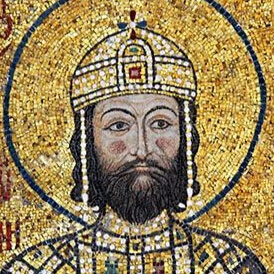 Emperor John II Komnenos,
Hagia Sophia Mosaic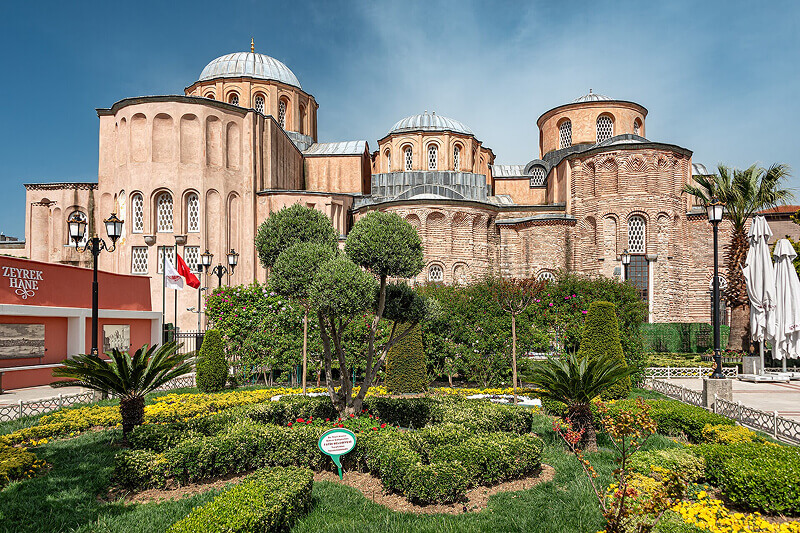 Pantocrator Monastery (Zeyrek Mosque) in Istanbul
The Eleousa appealed deeply to Byzantine spirituality, which saw in the Virgin’s compassion a reflection of Christ’s own mercy. Monastic communities, in particular, adopted the image as a focus for meditation on divine love and maternal sorrow. The foundation of the Pantocrator Monastery in Constantinople by Emperor John II Komnenos in the 12th century included a church dedicated to the Virgin Eleousa, attesting to the prestige of the cult. Although the icon once kept there is lost, it may have belonged to this type. The prestige of the monastery may also have helped spreading the image type throughout the empire.
By the late Byzantine period, the popularity of the Elousa manifested by numerous copies and local interpretations appeared from Crete to Russia, culminating in enduring icons such as the famous Virgin of Vladimir.
Famous examples of the Virgin Eleousa
Among surviving images, the Virgin of Vladimir remains the most celebrated. Painted in Constantinople around 1130 and later brought to Russia, it became a symbol of divine protection and maternal compassion. The Virgin’s inclined head, her gentle touch against the Child’s cheek, and Christ’s arm around her neck exemplify the defining tenderness of the type.
Other important examples once adorned churches in Constantinople and Mount Athos, though many have not survived. Fragments of wall paintings and portable icons from the 11th and 12th centuries show that the Eleousa was already a widely revered motif, often placed in the apse or on the templon to invite contemplation.
 Icon of Vladimir, ca. 1150
 Theotokos Episkepsis,
late 13th century icon of the Virgin Eleousa type, Byzantine Museum of Athens
Variants of the Eleousa type in Byzantine Art
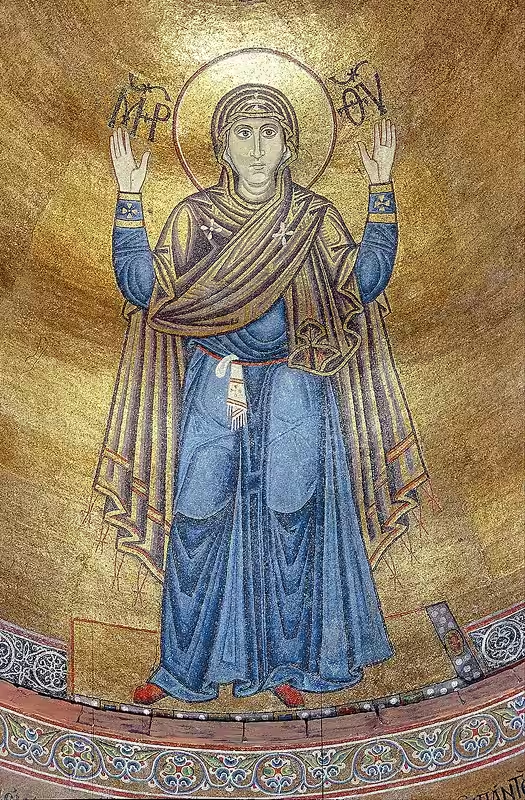
The Eleousa inspired many related images that expressed tenderness in distinct ways. These variants often carried their own names and devotional nuances, reflecting the richness of Byzantine Marian imagery. Among them are the Virgin Episkepsis, the Virgin Gorgoepekoos (“she who is quick to hear”), the Panton Chara. The epithet Blachernitissa, from the famous sanctuary near the Blachernae Palace in Constantinople, was occasionally applied to tender images as well, though it is more commonly associated with the Virgin Orans type.
and the Virgin Blachernitissa – the latter associated with the famous icon once kept in the church near the Blachernae Palace in Constantinople, reputed to protect the city until 1453.
One of the most expressive variations is the Virgin Pelagonitissa, named after a lost original from Pelagonia in Macedonia, perhaps of the 13th century. Here, the Child twists in his mother’s arms, turning his head back to touch her cheek with his hand. The gesture, almost playful, deepens the sense of movement and affection that defines the Eleousa spirit.
The Cypriot Kykkotissa, believed to replicate an icon given to the Monastery of Kykkos by Emperor Alexios I Komnenos, presents Christ in a short sleeveless chiton while the Virgin wears an additional veil over her maphorion. This peculiar detail marks the local character of the image.
In Crete, the Virgin Kardiotissa offered yet another interpretation. Here, the Child stretches both arms to embrace his mother fully, embodying the pure intimacy of divine love.
Legacy of the Eleousa in Post-Byzantine Art
After the fall of Constantinople, the Eleousa type remained central to Orthodox devotion. It was reproduced in Crete, the Balkans, and Russia, where it became fully integrated into local devotional practices. Cretan painters of the post-Byzantine period, particularly in Heraklion workshops, adapted the type with refined modeling and occasional Western influences while maintaining its essential emotional restraint.
The term Glykophilousa — meaning “sweet-kissing” — was applied to these images only in post-Byzantine times. It encapsulates what the Eleousa had conveyed for centuries: the intimate and compassionate bond between the Virgin and Christ.
The Eleousa type demonstrates the evolution of Byzantine Marian iconography, from its origins in the Hodegetria to its highly specific expression of maternal compassion. Through its emotional immediacy, the Eleousa became one of the most beloved and enduring images of the Theotokos in the Orthodox world. Its variants across Constantinople, Crete, Cyprus, and Russia reveal both the adaptability of Byzantine visual culture and the lasting devotional significance of the Virgin Mary. Even in post-Byzantine art, the type continued to shape Orthodox iconography, ensuring that the tender gesture of mother and child remained central to Christian visual devotion.
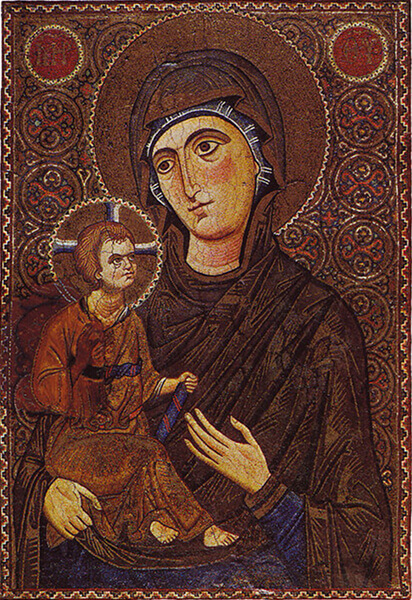
The other Virgin iconographic types

Sources and further reading
- Maria Vassilaki (ed.), Mother of God: Representations of the Virgin in Byzantine Art, Skira, 2000.
- Maria Vassilaki (ed.), Images of the Mother of God: Perceptions of the Theotokos in Byzantium, Ashgate, 2005.
- Bissera V. Pentcheva, Icons and Power: The Mother of God in Byzantium, Penn State University Press, 2006.
- Victor Lazarev, “Studies in the Iconography of the Virgin,” The Art Bulletin 20 (1938), pp. 26–65 — the classic study of the Marian types, including the Eleousa.
- Henry Maguire, “The Depiction of Sorrow in Middle Byzantine Art,” Dumbarton Oaks Papers 31 (1977), pp. 123–174 — on the emotional turn in Komnenian art.
- Alexander Kazhdan (ed.), The Oxford Dictionary of Byzantium, Oxford University Press, 1991 — entry “Eleousa.”