From Byzantine Christianity to Orthodoxy: The construction of a faith through Councils, Heresies, and Schisms
To fully grasp the richness of Byzantine heritage, one must first understand its religion, the force behind much of its art and architecture. Christianity, intertwined with Roman identity, shaped the very fabric of Byzantine society, replacing centuries of pagan traditions and defining cultural, political, and spiritual life. From the evolution of early Christian beliefs to the establishment of Orthodox practices, religion guided the empire’s laws, education, and artistic expression. Exploring this progression offers insight into how faith not only structured Byzantine society but also left a legacy that continues in modern Orthodoxy. To trace this transformation, we must return to the final years of the Roman Empire.
The rise of Christianity in the Eastern Roman Empire
When Constantine founded Constantinople, he was not yet a Christian. He authorized Christianity in 313 but initially built temples to the Roman gods in his new capital, even before the first churches. It was only by the end of the 4th century that Christianity became the empire’s official and sole permitted religion. The emperor then assumed the title of “Emperor of the Romans” and added “faithful in Christ the God,” presenting himself as God’s lieutenant on earth, the foremost Christian, and ultimately the head of the Church.
Christianity quickly imposed itself on the masses of the Roman East, extending beyond the empire’s borders into nearby regions and, in some cases, into distant areas of the Persian Empire. Yet paganism persisted among the educated urban aristocracy and declined only gradually. Justinian delayed the closure of the Academy of Athens until 529, and the temple of Philae in Egypt remained active until the 7th century.
Once Christianity was authorized, its leaders no longer opposed Roman identity. Bishops, often drawn from the aristocracy and educated in the paideia, were well-versed in Neoplatonic philosophy and ancient rhetoric. They became some of the strongest defenders of Roman heritage, successfully reconciling it with Christian thought.
The difficult birth of a unified Christian doctrine
The division of the church at the time of Constantine
The message of Christ was meant to be universal; the ultimate aim of Christianity was to encompass the oikoumene (literally, the inhabited world), meaning all of humanity. In practice, however, the reality was more complex. The core of Christian belief itself is intricate, teaching one God in three persons: the Father, the Son, and the Holy Spirit. In the early centuries, a vast corpus of scriptures, including many apocryphal texts, circulated among Christian communities. The new religion also encountered the diversity of the ancient world, where beliefs were often deeply rooted in local traditions and supported by established schools of thought. Adding to this complexity, early Christian communities were divided and often clandestine, with differing practices, interpretations, and sometimes even beliefs.
By authorizing Christianity, Constantine made a primarily political choice, regardless of his personal convictions. He sought the support of what appeared to be the most dynamic segment of the empire’s population. Consequently, he could not tolerate Christians tearing one another apart. To address these divisions, he convened the first Council of Nicaea. An ecumenical council normally gathers sufficient bishops and is regarded as speaking for the entire Christian community. Constantine had the council presided over by his representatives. No one contested this role, since he had authorized the new religion. At the time, ideology also considered the emperor as divine in a political sense. While Christians did not see him as God, he was recognized as God’s legitimate representative on earth. This notion remains strong in Orthodox tradition: the emperor, as God’s lieutenant on earth, convenes and presides over councils.
The Arianism dispute and the first council of Niceae
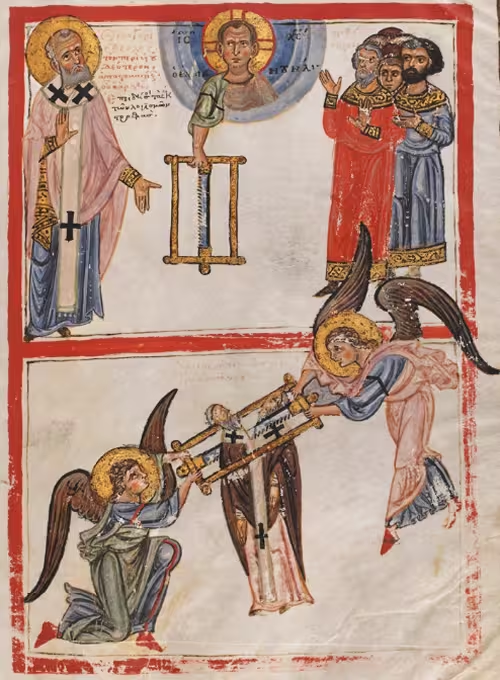
The main controversy of the time focused on the relationship between the three persons of the Trinity: the Father, the Son, and the Holy Spirit. Arius, a priest from Alexandria, advocated strict monotheism, arguing that the Son was a creation of the Father. This doctrine became known as Arianism.
It was condemned by the Council of Nicaea, which affirmed that the Father, the Son, and the Holy Spirit are of the same substance, a declaration known as the Nicene Creed. However, the issue was far from resolved. Constantine himself recalled Arius from exile as early as 328, and several of his successors embraced Arian beliefs. Arianism continued to spread across many eastern regions and among the Germanic peoples beyond the empire’s borders.
The controversy was only settled nearly a century later, at the Second Ecumenical Council of Constantinople convened by Theodosius in 381. This council did more than end the Arian dispute. It also condemned Apollinarianism — the belief that Christ possessed a human body but not a full human mind or soul — and formally extended the Nicene Creed’s declaration of divinity to the Holy Spirit.
The resulting text, still recited in Orthodox liturgy today, closed the foundational phase of Trinitarian doctrine and shifted the empire’s theological battles toward a new question: not who God is, but how divine and human nature coexist in Christ himself.
Nestorianism and Monophysitism
Nestorianism and the first Council of Ephesus
A new controversy arose over Christ’s nature: fully God and fully human. It divided the Eastern Church for centuries. Initially, two main schools of thought opposed each other: those of Antioch in Syria and Alexandria in Egypt. Nestorius, a priest of Antioch who became patriarch of Constantinople in 428, rejected the idea that Christ was born from a woman, arguing that the Virgin was not Theotokos but Christotokos—this became known as Nestorianism. Cyril of Alexandria opposed him, defending Mary’s divine motherhood. The Council of Ephesus in 431 condemned Nestorianism, but the doctrine did not disappear. Nonetheless, Cyril and his school succeeded in promoting a stricter interpretation of Christian dogma, leaning toward a more rigorous monotheism.
The rise of Monophysism
According to this belief, during the Incarnation, Christ’s human nature merges with his divinity, leaving only one nature (monos physis in Greek). This doctrine is known as Monophysitism. Cyril was able to impose it at a council held in Ephesus in 449. Political considerations soon intervened. When the new emperor Marcian ascended the throne in 450, he sought to avoid alienating Rome, which was less sympathetic to Monophysitism, and to secure the empire’s most threatened regions. He convened a new council at Chalcedon, on the Asian side of the Bosporus facing Constantinople, which condemned Monophysitism in 451.
Despite the council’s decision, Monophysitism remained strong in the eastern provinces, especially in Syria and Egypt. The choice of Chalcedon as the council site suggests that Constantinople’s population might have leaned toward Monophysitism at the time. The crisis ran deep: in the countryside, many resented bishops and tax collectors sent from the capital, and Monophysitism became a vehicle for the revival of local Coptic and Syriac cultures. This religious tension posed a real threat, especially with the Persian Empire as a formidable neighbor to the east, soon replaced by the rapidly expanding Arab forces.
Monophysitism even influenced the Constantinopolitan elite. Justinian’s wife, Empress Theodora, adhered to the doctrine, and several emperors followed her example. Justinian himself made the most sustained imperial attempt at reconciliation. In 553, he convened the Fifth Ecumenical Council in Constantinople to settle the so-called Three Chapters controversy, condemning the writings of three theologians associated with the Antiochene school in the hope of making Chalcedonian doctrine more palatable to Monophysite communities. The maneuver satisfied almost no one: it alienated the western Church, which saw it as an attack on Chalcedon itself, without winning over the Monophysite East. The failure illustrated a pattern that would recur for the next century — emperors treating doctrine as an instrument of imperial unity, only to find that theological conviction ran deeper than political calculation. Others, particularly in the early 7th century during conflicts with the Persians and Avars, attempted compromises but met little success. Ultimately, the issue was resolved by the loss of the Monophysite regions, which were conquered within about a decade by Muslim Arabs, who would permanently transform the religious landscape of the Near East and North Africa.
The veneration of the images and the iconoclastic crisis
The veneration of the images
The divine law given to Moses forbids graven images, the depiction of God’s creatures, and their worship. These commandments are strictly observed by Jewish and Muslim communities, as well as by the most rigorous Christians. As a result, sculptures – including those in the round – are absent in Eastern Christian churches. This contributes to the decline of statuary inherited from antiquity, reducing it to a minor art in Byzantium.
However, there was no unanimous agreement on representations in painting or mosaic. From the earliest days of Christianity, images appeared in churches. They illustrated sacred history for a largely illiterate population, providing indirect access to the Holy Scriptures. According to the Church Fathers of the 4th and 5th centuries, these images were not objects of devotion, unlike imperial portraits, which were honored with lights and incense. At the time, only relics of martyrs—and later of holy men—were objects of veneration.
From the 6th century onward, the situation changed. Portraits of holy men were created during their lifetimes, and images, like relics, were believed to possess miraculous powers. They first circulated privately, then became public and gained significant importance. Some images were even considered acheiropoieta, not made by human hands. Others were carried in procession, such as the image of the Protectress of Constantinople before the city walls during the Avar siege of 626.
Images thus acquired power in themselves, serving as intermediaries between God and humanity, especially as emperors’ credibility declined following military defeats and territorial losses. This belief was reinforced by a long-standing Greco-Roman tradition that attributed divine presence to material objects, predating Christianity. Learn more about the rise of icons in Byzantium →
The first iconoclasm, the councils of Hieria and Nicaea
Leo the Isaurian, who became emperor in 717, sought to consolidate support during the Arab siege of Constantinople. In the 730s, he began removing images from churches and prohibiting their worship, responding to the concerns of his clergy, especially in Asia Minor. His military successes against the Arabs gave him – and later his son, Constantine V – the authority to enforce this policy at the Council of Hieria in 754. Iconoclasm then became the official doctrine of the empire.
The controversy focused on whether Christ could be depicted in images, extending to representations of the Virgin Mary and the saints. Theologically, images showing both the divine and human natures of Christ risked implying Monophysitism, while images depicting only his human nature suggested Nestorianism. Under Iconoclasm, only symbolic representations of divinity were permitted: the Cross, the Eucharist, and the Word.
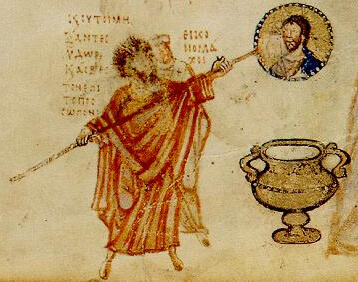
Voices rose in defense of images in response to imperial policy. The main figure of this movement was John of Damascus, a former official under the caliphate who retired to a monastery in Palestine. Being outside the empire, he could write freely. He argued that the Incarnation made God representable: Christ is the icon of the Father. John reversed the iconoclast argument: since Christ is fully human, he can be depicted; denying this risks Monophysitism, which confuses his divine and human natures. If Christ can be represented, so too can the Virgin and the saints. To counter accusations of idolatry, John distinguished between the image—a material object—and what it represents. The image was not worshiped itself but venerated, and the honor given to it passed to what it represented. These two views of the divine proved irreconcilable.
Despite this, the victories of the iconoclast emperors Leo III and Constantine V strengthened their authority. The Byzantine ecclesiastical hierarchy largely submitted to imperial will, which increasingly favored iconoclasm. The only serious opponents were monks who resisted the policy. Many monasteries relied on pilgrims attracted by sacred images and relics. To weaken them, the emperors secularized and dispersed monks from resistant monasteries. Constantine V staged a public mockery at the Hippodrome of Constantinople, parading stripped monks and nuns—men and women paired together—through the track to signify their reintegration into ordinary society. These persecutions were more humiliating than violent. Later iconodule sources portrayed figures like Stephen the Younger as martyrs, but they had actually been punished for conspiracy or lèse-majesté; for instance, Stephen was imprisoned for reconstituting a dissolved monastery and trampling an imperial coin.
-
Mosaics | Architecture | Art | Church
Byzantine Iconoclast Art and Mosaics at Hagia Irene, Constantinople – Istanbul
Discover the mosaics and decoration of Hagia Irene, one of the oldest Byzantine churches of Constantinople, and a rare witness to early Byzantine art.

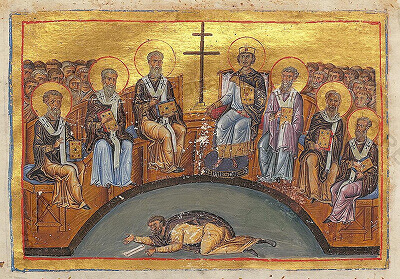
Iconoclasm never gained universal support. It faced resistance from parts of the population and from the papacy, which turned to the Carolingians, threatening Byzantine holdings in Italy.
To break this isolation, Empress Irene, regent for her son Constantine VI, restored the veneration of images. She convened a council at Nicaea in 787, supported by the pope, though the population of Constantinople remained divided, with many still favoring iconoclasm.
This enduring support would make the second wave of iconoclasm possible under Leo V.
The second iconoclasm and the definitive restoration of images
The iconodule emperors who followed faced repeated defeats against the Bulgars. In 813, the Bulgars even besieged Constantinople, and the panicked population rushed to the tomb of Constantine V – an iconoclast, but a victorious one. In 815, Leo V reinstated the Council of Hieria, while conceding that the veneration of icons could not be considered idolatry. His two successors continued this policy. The ecclesiastical hierarchy was again purged, and a few monks resisted once more. However, this second period of iconoclasm lacked the vigor and unity of the first.
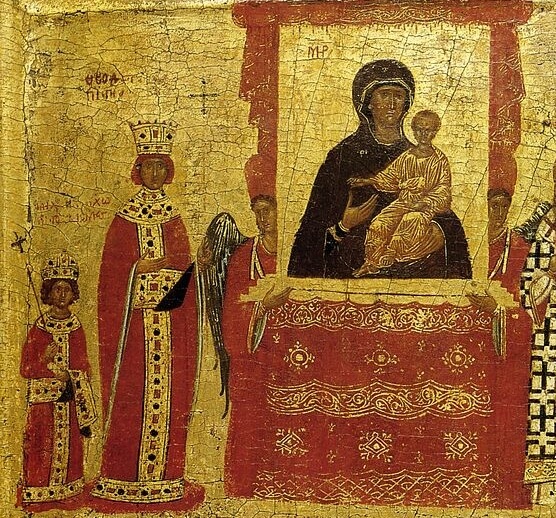
In 843, Empress Theodora, acting as regent for her son Michael III, restored the veneration of images permanently. This event is still celebrated as a feast in the Orthodox Church.
The crisis left deep and lasting effects on Byzantine life and art. Portable icons became widespread in homes, and their designs were gradually standardized. Church walls were again decorated with frescoes and mosaics, following an established program: Christ Pantocrator appeared in the dome, the Virgin in the apse, and saints’ portraits adorned the walls. At the same time, the pilgrimage of relics experienced a renewed boom, reflecting the resurgence of popular devotion.
Church and State after Iconoclasm
The restoration of images in 843 did not simply end a theological dispute — it reshaped the relationship between throne and altar for the remainder of Byzantine history. Emperors emerged from the crisis having learned that doctrine could not be dictated by decree alone; the Church’s cooperation was as essential to imperial legitimacy as its submission had once seemed guaranteed. The Patriarchate of Constantinople, weakened and repeatedly purged during both waves of iconoclasm, used the restoration to reassert its authority over doctrine, while the emperor retained the ceremonial and practical privileges of convening councils and appointing patriarchs.
This delicate balance — sometimes called caesaropapism, though the term overstates how absolute imperial control actually was — defined Byzantine religious life going forward. Patriarchs who resisted an emperor’s will could be deposed, as Photios and Ignatios discovered during their repeated depositions and reinstatements in the 850s–870s. Yet emperors who overreached doctrinally, as the iconoclasts had, risked lasting damage to their own legitimacy. The ninth and tenth centuries settled into an uneasy but durable equilibrium: an emperor who was head of the state but not, in practice, master of theology.
The spread of Orthodoxy beyond the Empire
Even as Constantinople stabilized its own religious order after Iconoclasm, it turned outward. Missionary expansion became one of the empire’s most effective instruments of influence — arguably more durable, in the long run, than any of its military campaigns.
Conversion of the Slavs
In 863, the brothers Cyril and Methodius, missionaries from Thessaloniki, were sent to Great Moravia at the request of its prince, tasked with bringing Christianity to the Slavic peoples in their own language. Cyril devised a new alphabet — the Glagolitic script, ancestor of the Cyrillic alphabet still used across the Orthodox Slavic world — and translated liturgical texts into Old Church Slavonic. Their mission in Moravia was ultimately eclipsed by Frankish and Latin rivals, but the tools they created outlived the setback.
Bulgaria proved the more lasting success. Khan Boris I accepted baptism in 864, and after a period of maneuvering between Rome and Constantinople, Bulgaria settled firmly into the Byzantine religious orbit, adopting Slavonic liturgy and establishing its own autocephalous church structures by the following century — the first fully Slavic-language Orthodox church, and the template the Rus’ would later follow.
Conversion of the Rus’
Byzantium’s relationship with the Rus’ began adversarially. Kievan raiding fleets had attacked Constantinople itself in 860, and Byzantine chroniclers treated the Rus’ for over a century afterward as a dangerous, unpredictable neighbor rather than a candidate for conversion. Contact nonetheless deepened through trade — the Dnieper river route linking Scandinavia to the Black Sea ran directly through Rus’ territory — and through the steady presence of Rus’ mercenaries in Byzantine service.
The decisive moment came in 987–988. Emperor Basil II, facing a serious internal revolt led by the general Bardas Phokas, secured military aid from Grand Prince Vladimir of Kiev in exchange for a double commitment: Vladimir’s conversion to Byzantine Christianity, and his marriage to Basil’s own sister, Anna Porphyrogenita — an extraordinary concession, since porphyrogenita brides born “in the purple” were almost never given to foreign rulers. Vladimir supplied roughly six thousand warriors, later formalized as the core of the Varangian Guard, and Basil’s revolt was crushed. When the emperor hesitated on delivering the marriage, Vladimir seized the Byzantine city of Chersonesos in Crimea to force the issue; he was baptized there in 988, married Anna shortly after, and returned to Kiev to impose baptism on his people, famously staging a mass baptism of the city’s population in the Dnieper.
Later chroniclers embellished the decision with the legend of Vladimir’s “trial of the faiths” — envoys sent to evaluate Islam, Judaism, Latin Christianity, and Byzantine Christianity in turn, won over decisively by the beauty of the liturgy they witnessed at Hagia Sophia. The story is almost certainly a later literary flourish rather than history, but it captures something real: Byzantine Christianity arrived in Rus’ bundled with the full weight of Constantinopolitan culture — art, architecture, and a written liturgical language already prepared by Cyril and Methodius a century earlier. Kiev’s own Hagia Sophia, built within decades of the conversion, was a deliberate echo of the capital it now looked to for both faith and legitimacy. The Kievan church was established as a metropolitanate under the direct authority of the Patriarch of Constantinople, cementing an ecclesiastical relationship that would long outlast Kiev’s own political independence — and that would ultimately relocate Orthodoxy’s demographic center of gravity northward after Constantinople itself fell in 1453.
Monasticism as an institution
Monks had already shaped Byzantine religious life well before 843 — as the most stubborn resisters of iconoclasm — but the post-iconoclast centuries saw monasticism mature into a defining institution of Orthodox spirituality. Monastic life in Byzantium was never centralized under a single order, as in the medieval West; instead, individual houses followed their own typika, or founding charters, setting out rules for communal life, property, and worship.
The most consequential development was the rise of Mount Athos, the peninsula in northern Greece that became, from the 9th century onward, the spiritual heart of Orthodox monasticism. The first major monastery, the Great Lavra, was founded there in 963 by Athanasios the Athonite with the support of Emperor Nikephoros II Phokas. Over the following centuries, Athos grew into a self-governing monastic republic drawing monks from across the Orthodox world — Greek, Georgian, Serbian, Russian, and Bulgarian — and it remains active today, largely on its own medieval terms. Beyond Athos, monasteries functioned as centers of manuscript production, theological education, and charitable work, and monastic clergy — rather than the married parish priesthood — supplied the Church’s bishops, giving monasticism outsized influence over Byzantine theology at the highest level.
The Great Schism of 1054
The doctrinal disputes of earlier centuries had been fought within a single Church; the mid-11th century produced a rupture between two. Tensions between Constantinople and Rome had been building for generations over a cluster of issues: the filioque clause added to the Nicene Creed in the Latin West (asserting the Holy Spirit proceeds from the Father and the Son, a wording Constantinople had never accepted), disagreements over clerical celibacy and liturgical practice, and above all the question of papal primacy — whether the Bishop of Rome held authority over the other patriarchates or merely precedence of honor among equals.
Matters came to a head in 1054, when a papal legation led by Cardinal Humbert of Silva Candida traveled to Constantinople amid disputes over churches in southern Italy. Negotiations broke down, and Humbert laid a bull of excommunication against Patriarch Michael Keroularios on the altar of Hagia Sophia; the patriarch responded in kind against the legates. At the time, this exchange was not understood as a permanent, empire-wide schism — such disputes had occurred before and been healed — but it hardened into one over the following generations, reinforced by the mutual suspicion generated by the Crusades, and above all by the Fourth Crusade’s sack of Constantinople in 1204. What began as a diplomatic incident became, in retrospect, the formal starting point of the enduring division between the Catholic and Orthodox Churches.
Hesychasm and the Palamite controversy
By the 14th century, as the empire’s political power had shrunk to a fraction of its former extent, its theological life produced one of its most original contributions: Hesychasm, a mystical tradition of contemplative prayer practiced especially on Mount Athos. Hesychast monks pursued the “prayer of the heart,” a repeated invocation aimed at achieving direct experiential union with God, described by its practitioners as a vision of the uncreated light — the same light, tradition held, that the apostles had witnessed at Christ’s Transfiguration.
The practice drew a sharp challenge from Barlaam of Calabria, a Greek Orthodox monk trained in Western scholastic method, who dismissed claims of directly perceiving divine light as theologically incoherent and verging on heresy. The defense of Hesychasm fell to Gregory Palamas, Archbishop of Thessaloniki, who developed a distinction between God’s unknowable essence and his knowable energies — the means by which the divine genuinely communicates with and is experienced by creation. This distinction allowed Palamas to argue that mystical experience of divine light was real without compromising God’s fundamental transcendence. A series of councils in Constantinople between 1341 and 1351 vindicated Palamas, and Palamite theology was formally adopted as Orthodox doctrine — a decision that still underpins much of Eastern Orthodox theology today, making this arguably the last great original doctrinal achievement of Byzantine Christianity.
Union attempts and the fall of Constantinople
As the Ottoman advance made the empire’s survival increasingly doubtful, Byzantine emperors turned to Rome for the military aid that only the West could offer — aid that came, inevitably, with the price of religious reunion. The most serious attempt was the Council of Florence in 1439, where Emperor John VIII Palaiologos and a Byzantine delegation, including many senior clergy, negotiated union with the Latin Church, accepting papal primacy and the filioque in exchange for promised support against the Ottomans.
The union was a diplomatic achievement and a popular disaster. Announced in Constantinople, it was met with open hostility from clergy, monks, and much of the laity, who saw it as a betrayal of Orthodox doctrine for military expediency that, in any case, delivered little effective Western aid. The famous remark attributed to the megas doux Loukas Notaras — that he would rather see the Turkish turban ruling in the city than the Latin mitre — captures the depth of popular resistance, whether or not he spoke those exact words. When Constantinople finally fell to Mehmed II in 1453, the union dissolved with the empire itself; the Ottoman conquest, paradoxically, left the Orthodox Church more institutionally intact under the millet system than the failed union with Rome ever had.
Legacy
The doctrinal battles traced across this article did not end with the empire that fought them. The Nicene Creed, refined at Constantinople in 381, remains the doctrinal core of both Orthodox and Catholic Christianity. The iconographic program standardized after 843 — Christ Pantocrator in the dome, the Virgin in the apse — still defines how Orthodox churches are built and decorated worldwide. Palamite theology, vindicated in the 1340s, remains living doctrine rather than historical curiosity. And the missions to the Slavs, launched almost as an afterthought to Constantinople’s own internal stability, gave Orthodoxy a demographic center of gravity that, after 1453, shifted decisively northward to Moscow and the Slavic world.
In this sense, Byzantine Christianity’s most significant achievement may not be any single council or crisis, but its durability: a doctrinal and liturgical tradition that outlived the state which forged it by more than five centuries, and counting.