Irene of Athens: The empress who had her son blinded to rule alone
In December 800, a pope crowned Charlemagne emperor in Rome. Some Frankish writers justified the act by pointing to Constantinople. The imperial throne, they said, was empty, because a woman sat on it. That woman was Irene of Athens.
Irene governed the Byzantine Empire for most of the years between 780 and 802. She ruled first for her young son, then beside him, and finally alone, using both a feminine and a masculine imperial title. She restored the veneration of icons. She also had her son deposed and blinded, and she lost her throne to her finance minister, Nikephoros I. Her reign overlapped with those of Charlemagne in the west and Harun al-Rashid in Baghdad, and both shaped her policy. Some traditions venerate her as a saint. Others do not.
Her story is well known in outline. Less well known is that almost every detail comes from writers who had a stake in the outcome, and that her court was more divided than the standard account suggests. This article follows her career in four stages, according to the office she held: empress consort, regent, co-ruler and sole ruler. At each stage, it asks what the sources record and where historians disagree.
Key dates
c. 752: Irene born in Athens.
Dec. 769: Marriage to Leo IV.
14 Jan. 771: Birth of Constantine VI.
776: Leo IV crowns Constantine VI co-emperor.
Sept. 780: Death of Leo IV; Irene becomes regent.
783–Jan. 784: Staurakios campaigns against the Slavs and celebrates a triumph.
Dec. 784: Tarasios elected patriarch.
786: First council in Constantinople disrupted.
787: Second Council of Nicaea.
Dec. 790: Constantine VI deposes Irene with Michael Lachanodrakon; Staurakios exiled.
Jan. 792: Irene returns as co-ruler.
792: Bulgars defeat Constantine VI at Markellai.
795: Constantine divorces Maria; Moechian controversy begins.
797: Constantine VI deposed and blinded; Irene rules alone.
3 June 800: Death of Staurakios.
25 Dec. 800: Charlemagne crowned emperor in Rome.
801: Aetios takes command of two armies and promotes his brother Leo.
31 Oct. 802: Nikephoros I overthrows Irene.
9 Aug. 803: Irene dies on Lesbos.
Who was Irene? The sources and their limits
Four groups of sources shape what we know about Irene.
The Byzantine chronicles. The main narrative is the Chronographia of Theophanes the Confessor, written in the years after her fall. Theophanes was a committed supporter of icons. He praises Irene’s religious policy, yet he also records her violence against her son. Later compilers add anecdotes of uncertain origin. The most important here is George Kedrenos, also written Cedrenus, an 11th-century chronicler whose world history ends in 1057. He wrote centuries after Irene and relied on earlier works.
Church documents. The Acts of the Second Council of Nicaea (787) are a direct record of the council. They say little about politics. Richard Price published an English translation with commentary in 2020.
Foreign sources. Frankish annals, papal correspondence and Arabic and Syriac historians view her from outside. They show how others read events in Constantinople, including the Frankish claim that the empire had no legitimate emperor.
Hagiography. A 12th-century Vita presents her as a saint. William Treadgold showed in 1982 that it depends almost entirely on Theophanes, so it adds little independent evidence.
Open question: how far can we trust the record?
Theophanes wrote with a clear agenda. He admired Irene’s defence of icons and disliked her successor, Nikephoros I. His account of her last years in particular needs to be read with that in mind. Treat a claim supported by one source with caution, and note where a second source confirms it.
Empress consort: from Athens to the palace (c. 752–780)
Irene was born in Athens around 752. Modern estimates range from about 750 to 756. She belonged to the Sarantapechos family, a noble house of central Greece. The feminine form of the name is Sarantapechaina.
The name is known, but the link is indirect. The sources do not give Irene’s family name when she reaches the capital in 769. Scholars connect her to the family through relatives who appear later:
- Constantine Sarantapechos, her uncle or cousin, was a patrikios and possibly strategos of the theme of Hellas.
- His son Theophylact, a spatharios, appears in connection with the suppression of a revolt in 799.
- A patrikios named Leon Sarantapechos is attested in 802. He was probably a relative, but the exact tie is unknown.
- Theophano of Athens, a kinswoman, married the emperor Staurakios in 807. This is the son of Nikephoros I, not Irene’s eunuch minister of the same name.
- A female relative also married Telerig, the Bulgar khan who took refuge in Constantinople.
Tradition describes Irene herself as an orphan.
Emperor Constantine V chose Irene as a bride for his son Leo. Byzantine courts sometimes held a bride show, in which candidates from across the empire were gathered for selection. There is no evidence that Irene took part in one. She reached Constantinople in November 769. She was crowned Augusta and married to Leo on 17 December 769, according to Theophanes. Some reference works, including the Oxford Dictionary of Byzantium, give 768. Theophanes and the Prosopography of the Byzantine Empire point to 769.
Her husband, Leo IV, was born in 750 and crowned co-emperor in 751. He is called “the Khazar” because his mother, also named Irene, was a Khazar princess. The two empresses are easy to confuse.
Irene’s son Constantine was born on 14 January 771. Leo became emperor when Constantine V died in September 775. Soon afterwards he crowned the boy co-emperor, in 776. The move provoked a conspiracy in favour of Leo’s five half-brothers, among them Caesar Nikephoros, which Leo suppressed easily. Little else is known about his reign. He sent campaigns into Syria in 776 and 778 under Michael Lachanodrakon, but he could not stop Arab incursions into Asia Minor in 776, 779 and 780.
Open question: how historical is the bride-show story?
The practice itself is attested for several Byzantine dynasties. The details of Irene’s selection are thin. Historians also disagree on her family’s standing. Some call it relatively prominent, others not particularly so. The orphan tradition and the family’s later offices pull in different directions.
Open question: why was Irene chosen?
The sources give no reason. Her devotion to icons makes her an odd choice for an iconoclast emperor. Historians have suggested two explanations. Constantine V may have wanted an alliance with her family’s network in central Greece. Or she may have been made to swear publicly to support iconoclasm. Kedrenos has Leo accuse her of breaking such an oath, which is the only hint. Both ideas are hypotheses.
Regent, 780–790
The first months
Leo IV died of a fever on 8 September 780, while campaigning against the Bulgars. Constantine VI was nine, so Irene took charge as regent. Leo and Constantine V had been iconoclasts. Irene favoured icons.
A later anecdote says Leo found two icons under Irene’s pillow and refused to share her bed afterwards. It comes from Kedrenos, who wrote centuries after the event. It is not in Theophanes. Theophanes does record the crackdown around it. Leo supported iconoclasm, but he persecuted icon supporters actively only in August 780, when he had several court officials beaten, tonsured and imprisoned for venerating icons. One of them, Theophanes the cubicularius, died.
Historians treat the anecdote with caution. Lynda Garland notes that it closely resembles a story told about the later empress Theodora, wife of Theophilos. It may be a later invention, perhaps by Irene’s supporters, or a distorted memory of real events.
Irene faced a challenge almost at once. Supporters of Caesar Nikephoros, Leo’s half-brother, plotted against her. She crushed the plot. Theophanes says she had the half-brothers made clergy, which barred them from the throne.
A second challenge came from Sicily. In February 781 Irene appointed Elpidios governor of the island. She then summoned him back to Constantinople, apparently on suspicion of plotting. He refused, and the local army and population backed him. Irene had his wife and children whipped and imprisoned in the capital. She then sent a fleet under the eunuch Theodore, a patrikios. It defeated Elpidios in 782, and he fled to the Arabs in Africa.
Open question: was Elpidios a rebel?
The sources describe him as a conspirator. It is not clear that he ever declared himself against Irene. Some scholars think she acted on a rumour that he wanted to put one of Leo’s half-brothers on the throne. The episode shows how nervous the new regency was.
The restoration of the icons
Choosing a patriarch
Irene could not restore icons alone. She needed a patriarch who shared her aim, and she needed a council. Patriarch Paul IV resigned in 784 and urged the court to call one.
Irene chose Tarasios, her chief secretary. He was a layman, born about 730 into a family of senior officials. According to later accounts, he accepted the office on one condition: the church would restore the veneration of icons through a council. He was elected in December 784. He then persuaded Irene to write to Pope Hadrian I and invite him to send delegates.
The council that failed, 786
The council opened on 17 August 786 in the Church of the Holy Apostles in Constantinople. Soldiers of the capital’s guard regiments, the tagmata, prevented the bishops from meeting and dispersed them. The papal legates left the city at once.
Irene did not give up. She sent the guard regiments to Malagina in Bithynia, on the pretext of a campaign against the Arabs. There about 1,500 men were dismissed. Staurakios brought loyal troops from Thrace to guard the capital. The legates and the bishops met again the following year.
The Council of Nicaea, 787
Irene moved the council to Nicaea, the city of the first ecumenical council in 325. Constantinople was still thought to hold too many iconoclasts. The council opened on 24 September 787 in the church of Hagia Sophia at Nicaea.
Tarasios presided, together with two legates of Pope Hadrian I. Ancient accounts of attendance range from about 330 to 367 members. The surviving acts record 308 bishops or their representatives.
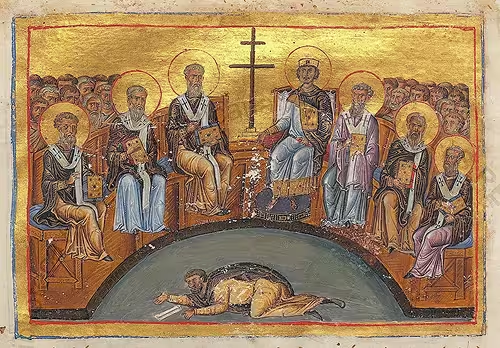
The council held seven sessions between 24 September and 13 October.
- The first session debated whether bishops who had accepted iconoclasm could keep their sees. In the end, those who repented were readmitted.
- In the second session, Hadrian’s letters were read in Greek translation. They approved the veneration of images. They also criticised Byzantine infringements of papal rights.
- The middle sessions read biblical and patristic texts in support of images, and examined the definition issued by the iconoclast council of 754.
- The seventh session, on 13 October, issued the council’s own definition.
The definition drew a line between veneration and worship. Icons of Christ, the Virgin, angels and saints deserve respect, shown by a kiss or a bow. Worship in the strict sense belongs to God alone. Honour paid to an image passes to the person it represents. The council also condemned the iconoclast council of 754, which had called itself ecumenical although none of the five patriarchs had been represented. It issued disciplinary canons as well. One of them forbade the appointment of bishops by secular rulers.
The Frankish response
The Franks rejected the council. Charlemagne’s court produced a long refutation, the Libri Carolini, in the early 790s. The Council of Frankfurt in 794 repeated the rejection. Pope Hadrian defended Nicaea.
A poor Latin translation of the Greek acts is often cited as one cause. It made the Greeks seem to demand worship of images. One hypothesis adds politics: the Franks had no say in the council, and Irene had just broken the engagement between Constantine and Charlemagne’s daughter. The sources do not settle the question.
Open question: how solid was the settlement?
Her motives. The acts show Tarasios leading the theological work. Irene’s own part was political and practical. Some historians read her icon policy as a tool to secure her rule against an army with iconoclast loyalties. Others stress sincere piety. No source lets us decide, and both can be true.
The record. A traditional eighth session, held in Constantinople, is regarded by Erich Lamberz as a later forgery. Richard Price discusses the case in his edition.
Its future. The settlement lasted about 30 years. Leo V restored iconoclasm in 815, and the second period ended only in 843.
Wars and diplomacy
Irene’s foreign record is mixed.
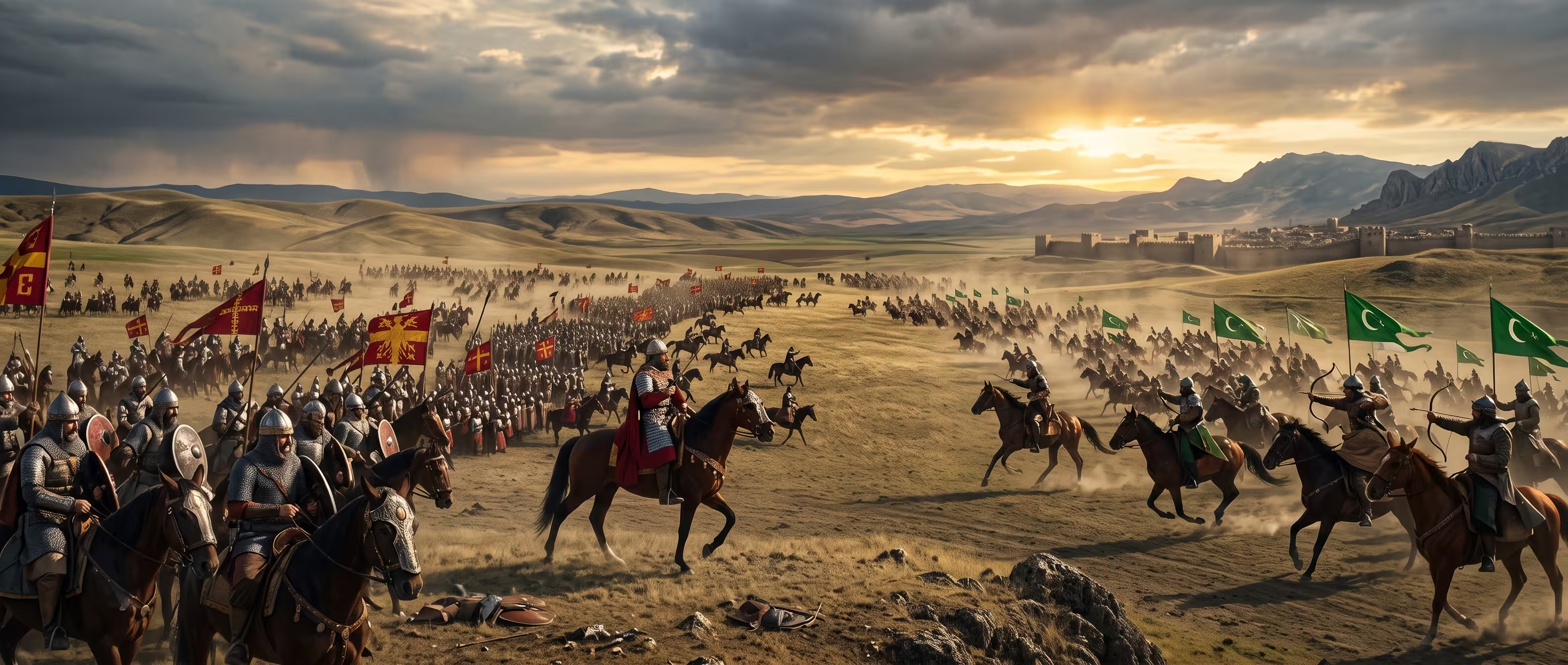
In the east, Arab armies kept up pressure. Irene accepted a treaty with Harun al-Rashid in 782, after the defection of the general Tatzates, and a second one in 798.
In the Balkans, the eunuch Staurakios campaigned against the Slavs of Greece in 783, as far as the Peloponnese. He celebrated a triumph in Constantinople in January 784. The theme of Macedonia was probably created in her reign.
As early as 781, Irene sought closer ties with the Carolingians and the papacy. She sent an official to teach the Frankish princess Greek. In the west, the picture is less favourable. Irene betrothed Constantine to Rotrude, a daughter of Charlemagne, in the early 780s. She broke the engagement in 788. A Byzantine invasion of Italy that year did not stop the Franks, who advanced in the south and took control of Istria and Benevento.
In 788 she also married Constantine to Maria, a woman from Amnia in the Armeniakon theme. Theophanes says the match upset the young emperor.
Domestic policy
Irene built hospices and a cemetery for the poor. After a cure at the shrine of Pege, she gave rich gifts to the church of the Virgin there. A hagiographical source reports that she set up mosaic portraits of herself and her son there. It is the only recorded monumental portrait of Constantine. The same source describes the cure, so treat the story as part of her saintly image.
Open question: did Irene weaken the army?
The Oxford Dictionary of Byzantium follows William Treadgold in arguing that Irene removed capable iconoclast generals appointed by Constantine V, such as Michael Lachanodrakon, and weakened the empire. Other scholars, including John Arvites, have studied the defence of Anatolia in her reign and give a more nuanced picture. The question is still debated. It is better treated as an interpretation than as an established fact.
Co-ruler, 790–797
Constantine VI against his mother
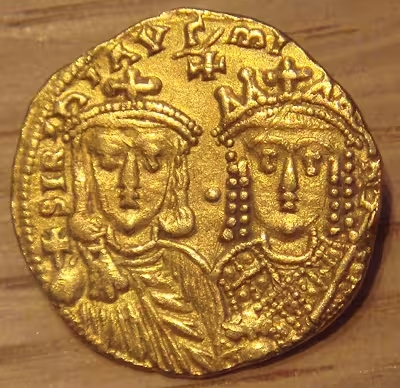
In 790 the army refused Irene’s demand to take precedence over her son. Constantine acted in December. He deposed his mother with the help of Michael Lachanodrakon, the general who had served his father and grandfather. At the same time he had Staurakios beaten, tonsured and exiled to the Armeniakon, and he sent Aetios away. Irene retired to the suburban palace of Eleutherios.
Lachanodrakon’s role is telling. It may suggest iconoclast leanings in Constantine, although he had signed the acts of the Council of Nicaea. In January 792 Constantine recalled Irene and restored her title. Her return disappointed his own supporters. Constantine ruled with her, but their relations stayed tense.
The young emperor’s mistakes
Constantine’s own record gave Irene an opening. He campaigned against the Bulgars and the Arabs in 791 without result, and the Bulgars defeated him heavily at Markellai in 792. In 792–793 he put down a conspiracy in favour of his uncle, Caesar Nikephoros. At Irene’s urging he blinded the general Alexios Mosele, which fed an uprising in the Armeniakon that he suppressed cruelly. In 795 he divorced Maria, who had borne him two daughters, and married his mistress Theodote. Many churchmen condemned the remarriage, among them Plato of Sakkoudion and his nephew Theodore the Studite. The dispute is known as the Moechian controversy.
The blinding of 797
In 797 Irene, working with Staurakios and Aetios, deposed and blinded Constantine. Theophanes says Staurakios had undermined the emperor’s authority by frustrating his campaign against the Arabs that year. Aetios obtained the surrender of Caesar Nikephoros and his brothers. Irene took sole power.
Open question: what did the blinding mean? Did Irene want her son dead?
Blinding was a standard way to disqualify a rival from the throne, and it was often meant to spare the victim’s life. The Oxford Dictionary of Byzantium holds that Constantine survived and died in exile before 805, and that he was buried in Irene’s monastery of St Euphrosyne. The exact date of his death is not known. Whether Irene intended him to die is uncertain. What is clear is that she accepted the removal of an anointed emperor, her own son, which shocked contemporaries.
Sole ruler, 797–802
An unusual title
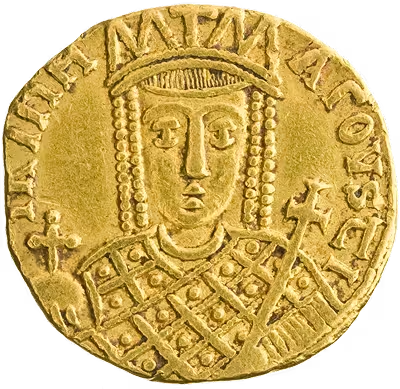
The Oxford Dictionary of Byzantium calls Irene the first female Byzantine autocrat. The point needs a nuance. Women had held power before, but Irene was the first to rule in her own name, with no male co-emperor.
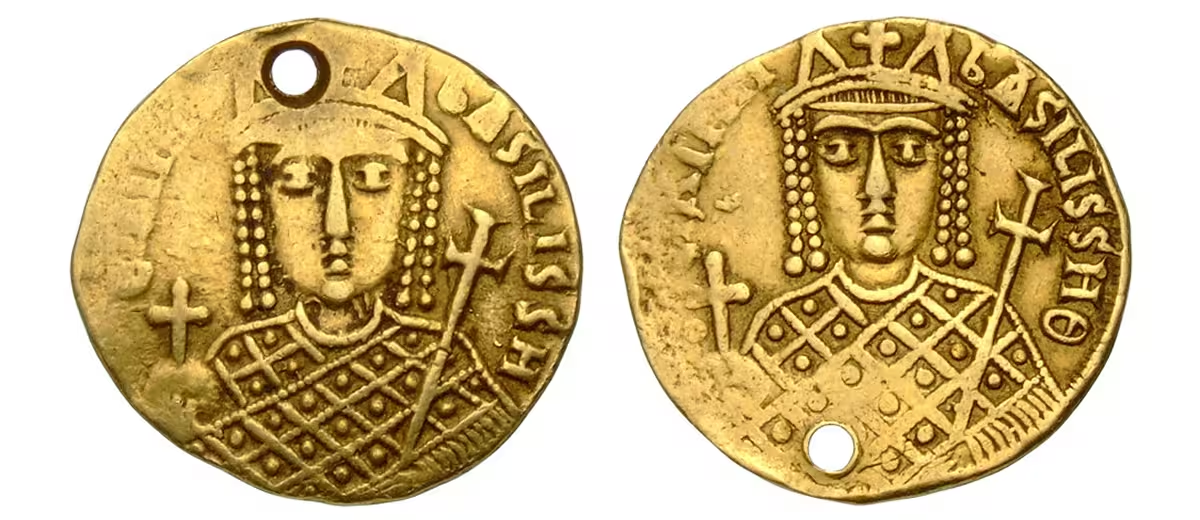
Her titles are worth looking at. Her coins use the feminine basilissa. Some documents from her reign give her the masculine title basileus, and she used it in some official contexts. This suggests the court had no settled way of describing a woman who held the full imperial office. Modern studies of her reign, including those listed under further reading, discuss the question.
A parallel: Wu Zetian (624-705)
Wu Zetian ruled China about a century before Irene, so the two never overlapped. Historians still compare them. Wu rose through her marriage to the Tang emperor Gaozong and governed through her sons. She then founded her own dynasty, the Zhou, in 690, and she is the only woman to hold the title of emperor in China. Like Irene, she held the full imperial office in her own right. Like Irene, she lost power in a palace coup, in 705, and she died within the year. Both women also reach us through male historians who were often hostile. But the comparison has limits. The two states, their religious settings and their ideas about female rule differed widely.
Staurakios, Aetios and a divided court
Irene relied on two eunuchs, Staurakios and Aetios, who held the rank of patrikios. Staurakios had been her chief minister since 781, when he became logothete of the dromos. He negotiated with the Arabs in 782, campaigned against the Slavs in 783 and, in 786, disarmed the guards who had blocked the first council. After 797 his influence declined. In February 800 Irene fell ill. Staurakios tried to seize power, was arrested, and then stirred up a revolt in Cappadocia shortly before he died on 3 June 800.
Aetios rose as Staurakios fell. Constantine VI had exiled him in 790, and he returned with Irene in 792. In May 799 he allied with Niketas, the domestikos of the scholai, against Staurakios. After Staurakios died, he became Irene’s chief adviser. In 801 he took command of the Opsikion and Anatolikon armies, and he made his brother Leo monostrategos of the Macedonian and Thracian themes. The aim, apparently, was to make Leo emperor.
The court was therefore divided before Nikephoros acted. Irene’s leading adviser was working for his own family.
Taxes and laws
Her fiscal policy was popular. She repealed the municipal tax in Constantinople and lowered tariffs at Abydos and Hieron. Treadgold argues these measures hurt state finances. She also issued laws (Ludwig Burgmann studied these novels in a 1981 article).
Charlemagne
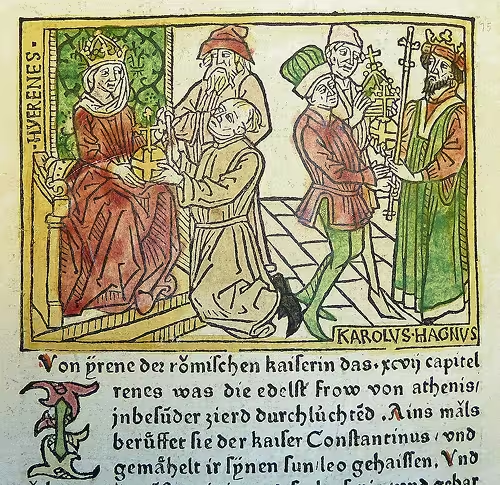
On Christmas Day 800, Pope Leo III crowned Charlemagne emperor in Rome. Frankish writers justified the act partly by pointing to the situation in Constantinople. They suggested that the imperial throne was vacant because a woman held it.
Theophanes adds a further story. In 802, he says, envoys from Charlemagne and the pope proposed that Charlemagne marry Irene and reunite the empire. Theophanes credits Aetios with blocking the plan, in the same period when Aetios was promoting his own brother.
Open question: was there a marriage proposal?
Only Theophanes reports the proposal. No Frankish source confirms it, and Frankish sources of the time are fairly detailed about Charlemagne’s diplomacy. Some historians take it as a real, if exploratory, approach. Others think Theophanes recorded a rumour or exaggerated a routine embassy. One reading ties the story to Aetios’s own ambitions, but nothing can test that. The safest statement is that the proposal is possible but unproven.
Fall, exile and afterlife (802–803 and after)
Irene’s fall came from within her own administration. On 31 October 802, a group of officials overthrew her and put Nikephoros I on the throne. Nikephoros had been a senior finance official.
Irene went into exile first on Prinkipo, one of the Princes’ Islands, and was then sent to Lesbos. She died there on 9 August 803. Her body was taken to Prinkipo and buried in the monastery she had founded there. Her remains were later moved to the Church of the Holy Apostles in Constantinople, the burial church of the emperors. The 10th-century Book of Ceremonies lists her tomb among the imperial tombs of that church. Her tomb has not been identified. The church was demolished in the 15th century, after the Ottoman conquest.
The Orthodox Church venerates Irene as a saint, mainly because of her role in restoring icons. Her feast day is 9 August, the day she died. Iconoclasm returned under later emperors, and the second period ended in 843.
Open question: was Irene seen as a saint in Byzantium?
The answer is less certain than it is often made to sound. Theodore the Studite praised her warmly for her support of icons, and a 12th-century Life presents her as a saint. Britannica calls her a saint of the Greek Orthodox Church and gives 9 August as her feast day. Other sources say she was never formally canonised. OrthodoxWiki notes that the claim is not supported by the Menaion or by Nikodemos the Hagiorite’s Lives of Saints, and it traces part of the claim to Western sources. Whatever her standing, her settlement did not last. Iconoclasm returned under later emperors, and the second period ended in 843.
How historians judge Irene
Modern assessments differ. Treadgold emphasises the costs of her policies. Judith Herrin, in Women in Purple, devotes a chapter to Irene and presents her as an unfamiliar figure who deserves closer study. Older accounts often stressed her ambition and her treatment of her son. Recent work asks how far that image reflects the sources’ own bias.
A fair summary: she was a skilled political survivor who won power through methods that Byzantines themselves condemned, and she left a religious settlement that her successors only partly kept.
Further reading
- Theophanes the Confessor, Chronographia, translated by C. Mango and R. Scott (Oxford, 1997).
- R. Price (trans.), The Acts of the Second Council of Nicaea (787) (Liverpool, 2020).
- W. Treadgold, The Byzantine Revival, 780–842 (Stanford, 1988).
- W. Treadgold, “The Unpublished Saint’s Life of the Empress Irene,” Byzantinische Forschungen 8 (1982).
- J. Herrin, Women in Purple: Rulers of Medieval Byzantium (London, 2001).
- P. Speck, Kaiser Konstantin VI. (Munich, 1978).
- L. Garland, Byzantine Empresses (London, 1999).
- R.-J. Lilie, Byzanz unter Eirene und Konstantin VI. (780–802) (Frankfurt, 1996).
- L. Burgmann, “Die Novellen der Kaiserin Eirene,” Fontes Minores 4 (1981).
- J. Arvites, “The Defense of Byzantine Anatolia during the Reign of Irene,” in S. Mitchell (ed.), Armies and Frontiers in Roman and Byzantine Anatolia (Oxford, 1983).
- P. Grierson, “Tombs and Obits of the Byzantine Emperors (337–1042),” Dumbarton Oaks Papers 16 (1962).
- Prosopography of the Byzantine Empire, entry “Eirene 1” (online).