The Second Council of Nicaea (787): How Empress Irene brought back the Icons
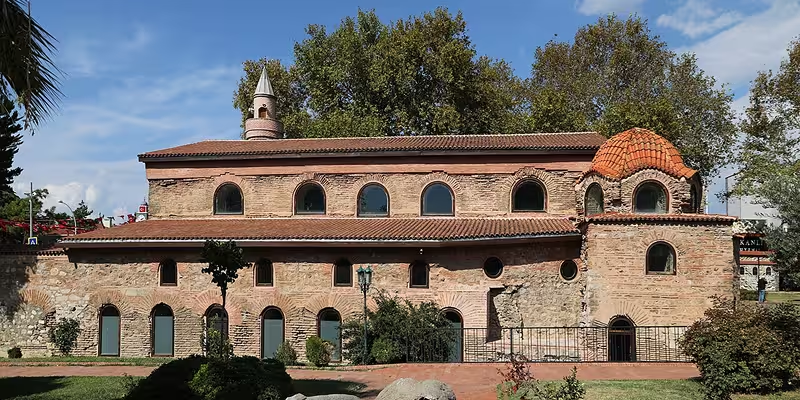
In autumn 787, about 350 churchmen gathered in the church of Hagia Sophia at Nicaea, the city where the first ecumenical council had met in 325. Their task was to decide whether Christians could venerate images of Christ, the Virgin and the saints – a core question of Byzantine identity. Their answer was yes, within limits. The Second Council of Nicaea, counted as the seventh ecumenical council, ended the first period of Byzantine iconoclasm.
It did not settle the question for good. Iconoclasm returned about thirty years later and ended again only in 843. Nicaea II still shaped everything that followed. It defined how Orthodox Christians understand icons. It reset the discipline of a clergy shaken by decades of imperial pressure. And it opened a quarrel with the Franks.
The council is easiest to understand through the people who needed something from it. An empress, Irene of Athens, needed the Church’s backing and a way to control the army. Bishops who had served iconoclast emperors needed a way back. A pope wanted Rome’s rights respected. A Frankish king, who was not invited, refused to accept the result. This article follows those four audiences.
One odd fact frames the story. Almost no iconoclast writing of the period survives on its own. The definition issued in 754 is known largely because Nicaea II read it out and refuted it, line by line. We know the losers’ arguments through the winners’ acts.
Why a council? Sixty years of iconoclasm
Veneration of images had grown popular in the eastern provinces of the empire. In the 720s or 730s, Emperor Leo III turned against it, and the state moved to remove sacred images. His son Constantine V went further. In 754 he called a council at the palace of Hieria, across the water from Constantinople. It sat from February to March, and 338 bishops attended. Theodosios, archbishop of Ephesus, presided.
The bishops of Hieria argued that an icon of Christ must fail in one of two ways. Either it shows his humanity alone, and so divides him, or it confuses his humanity with his divinity. They held that the only true image of Christ was the Eucharist. Their council called itself the seventh ecumenical council.
Its opponents named it the headless council. The see of Constantinople was vacant, the patriarchates of Antioch, Jerusalem and Alexandria lay under Muslim rule, and Rome was not asked. That flaw mattered later. Hieria had claimed ecumenical authority, so only another ecumenical council could undo it.
Constantine’s reign brought the persecution of monks who defended images. The policy had a political edge. He left images of the emperor untouched, and his opponents suspected the real aim was to raise imperial authority above that of saints and bishops.
Empress Irene’s road to Nicaea
Irene of Athens, a supporter of icons
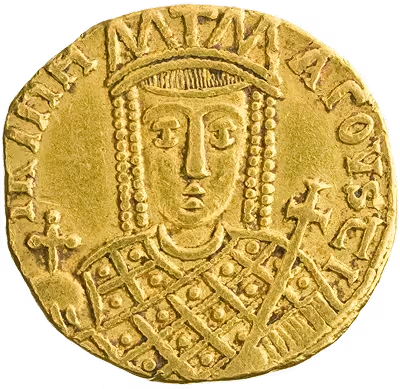
After Constantine V died in 775, his son Leo IV eased the pressure at first. He persecuted icon supporters actively only in his last months. When he died in 780, his widow Irene became regent.
She was an iconodoule – a supporter of icons veneration. She needed a way to restore them without losing the army, which still had many iconoclast sympathies.
The full story of her regency is told in the Irene of Athens article. For the theology of icons, see the article on Orthodoxy.
A patriarch first
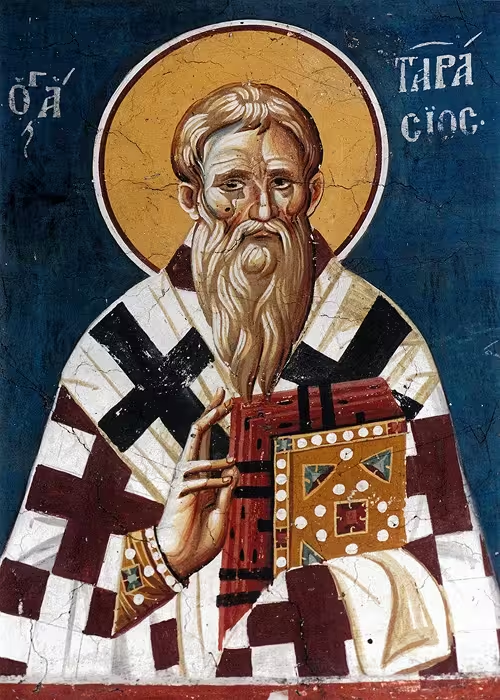
Irene could not restore icons without a patriarch who agreed. Patriarch Paul IV, who had once opposed icons himself, urged the calling of an ecumenical council. He then resigned and retired to a monastery, citing age and illness. He recommended Tarasios, Irene’s chief secretary, as his successor.
Tarasios was a layman and the son of a high-ranking judge. His family later gave the Church another patriarch, Photios. To qualify, Tarasios had to be ordained deacon and priest in quick succession before his consecration as bishop. He accepted the office reluctantly and on conditions: the veneration of icons would be restored, a council would be held, and the Church would be reunited with Rome and the eastern patriarchs. He was installed on 25 December 784.
At his urging, Irene wrote to Pope Hadrian I and invited him to send representatives. The invitation came from the empress and her son Constantine VI, then a boy of thirteen. Hadrian agreed, though he disliked the appointment of a layman as patriarch.
The council that failed
An imperial edict called the council in the summer of 786. It opened in the Church of the Holy Apostles in Constantinople at the start of August. Irene and Constantine were present. Soldiers of the capital’s guard regiments, the tagmata, then burst in and broke up the assembly. Constantine V had founded those units, and they remained loyal to his policy. The papal legates left the city. According to one account, they had reached Sicily before Irene recalled them.
Irene did not give up. She sent the guard units to Malagina in Bithynia, on the pretext of a campaign against the Arabs. There about 1,500 men were dismissed. Her minister Staurakios brought troops he trusted from Thrace to guard the capital. She also dismissed the most stubborn iconoclast bishops. Tarasios handled the rest differently. He let bishops who had accepted iconoclasm keep their sees if they admitted their error in public.
Irene then called the council again. This time she chose Nicaea, since Constantinople was still distrusted. The city was also the site of the first council of 325, which gave the new assembly a powerful precedent.
Open question: when did the first council meet?
Sources give three dates for the failed meeting in Constantinople: 31 July, 1 August and 17 August 786. Tarasios himself, opening the council at Nicaea, spoke of the earlier meeting as held at the beginning of August. That agrees with the first two dates, and I follow them. The 17 August date appears in some modern accounts. The difference is small, but it is worth knowing if you meet it.
Who came, and who spoke for whom
About 350 people attended, counting the legates. The surviving lists name 308 bishops or their representatives, and ancient accounts give numbers between 330 and 367. Studies of the bishops’ lists, such as Jean Darrouzès’s work in 1975, show that most had served under iconoclast rulers. Four bishops from the Dalmatian coast also signed, though their cities no longer lay under Byzantine rule.
The acts name the two Roman legates first, a priest and an abbot, both called Peter. Then comes Tarasios. Yet the patriarch ran the sessions. Tradition adds that Christ was regarded as the true chairman.
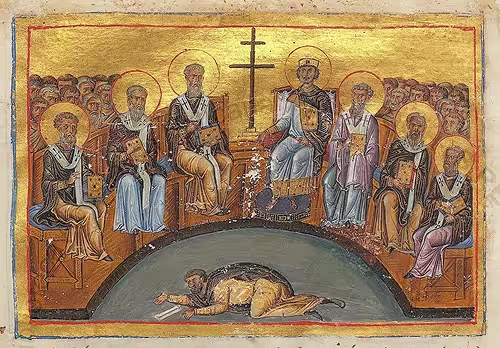
Constantine VI and Irene were credited as conveners.
Open question: who spoke for the East?
Two monks, John and Thomas, signed in the name of the patriarchates of Alexandria, Antioch and Jerusalem. Those sees lay under Muslim rule. At the third session the monks presented their credentials, and these made clear that the patriarchs had not appointed them. Marie-France Auzépy treats the monks as a stratagem to support the council’s claim to be ecumenical. An older Catholic account sees no fraud. It says they were sent by senior monks and priests who acted in place of patriarchs unable to act themselves. Either way, the claim of eastern consent rests on a thin base. The council is still accepted as ecumenical.
Open question: was there an eighth session?
Tradition counts eight sessions, the last held in the Magnaura palace in Constantinople on 23 October 787, with the emperors present. There the definition was proclaimed again and the canons were read out. Erich Lamberz, who prepared the standard critical edition of the Acts, has shown that this session is a late ninth-century forgery. Its purpose was to give the emperors the role they had played at earlier ecumenical councils. Richard Price reports the finding in his translation. If Lamberz is right, the date and place at which the canons were issued are uncertain.
The sessions at a glance
| Session | Date | Business |
|---|---|---|
| I | 24 Sept. | Debate on whether bishops who had accepted iconoclasm could keep their sees. |
| II | 26 Sept. | Letters of Pope Hadrian are read in Greek. They approve images but criticise Byzantine interference in papal rights. |
| III | 28 Sept. | The envoys of the eastern patriarchates present their credentials. |
| IV | 1 Oct. | Proof texts from Scripture, the Fathers and saints’ lives, including the cherubim of the Ark. |
| V | 4 Oct. | A further collection of texts claims that iconoclasm came from pagans, Jews, Muslims and heretics. |
| VI | 7 Oct. | The definition of Hieria is read and refuted at length, probably by Tarasios. |
| VII | 13 Oct. | The council’s own definition is proclaimed and signed. |
| VIII | 23 Oct. | Traditional session in Constantinople. Probably a later addition. |
Some sources date sessions V and VI to 5 and 6 October. The difference is a day.
What the council decided
The definition rests on the Incarnation. Christ became man, and a man can be seen and painted. For the council, the visible Christ allowed images and even required them. To reject images of Christ was to deny that he had a real human body. The council also stressed that the practice was ancient. It did not meet Hieria on its own Christological ground.
The council then drew a careful line between two kinds of honour. Veneration, in Greek proskynesis, means respect: a bow, a kiss, a candle. The council set icons beside the cross and the Gospel book as objects that deserve it. Worship, latreia, belongs to God alone. Giving worship to an image was idolatry, and the council said so. Even in the case of veneration, the honour does not stop at the wood and paint. It passes to the person depicted, as if the image were a window.
The definition called for images of Christ, the Virgin, the angels and the saints on vessels, vestments and church walls, in homes and by the roadside. The fourth session gave the scriptural case. The speakers pointed to the carved cherubim of the Ark and the Tabernacle, which God himself had commanded. They added passages from the Fathers and from saints’ lives.
The council also gave weight to unwritten tradition. Church practice, handed down from the apostles, counted alongside Scripture. That principle matters for the Orthodox understanding of tradition.
The decree was moderate. It stood back from some of the excesses of popular practice, according to modern historians. That restraint was deliberate. Tarasios wanted to win over the hesitant bishops, and a measured text did that better than a triumphant one.
The council condemned the 754 council as a false one and refused it the title of ecumenical.
A reset for the clergy: bishops, money and monks
The decree on images made the headlines. The canons show what the Church thought had gone wrong. The council issued twenty-two disciplinary canons, which reveal how deeply iconoclasm had disturbed the clergy. Money, lay control and monastic discipline dominate the list. The Byzantine clergy article places these rules in the wider story of bishops, priests and monks.
| Canon | Subject |
|---|---|
| 1 | The earlier canons are to be observed in everything. |
| 2 | A candidate for bishop must know the Psalter by heart and read Scripture with understanding. |
| 3 | Bishops, priests and deacons may not be appointed by secular rulers. |
| 4–5 | No bishop may extort gifts from his clergy. Buying church office is condemned. |
| 7 | Relics are required in every consecrated church. |
| 9 | Iconoclast writings are to be handed in and kept under lock. |
| 12–13 | Church property may not be handed to laymen or put to secular use. |
| 15 | Against holding several church offices at once. |
| 17–18 | Monks may not wander and build chapels they cannot finish. Women may not live in bishops’ houses or in men’s monasteries. |
| 19–20 | No fees for entering the clergy or monastic life. Double monasteries are banned. |
Adolf von Harnack judged them the best canons any ecumenical synod ever produced. He compared them to the reforming decrees of the Council of Trent. The rules on money and lay control were not abstract. Under the iconoclast emperors, bishops had often owed their sees to the court. Nicaea II tried to cut that link. It also had to live with its own awkward fact: the patriarch presiding over the reform had been a layman a few years earlier, chosen by the empress.
The price of leniency
Almost all the bishops had served under iconoclast rulers. The council could not remove them all. It readmitted those who repented. The strictest monks objected, and Theodore the Studite became the leading voice against the policy. They accused Tarasios of weakness toward bishops who had bought their sees, and the charge of tolerating simony followed him for the rest of his life. He steered a middle course that hurt the council’s reputation. The same fault line, between severe monastic reformers and a patriarch who had to govern, shows up again in the dispute over Constantine VI’s second marriage.
Open question: how much did the monks matter?
The monks were the heart of the resistance to iconoclasm, and they were numerous at Nicaea. Yet the council’s own leader was a lay official turned patriarch, and its mood was conciliatory, not monastic. Marie-France Auzépy has studied the place of the monks at the council. The balance between monks and bishops is still being weighed.
Rome and the Franks: a quarrel about more than a word
Pope Hadrian I welcomed the decree on images. His letters also pressed Rome’s claims against Byzantine interference in the Church. Afterwards he wrote to Charlemagne that the synod had met in accordance with Rome’s directions.
The Frankish court saw it differently. The acts presented the emperor and the pope as united on icons and said nothing of Charlemagne. At that very moment, a Byzantine force was landing in Calabria to drive out the Franks. The expedition failed, and Hadrian’s relations with Charlemagne recovered, but the acts had already given offence.
The Franks answered in two steps. In 792 they sent two tracts against the council to Hadrian, who replied with a rebuttal. Then, in the mid-790s, a long work was drawn up at Charlemagne’s order, the Libri Carolini. Theodulf of Orléans most likely wrote it. Charlemagne decided that further controversy with Rome would serve no purpose, and the work was never sent. In 794 the Council of Frankfurt condemned the Greek decision.
The Libri Carolini do not reject images. They allow them as ornament, as teaching aids and as memorials. They object to burning incense and lights before them, and they argue that it is wrong to destroy them. They reject the demand that images be venerated. The authors point out that martyrs and monks had done without such veneration, and they argue that the Fathers quoted by Hadrian approved images only as teaching aids. They also appeal to a letter of Gregory the Great, which said pictures were placed in churches to instruct the ignorant. On that basis they claimed that Hadrian, by defending Nicaea, betrayed the Roman tradition.
Open question: translation, politics or theology?
Older accounts blame a faulty Latin translation. One passage of the acts was indeed mistranslated, and the Libri mock it. But recent scholarship, notably Richard Price’s, holds that the Franks understood the distinction between veneration and worship and objected on substance. They disliked the claim that prayer to images and their miraculous powers were legitimate. Politics added to it, since the Franks had been ignored. The three explanations probably worked together. The West gave its formal approval much later, in 880.
A settlement that did not hold
Irene lost her throne in 802, and Tarasios died in 806. The settlement outlasted both for a few years. Then military defeats reopened the old argument that God had favoured the iconoclast emperors. The Bulgars had killed Nikephoros I in 811, and in 813 they beat Michael I at Versinikia. Leo V, a general who took the throne after that defeat, told his advisers that icon-venerating emperors had lost, while the iconoclasts Leo III and Constantine V had won.
In 815 Leo V deposed Patriarch Nikephoros during Lent. His new patriarch, a layman named Theodotos, held a synod that overturned Nicaea II and reaffirmed Hieria. The second iconoclasm was milder than the first. It did not accuse icon supporters of idolatry. Images hung low enough to be kissed were removed, and those hung high were left. Leo was murdered at Christmas 820, and iconoclasm survived him.
It ended after Theophilos died in 842. His widow Theodora, ruling for her young son Michael III, had Methodios installed as patriarch, and the veneration of icons was restored on 11 March 843. The Orthodox Church marks the event each year on the first Sunday of Lent, the Triumph of Orthodoxy. It also commemorates the council of 787 itself on the Sunday closest to 11 October.
Nicaea II remains the last council that both Catholic and Orthodox churches recognise as ecumenical. Protestant views vary. John Calvin rejected the distinction between veneration and worship as sophistry, and classical Anglicanism condemned the council. In 1987, on its twelve-hundredth anniversary, Pope John Paul II issued an apostolic letter to mark it.
Frequently asked questions
What was the Second Council of Nicaea?
It was a council of about 350 churchmen held at Nicaea in 787 under Empress Irene and Patriarch Tarasios. It restored the veneration of icons after decades of iconoclasm and is counted as the seventh ecumenical council.
When and where did the Second Council of Nicaea take place?
It was a council of about 350 churchmen held at Nicaea in 787 under Empress Irene and Patriarch Tarasios. It restored the veneration of icons after decades of iconoclasm and is counted as the seventh ecumenical council.
When and where did the Second Council of Nicaea take place?
It opened on 24 September 787 in the church of Hagia Sophia at Nicaea, now İznik in Turkey. It held seven sessions there by 13 October. A traditional eighth session in Constantinople on 23 October is probably a later addition.
Who called the council and who presided?
Empress Irene and her son Constantine VI convened it. Patriarch Tarasios of Constantinople led the debates, alongside two legates of Pope Hadrian I.
What did the council decide about icons?
It allowed the veneration of icons, shown by a bow or a kiss, and reserved worship in the strict sense for God alone. Honour paid to an icon passes to the person it represents.
Why did the first council fail in 786?
Soldiers of the capital’s guard regiments, loyal to the iconoclast tradition, broke up the meeting at the Church of the Holy Apostles. Irene sent the units away, dismissed about 1,500 men and called the council again at Nicaea in 787.
Is the Second Council of Nicaea the same as the First Council of Nicaea?
No. The first council, in 325, dealt with Arianism and produced the Nicene Creed. The second, in 787, dealt with the veneration of images.
Did the council end iconoclasm?
It ended the first period of iconoclasm. Emperor Leo V restored iconoclasm in 815, and it ended for good in 843.
Why did Charlemagne reject the Second Council of Nicaea?
His court disagreed with the theology of the decree and resented being ignored. A flawed Latin translation added confusion. The Libri Carolini and the Council of Frankfurt in 794 rejected the council.
Do Catholic, Orthodox and Protestant churches accept the council?
Catholic and Orthodox churches accept it as the seventh ecumenical council, the last they both recognise. Protestant views vary. John Calvin and classical Anglicanism rejected it.
What is the Triumph of Orthodoxy?
It is the feast marking the final end of iconoclasm in 843, held on the first Sunday of Lent. The council of 787 itself is commemorated on the Sunday closest to 11 October.
Sources and further reading
The acts of the council survive and are the main source. They preserve the iconoclast definition of 754 inside the refutation. Theophanes the Confessor tells the political story. The Frankish response survives in the Libri Carolini. The Life of Tarasios by Ignatios the Deacon gives the patriarch’s side.
- R. Price (trans.), The Acts of the Second Council of Nicaea (787), 2 vols. (Liverpool, 2018).
- E. Lamberz (ed.), Concilium universale Nicaenum secundum, Acta conciliorum oecumenicorum, series 2, vol. 3 (Berlin, 2008–2016).
- S. Efthymiadis (ed.), The Life of the Patriarch Tarasios by Ignatios the Deacon (Aldershot, 1998; reissued Routledge, 2016).
- D. J. Sahas, Icon and Logos: Sources in Eighth-Century Iconoclasm (1986).
- G. Dumeige, Nicée II (Paris, 1978).
- F. Boespflug and N. Lossky (eds.), Nicée II, 787–1987: douze siècles d’images religieuses (Paris, 1987).
- M.-F. Auzépy, “La place des moines à Nicée II (787),” Byzantion 58 (1988).
- M.-F. Auzépy, “State of emergency (700–850),” in J. Shepard (ed.), The Cambridge History of the Byzantine Empire (Cambridge, 2008).
- M. McCormick, “Western approaches (700–900),” in the same volume.
- J. Darrouzès, “Listes épiscopales du concile de Nicée (787),” Revue des études byzantines 33 (1975).
- P. Henry, “Initial Eastern Assessments of the Seventh Oecumenical Council,” Journal of Theological Studies 25 (1974).
- T. F. X. Noble, Images, Iconoclasm, and the Carolingians (Philadelphia, 2009).
- A. Freeman and P. Meyvaert (eds.), Opus Caroli regis contra synodum (Libri Carolini) (Hannover, 1998).
- L. Brubaker and J. Haldon, Byzantium in the Iconoclast Era, c. 680–850: A History (Cambridge, 2011).
- W. Treadgold, The Byzantine Revival, 780–842 (Stanford, 1988).
- John Paul II, apostolic letter Duodecimum saeculum (1987).
Key dates
| Date | Event |
|---|---|
| c. 726–730 | Leo III turns against images |
| Feb.–Mar. 754 | Council of Hieria under Constantine V |
| Sept. 780 | Death of Leo IV; Irene becomes regent |
| 25 Dec. 784 | Tarasios installed as patriarch |
| 31 July–1 Aug. 786 | First council at the Holy Apostles, broken up by soldiers |
| 24 Sept. 787 | Second Council of Nicaea opens |
| 13 Oct. 787 | Definition proclaimed (seventh session) |
| 23 Oct. 787 | Traditional eighth session in Constantinople (probably a later addition) |
| 792 | Frankish tracts against the council sent to Hadrian |
| Mid-790s | Libri Carolini written for Charlemagne |
| 794 | Council of Frankfurt rejects the Greek decision |
| 802 | Irene overthrown by Nikephoros I |
| 806 | Death of Tarasios |
| 815 | Leo V restores iconoclasm; synod overturns Nicaea II |
| 11 Mar. 843 | Triumph of Orthodoxy |
| 880 | Formal approval by the West |
Cover image credits: @ ANS, CC0
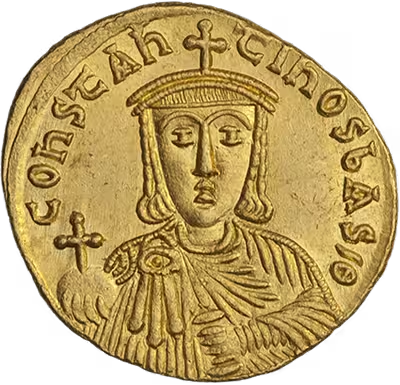
Constantine VI solidus – АНО “Международный нумизматический клуб”, CC-BY 4.0
Menologion of Basil II – public domain




One Comment