
Byzantine Women: Role, Rights and Power
Byzantine society was a traditional and patriarchal one, where the role of women was often seen as subordinate. This status was rooted in the legacy of Greco-Roman civilization: in ancient Greece, a woman’s sphere was the home. Similarly, in Rome, and within Roman law inherited by Byzantium, a woman’s status was clearly inferior, rendering her dependent. Christianity did not fundamentally challenge the position of women but introduced some innovations, particularly in marriage and through the establishment of female monastic communities, which provided new opportunities previously unavailable to many Greek or Roman women.
However, within this society where women often appeared to remain in the background, certain figures stood out, their impact all the more striking. Empresses with remarkable personalities such as Theodora, Irene, and Zoe made their mark. Intellectual or theological princesses like Annicia Juliana, Anna Komnena and Theodora Koumnaïna also emerged. Additionally, Byzantine women were artists like Kassia, abbesses, saints and even stylites. They were also wealthy widows like Danielis, aristocrats, or common women who emerge in the chronicles for one anecdote or another. All were part of Byzantine society and contributed to shaping it, leaving a lasting mark centuries after their death
It is important to note that the place reserved to women in the Byzantine society was not static. For instance, the Comnenian era seemed to grant women greater freedom, whereas some texts describe Byzantine women of the later centuries as being confined to their gynaeceums. The fate of women also varied according to their birth and their path. They could exert influence through their roles in the church and their involvement in charitable activities. They were active in matrimonial or diplomatic negotiations between families and dynasties. Female saints and martyrs were venerated. Widows could also own property, manage estates, and engage in business. Their influence was therefore significant, even if circumscribed by broader societal norms.
Let us delve into the lives of these millions of women who also shaped Byzantium. Daughters, sisters, mothers, wives; empresses, aristocrats, saints, or nuns, they all contributed to this fascinating civilization. Although they are often less visible in historical sources, and reconstructing their lives and histories can be challenging, their contributions remain significant.
Quick facts about women in the Byzantine empire
Legal marriage age:
girls from age 12, boys from age 14; betrothal forbidden before age 7
Sole female rulers:
Irene of Athens (797–802) and, briefly, Zoe and Theodora Porphyrogenita (1042) — rare in the medieval world
Religious office open to women:
the order of deaconess, ordained by the laying-on of hands, active from late antiquity and largely gone by the 12th century
Named women writers of the middle Byzantine period:
only two are known — Kassia (hymnographer) and Anna Komnene (historian)
Legal reform:
Emperor Leo VI extended the right to adopt to women and eunuchs
Women and matrimonial fate
The importance of marriage
One of the primary roles of Byzantine women was to become wives and mothers. Their education and upbringing were geared toward this goal, even though another potential path was available to them, which may not seem appealing today but could nevertheless offer a genuine opportunity for personal fulfillment at the time: the monastery. However, the destiny of most women, whether of high or low birth, was to marry and, if possible, to bear children. The very origin of the family was marriage, transformed by Christianity, which elevated the mutual consent of both spouses to the status of a sacrament. The earliest a girl married was around the age of 12 and for boys it was 14. While Christian marriage may appear restrictive, it theoretically protected women from coercion and divorces that often resembled repudiations in ancient Greece and Rome.
Byzantine position on divorce
However, Byzantine civil law recognized divorce by mutual consent, in contradiction to ecclesiastical legislation, which eventually prevailed in practice. An Egyptian papyrus from the 6th century presents the divorce contract between Fl. Callinicus and Aurelia Cyra, attributed to a “wicked demon,” who agree to joint custody of their son, Anastasius. But subsequently, civil law, under the influence of the Church, placed numerous obstacles to this practice. Divorce was therefore difficult to achieve, and only possible if a wife committed adultery – or if a husband was guilty of murder or witchcraft. Justinian revised the law regarding the matter and went further, prohibiting it altogether except if both parties consented to retire to a monastic life.
Betrothals
An important innovation introduced by the Church was the legal value given to betrothals, blessed by a priest. Their unjustified breach was punished with pecuniary fines and spiritual penalties. Faced with abuses that arose, with families betrothing their children at very young ages for reasons of interest, it became necessary for civil law to intervene and prohibit betrothing a child before the age of seven. The agreement was concluded in writing; it is known that in Cyprus, the betrothed swore oaths on relics, in front of witnesses, and exchanged crosses or small reliquaries. For the lower classes of the population, where patrimonial or strategic motives did not exist, it can be doubted whether arranged marriage was the norm, even though parental authority could have its importance in this matter. Marriage itself was also regulated by law. Girls had to be at least twelve years old, boys fourteen.
Attitude and liberty towards marriage
In practice, whether in matters of engagements or marriage, women probably did not have the final say. In fact, neither did underage boys when the union concerned aristocratic families. However, one should not necessarily assume that women were merely passive actors in what may appear as arranged marriages or even transactions. They certainly had their say as mothers and wives concerning the future of their children. Anne Dalassene, the mother of the future Emperor Alexios I Komnenos, devised a matrimonial strategy that greatly helped her son ascend to the throne. An episode even demonstrates an alliance between mother and daughter that ultimately succeeds in altering the matrimonial fate of the young Theodora Palaiologina, niece of Michael Palaiologos, at a time where he has not yet ascended to the throne. Theodore II Laskaris, the reigning Emperor, decided to marry her to a man of rather modest origin name Balaneidiotes. According to the sources, he managed to win the heart of the lady and became well acquainted with his fiancée and her family. However the emperor changed his mind and forced Theodora to marry another nobleman, Basileios Kaballarios instead. George Pachymeres reports : “those ladies (Theodora and her mother Martha) who preferred the previous union and considered it a shame to change it, despised the (new) fiancé. According to the order of the emperor, the usual rituals none-the-less took place along with a splendid wedding. In the following days the young groom did not consummate the union, a fact which he ascribed to the sorcery of his mother-in-law. Soon afterwards, however, Theodore II Laskaris died and the uncle of the unhappy bride, Michael, assumed his place. At the request of his sister, he allowed Theodora to separate from Kaballarios and marry Balaneidiotis, who on this occasion rose to the honor of grand stratopedarch.” Even if such a happy outcome seems unlikely in most cases, it nevertheless shows that the women concerned did not necessarily refrain from intervening – sometimes indirectly – when they had the opportunity.
Sometimes, they may have even rebelled, which seems to be implied between the lines of the Life of Matrona of Chios, a 14th-century saint.. This hagiography describes its young heroin’s early yearning to become a bride of Christ: (…) when the time came for her parents to give her in marriage she refused wishing instead to maintain her virginity and purity in order to become a beautiful and blameless bride of the im- mortal bridegroom Christ (…). She secretly left her family, forsaking her father, mother and sis- ters and came to the hills called Katabasis where she opened a stadium of ascetic fights (…). Her parents not knowing what had happened and where she was were overcome with grief and did not cease to search for her until they found her.When they discovered her whereabouts, they did not deem it right to leave her there alone but persuaded her to return to their house. A servant of God, she obeyed the blessed order of her parents and returned home.
Reading between the lines, one – as Petra Melichar does – might be tempted to see in the young woman’s flight less the urgent call of God than the desire to escape an unwanted marriage. The heroine’s return home, perhaps weary of her adventure – which was not without danger – can also be explained by her parents’ abandonment of this marriage plan that was against their child’s wishes. However, it is certain that most women did not have many other options than to submit to their family’s wishes.
Remariage
After a woman had become a widow, remarriage was possible as long as a suitable period of mourning was observed. However, a third marriage was disapproved by the Church. Therefore, it was rare and only permitted under special circumstances which included being without children.
The best-documented crisis to grow out of this rule is, fittingly, not a third marriage but a fourth. Emperor Leo VI was widowed three times without a surviving son; when his mistress Zoe Karbonopsina bore him the future Constantine VII in 905, he married her the following year to legitimize the child — an uncanonical fourth marriage that plunged Church and state into what became known as the “Tetragamy affair.” Patriarch Nicholas Mystikos refused to recognize the union and was exiled for his defiance; the schism between his supporters and those of his successor was not resolved until the Tomos of Union in 920, which permitted third marriages under strict conditions while permanently barring a fourth. It’s a striking illustration of just how seriously Byzantine church and state took the regulation of remarriage — serious enough to depose a patriarch over it.
Bearing children… or not
Contraception and Abortion
Some Byzantines practiced contraception and abortion, primarily to avoid illegitimate conception. Church authorities condemned these practices. The Penitential ascribed to John IV Nesteutes categorized birth control methods based on severity: applying an ointment was considered the least heinous; drinking a potion was worse; and using herbs to induce abortion was the most serious. Another text required individuals to confess if they desired to remain childless or used contraceptive herbs.
John Chrysostom condemned contraception as “a murder before birth,” criticizing not only its interference with procreation but also its association with magic and idolatry. Contraceptive practices were often limited to prostitutes or women attempting to break vows of chastity or marital fidelity. Married couples, however, sometimes abstained from intercourse or restricted sexual activity after producing one or two children.
Epiphanios of Cyprus described heretical Gnostics who rejected childbirth and used coitus interruptus or abortion for pleasure. His accounts claim that they consumed ground embryos mixed with honey, pepper, and spices during their gatherings—a claim clearly exaggerated to emphasize moral outrage.
Byzantine medical writers, including Paul of Aegina in the 7th century, transmitted earlier Greek theories of contraception. The 2nd-century Gynaikeia of Soranos recommended vaginal wool suppositories and applying olive oil, honey, cedar resin, or other substances to block sperm. Paul included one recipe for herbal contraception, while Dioscorides had documented 20. In the 6th century, Aetios of Amida recommended magical protections, such as wearing a cat’s liver or a lioness’s womb in an ivory tube.
Abortion faced condemnation in both imperial legislation and church canons. Justinian’s Digest incorporated early Roman laws that penalized abortion, targeting both women who underwent the procedure and those who provided abortifacients. Abortion persisted, particularly among prostitutes, as Prokopios’s Secret History notes in his account of Empress Theodora’s youth. Surgical tools for abortion, such as spikes, are preserved in Roman medical collections. Recipes for abortifacients appear in Byzantine texts, with Aetios prescribing their use only during the third month of pregnancy. Civil and canon law equated abortion with murder, regardless of the embryo’s age.
Procreation and adoption
Procreation was the primary purpose of marriage in Byzantine society, making infertility a calamity. The birth of a child, especially a boy, was celebrated with great joy. Family size varied significantly, and a typical Byzantine household in the 14th century, on the domains of some Mount Athos monasteries, could include between one and three children. However, women could bear many more, as infant mortality was common, especially after weaning. For example, the Vita of Saint Maria the Younger notes that she lost two of her four children during infancy.
Where a couple could not have children of their own, adoption offered a documented alternative — and one where Byzantine law made a distinctly gendered exception. Emperor Leo VI broke with earlier tradition by explicitly permitting women, as well as eunuchs, to adopt, reasoning in the law itself that adoption gave childless people support in old age regardless of their sex. Adoption remained more common among the elite, where inheritance and the transmission of a family name were at stake, but it was not confined to imperial drama: the 11th-century scholar and courtier Michael Psellos adopted a second daughter after the death of his own child Styliane, a case well documented through his own writings and a more representative example of the practice than a palace succession crisis.
The role of women in transmitting inheritance
In the aristocracy, the role of women is primarily attested in the transmission of inheritance. According to the principles of Roman law, children, including daughters, inherited equally from their parents. The key moment for inheritance was at the death of the parents, but also during the children’s marriage or rather engagement (a contract as binding as marriage, but which could be concluded much earlier, when both parents were still alive and could decide). Isogamy (i.d. marriage within the same social sphere) was the rule, and it was about protecting the woman who brought her dowry, which the husband could manage but not sell. Aristocratic women were not passive elements in these transactions, as they were not confined to the gynaeceum. They received a good education and, during the Komnenian period, seemed to enjoy considerable freedom, forming literary circles, for example. When they entered a monastery, usually a family establishment, they were not necessarily cloistered and could attend to their affairs in the city, accompanied by their servants. Remarkably, several of them successfully engaged in political intrigues. Anna Dalassene devised a matrimonial strategy that greatly contributed to the success of her son Alexios Komnenos. His eldest daughter, Anna, not only left us the Alexiad but also did not hesitate to claim power against her brother John II. Finally, the Komnenian princesses were often effective agents of influence with the foreign princes they married. The Trebizond Emperors also demonstrated a willingness to marry their sisters and daughters to neighboring rulers, including Muslim ones, for diplomatic purposes.
Widowhood
However, a Byzantine widow might not have been inclined to remarry. A common practice for Byzantine women after the death of their husband was to take the veil in a monastery, often one founded or patronized by themselves or their families, particularly among women of aristocratic or wealthy lineage.
Yet some women were neither inclined to remarry nor willing to become nuns. Although the father was traditionally the head of the family, a widow could inherit her husband’s property and assume that role if necessary. She could manage the estate and protect the interests of her children, if she had any. In some cases, the status of a widow represented one of the freest and most autonomous positions available to women in Byzantine society.
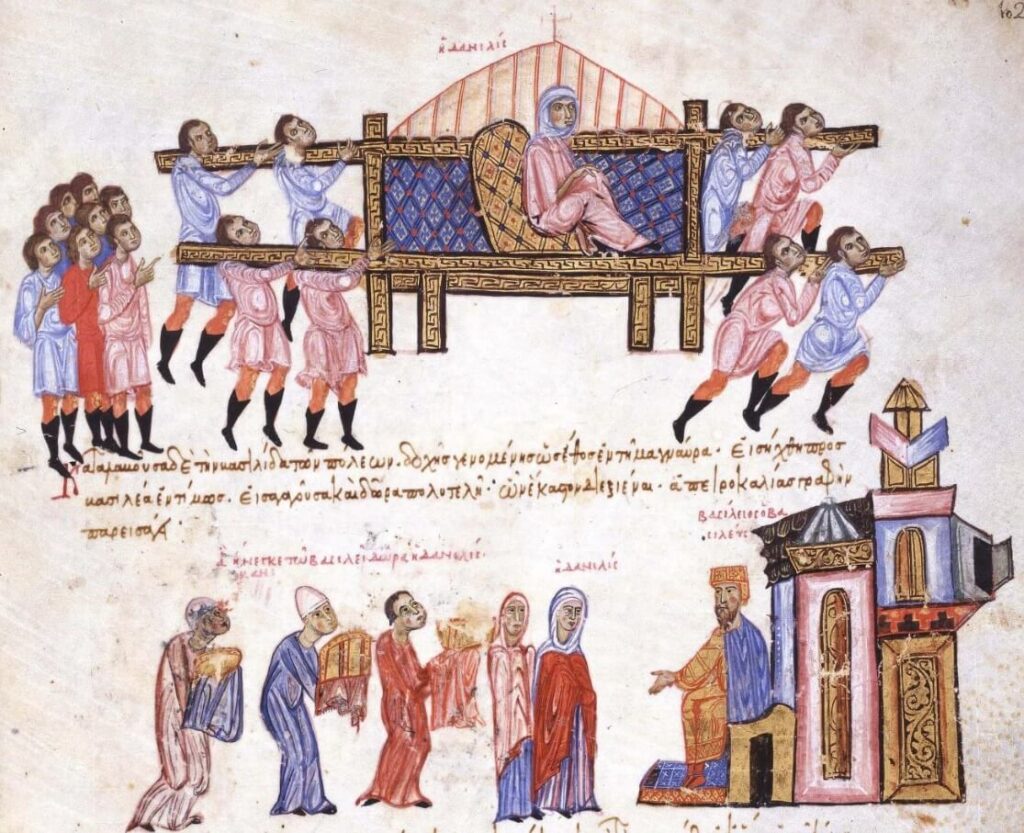
Be it true or not, one striking illustration of this privileged status is the story of the widow Danielis. She was a prominent and affluent Byzantine noblewoman from Patras, in the 9th century. She owned vast estates in the Peloponnese and managed a thriving carpet and textile industry. Not only was she succesful in her business, but she also became acquainted to the future Emperor Basil I when he visited Patras, and bestowed upon him generous gifts which facilitated his rise to power.
After Basil became Emperor, she travelled to Constantinople with a large retinue, offered him lavished gifts – including 100 eunuchs – underscoring her esteemed status in Byzantine society. Her loyalty to the throne was recognized with the honorary title of “Basileomētōr,” meaning “Mother of the Emperor.” Danielis outlived Basil I and named his son, Leo VI the Wise, as her heir. Upon her death, Leo VI emancipated 3000 of her slaves and resettled them in Southern Italy, reflecting the magnitude of her estate and the lasting impact of her legacy. Her life exemplifies the significant roles that women, particularly widows, could play in Byzantine society, wielding economic power and political influence during that era.
Byzantine women’s work and occupations
The social situation of women in the Byzantine world had a great influence on what they could or could not do. Women from aristocratic lineages or wealthy families were expected to comply with a specific set of social rules. Women from more modest backgrounds, whose families could not spare their labor or the income they could generate, often occupied a different position and were able to engage in various activities.
Expectations regarding their public behavior and prohibited attitudes partly overlapped across social classes. However, historical sources attest that women did work. In the countryside, they certainly participated in agricultural activities, while in cities their role as merchants is well documented in both written sources and iconography, especially during the Late Byzantine period.
Even an empress’s early life could include ordinary — or, in one famous case, scandalous — work. Prokopios’s hostile but detailed Secret History claims that the future Empress Theodora, before her marriage to Justinian, worked as a performer on the Constantinopolitan stage, in a milieu the historian associates with prostitution and low repute; whatever the exaggeration in Prokopios’s account (he wrote to discredit both Theodora and Justinian), it points to a real category of working women in Constantinople’s theatrical world, at the opposite end of the social spectrum from the empress she became.
Next to their economic role, women also played an influential part in the religious life of the empire. Monasteries in particular were places where they could exercise a degree of power that was not necessarily accessible to them in other areas of society.
Sexual violence, abuse and feminicide
While this aspect is not much documented, one can assume that the Byzantine society was not exempt from abuse and sexual violence towards the women. Wars and raids were common, from the pirats or from the Arabs, Slavs, Turks. Captivity, enslavement, rape or murder must have been the lot of many Byzantine women. Within the Empire´s borders, many women may have been exposed to force marriages, rape or marital rape or many form of abuse.
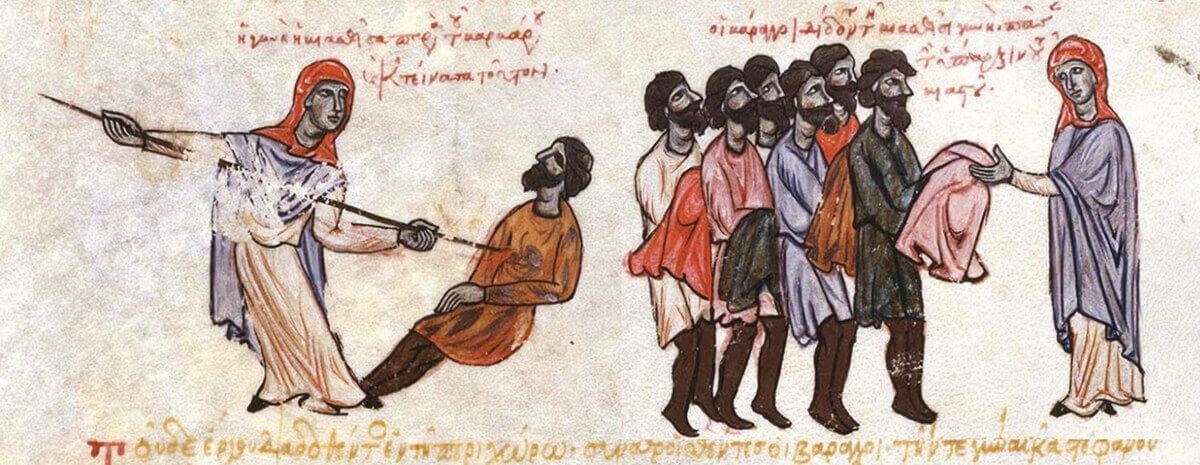
In the “Synopsis historion”, the Byzantine chronicler John Skylitzes records a rape attempt from a Varangian, member of the imperial guard, the defense of the victim and the following of the matter. “There were some Varangians dispersed in the Thrakesion theme for the winter. One of them coming across a woman of the region in the wilderness put the quality of her virtue to the test. When persuasion failed he resorted to violence, but she seized his Persian-type sword, struck him in the heart and promptly killed him. When the deed became known in the surrounding area, the Varangians held an assembly and crowned the woman, presenting her with all the possessions of her violator, whom they threw aside, unburied, according to the law concerning assassins.“
The woman appears here in a martial role, which is very uncommon for the Byzantines. However, since she successfully protected her virtue against the lust of her aggressor, she is finally praised despite this transgression.
An example of domestic violence and feminicide is described in the Vita of Saint Mary the Younger, probably written around 1025. This hagiographic story recounts the life of a woman of aristocratic Armenian descent. At around 13 or 14 years old, she marries Nikephoros, a military officer commanding a tourma in Byzie, Thrace. The marriage is troubled, as Mary is wrongly accused of infidelity and other offenses. One day, a servant intentionally distorts some of her words and reports them to Nikephoros. He becomes angry, strikes her, and physically abuses her. As she tries to escape, she falls and sustains a head injury. She dies a few days later at the age of 27, likely due to the injury, in 902.
Another Vita from the same timeframe relates the life of Thomais of Lesbos, a 10th century woman unhappily married to a man named Stephen, who is reported to have beaten her daily.
Love, affairs, and elopement
Despite the role traditionally assigned to them and the piety of Christian society, Byzantine sources sometimes reveal a less rigid world than we might expect. Some love stories did happen, some affairs occurred, sentiments were involved, and sometimes, even, lovers eloped. While this must have been the exception rather than the norm, it did happen.
The romantic life of Theodora Komnene, a Byzantine princess and niece of Emperor Manuel I, attests to this. Married at age 12, in 1158, to King Baldwin of Jerusalem to secure an alliance with the Kingdom, she was already a widow at age 17, without children. Her following years must have been dull. A foreigner in a Frankish kingdom, she possessed Acre, the largest city in the Kingdom of Jerusalem, as her dowry. This made the new king eager to keep her a widow so he could reclaim the city upon her death.
Nonetheless, she met her kinsman, Andronikos Komnenos, and started a relationship with him. When Emperor Manuel ordered Andronikos’ blinding, they eloped and wandered through the Muslim Levant and later Georgia. They had two children together and eventually moved to Anatolia, where Theodora and her children were captured and brought to Manuel. The Emperor and Andronikos reconciled, and Theodora and Andronikos were sent to govern Paphlagonia in a form of exile.
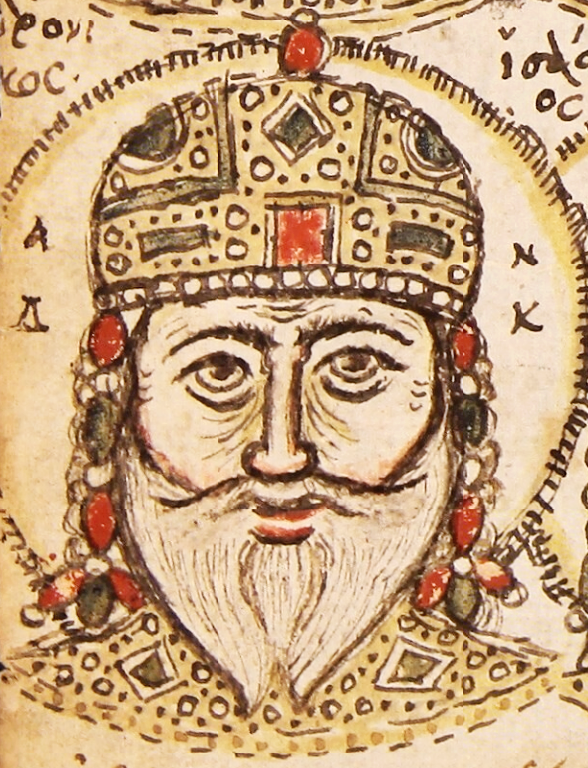 Andronikos I Komnenos
 Theodora Komnene, queen of Jerusalem
Though their story was a scandal – a queen dowager of Jerusalem, niece of the Byzantine Emperor, having an affair and eloping with an adventurer, it also shows that women could, at times, make their own risky choices. Theodora and Andronikos may have lived happily for a time, but Theodora died before 1182. In a twist of fate, Andronikos killed Emperor Manuel’s son, married his widow, Agnes of France, and became Emperor in 1183.
After meeting a brutal end, Andronikos left behind Agnes of France. Raised in Constantinople since she was eight years old, and twice Empress of Byzantium, the french princess had had little say on her destiny until that time. But being still quite young, Agnes became the lover of Theodore Branas, a Byzantine military leader. They eventually married in the summer of 1204, after the fall of Constantinople, at the urging of the new Latin Emperor, Baldwin of Constantinople – a rare happy ending in Byzantine history.
The education of Byzantine women
In Byzantium, the education of women was limited but not entirely absent. Elite women, particularly those from aristocratic or imperial families, often received instruction in reading, writing, and religious studies, and sometimes in music, embroidery, or philosophy. They were expected to manage households, participate in court life, and cultivate moral and religious virtues. Monasteries also played a role, offering education and literacy to women who chose religious life. While most women had few formal educational opportunities, the Byzantine elite recognized the value of intellectual cultivation, allowing some women to contribute to literary, religious, and cultural life. A notable example is Anna Komnene, daughter of Emperor Alexios I, who received a thorough education in classical literature, philosophy, and history, enabling her to write the Alexiad, a detailed account of her father’s reign and Byzantine political life.
Anna Komnene’s classical education was exceptional even among elite women, and it’s worth setting it against a more typical case from the same broad social world: the family of the 11th-century courtier and scholar Michael Psellos. In his funeral oration for his mother Theodote, Psellos describes her teaching him Bible stories as a child and forbidding his nurse from telling him pagan fables of Greek monsters — his own religious formation, filtered through his mother’s. Theodote herself is remembered for her charity and for weaving garments that she distributed to servants and the poor. Psellos’s daughter Styliane, who died at around nine years old — probably of smallpox, in an epidemic recorded by the chronicler Skylitzes — is honored in one of his most personal works, a funeral oration describing a childhood already being shaped toward the same pattern: piety, needlework, charity, in preparation for marriage rather than for scholarship. Where Anna Komnene represents the rare woman who received a classical education equal to her male peers, Theodote and Styliane represent the far more common pattern of religious and domestic formation that defined most elite Byzantine girlhoods, Psellos’s own included.
Women as artists and scholars
Named Byzantine women writers and composers are rare enough in the surviving record that the two best-known cases are worth treating together. Kassia (c. 810–865) is the only woman whose music survives in active use in the Byzantine liturgy today; of roughly fifty hymns attributed to her, around two dozen are securely hers, the rest disputed or reassigned to male authors over the centuries — itself a telling detail about how female authorship was preserved, or wasn’t, in the manuscript tradition. Chroniclers record that as a young noblewoman she took part in a bride-show organized for Emperor Theophilos, where her sharp reply to his opening remark reportedly cost her the match — Theodora was chosen instead, and Kassia went on to found and lead a convent in Constantinople, where she wrote both hymns and secular epigrams.
Anna Komnene, already discussed above for her education, belongs on this list as a scholar and historian in her own right: alongside Kassia, she is one of only two women of the middle Byzantine period known to have written under their own name, and her Alexiad remains a major primary source for the empire’s late 11th-century politics and warfare.
Women and the Law
In Byzantium, women’s legal status was shaped by Roman law but adapted to Christian principles, giving them certain protections while also imposing limits within a patriarchal, Mediterranean society. Women could own, inherit, and manage property, enter contracts, and engage in business, though male guardians or relatives often oversaw major transactions. Marriage laws defined their rights and obligations: a wife was expected to be obedient to her husband, while husbands exercised legal authority over the household. Women could initiate divorce under certain circumstances, such as abandonment or cruelty, and widows enjoyed particular protections, including control over dowries and inheritance. The law also addressed sexual conduct and morality, often imposing stricter penalties on women than men. Despite these limitations, Byzantine women – especially in the aristocracy – could exert influence through legal channels, religious endowments, and involvement in family and estate management, navigating the constraints of a male-dominated society.
Women and imperial power
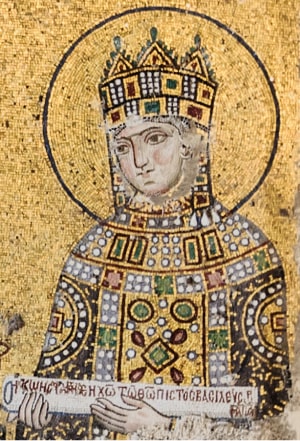
Despite the subaltern position granted to women in Byzantine society, Byzantine history saw a handful of powerful women at the pinnacle of society — sharing imperial rule with their husbands, and, remarkably for the medieval world, occasionally ruling alone. Theodora, wife of Justinian, heavily influenced policy and acted as regent on occasion. Irene of Athens ruled in her own right between 797 and 802 after sidelining her own son. Zoe Porphyrogenita ruled jointly with her sister Theodora for about a year in 1042. Several emperors, including Nikephoros Phokas and Romanos III Diogenes, were deposed or killed with the direct involvement of their wives, and Anna Dalassena effectively ran the empire’s administration and diplomacy during the early years of her son Alexios I’s reign.
The role of women in the highest echelons of Byzantine society, though never widely accepted without challenge, often proved highly influential and decisive, leaving a greater imprint than one might expect.
Byzantine women in Religion
The order of deaconess
One formal religious office was open specifically to women: the deaconess, ordained — like a male deacon — by the laying-on of hands, with her own liturgical rite preserved from the Great Church of Constantinople. Byzantine canon law set a minimum age for the office, sixty under the Theodosian Code and later lowered to forty by canon 15 of the Council of Chalcedon. Deaconesses assisted at the baptism of women (preserving modesty in an era of full-immersion baptism), brought communion and pastoral care to sick or homebound women, and served within female monastic communities. Olympias, already mentioned above among Byzantium’s holy women, was herself a deaconess and a close associate of John Chrysostom. The office flourished in late antiquity, declined from around the 8th century, and had largely disappeared by the 12th — historians remain divided on exactly why, with explanations ranging from the growing influence of male monastic liturgical practice to broader geopolitical pressures on the empire, so this article treats the decline as an open question rather than a settled one.
Women and monasteries
Women in Byzantium also exercised significant influence in the religious sphere, particularly through the foundation, patronage, and administration of monasteries and other religious institutions. Aristocratic and imperial women frequently endowed convents, funded churches, and established monasteries. These institutions became centers of education, manuscript production, and charitable activity, allowing women to exert authority in ways largely inaccessible in the secular sphere. Often serving as abbesses or guiding figures, overseeing both spiritual and material affairs, many of these founders played a part in the spiritual, religious and even political life of the empire, like Theodora Palaiologina Raoulaina, who opposed the policy of her uncle Michael VIII Palaiologos aiming at the Union of Churches, but also renovated and turned into a convent the former monastery of Saint Andrew in Krisei, in Constantinople.
In addition to their spiritual and social functions, many of these foundations served a practical purpose for family and social networks: they provided a secure and respectable place for widows, unmarried daughters, or women from client families to retire or pursue a religious vocation. This practice, relatively common among the elite, ensured that female relatives could live under the protection and guidance of trusted family members while remaining engaged in the devotional life of the empire. Through these combined spiritual, social, and familial roles, Byzantine women shaped devotional life, influenced theological debates, and maintained the social and economic networks of the Church, exercising a unique form of agency and leadership within the religious landscape.
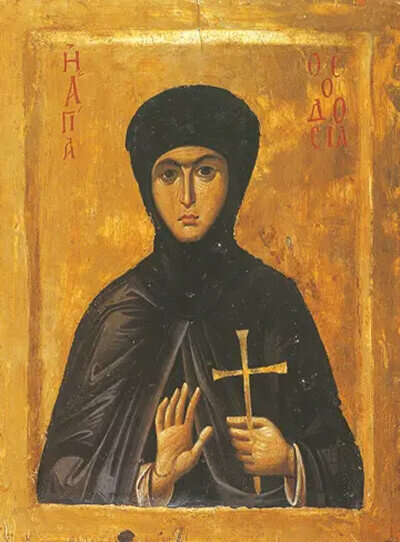
Icon depicting Saint Theodosia, monastery Saint Catherine in Sinai, Egypt, 13th century 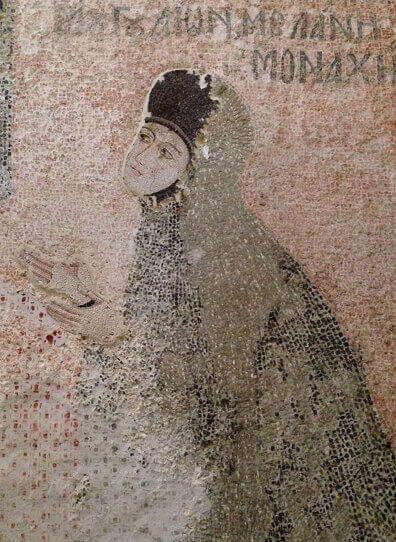
Mosaic in the Chora Church in Istanbul depicting nun Melane, formerly Maria Palaiologina, 13th century 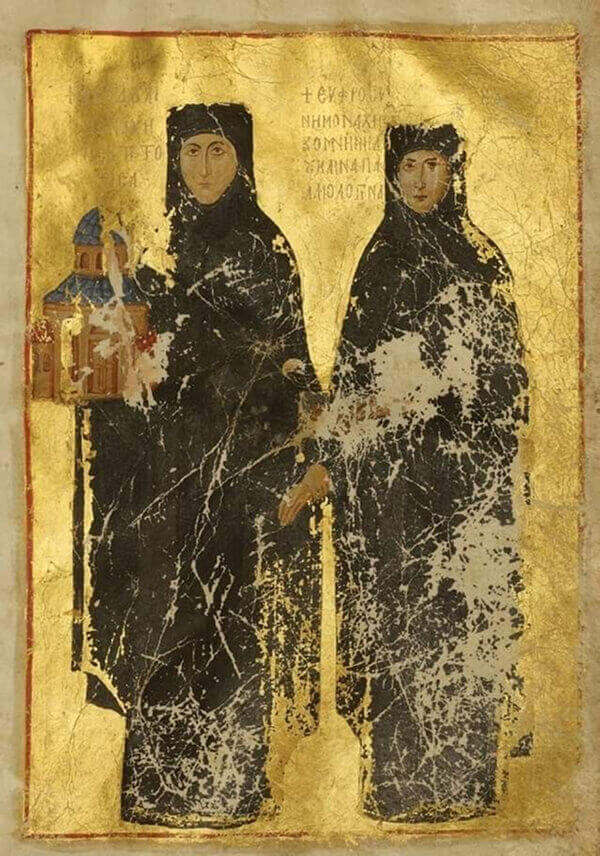
Theodora presenting the church of the monastery she is founding with her daughter Euphrosyne, Lincoln College Typicon, 14th century
Byzantine holy women
Holy women played an important and enduring role in Byzantine religious life, from late antiquity onward, as founders of monasteries, ascetics, miracle workers, and patrons of charitable institutions. The early and middle Byzantine periods produced a particularly rich constellation of female saints whose Lives articulated ideals of piety, virginity, ascetic discipline, and philanthropic leadership. Among the most influential were figures such as Macrina the Younger, whose spiritual authority shaped the Cappadocian tradition; Olympias the Deaconess, renowned for her generosity and ecclesiastical patronage; Mary of Egypt, the paradigmatic desert ascetic; Theodora of Thessalonike and Thomais of Lesbos, famous for their monastic rigor; and the imperial saints Pulcheria, Eudocia, Irene of Athens, and Theophano, whose political and religious roles intertwined in shaping Christian memory.
Yet after the tenth century, the pattern shifts dramatically: for reasons that remain poorly understood, Byzantines largely ceased to elevate women to sainthood. Only four are known for the entire late period: Marina in the 11th century, Irene-Xene (wife of John II Komnenos) in the 12th, Theodora of Arta in the 13th, and Matrona of Chios in the 14th.
Their scarcity contrasts sharply with earlier centuries, underscoring both the long tradition of female religious authority and its noticeable contraction in the final phase of the empire.
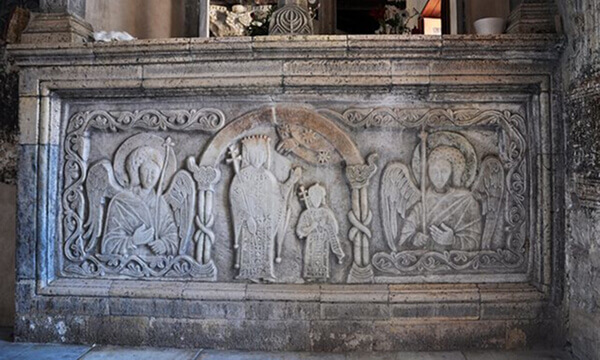
Discover some of the remarkable women who shaped Byzantium’s history
Source:
- Lynda Garland, Byzantine Empresses: Women and Power in Byzantium, AD 527–1204 (Routledge, 1999)
- Barbara Hill, Imperial Women in Byzantium 1025–1204: Power, Patronage and Ideology (Routledge, 1999)
- Alice-Mary Talbot, Women and Religious Life in Byzantium (Ashgate/Variorum, 2001)
- Judith Herrin, Women in Purple: Rulers of Medieval Byzantium (Weidenfeld & Nicolson, 2001)
- Liz James, Empresses and Power in Early Byzantium (Leicester University Press, 2001)
- Anthony Kaldellis (ed. & trans.), Mothers and Sons, Fathers and Daughters: The Byzantine Family of Michael Psellos (Notre Dame, 2006)
- Petra Melichar, Adolescent Behavior in Byzantine Sources. Some observations on young Byzantine women pursuing their goals.