Virgin Galaktotrophousa, the rare depiction of the Nursing Virgin in Byzantine Art
What is the Virgin Galaktotrophousa? Galaktotrophousa (Γαλακτοτροφούσα, “she who nourishes with milk”) is a Byzantine iconographic type of the Theotokos showing Mary breastfeeding the Christ Child. Unlike the Western Nursing Madonna or Virgo Lactans, which became a common devotional image from the 13th century onward, the Byzantine Galaktotrophousa remained rare throughout the empire’s history, surviving mainly in Coptic Egypt, Christian Nubia, Byzantine minor arts, and a handful of later icons from Mount Athos.
The image sits apart from the other Marian types on this site. It developed from an entirely different formal source than the Hodegetria, owes its posture more to Egyptian than to Constantinopolitan tradition, and never achieved the currency of the Eleousa or the Hagiosoritissa in mainstream church decoration. Its interest lies precisely in that marginality: an image with real theological weight, that Byzantine art largely chose not to put at the center of its churches.
From Isis to the Theotokos: the origin of a borrowed gesture
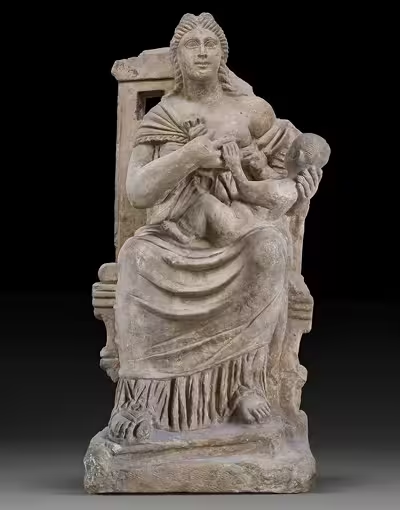
The Galaktotrophousa’s closest formal ancestor is not Christian at all. The Egyptian Isis Lactans — Isis enthroned, nursing her son Horus — was one of the most widely reproduced images in the late-antique Mediterranean, and in early Coptic art the borrowing was so direct that, in a handful of surviving pieces, only a small attribute (a cross, or the absence of Harpocrates’ finger-to-mouth gesture) tells the two apart. Whether this reflects a genuine continuity of cult or simply the reuse of an available formal schema is disputed — Elizabeth Bolman and Sabrina Higgins have each argued, from different angles, that the resemblance is largely superficial, separated by centuries and by incompatible theological content.
>> More about the debate about the Isis roots of the Theotokos Galaktotrophousa image
What is not disputed is why Christian Egypt reached for this image. In the 6th and 7th centuries, as Monophysite Christology hardened around the question of Christ’s human nature, a picture of Mary literally nursing her son made an argument no text could make as economically: this child had a real body, fed like any child’s. Patristic writers built on the image accordingly — Clement of Alexandria had already described the Logos itself as milk flowing from the Father’s breast, and later writers like Cyril of Alexandria drew an explicit line from Mary’s milk to the Eucharistic blood her Son would later give the Church. The nursing scene, in other words, was never read in Egypt as domestic tenderness; it was a compressed statement about the Incarnation and the sacrament that flowed from it.
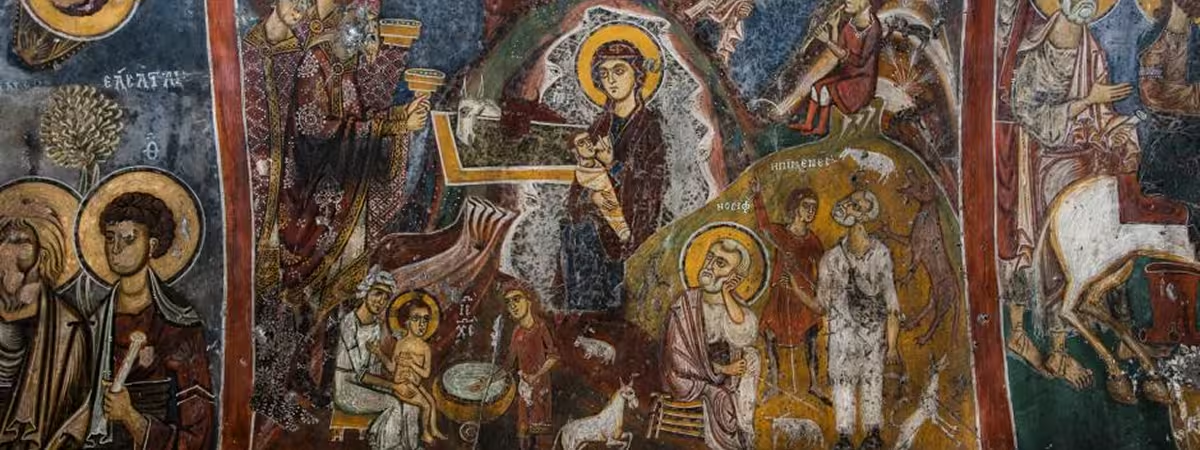
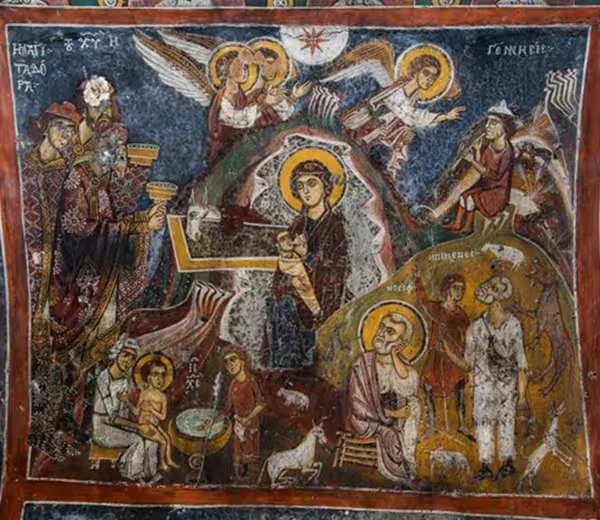
The earliest surviving Christian examples of any kind are, in fact, Roman rather than Egyptian: two 3rd-century frescoes in the Catacomb of Priscilla, predating the Christological controversies entirely and belonging to the plainer, narrative idiom of early funerary art. The type’s real elaboration, however, happens in the Coptic monasteries of Saqqara – like in the Monastery of St. Jeremiah, in a cell’s decorated prayer niche painted in the 6th or 7th century – and Bawit between the 6th and 10th centuries, where Mary is enthroned, cushioned, and haloed with the same hieratic gravity as any Pantocrator, and Christ — though an infant — is given the grave, ageless face of eternal God.
The same devotional current reached further south, into Christian Nubia, where three 11th-century paintings of the Galaktotrophousa survive from the north aisle of Faras Cathedral (now divided between the National Museum in Warsaw and the Sudan National Museum in Khartoum). Their votive inscriptions — asking Christ and Mary to “guard, bless, protect, strengthen” named donors — show the image functioning less as a doctrinal statement for the community and more as an intensely personal devotional object, lit by oil lamps burning in front of it.
Why the type stayed marginal in the Byzantine heartland
This is where the chronology needs unpacking rather than skipped over. Between the Coptic paintings of the 6th–10th centuries and the Athonite icon discussed below, the Galaktotrophousa does not disappear from the Byzantine world — but it disappears from monumental art. No Constantinopolitan mosaic, no major church fresco cycle, gives the nursing Virgin the prominence granted to the Hodegetria or the Blachernitissa. The type survives instead almost entirely in the minor arts: it is one of the recognized Marian types found on Byzantine lead seals, the small administrative sigillia stamped by officials and clergy across the empire, and it appears in illuminated cycles of the Akathist Hymn — the great 6th–7th-century liturgical poem to the Theotokos that Byzantine manuscript illustrators mined repeatedly for Marian imagery.
That distribution is telling. Lead seals and manuscript miniatures are private, portable, and often monastic or clerical in origin — exactly the milieu where the Coptic Galaktotrophousa had also flourished. What seems to have kept the type out of the great churches was less doctrinal objection than a mismatch of register: the Theotokos as venerated in the imperial capital was overwhelmingly the majestic intercessor of the Hodegetria and the Blachernitissa, not a mother caught in an intimate physical act. The nursing image persisted, but at the edges of Byzantine visual culture — in Egypt, in Nubia, in the pocket-sized world of seals and manuscripts — rather than at its center.
The Galaktotrophousa on Mount Athos: the Hilandar icon
The most important surviving Byzantine-Orthodox panel of the type is the Panagia Galaktotrophousa of the Hilandar Monastery on Mount Athos, painted around the 13th century and, by tradition, brought to the monastery by St Sava of Serbia. Its placement is exceptional: the icon occupies the Royal Doors of the iconostasis, a position normally reserved for the Annunciation or for Christ himself, and understood in patristic exegesis as marking the threshold into the Kingdom of God. Installing the nursing Virgin there activated a specific strand of Marian hymnography — the Acathist Hymn’s praise of the Theotokos as “gate of heaven” — turning a rarely-seen iconographic type into the literal doorway to the sanctuary.
Stylistically the Hilandar panel follows the mature formula: a red maphorion over a blue chiton, three stars marking perpetual virginity, the Child in green — the color of regeneration — grasping his mother’s breast, his gaze turned inward rather than toward the viewer, consistent with an icon meant to carry theological content rather than to depict a scene.
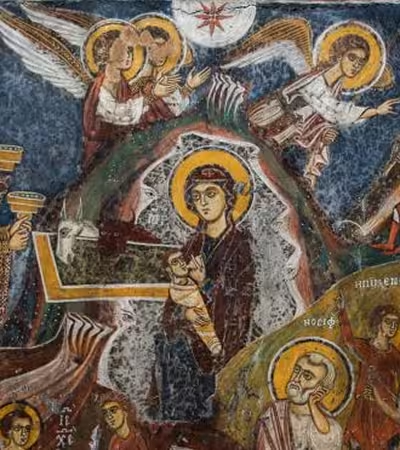
A comparable, more modest example can be found among the Byzantine frescoes of the Omorphi Ekklisia in Aegina, confirming that the type, though never common, did not vanish from the Greek mainland either.
Legacy: paper icons, and the West’s very different Nursing Madonna
After the fall of Constantinople, the Galaktotrophousa had an unlikely afterlife in the cheap paper icons printed on Mount Athos from copper plates between the late 17th and late 19th centuries and distributed to Orthodox communities across the Balkans and Russia — where the type is known as the Mlekopitatelnitsa. A well-documented plate engraved in 1871 by the hieromonk Gabriel of Skopelos, probably in the Hilandar workshop at Karyes, carries parallel Greek and Church Slavonic inscriptions, evidence of the image’s continued pull on Slavic-speaking donors supporting Athonite monasteries.
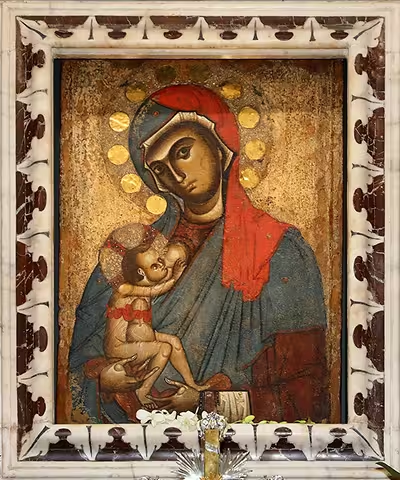
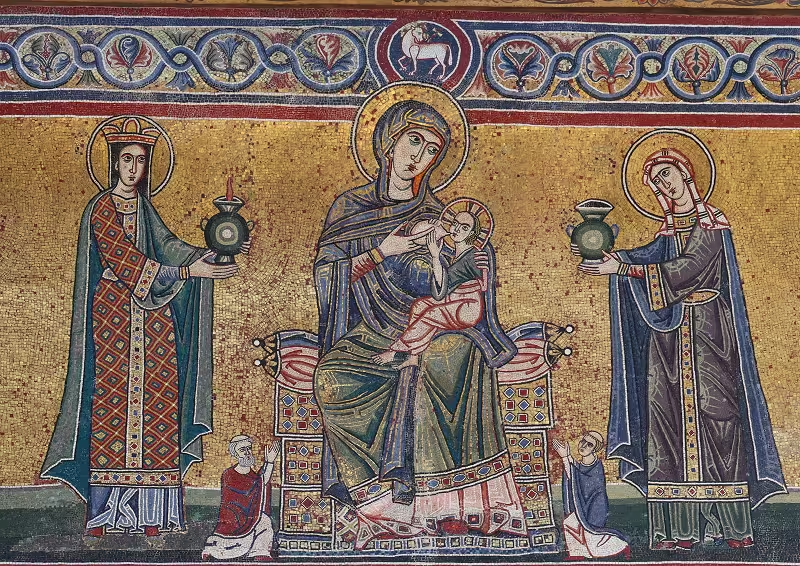
In the Latin West, the same underlying image took a very different path under the name Nursing Madonna (Virgo Lactans, Madonna del Latte). Mentioned as early as Pope Gregory the Great and visible in a 12th-century mosaic on the façade of Santa Maria in Trastevere in Rome or in an icon in Cosenza, the type was revived by the Cistercian order in the 12th century — the same period that produced the Lactation of St Bernard, in which the Virgin’s milk is shown falling directly onto the saint’s lips — and spread widely across 13th- and 14th-century Tuscany and Iberia, softening from the grave Byzantine model into an image of approachable maternal humility, closely tied to the Madonna of Humility type. It survived, increasingly discouraged on grounds of propriety, into Baroque devotional painting before fading from Catholic art after the Council of Trent — a trajectory almost the reverse of the Byzantine type’s: expanding in the West exactly as it receded in the East.
Debate: does the Galaktotrophousa really descend from Isis?
The claim that the Galaktotrophousa is a Christianized Isis Lactans is repeated in nearly every popular account of the image, but among specialists it is genuinely contested, and worth pausing on rather than treating as settled.
The case for direct continuity rests on formal resemblance that is, in places, extremely close. Both goddesses are shown enthroned, in three-quarter or frontal view, offering a bared breast to a divine child seated on their lap; both wear a distinctive headdress; both images were produced in the same Egyptian workshops, sometimes within a generation of each other. In a small number of surviving pieces — a funerary stele from Medinet el-Fayum is the most frequently cited example — art historians still disagree on whether the figure represents a late image of Isis or an early image of Mary, precisely because the iconography offers no reliable way to tell them apart. Scholars in this camp, following earlier work by figures such as Cristina Martínez Maza, argue that Coptic Christianity reached for the pre-existing Isiac schema out of iconographic necessity: there was no established visual language for a nursing divine mother, so artists borrowed the nearest available model wholesale, then adapted it — Anthony Cutler’s foundational 1987 study on the cult’s diffusion across Byzantium and Italy takes broadly this line, treating the parallel development of both images as too close to be coincidental.
The case against has been argued most forcefully by Elizabeth Bolman and, more recently, Sabrina Higgins. Bolman’s objection is chronological and conceptual rather than purely visual: the period in which the Galaktotrophousa is actually being produced in quantity — the 6th and 7th centuries, in monastic contexts — postdates the height of Isiac cult by several centuries, and she argues that 4th–6th-century notions of motherhood and infancy were different enough from later assumptions that reading the image as a straightforward statement of maternal bonding projects a modern sentiment backward onto it. For Bolman, the milk itself is not maternal in origin at all: patristic sources consistently locate its true source in God the Father, with Mary as a channel rather than the milk’s origin, which makes the image a statement about the Incarnation and the Trinity, not a borrowed scene of motherly affection. Higgins goes further, arguing that the resemblance between the two goddesses has been overstated by generations of scholars repeating one another rather than re-examining the evidence, and that the surviving corpus shows real gaps — geographic, chronological, and iconographic — that a theory of direct, continuous borrowing struggles to explain. On her reading, the Galaktotrophousa’s meaning is specifically and distinctly Christian: a virgin who should have no milk to give does so anyway, and gives it to a God who needs no nourishment at all — a paradox with no equivalent in the Isis myth, however similar the two images look.
Where this leaves the question. Most current scholarship treats the two positions as describing different things rather than flatly contradicting each other: few historians deny that Coptic artists had Isis Lactans imagery in view when the Galaktotrophousa’s visual schema first took shape, but there is real disagreement over whether that borrowing carried theological substance or was purely a matter of convenient form, emptied out and refilled with entirely new Christian content. The debate matters beyond iconographic bookkeeping — it bears directly on how much weight the image can carry as evidence of continuity between pagan and Christian Egypt, a question that recurs across Late Antique religious art far beyond this one motif.
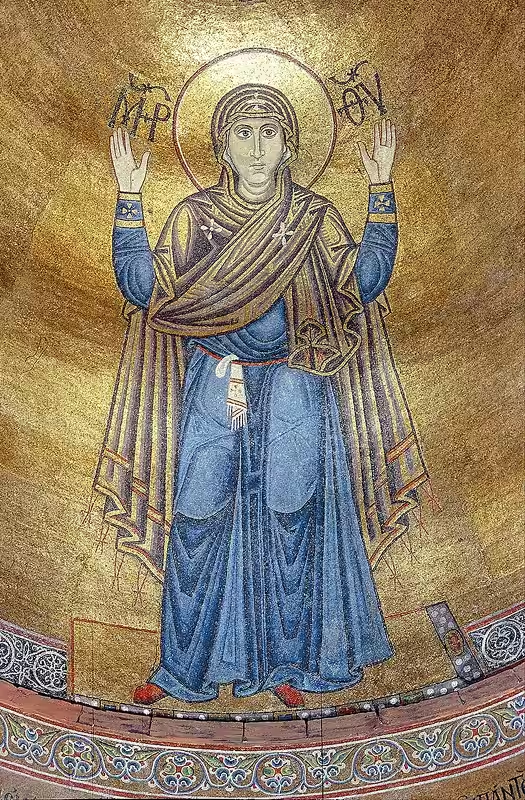
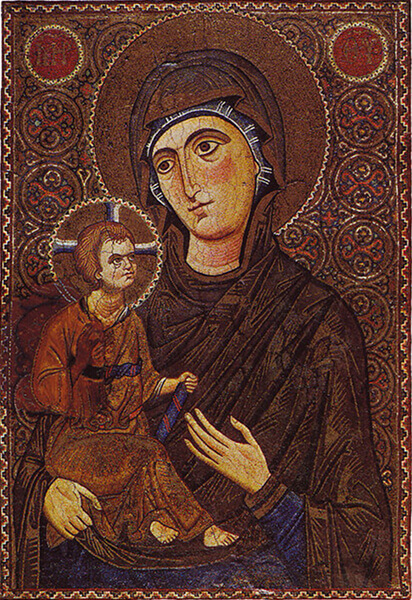
The other Virgin iconographic types


Sources and further reading
- Anthony Cutler, “The Cult of the Galaktotrophousa in Byzantium and Italy,” Jahrbuch der Österreichischen Byzantinistik 37 (1987), pp. 335–350.
- Elizabeth Bolman, “The Enigmatic Coptic Galaktotrophousa and the Cult of the Virgin Mary in Egypt,” in Maria Vassilaki (ed.), Images of the Mother of God: Perceptions of the Theotokos in Byzantium, Ashgate, 2005, pp. 13–22.
- Sabrina Higgins, “Divine Mothers: The Influence of Isis on the Virgin Mary in Egyptian Lactans-Iconography,” Journal of the Canadian Society for Coptic Studies 3–4 (2012), pp. 71–90.
- Aleksandra Sulikowska-Bełczowska, “‘I Gave Milk to Him While He Was Feeding All the World’: Representations of the Galaktotrophousa in Faras Cathedral,” 2019.
- Judith T. Brooks, “An Engraved Copper Plate of the Virgin Galaktotrophousa,” Journal of Modern Hellenism 27–28 (2009–2010), pp. 353–381.
- Alexander Kazhdan (ed.), The Oxford Dictionary of Byzantium, Oxford University Press, 1991 — entries “Galaktotrophousa” and “Eleousa.”
- “Mary, Blessed Virgin, Iconography of,” New Catholic Encyclopedia — on the type’s presence on Byzantine seals and in Akathist illustration.
- “Nursing Madonna,” Wikipedia — for the Western reception and terminology (Virgo Lactans, Madonna del Latte, Mlekopitatelnitsa).



One Comment