Virgin Orans: The praying Mother of God in Byzantine Art
Among the great Marian images of Byzantium, the Virgin Orans is at once the oldest and the most solemn: Mary standing frontally, her hands raised to heaven in the ancient gesture of prayer. Like the other major types of Byzantine icons, the Orans was never confined to painted panels — she filled the golden apses of churches, stood guard on city walls in legend, and circulated on coins and lead seals across the empire. In her most influential form, with the medallion of Christ on her breast, she became the Blachernitissa of Constantinople, the Platytera of the sanctuary apse, and the Virgin of the Sign of Novgorod: one prayerful gesture, radiating across the entire Orthodox world.
What is the Virgin Orans?
The Virgin Orans (from the Latin orans, “praying”) is a Byzantine iconographic type showing the Theotokos frontally with both hands raised in prayer and intercession. In the strict sense, the Orans depicts Mary alone, without the Child. When a round aureole containing the Christ Child appears on her breast, the image becomes a distinct family of types — known as the Blachernitissa in Byzantium, the Platytera when placed in a church apse, and the Virgin of the Sign (Znamenie) in Russia. All express the same double idea: Mary praying for humanity, and Mary as the living temple who contained God.
Origins of the orans gesture
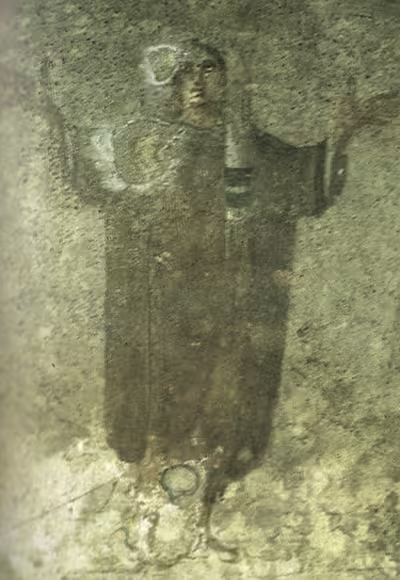
The raised-hands posture is far older than Christianity. Figures praying with uplifted palms appear in the art of the ancient Near East and the Greco-Roman world, where the gesture signified piety itself. The first Christians adopted it naturally: the catacombs of Rome are full of orants, anonymous figures — most often female — standing in prayer, painted above tombs from the 3rd century onward as images of the soul at peace.
It was a small step to give the praying figure the identity of the greatest of intercessors. Depictions of Mary as an orant appear by the 4th century, and the gesture attached itself to her permanently in scenes of the Ascension, where she stands at the center of the apostles, hands raised, embodying the praying Church left on earth. By the post-iconoclastic period, the Virgin Orans had become one of the canonical Marian types, alongside the Hodegetria and, later, the Eleousa. Where those types present the Mother with her Child, the Orans presents her office: perpetual prayer on behalf of humankind — the same intercessory role that the Hagiosoritissa expresses in profile, the Orans states frontally and monumentally.
The Blachernitissa: the Orans of Constantinople
In Byzantium, the praying Virgin was inseparable from one sanctuary: the church of the Theotokos at Blachernai, in the northwest corner of Constantinople. Founded in the 5th century and enlarged by successive emperors, the Blachernai housed the most precious Marian relic of the capital — the maphorion, the Virgin’s veil or mantle, kept in a reliquary chapel called the soros. Around relic and church grew a dense fabric of devotion. Tradition credited the Virgin of Blachernai with saving the city from the Avar siege of 626, and again from the Rus’ attack of 860, when the maphorion was carried in procession and, according to later accounts, dipped into the sea to raise a storm against the enemy fleet. By the 11th century the church was famous throughout Christendom for its “usual miracle,” described by Michael Psellos: every Friday evening, the veil covering the icon of the Virgin rose by itself, as if lifted by an unseen breath, and remained suspended until the following day.
Which image, exactly, was “the Blachernitissa”? Here Byzantine usage is genuinely slippery, and it is worth being precise. The epithet — simply “she of Blachernai” — was attached to whatever icons the sanctuary held, and the sources connect it with several different compositions: a praying Virgin, an enthroned Virgin, and images with the medallion of Christ. Modern scholarship, following the testimony of coins and seals, most commonly reserves “Blachernitissa” for the Orans with the medallion of Christ Emmanuel on her breast, and that is the convention adopted here. The confusion is ancient, not modern — a reminder that Byzantine image names were epithets of devotion, not catalogue entries. The great church itself burned down in 1434, two decades before the fall of the city, taking its icons with it; the Blachernitissa survives only in its countless descendants.
Description and variants of the type
The pure Orans shows Mary standing full-length, frontal, in tunic and deep-blue or purple maphorion, arms lifted symmetrically, palms open toward heaven. The composition is hieratic and architectural — made for monumental settings, where the raised arms span the curve of an apse as if holding it up.
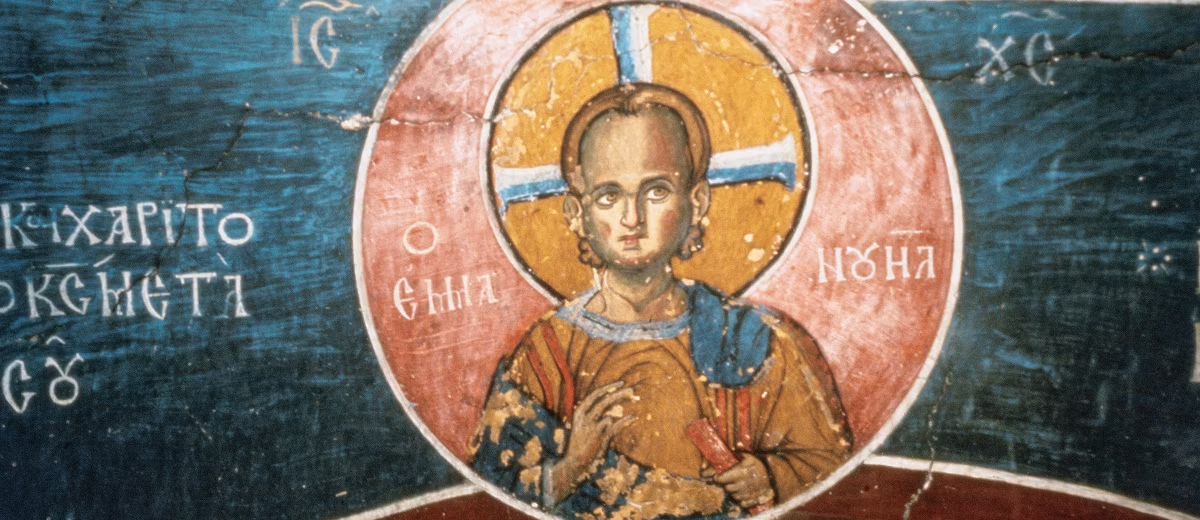
The addition of the Christ medallion transformed the image’s meaning. Within a radiant aureole on the Virgin’s breast appears Christ Emmanuel — not an infant carried in arms, but the Lord present in her womb, robed and blessing, shown at the moment of the Incarnation itself. The image is a theological diagram of Isaiah’s prophecy: “the Lord himself shall give you a sign — behold, a virgin shall conceive and bear a son” (Isaiah 7:14). From this verse comes the Russian name of the half-length version, the Virgin of the Sign (Znamenie), and ultimately the type’s most poetic title. The epithet Platytera ton Ouranon — “more spacious than the heavens” — drawn from the liturgy, celebrates the paradox at the image’s heart: she contained within herself the One whom the universe cannot contain.
The family of variants is thus easier to navigate than it first appears. The Orans proper: praying Virgin, no Child. The Blachernitissa: Orans with medallion, the form of the great Constantinopolitan cult image. The Platytera: the same composition named for its placement in the apse. The Virgin of the Sign: the Russian name for the half-length form — a format the Byzantines themselves used widely, on coins, seals, and panel icons alike. The Great Panagia: the Russian name for the full-length form.

Virgin Platytera in one of the chapel of the ambulatory.
Church of Saint Pantelemeion in Thessaloniki.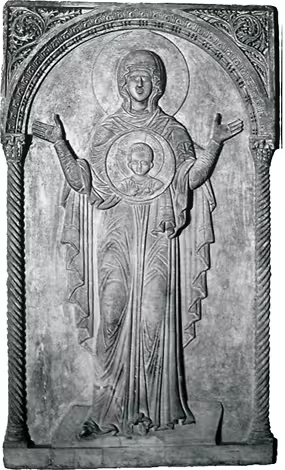
Marble relief of the Virgin Blachernitissa, 11th century, San Marco, Venice 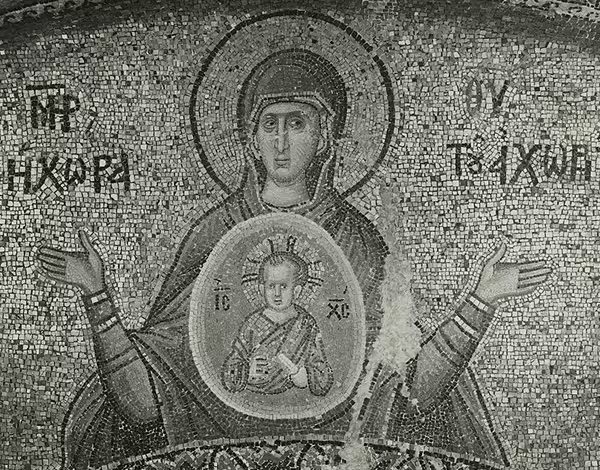
Mosaic in the Chora Church in Istanbul,
showing the Blachernitissa, in bust, 14th century.
The Platytera in the apse
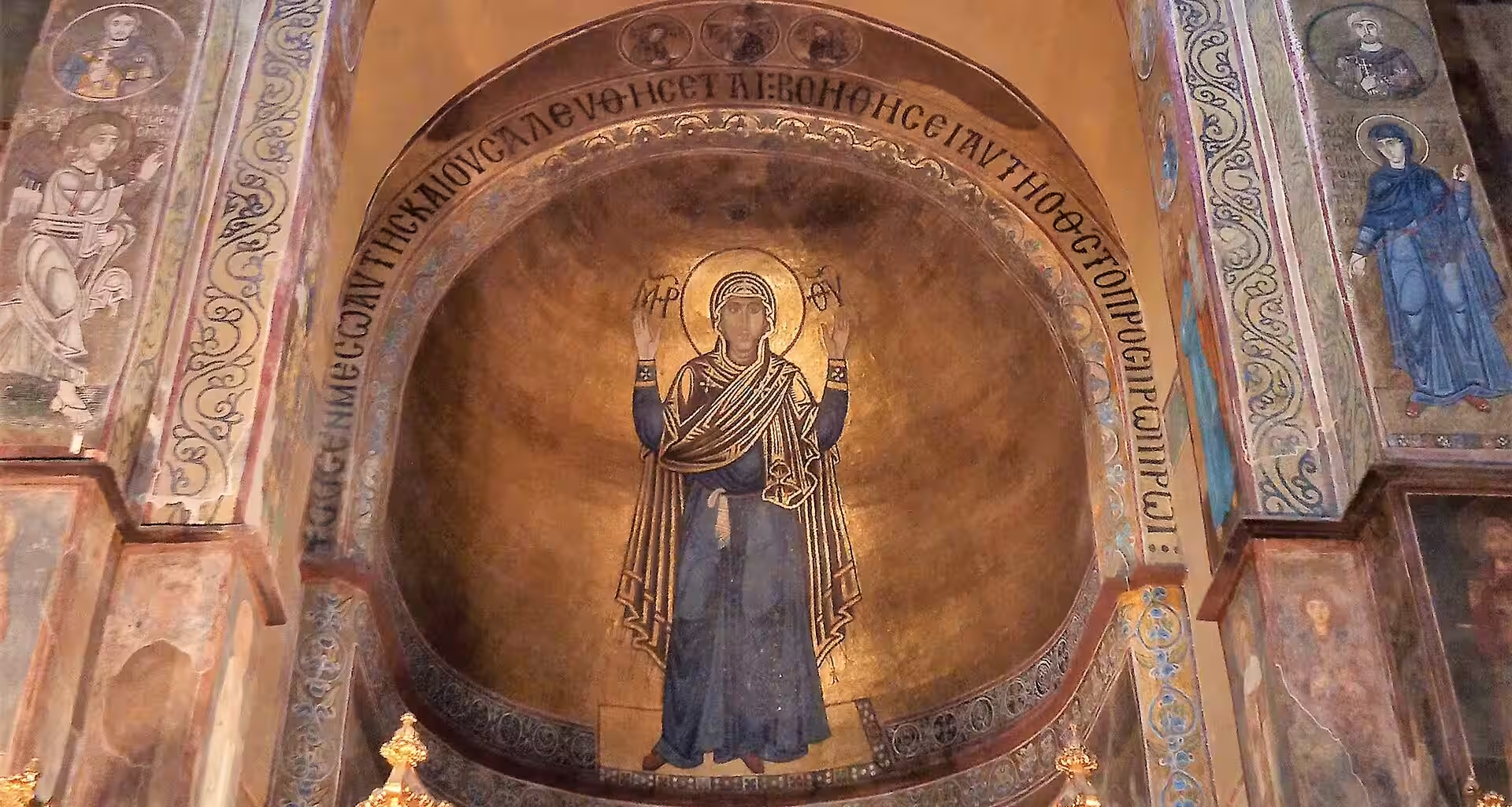
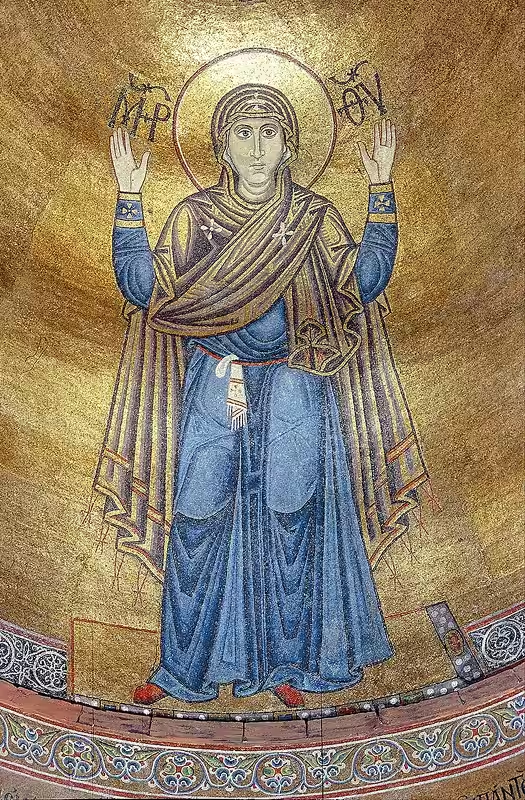
After Iconoclasm, when the classical decoration system of the Byzantine church took shape, the Virgin claimed the apse — the second most exalted field of the building after the dome of the Pantocrator. The logic was theological: the dome was heaven, the naos earth, and the apse — where heaven bends down to meet the altar — belonged to the Incarnation, to the woman through whom God entered the world. Whether shown enthroned with the Child, like in the Hagia Sophia, or standing as an Orans, the apse Virgin presided over the liturgy as the bridge between the two realms; the orans form, with its raised arms echoing the conch’s curve, suited the space so perfectly that it became the standard, and “Platytera” simply came to mean the Virgin of the apse.
The supreme surviving example is the Oranta of Kyiv, in the apse of Saint Sophia Cathedral — a mosaic nearly six meters high, executed by Byzantine masters in the 11th century for the new cathedral of the Rus’. Above her arches an inscription from Psalm 46: “God is in the midst of her; she shall not be moved.” The words became prophecy in popular belief: the Kyiv Oranta acquired the name “the Unbreakable Wall,” the image that would stand as long as the city stood — a northern heir to the Blachernitissa’s role as guardian of Constantinople.
The Orans on coins and seals
Like the Pantocrator, the praying Virgin had a life in metal. From the 11th century, the Blachernitissa type appears on imperial coinage — notably under Constantine IX Monomachos — the medallion of Christ on the Virgin’s breast rendered in miniature on gold nomismata. On lead seals the Orans was more common still: emperors, patriarchs, monasteries, and officials by the hundreds sealed their documents with the praying Theotokos, making the type one of the most widely reproduced Marian images of the Middle Ages. The choice was pointed. A seal invoked a protector; and no image said “protection” more plainly than the Virgin with raised hands, interceding without pause.
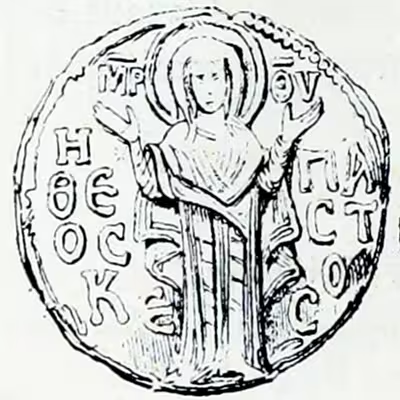
Seal of the Theoskepastos monastery, 13th of 14th century, showing the Virgin Orans with the abbreviation MP ΘY, meaning Mother of God. 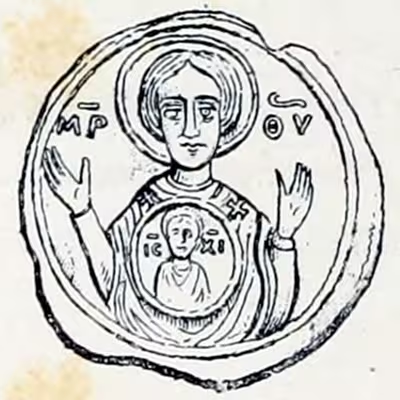
Seal of the Sebastos Andronikos Komnenos, 12th century, showing the Virgin Orans of the Blachernitissa type, with Christ Emmanuel in medallion.
In Russia: the Virgin of the Sign
Nowhere did the type take deeper root than in the Rus’ lands. The half-length Orans with medallion — the Znamenie, “the Sign” — became one of the most venerated images of medieval Russia through a single event. In 1170, the armies of Andrei Bogoliubsky besieged Novgorod; the defenders carried their icon of the Virgin onto the city ramparts, where, according to the chronicle tradition, an arrow struck the image and the Virgin turned her face toward the city, weeping. The besiegers were seized by confusion and defeated. The Novgorod Znamenie — a 12th-century icon that still survives — became the city’s palladium, and its feast is still kept in the Orthodox calendar on 27 November.
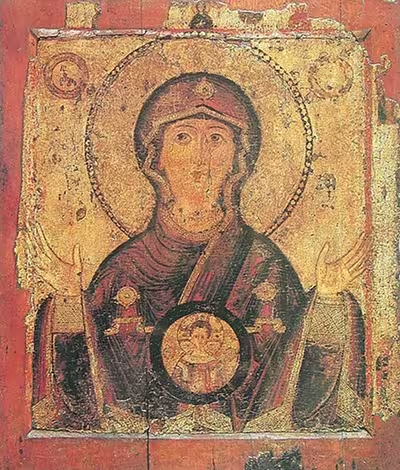
Russian painters also monumentalized the type on the panel. The Great Panagia of Yaroslavl (early 13th century, now in the Tretyakov Gallery) transposes the full-length apse composition onto wood: the Virgin stands on a red podium, arms raised, gold-striated garments blazing, the medallion of Emmanuel radiant on her breast — an apse you can stand before. Later miracle-working icons of the Sign, such as the Kursk Root icon, carried the tradition into the modern era.
Legacy of the Virgin Orans
Of all the Marian types of Byzantium, the Orans has kept its liturgical station most completely. Walk into virtually any Orthodox church built in the last two centuries — in Greece, the Balkans, Russia, or the diaspora — and the Platytera fills the apse above the altar, arms raised over the liturgy exactly as at Kyiv a thousand years ago. The gesture has proven as durable as the faith it depicts: older than Christianity, adopted by it, given to Mary, and fixed at the visual heart of Orthodox worship. Where the Hodegetria points and the Eleousa embraces, the Orans simply prays — and after fifteen centuries, she has not lowered her arms.
Frequently asked questions about the Virgin Orans
What does “Orans” mean?
Orans is Latin for “praying.” The term describes the ancient posture of prayer — standing, arms raised, palms open — used across the ancient world and adopted by early Christian art long before it became attached to the Virgin Mary.
What is the difference between the Virgin Orans and the Virgin of the Sign?
The Orans in the strict sense shows Mary praying alone, without the Child. The Virgin of the Sign (Znamenie) adds a medallion of Christ Emmanuel on her breast and shows her half-length. The full-length version with medallion is called the Blachernitissa or, in Russia, the Great Panagia.
Why is the type called “Platytera”?
From the liturgical epithet Platytera ton Ouranon, “more spacious than the heavens”: by carrying God in her womb, Mary contained the One whom the universe cannot contain. The name is used above all for the Virgin orans painted in the apse of Orthodox churches.
Why is the Virgin Orans placed in the church apse?
In the Byzantine decoration system the dome belonged to Christ Pantocrator and represented heaven; the apse, where heaven meets the altar, represented the Incarnation. The Virgin, through whom God entered the world, presides there as the bridge between the two — her raised arms echoing the curve of the vault.
What was the Blachernitissa?
The Virgin venerated at the church of Blachernai in Constantinople, which held the relic of Mary’s veil and was famous for its weekly “usual miracle.” The name was applied to more than one composition, but scholars most often use it for the Orans with the medallion of Christ — the ancestor of the Virgin of the Sign.
The other Virgin iconographic types


Sources and further reading
- Bissera V. Pentcheva, Icons and Power: The Mother of God in Byzantium, Penn State University Press, 2006 — the fundamental study of the Blachernai cult and its images.
- Maria Vassilaki (ed.), Mother of God: Representations of the Virgin in Byzantine Art, Skira, 2000.
- Maria Vassilaki (ed.), Images of the Mother of God: Perceptions of the Theotokos in Byzantium, Ashgate, 2005.
- Victor Lazarev, “Studies in the Iconography of the Virgin,” The Art Bulletin 20 (1938), pp. 26–65.
- Otto Demus, Byzantine Mosaic Decoration: Aspects of Monumental Art in Byzantium, London, 1948 — on the placement of the Virgin in the apse.
- Alexander Kazhdan (ed.), The Oxford Dictionary of Byzantium, Oxford University Press, 1991 — entries “Blachernai,” “Blachernitissa,” “Virgin Mary.”