The Sivas Hoard: Secrets of a 7th-century Byzantine gold treasure
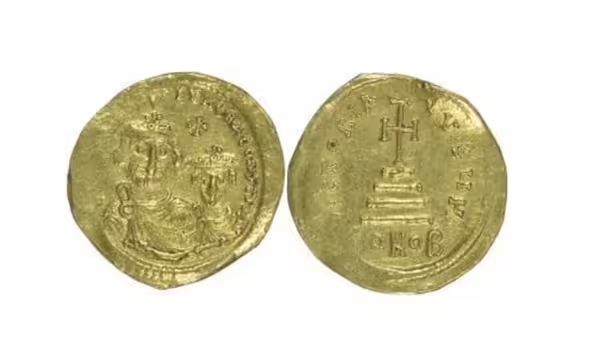
The Sivas Hoard – twenty Byzantine gold coins minted between 607 and 668 CE – offers one of the sharpest windows we have into a century that nearly destroyed the Byzantine Empire. Preserved today at the Sivas Archaeological Museum, this rare 7th-century gold treasure connects economics, imperial propaganda, military crisis, and the fate of a single unknown person who buried their wealth and never came back.
Sebasteia: a city at the crossroads of empire.
Before examining the coins themselves, it helps to understand where they were found – or rather, where they almost certainly came from.
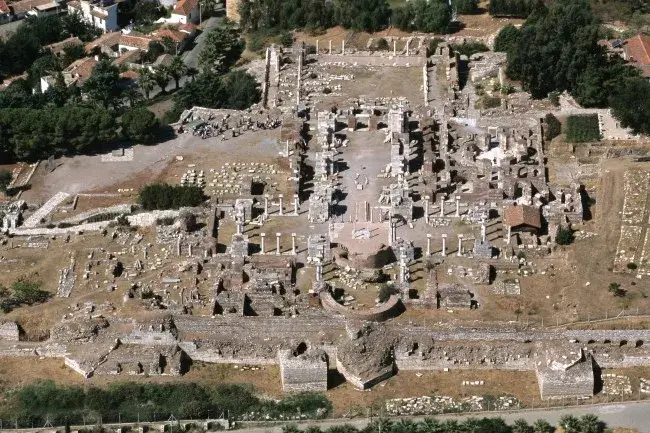
The city we now call Sivas was known in the Byzantine period as Sebasteia. It was not a provincial backwater. It sat at the intersection of the empire’s most important east-west and north-south trade routes, connecting Europe and Asia on one axis and Mesopotamia and the Black Sea on the other. Merchants, armies, and imperial envoys all passed through it.
Emperor Justinian I recognised its strategic value. He personally ordered the reinforcement of its walls and designated Sebasteia the capital of the Armenia II province. The city’s population approached 100,000, among the largest in Anatolia.

Sebasteia also held deep religious significance for the Byzantine world. In 320 CE, forty Roman soldiers stationed in the city refused to renounce their Christian faith despite orders from the Emperor Licinius. As punishment, their captors drove them onto a frozen lake and left them to die through the night. According to tradition, all forty held firm. They became known as the Forty Martyrs of Sebasteia, and their story spread rapidly across the Christian world. By the 4th century, Basil the Great, himself from Cappadocia, was preaching sermons in their honour. Churches dedicated to the Forty Martyrs appeared from Constantinople to Jerusalem. For Byzantine Christians, Sebasteia was not just a military and commercial hub. It was holy ground, famous for its many churches.
That importance also made Sebasteia a target. In 575, the Sasanian king Khusrow II marched his army through Erzurum and seized the city, devastating it in the process. Byzantine forces eventually recovered it, but the trauma was not forgotten.
Under Constans II, the pressure returned from a new direction. Arab raids began striking the region from 663 onwards. The borders were collapsing, and Sebasteia was once again in the path of war.
This was the time where someone buried twenty gold coins and never returned to claim them.
A mysterious cache – and what type of hoard it might be.
The hoard entered the Sivas Archaeological Museum in 2009 following a legal confiscation. Its exact burial site remains unknown.
Numismatists classify hoards into three broad types: panic hoards, buried in immediate danger and reflecting whatever coins the owner had at hand; savings hoards, accumulated deliberately over time; and lost purse hoards, smaller and mixed collections that suggest accidental loss rather than intentional concealment.
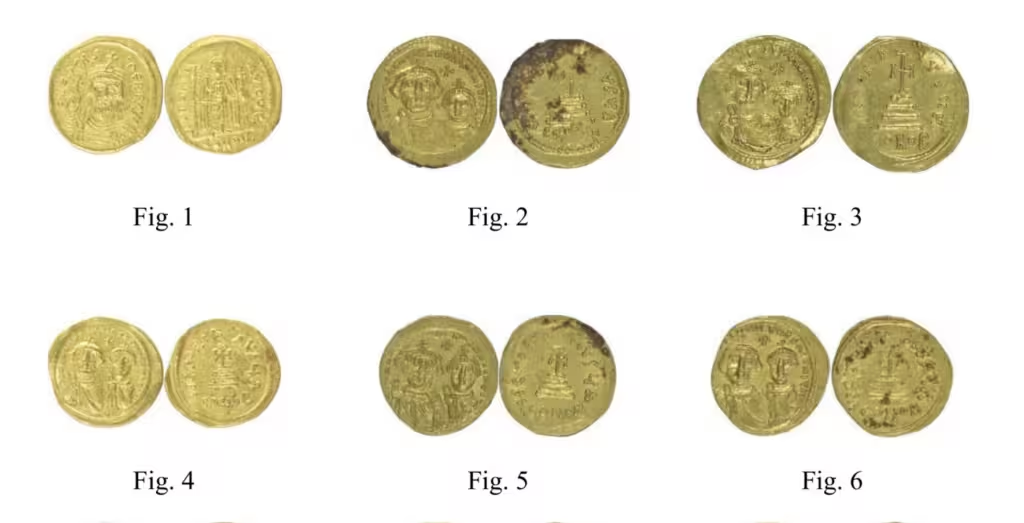
The Sivas Hoard fits the savings category most convincingly. Its 20 coins (19 solidi and 1 tremissis) span three successive reigns across roughly 60 years of accumulation. Someone gathered these coins carefully over a long period. The consistency of the collection, all struck in Constantinople, all high-quality gold, points to a deliberate and disciplined saver rather than someone emptying their pockets in a crisis.
But the hoard was never reclaimed. That fact tilts the story back toward danger.
The Byzantine solidus: currency of global stability.
At the heart of the hoard is the solidus. Scholar R.S. Lopez famously called it the “dollar of the Middle Ages” – a phrase that captures its extraordinary reach. First introduced by Constantine I, the solidus circulated not just across the Byzantine Empire but throughout Europe, the Mediterranean world, and into Islamic territories, where Byzantine gold coins were sometimes called “bezants.” It served as a trusted medium of exchange for roughly 700 years.
Each coin weighed approximately 4.5 grams of high-purity gold. That consistency was the point. The solidus worked as an international currency precisely because it never surprised you.
Even under the fiscal pressures of the 7th century, Byzantium protected the purity of its gold coinage to preserve its international credibility. The Sivas Hoard reflects this discipline – all 20 coins are Constantinople-minted, and their gold content remains high. Yet subtle weight variations in the later coins hint at the strain the imperial treasury was beginning to feel.
The hoard also includes one tremissis, worth one-third of a solidus. These smaller coins were used for minor payments, gifts, and religious donations. Importantly, tremisses rarely appear outside hoards in excavations – their presence here is a small but telling sign of deliberate accumulation rather than casual loss.
Imperial propaganda in the palm of a hand.
Byzantine coins were more than currency – they were a mean to reflect imperial power. Every face that passed through a merchant’s hand or a soldier’s pay packet carried a political message, and the Sivas Hoard shows that message changing under pressure.
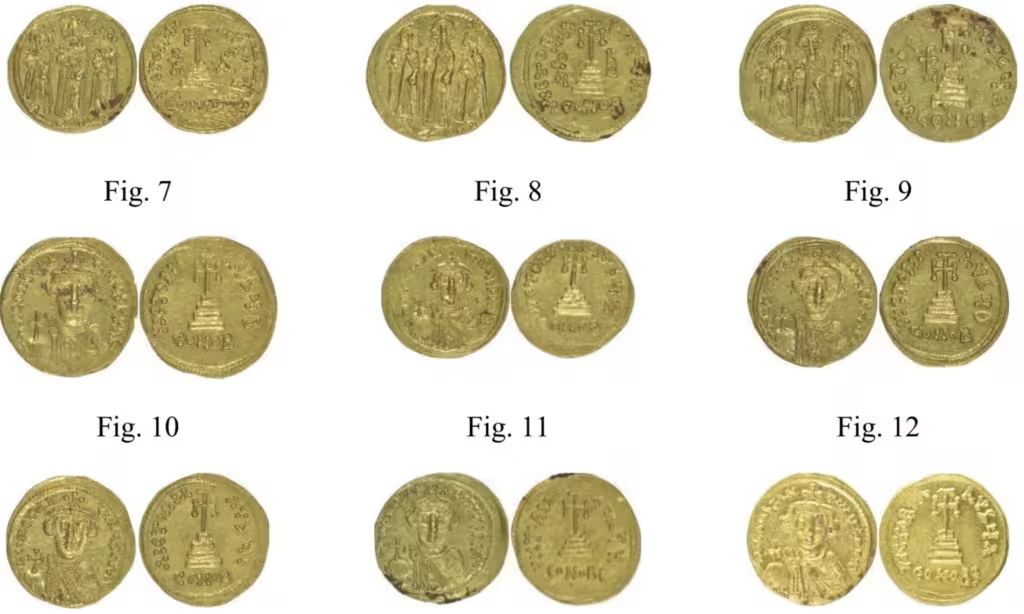
The single Phocas coin in the collection sits at a turning point in Byzantine portraiture. Earlier imperial coins favoured idealised, almost abstract faces – timeless images of authority rather than portraits of actual men. Phocas broke with this tradition. His coins show a distinctly individual emperor: unkempt hair, a short pointed beard, features that feel observed rather than composed. Scholars believe this realism reflected a personal preference – Phocas came from outside the traditional aristocracy and may have wanted to look different. He also used pendilia, hanging ornaments on his crown, in his earliest coin types before abandoning them – a small detail that marks the moment of transition.
The eight Heraclius coins in the hoard tell a different story. Heraclius placed his heirs alongside him on the coins – first his son Heraclius Constantinus, later adding Heraclonas as well. Where Phocas projected a single authority, Heraclius projected a dynasty. The coins insisted that stability was structural, not personal. They also show Heraclius aging: early coins depict him short-bearded, later ones long-bearded. The progression of a reign made visible on gold.
Heraclius was also the first emperor depicted on solidi wearing the chlamys (a military cloak) rather than the more formal paludamentum. In a century defined by war, even court costume became propaganda.
The ten Constans II solidi and single tremissis complete the set. Constans continued the dynastic strategy, eventually placing his three sons alongside him on coins. His portrait follows its own arc: clean-shaven in his early years, heavily bearded by the end of his reign. Byzantine convention used the emperor’s beard to mark the passage of time in office – a shorthand for longevity and continuity that every coin-handler would have read instantly.
Religious imagery runs through the entire collection. The cross appears on the reverse of every coin, replacing the Victoria figures common in earlier Roman coinage. Christian symbolism was not merely decorative — it anchored the emperor’s authority in divine appointment, making every transaction a small reminder of the cosmic order underpinning imperial rule.
Economic survival amidst Byzantine decline.
The 7th century forced Byzantium into painful contraction, and the coin record documents it precisely. Scholars have counted approximately 95 Byzantine hoards dateable to the 6th and 7th centuries. Between 700 and 850 AD, that number drops to just 11. The collapse in hoard frequency directly tracks the empire’s territorial losses and the impoverishment that followed.
As provinces fell – first to the Sasanians, then to the Arab conquests – minting activity consolidated almost entirely in Constantinople. The Sivas Hoard reflects this narrowing. All 20 coins came from a single mint in a shrinking empire.
The quality of the gold tells its own story. In periods of monetary uncertainty, people hoarded good coins and spent bad ones. The high preservation of the Sivas collection suggests deliberate savings – coins set aside and protected, not circulated. The Byzantine state was aware of this behaviour and periodically passed laws restricting the private stockpiling of gold, concerned that hoarding was draining coin from circulation. People did it anyway.
For researchers today, hoards like this one are indispensable tools. They reconstruct patterns of monetary circulation, reveal shifts in minting practice, and offer a ground-level view of how imperial systems functioned under duress, more honestly than official records ever could.
A legacy preserved in gold – and in silence.
The Sivas Hoard is a compressed record of an empire navigating catastrophe: projecting authority through art, maintaining monetary credibility through discipline, and watching its borders contract while its coins told a story of continuity.
But the hoard’s most powerful quality is what it cannot tell us.
We know the city. Sebasteia stood at the crossroads of empire, fortified by Justinian, used as a military base by Heraclius, raided by Arab armies from 663 onwards. We know the coins: 60 years of careful, disciplined accumulation, all struck in Constantinople, all high-quality gold.
What we do not know is who buried them. We do not know what threat was closing in when the decision was made. We know only that someone trusted gold to keep them safe, and that they never came back to retrieve it.
That silence is the hoard’s final testimony. The coins outlasted the person who saved them.
Images Credit: Sözcü, S. (2026), PROPONTICA