The mosaics of the church of Hagios Demetrios in Thessaloniki
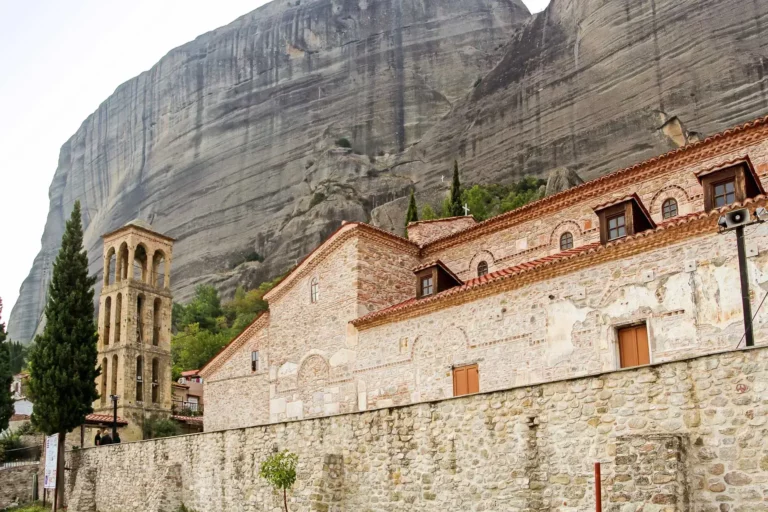
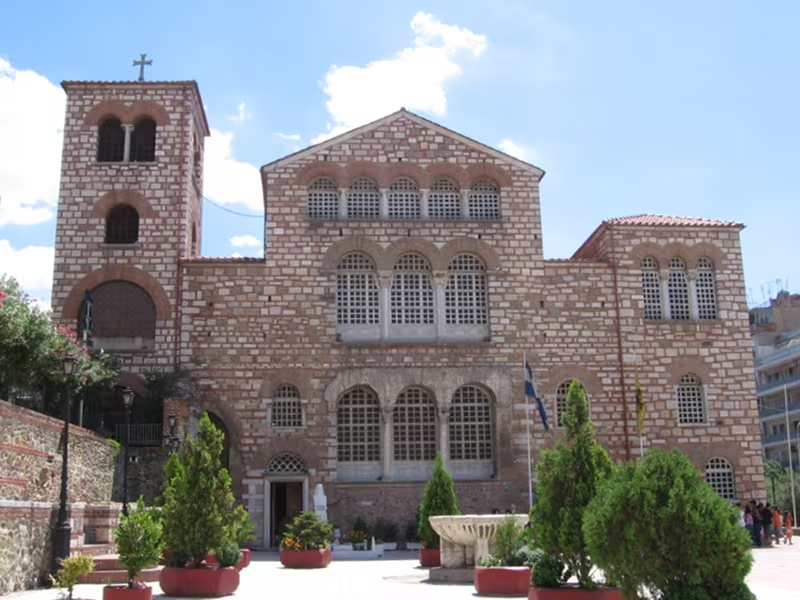
The mosaics of the church of Hagios Demetrios in Thessaloniki are the crowning treasure of one of the oldest and most prestigious sanctuaries in the city, once the second most important Byzantine center after Constantinople. The cult of Saint Demetrios was widely popular in the Middle Ages, and the basilica, built where the saint’s martyrdom was believed to have occurred c. 306, was an important monument with a splendid ciborium — a hexagonal, silver-clad canopy that served as the saint’s symbolic tomb — as well as lavish decorations and mosaics. It was the center of a major pilgrimage, which helps explain why so many citizens commissioned the votive mosaics that survive today.
Planning to see it in person? It is an easy stop on any walking tour of the city’s monuments — see our complete visitor guide to Byzantine Thessaloniki.
Quick facts — the mosaics of Hagios Demetrios
Location:
Basilica of Hagios Demetrios, Thessaloniki, Greece (UNESCO World Heritage Site since 1988)
Date:
chiefly 7th century (c.620s–730); a few panels possibly 5th–6th century
Type:
votive (ex-voto) wall mosaics — donor portraits, not narrative scenes
Subjects:
Saint Demetrios or other saints with bishops, officials, donors and children
Technique:
glass and stone tesserae on a gold ground
Survival:
~9 panels in situ (sanctuary piers + west wall of the nave) plus fragments in the Museum of Byzantine Culture
Nearly lost:
hidden under plaster as a mosque from 1493; much destroyed in the Great Fire of 1917
Why are the Hagios Demetrios mosaics important?
The mosaics of Hagios Demetrios are among the very few figural mosaics to survive from before Byzantine Iconoclasm, the 8th–9th-century campaign that destroyed most religious imagery. Commissioned by the citizens of Thessaloniki as votive offerings to their patron saint, they form the richest surviving collection of early Byzantine donor portraits — a rare window onto the faces, dress and piety of a 7th-century provincial elite. Their partial loss in the 1917 fire makes the survivors, and the watercolours that record the rest, all the more precious. Despite this dramatic loss, the votive panels and mosaics of the church feature in our selection of the finest Byzantine mosaics you can still see, as the tradition’s most personal survivals.
The creation of the mosaics of Saint Demetrios
An earlier church on the site, built in the 5th century by the prefect Leontios in the form of a three-aisled basilica, was destroyed by a fire around 620. The church we see today was rebuilt between 629 and 634, and an extensive program of mosaic decoration followed in the course of the 7th century, until the rise of Byzantine Iconoclasm in 730.
Dating the individual panels is not settled: while the main group belongs to the 7th century, some scholars spread the surviving mosaics across a longer span, from the 5th to the 9th century. This is partly why counts differ from book to book — depending on which fragments and later panels are included, you will see anywhere from six to nine surviving mosaics cited.
These mosaics are not only a testimony to the development of early Byzantine art but also represent the most important collection of patron portraits produced during this period. The mosaics were commissioned by the wealthy inhabitants of Thessaloniki as a form of ex-voto, to commemorate their patron saint Demetrios and his companions, and to thank them for previous interventions on their behalf.
They also portray the elite of early Byzantine Thessaloniki and illustrate how their patronage contributed to the construction of an elite identity at the time.
The mosaics of Hagios Demetrios: A history of rediscovery and loss
Since 1492–93, following the conquest of Thessaloniki by the Turks about sixty years earlier, the church had been converted into a mosque, and the Christian decorations, including the mosaics, were covered.
In August 1907, extensive renovations began on the Kasimiye Camii—the name of the mosque. During these repairs, many mosaics came to light, notably on the wall of the north inner aisle. The quality and preservation of the artworks attracted numerous scholars, who documented the discoveries with photographs, drawings and watercolors – though only partially – before a new white layer was applied over them.
In August 1917, a catastrophic fire broke out in Thessaloniki and ravaged two-thirds of the city. Miraculously, most of the Byzantine churches survived, but Hagios Demetrios was one of the churches nearly completely destroyed in this disaster.
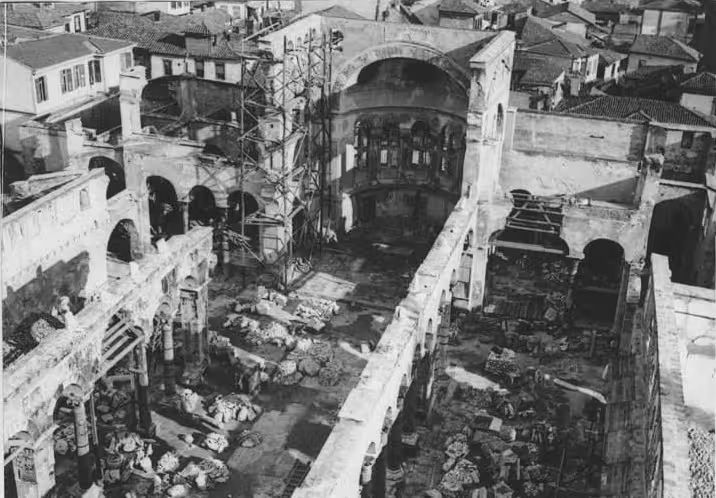
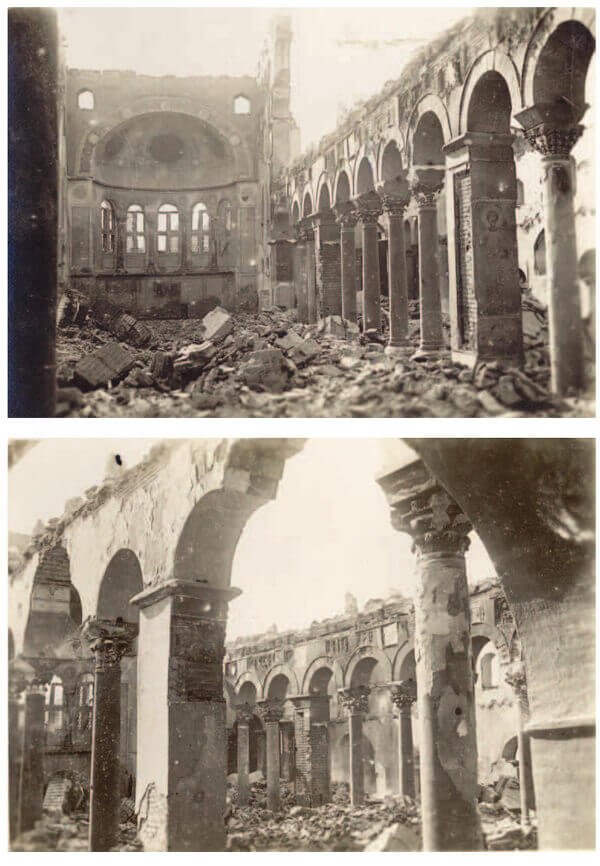
However, the excavation and consolidation of the church after 1917 revealed a few additional mosaic panels that had remained concealed beneath Ottoman plaster. A niche in the outer south wall of the apse also preserves fragmentary mosaic, together with the remains of a votive inscription. A few fragments were also salvaged from the rubble and later transferred to the Museum of Byzantine Culture of Thessaloniki.
How to read the mosaics of Hagios Demetrios
Before looking at the panels one by one, it helps to know the visual code they share. These are votive portraits, not stories, and almost every detail — a halo, a book, the size of a figure — carries meaning.
Technique and materials
Like the finest early Byzantine mosaics, the panels are built up from thousands of small tesserae — cubes of colored glass, with marble and stone reserved for flesh tones, set against a shimmering gold ground made from gold leaf fused inside glass. Style and meaning go together: Saint Demetrios is shown frontally and almost weightless, in a hieratic, otherworldly manner that marks him as holy, while the donors, bishops and officials beside him have fuller, more individualized faces and richly patterned clothes. That deliberate contrast — the transcendent saint against the lifelike patron — is what makes these mosaics such valuable portraits of real early Byzantine people.
Halos
A halo, or nimbus, separates the holy from the mortal. Saints, the Virgin and angels wear a round, golden one, so a beardless youth with a gold halo is a saint, whereas a beardless figure without one is simply a living person. The key to this church is the square (rectangular) halo, which marked a person still alive when the mosaic was made — the reason the living officials and donors carry one while the saint keeps his round nimbus. Imperial figures are a further exception, though none appear at Hagios Demetrios: emperors and empresses were given a round golden halo like the saints, as in the famous Zoe mosaic in Hagia Sophia, Istanbul.
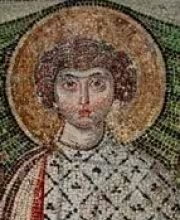
Saint with golden halo 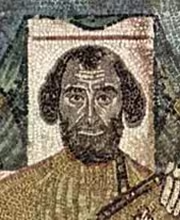
Donor with square halo 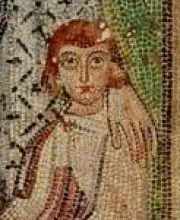
Child without halo
Reading the figures: dress, objects and scale
Status and role are written into costume and gesture. Clergy carry a jeweled Gospel book and wear ecclesiastical vestments; secular officials wear the chlamys — a court mantle — with a tablion, the rectangular cloth panel that signalled rank, often in gold. Holding a book or wearing vestments tells you a churchman; the patterned silk mantle and tablion, a layman. Donors and children appear smaller than the saint (a hierarchy of scale, not perspective) and reach toward him with hands respectfully veiled beneath their garments. The patterned silks themselves are a guide to Byzantine court dress and the wealth of those who could commission such a panel.
Children — and the missing women
The children are shown as miniature adults rather than with childlike bodies, often nudged forward by a parent and dedicated to the saint’s protection. Look closely at who is portrayed, though, and a pattern emerges: the patrons are overwhelmingly male — officials, bishops, deacons and boys. Women are strikingly rare among the donors; they appear chiefly as the sacred figure of the Virgin, with only the occasional girl among the dedicated children. This largely reflects who held public office and commissioned monuments in their own image in early Byzantium, and it makes the female presences that do survive all the more notable.
Identifying the saints — and why it is hard
Saint Demetrios is the beardless young man in court dress, frequently orant (hands raised in prayer); Saint Sergios is known by his military collar and a surviving inscription. But naming the figures is often difficult, and for good reasons: many inscriptions are lost or damaged, several faces were deliberately removed in later centuries, the same garment types recur from panel to panel, and beardless young saints simply resemble one another. That is why one panel of a saint with two children is still debated between Demetrios, Saint George and Saint Bacchus.
Reading the backgrounds
The settings are stage-sets rather than real places. Crenellated walls evoke the city Demetrios protects, hanging curtains and patterned cloths frame the holy figures, and an undulating ground floats them in gold. Now and then the background turns specific — the roofline of the silver ciborium, the canopy at the heart of the saint’s cult, appears behind more than one figure, tying the image to the real shrine that once stood in the church.
The surviving mosaic panels of the basilica of Saint Demetrios
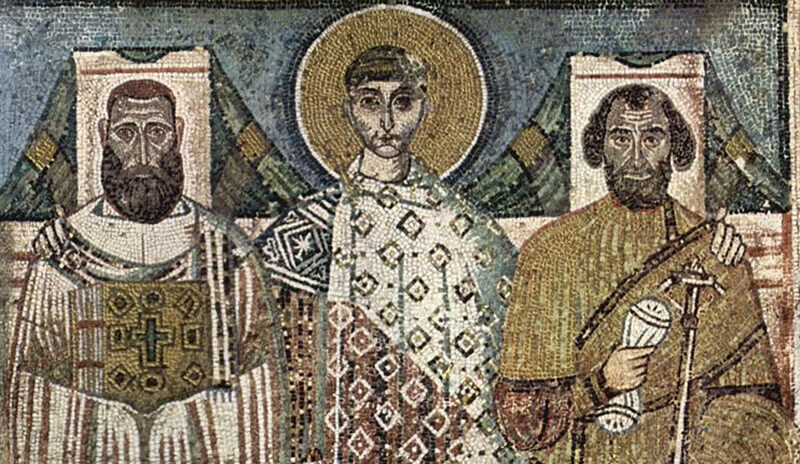
The panel of saint Demetrios and the founders of the church
Across the nave, facing another mosaic of the Virgin and Saint Theodore, stands one of the best-preserved panels in the church. It depicts Saint Demetrios with two ktetors (founders) responsible for the restoration of the church. The saint wears a tablion chlamys and places his arms around their shoulders.
On the left stands a bearded bishop holding a book adorned with a cross. Scholars identify him as John, the Bishop of Thessaloniki, as referenced in some sources. On the right, a secular official is depicted in gold attire, possibly Eparch Leo, who supervised the church’s reconstruction after 620.
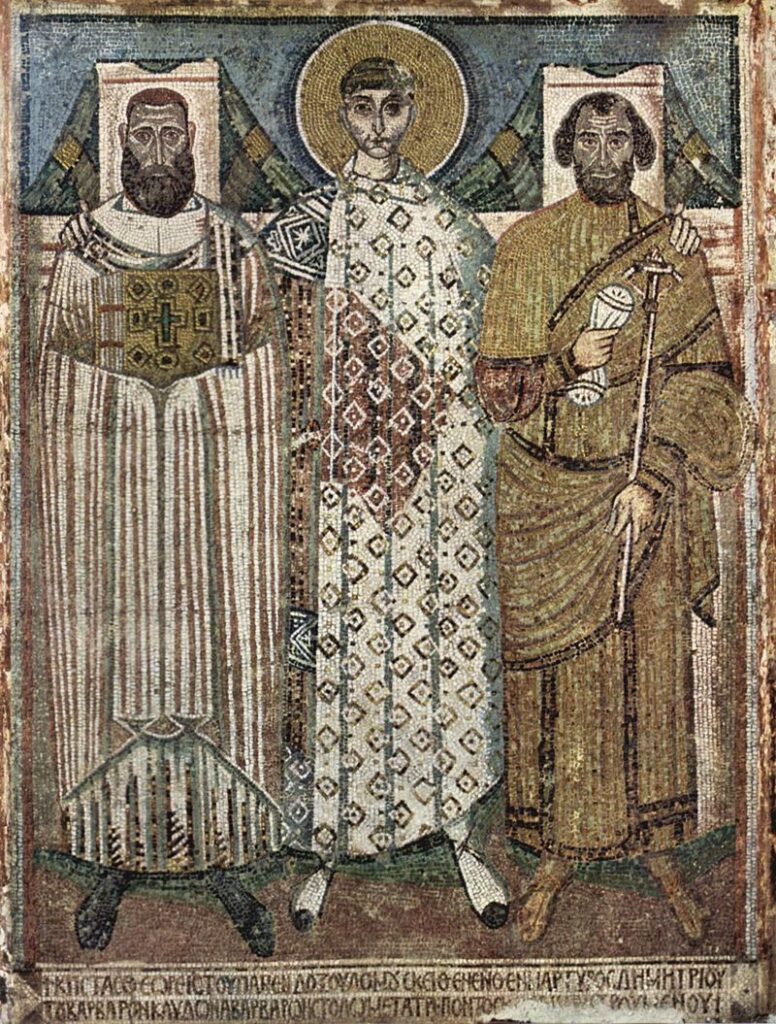
The figures stand on an undulating light-brown ground. Behind them rises a white wall with crenellations, draped with cloth, framing the officials’ heads. This arrangement creates square-like haloes, presumably to indicate that the portraits represented living men.
At the base, a metrical inscription reads: “The founders of this glorious house you behold at both sides of the martyr Demetrios, he who diverted a barbarous flood of barbarian ships and ransomed the city.” This refers to the saint’s supposed intervention in saving Thessalonica from a Slavic raid in c. 615.
Panel of the Virgin and Saint Theodore
This panel occupies the south side of the northeast sanctuary pier, directly opposite the scene of Saint Demetrios with the church’s founders.
The Virgin and Saint Theodore stand upon a rippling, light-brown ground, surmounted by rows of yellow-green tesserae that extend the wall decoration, visually consistent with the adjacent panel. The wall itself is rendered in blue, decorated by a horizontal red band adorned with alternating ovals, and intersected by vertical lines topped with fleur-de-lys motifs.
The figure of the Virgin shows signs of modification; the outline of her earlier right shoulder remains faintly visible. She holds an open scroll inscribed with the words: “Supplication. Lord God, hearken to the voice of my prayer, for I pray for the world.”
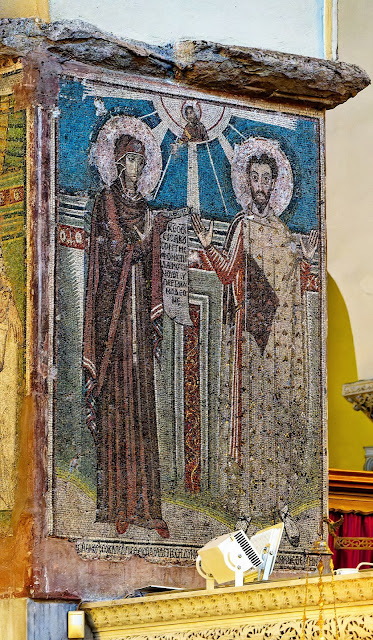
Beside her stands an orant figure, identifiable as Saint Theodore by his beard and facial type. He faces the viewer directly, wearing a tablion chlamys patterned in the same design seen on Demetrios’s garment on the east face of the southeast pier.
Above the two figures, a half-length image of Christ descends from a radiant arc, extending his hand toward the Virgin in response to her prayer. A second inscription, now only partly preserved, runs along the lower edge of the panel: “… discouraged by men, made alive by your strength, in thankfulness I dedicated [this].”
Panel of saint Demetrios and a bearded deacon
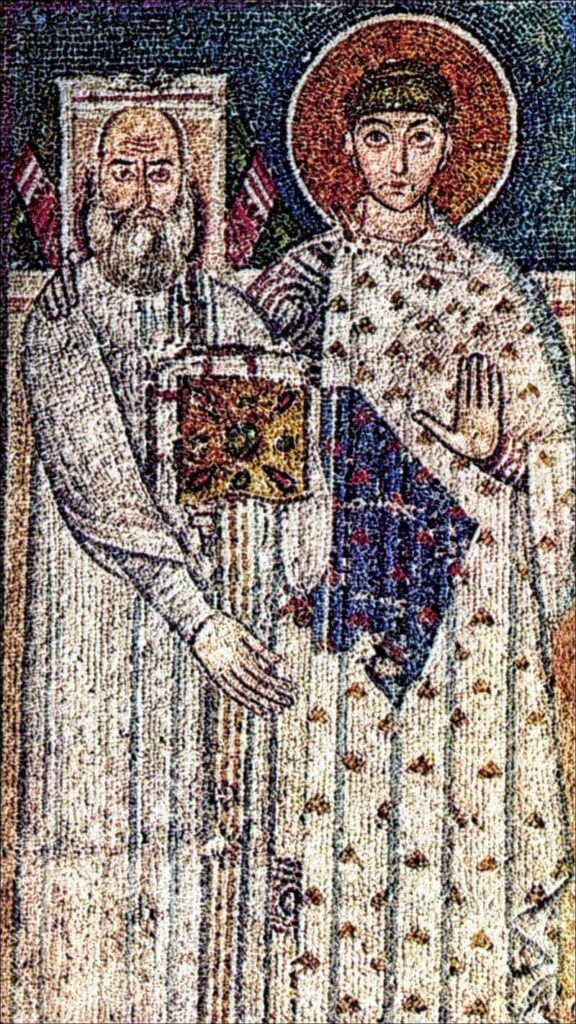
On the east face of the southeast sanctuary pier, in an area not visible from the public areas of the church, a mosaic panel depicts saint Demetrios with his arm around the shoulder of the white-bearded deacon familiar from the tribelon mosaic.
The background details are identical to those on the adjacent north face, the panel of saint Demetrios and the founders of the church.
An inscription also runs beneath the panel, reading: “blessed martyr of Christ, friend of the city, protect both citizens and outsiders”. This invocation could reflect the deacon’s role as liaison between ecclesiastical and civic authority, and his pastoral duties.
Panel of a beardless saint and angels
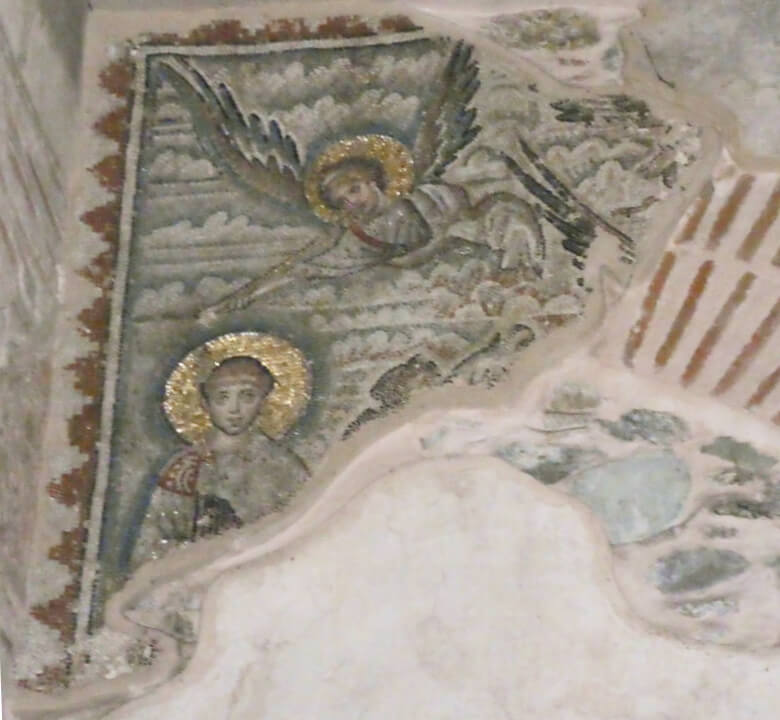
On the west wall, in the inner north aisle, the upper left corner of a panel is visible. Framed with red and white triangles, it still shows the upper torso of a youthful, nimbed saint dressed in a chlamys with a tablion, standing against a sky filled with clouds.
Above the saint, a half-figure of an angel blowing a golden trumpet appears, while the wings of a second angel can be seen at the right edge of the fragment.
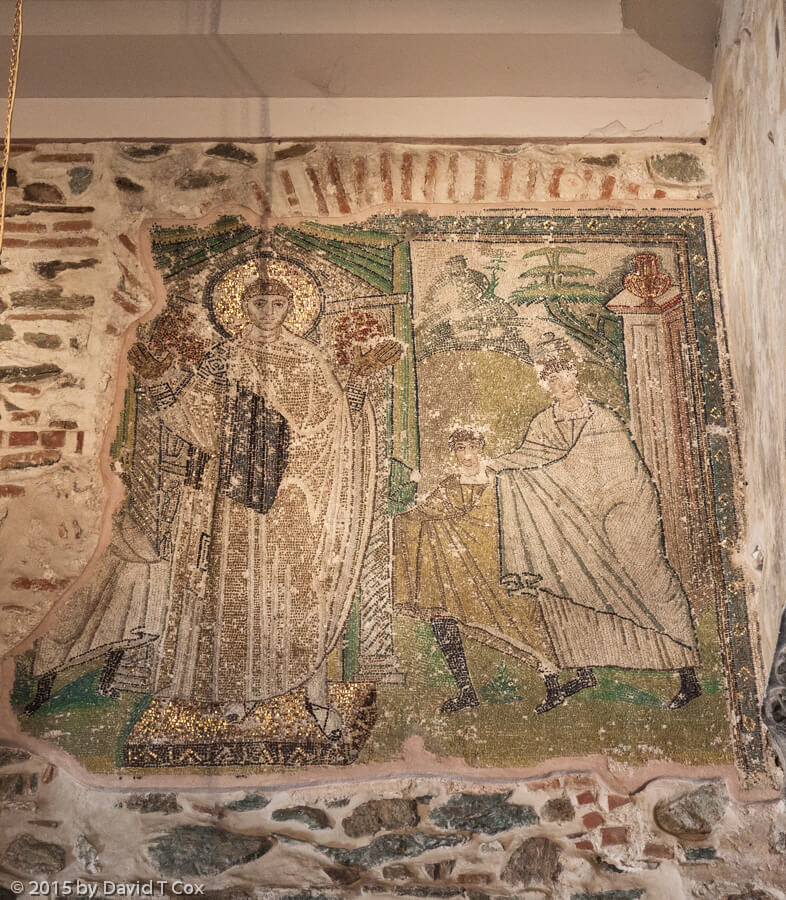
Panel of a beardless saint with two figures
On the west wall in the inner south aisle, the preserved right portion of a panel depicts a nimbed saint, likely Saint Demetrios, in an orant posture with golden hands. He stands before a structure that may represent the silver ciborium, a focal point of his cult in the church.
To the saint’s right, an adult male nudges a youth toward him, both figures extending covered hands in reverence. This gesture is mirrored by a fragmentary figure on the left. The frame features gold lozenges set against a greenish-blue background, bordered by an inner gold rim and an outer white rim.
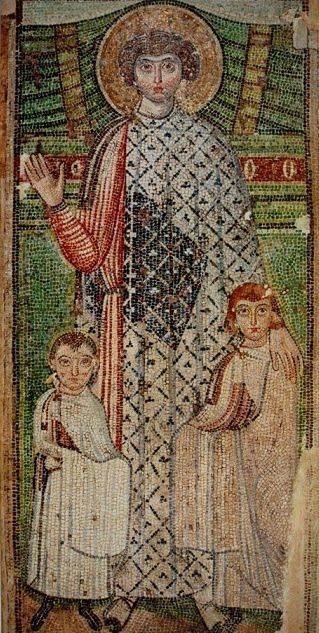
Panel of a saint with two children
On the west face of the northeast sanctuary pier, a mosaic depicts a beardless saint wearing a chlamys with a tablion, decorated with trefoils set within lozenges.
The saint rests his left hand on the shoulder of a small child with covered, raised hands. Below the saint’s right hand, raised in a blessing gesture, stands a shorter child, also with covered and raised hands.
The background is a green surface, possibly representing a wall, with colored bands along the top, including a thick red stripe adorned with alternating ovals and vertical lines. A piece of drapery is visible, and at the top appears what seems to be the roofline of a structure, possibly the ciborium shown in the previous panel.
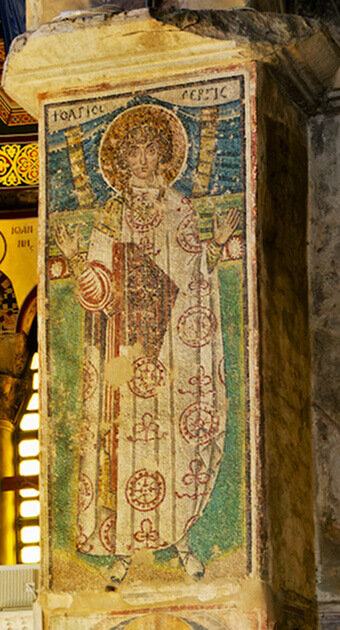
Mosaic panel of Saint Sergios
On the west face of the southeast sanctuary pier, next to a donor portrait, appears a representation of Saint Sergios, identified by an inscription above the figure. He faces the nave and serves as the pendant to the preceding figure on the northeast pier.
The saint stands on undulating ground, with a backdrop wall and a curtain above him—elements identical to those in the pendant panel. However, the fabric of the chlamys he wears differs and resembles that worn by Saint Demetrios on the tribelon panel.
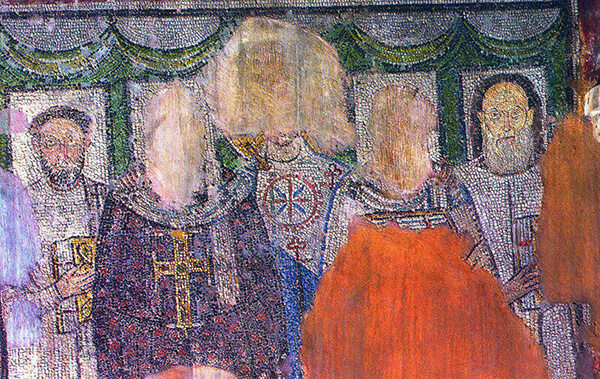
Panel of a saint and four ecclesiastics
A badly damaged panel on the tribelon wall, facing the inner north aisle, shows a nimbed male figure, presumably Saint Demetrios, flanked by four ecclesiastics—two on each side—standing before a curtain. Demetrios has his arms around the shoulders of the two nearest figures, both dressed as bishops. The remaining two figures appear to be a priest on the right and a deacon on the left. This character reappears on the east face of the southeast sanctuary pier and in a medallion set within the inner north arcade sequence.
The faces of the central figures have been removed, but enough remains to confirm that Demetrios had a circular nimbus, while the others had square halos.
Demetrios’ chlamys is adorned with a star-filled medallion and trilobes with basal ribbons, echoing variants of the fabric design worn by Saint Sergios on the southeast sanctuary pier.
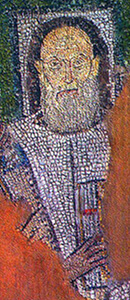
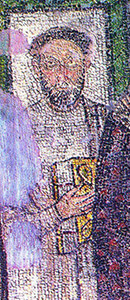
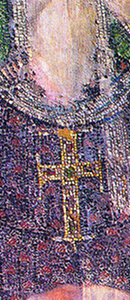
Mosaic fragment of the basilica of Saint Demetrios transferred to the Museum of Byzantine Culture
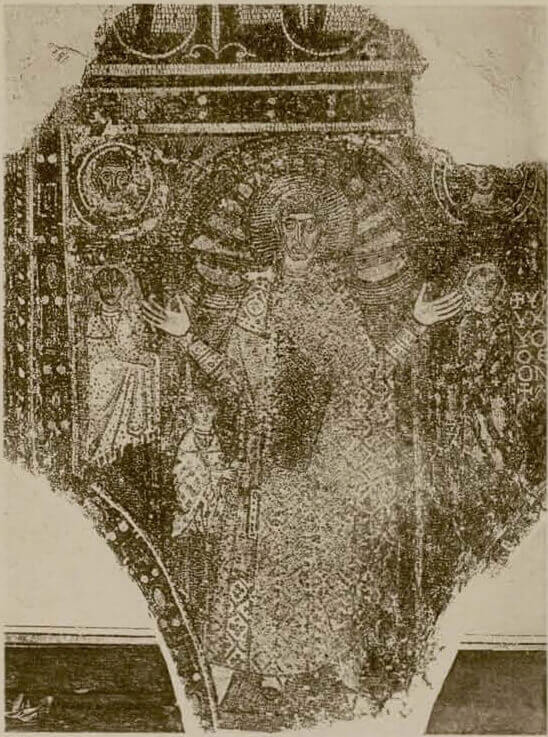
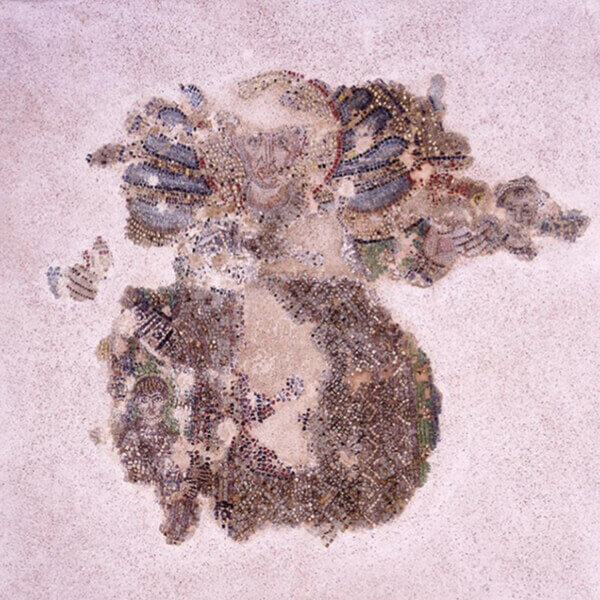
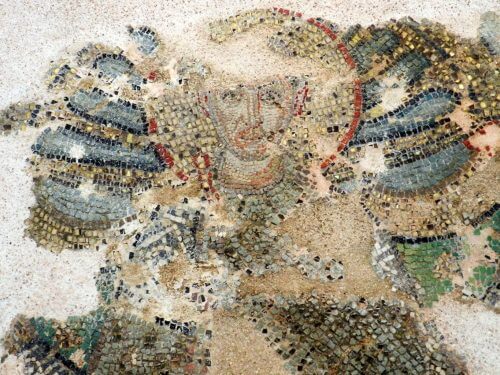
Detail of the fragment, showing Saint Demetrios in front of a golden niche or a ciborium decorated with a blue shell. 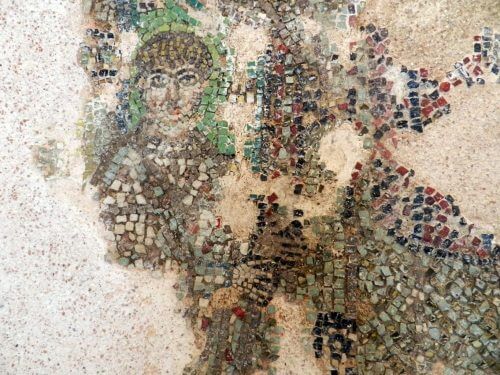
Detail of the mosaic fragment showing the child on the right of the saint, with a green halo around his head.
Lost mosaics of Saint Demetrios documented before their destruction in 1917
Panel of the Virgin between two angels with saints, donors and medallions
This panel is documented through two watercolours by different artists (Walter S. George and Konstantinos Maleas) and a photograph showing a detail of the mosaic. The scene depicted the Virgin enthroned, holding the Child on her knees and flanked by two angels. Next to the left angel stood a saint acting as intercessor for a kneeling donor, while beside the right angel another saint was shown in an orant pose. The composition was framed on the left by two medallions of saints and on the right by three medallions, with an additional donor figure represented in the lower right corner.
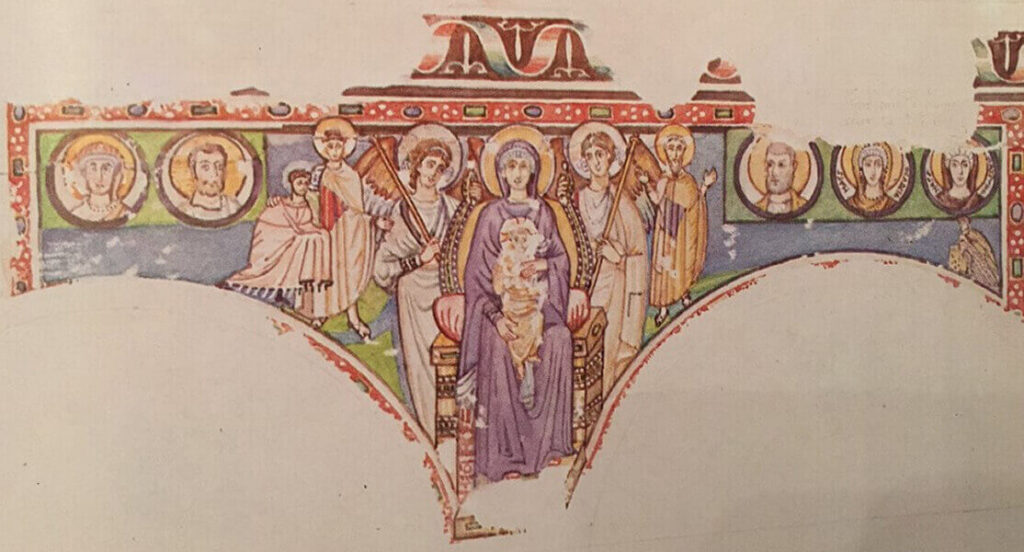 Watercolor of Walter S. George, 1907
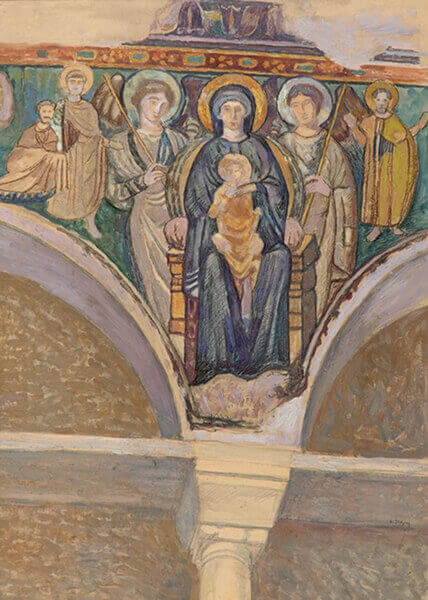 Watercolor by Konstantinos Maleas
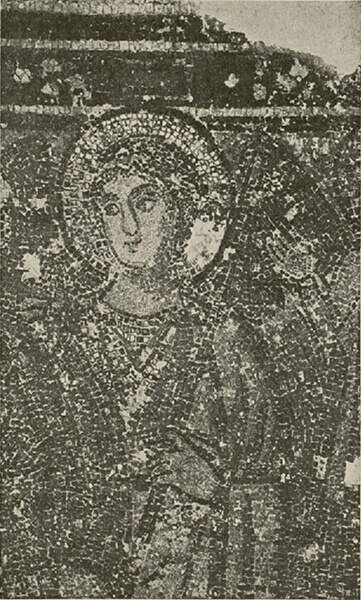 Picture of the right angel
Panel showing the Virgin with angels or saints presenting children
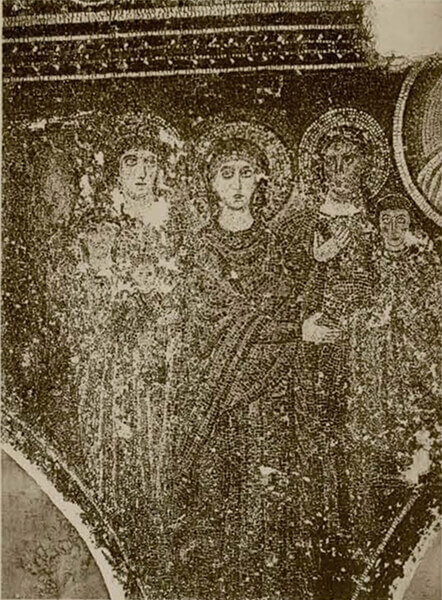
Panel with medallions between two angels with Saint Demetrios and two prelates, inscriptions and donors
The panel above the arch features three medallions. The central medallion depicts Saint Demetrios, while those on either side portray two prelates. Below runs an inscription, and on one side, a partially visible figure of a saint holding a child can be seen.
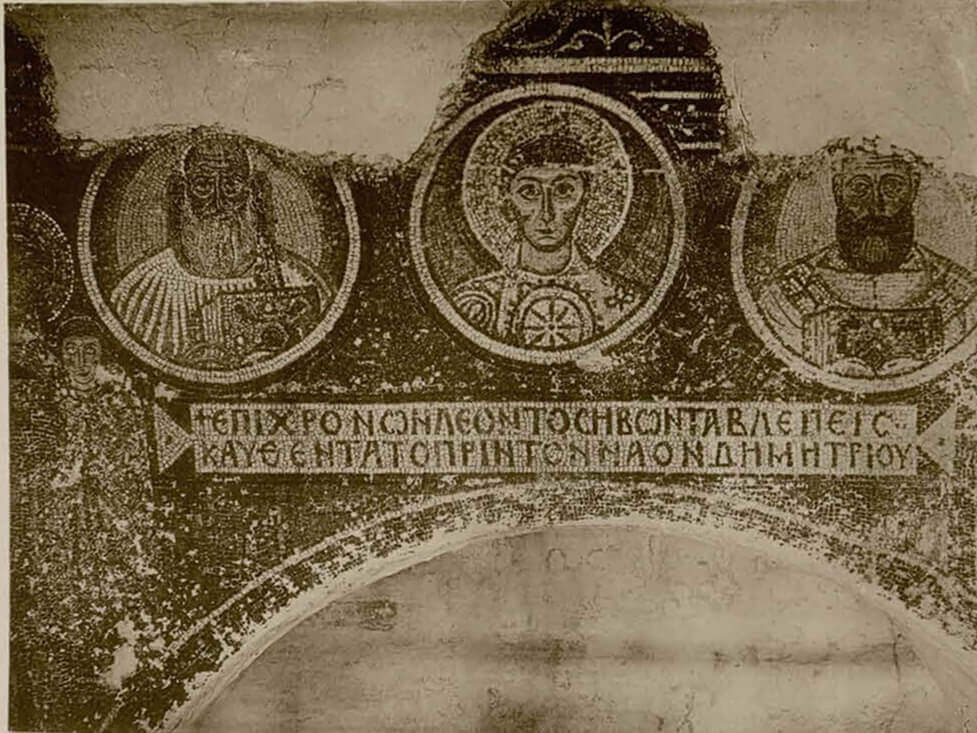 Lost mosaic showing medallions of Saint Demetrios flanked by two prelates above an inscription.
How to see the mosaics of Hagios Demetrios today
The surviving mosaics are split between two places in Thessaloniki: most remain in the church itself, while the fragments rescued after the 1917 fire are displayed in the Museum of Byzantine Culture.
In the church of Hagios Demetrios
The nine panels that escaped the fire are still in their original setting, on the two large piers flanking the sanctuary and on the west wall of the nave. The basilica stands in the center of the city at 97 Agiou Dimitriou Street, a short walk uphill from the ancient Agora. It remains an active Greek Orthodox church, so entry is free, but visitors are asked to dress respectfully and to be discreet during services. Aim for daytime hours and try to avoid liturgy times if you want to study the mosaics closely; opening hours shift with the church calendar, so it is worth checking locally before you go.
While you are there, do not miss the crypt beneath the sanctuary — the site traditionally identified as the place of the saint’s martyrdom. It now houses a small exhibition of sculpture, capitals and architectural fragments from the early basilica, and usually keeps shorter, separate hours from the main church (typically mornings on weekdays).
In the Museum of Byzantine Culture
The mosaic panels that were detached from the north inner aisle and salvaged from the rubble after the Great Fire are now conserved and displayed in the Museum of Byzantine Culture, at 2 Stratou Avenue, near the White Tower and the Archaeological Museum. Among them is the well-known fragment showing Saint Demetrios with his hands raised in prayer beside a richly dressed child — a rare chance to see one of these early Byzantine donor mosaics up close, at eye level, rather than high on a pier. The museum charges an admission fee and is open most days (with longer hours in summer); confirm the current timetable on the museum’s website before visiting.
Seen together, the two sites tell the full story: the church preserves the mosaics in the space they were made for, while the museum safeguards the fragments that survived the building’s near-destruction.
Explore more Byzantine monuments of Thessaloniki
-
The most beautiful Byzantine Mosaics you can still see today: A visual journey from Ravenna to Constantinople
From Ravenna to Istanbul and Thessaloniki — the most beautiful Byzantine mosaics surviving today, where to see them, and the stories behind the gold.
-
The Rotunda of Thessaloniki: From Roman Mausoleum to one of the world’s oldest churches
The Rotunda of Thessaloniki, built by Emperor Galerius around 300 CE, is one of the world’s oldest churches — famed for its early Byzantine dome mosaics. History, mosaics and visiting info.
-
Byzantine Thessaloniki: A Complete Visitor’s Guide to the UNESCO Monuments
Thessaloniki preserves 15 UNESCO-listed Byzantine monuments — from the mosaic-covered Rotunda to the hilltop churches of Ano Poli. A complete guide to visiting Byzantine Thessaloniki.

FAQ
How old are the mosaics of Hagios Demetrios?
Most date to the 7th century (roughly the 620s to the start of Byzantine Iconoclasm in 730), after the basilica was rebuilt following the fire of c.620. A few panels may be earlier, 5th–6th century.
Why were so many of the mosaics lost?
When the church became the Kasimiye mosque in 1493 the Christian images were covered with plaster. Much of what remained was destroyed when the Great Fire of 1917 gutted the church; only part survived.
How many mosaics survive?
About nine panels survive in place — on the two large sanctuary piers and the west wall of the nave — plus detached fragments now in the Museum of Byzantine Culture in Thessaloniki.
What do the mosaics show?
They are votive (ex-voto) portraits, not narrative scenes: Saint Demetrios standing with bishops, civic officials, donors and children who commissioned the panels in thanks for the saint’s protection.
Why does Saint Demetrios appear with a square halo in some panels?
A square (rather than round) nimbus indicated that the person shown was still alive when the mosaic was made — a convention used here for the living donors and officials.
Where is the church of Hagios Demetrios?
In the centre of Thessaloniki, Greece. The basilica is part of the Paleochristian and Byzantine Monuments of Thessaloniki, a UNESCO World Heritage Site since 1988.
Can you see the mosaics today?
Yes. Hagios Demetrios is an active church open to visitors, and its crypt houses a small museum with related sculpture and mosaic fragments.
What makes these mosaics so important?
They are among the few figural mosaics to survive from before Byzantine Iconoclasm and form the richest known collection of early Byzantine donor portraits.
Sources and further reading
- UNESCO World Heritage listing.
- Les Monuments chrétiens de Salonique. Texte by Diehl, Charles (1859-1944) – National Institute for Art History, France – Public Domain.
- Leslie Brubaker, “Elites and patronage in early Byzantium: the evidence from Hagios Demetrios”