Discovery of a Byzantine gold treasure in Hippos, Israel
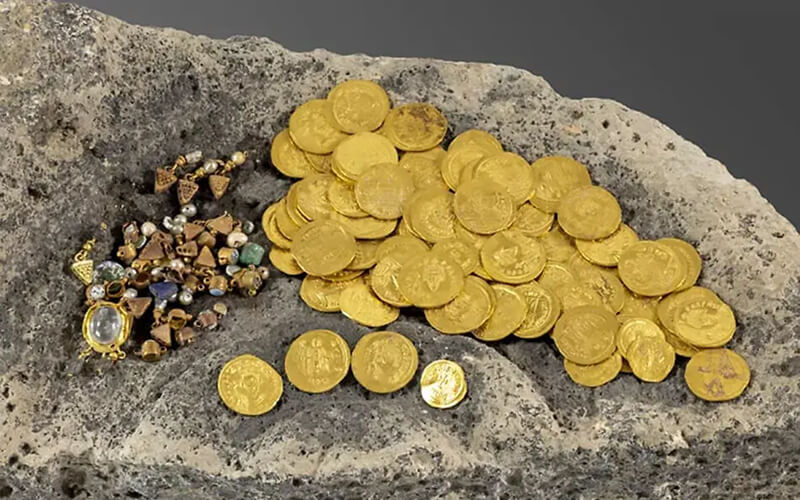
The University of Haifa announced on September 25, 2025, the discovery of a treasure of 97 pure gold coins from the 6th and 7th centuries CE in the ancient city of Hippos (Sussita), near the Sea of Galilee, on the slopes of the Golan Heights. This remarkable find offers new insight into life in the city during the final years of the Byzantine Christian era. The hoard was likely hidden during the Sasanian invasion of the Land of Israel in 614 CE, only a few years before the Islamic conquest permanently transformed the region.
One of the largest Byzantine treasures found in Israel.
The treasure – probably hidden by a wealthy resident, perhaps a goldsmith, during the Sasanian advance – remained untouched for nearly 1,400 years. It was discovered by chance in July in an area that had been excavated about six years earlier but was not the main focus of current work. Edie Lipsman, a metal detector operator, was walking between excavation areas when he accidentally struck a stone and his detector suddenly began to beep. The stone was lodged between two basalt walls, within a burnt layer that had recently collapsed after winter rains. As the soil was cleared, gold coins began to emerge.
“This is one of the largest Byzantine-period treasures ever discovered on land in Israel. Its uniqueness lies in the combination of jewelry and gold coins from the reigns of different emperors. Gold is a noble metal. When you find coins and jewelry almost 1,400 years old that look new, it is a rare experience.”
Dr. Eisenberg, co-director of the Hippos-Sussita excavation, from the Zinman Institute of Archaeology and the Department of Archaeology at the University of Haifa.
Rare gold coins and jewelry.
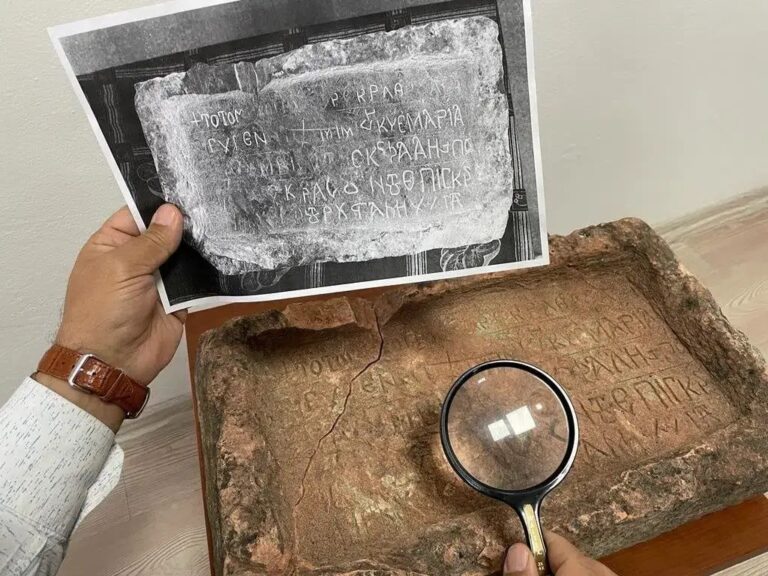
The hoard contains 97 pure gold coins along with dozens of pieces of jewelry. These include earrings inlaid with glass, pearls, and semi-precious stones. Their variety suggests that the owner may have been a jeweler. An inscription dated to 556 CE, found in the Martyrion Church of Theodoros at Hippos, even mentions a goldsmith named Symeonios as a donor.
The coins represent different denominations: solidi (full-value coins weighing 4.45 grams), semisses (half a solidus), and tremisses (a third of a solidus). Gold coins are rarely found in Israel, and one of the specimens in the hoard is only the second of its type ever discovered in the country. Struck in 610 CE at a military mint—sometimes a mobile one—in Cyprus, it offers a rare glimpse into the turbulent years of the early 7th century.
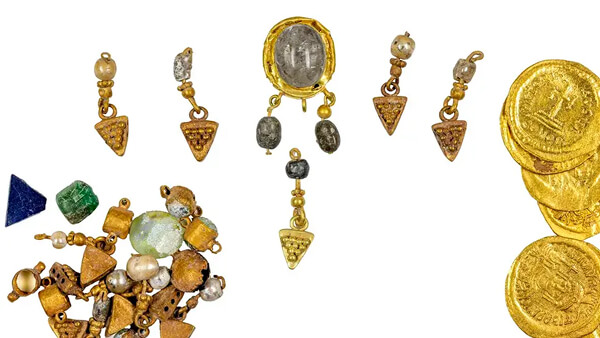 Fragments of jewelry found in the treasure.
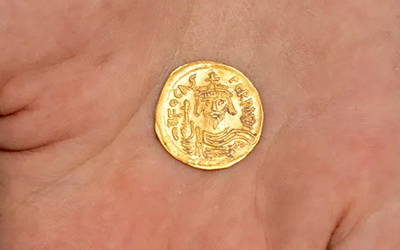 Gold coin of Emperor Phocas (602-610), one of the 97 coins found.
“This is a pure Byzantine treasure. Coins can be dated with precision. Those in this hoard range from Emperor Justin I (518–527) to the early reign of Emperor Heraclius (610–613), which helps explain why it was hidden.”
Dr. Eisenberg.
Indeed, archaeologists believe the hoard was buried during the turbulent years preceding the Sasanian-Persian conquest of 614 CE. The Byzantines briefly regained control about fifteen years later – only briefly, since the region would soon fall to the Arabs.
Hippos: A Byzantine city on the Sea of Galilee.
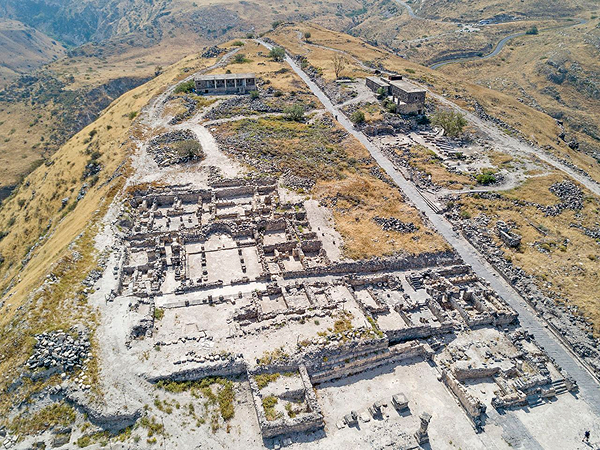
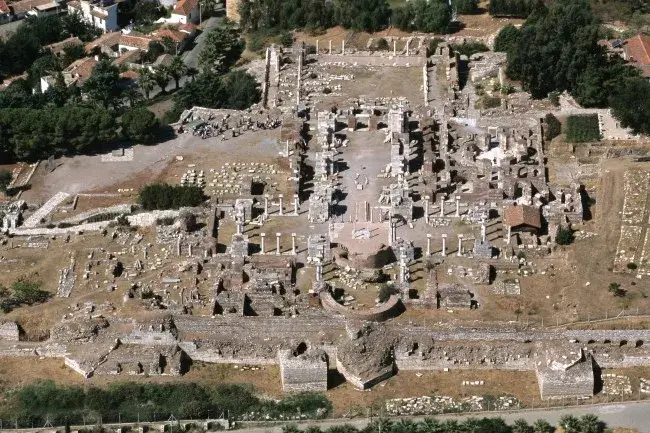
Antiochia Hippos, known as Sussita in Aramaic, lies about two kilometers east of the Sea of Galilee at an elevation of 350 meters. It was founded during Antiquity by the Seleucid kings in the 2nd century BCE. During the Byzantine period (330–636 CE), Hippos became an important Christian city. It had at least seven functioning churches and survived into the early Arab period. However, the city was devastated by a major earthquake in 749 CE and permanently abandoned.
Excavations at Hippos have been directed by Eisenberg for 26 years. They have revealed the remains of seven churches built between the 5th and early 6th centuries CE, all still in use during the 7th century.
The discovery sheds light on the dramatic events of the early 7th century, when both the Byzantine Empire and the city of Hippos were at a turning point. Engaged in a devastating war against the Sassanids, the Byzantines also experienced internal turmoil, as General Heraclius and his son rebelled against Emperor Phocas (602–610). They minted their own coins while marching toward Constantinople—some of which, found in the hoard, are considered rare.
The discovery also challenges assumptions about Hippos’ decline in the late Byzantine period. Earlier excavations had revealed less impressive buildings compared to previous eras, leading archaeologists to suggest reduced wealth and a simpler lifestyle. Yet the treasure demonstrates that some inhabitants remained wealthy and that the city was still prosperous enough to sustain them.
Sasanian conquest and the end of Hippos.
Archaeological evidence shows that the Martyrion Church of Theodoros was burned during the Sasanian invasion of 614, earning it the nickname “the Burnt Church.” Some scholars suggest that it may not have been destroyed by the Sasanians themselves but by Jews from Tiberias who allied with the invaders. It was likely in this troubled context that the hoard was hidden.
The Byzantines regained Hippos around 629, but the treasure’s owner never returned to claim it. In 636, the city fell once more, this time to the Arab conquest. The new rulers shifted the regional administrative center to Tiberias, and Hippos entered a long decline. Its final destruction came with the devastating earthquake of 749 CE, after which the city was permanently abandoned.
“Strong communities were rebuilt after the earthquake, but weaker ones were abandoned. For Hippos, the quake was the final blow.”
Dr. Eisenberg.
The treasure of Hippos offers an extraordinary glimpse into Byzantine life at the moment of crisis, between Sasanian and Islamic conquests. Its coins and jewelry reveal not only wealth but also resilience and uncertainty in a city at the edge of empires.