
Jews in the Byzantine Empire: Between tolerance and persecution
Byzantine sources refer to Jews (Ioudaioi, Evraioi) and sometimes Israelites to designate both the ancient peoples of Judah and Israel, as well as the Byzantine citizens who practiced Judaism. The Jews formed an important minority within the Byzantine Empire. Until the 7th century, the Byzantines exercised direct control over territories with significant Jewish populations, while Jewish communities were also widespread in many urban centers across the empire.
As one of the few tolerated religious minorities, the Jews lived under a policy that alternated between relative tolerance, hostility, and outright persecution. Despite facing legal and social restrictions, Jewish communities exerted a notable economic and cultural influence within Byzantine society — an influence that remains poorly documented.
Reconstructing the history of the Jews in Byzantium is particularly difficult for certain periods, such as the age of Justinian, due to the scarcity of securely datable written sources, especially those produced by Jews themselves. The absence of records revealing the inner life, mindsets, and challenges of Byzantine Jewish communities means that most of what is known derives from non-Jewish, and often antagonistic, sources.
The Jews in Byzantine Palestine.
Organisation in the Roman Empire.
After the destruction of Jerusalem in 70 CE, Jewish life reorganized around new centers in Galilee — particularly Usha, Sepphoris, and Tiberias – where communities flourished until the 7th century. Their administration was led by a scholarly hierarchy headed by the nasi (Greek: patriarch of the Jews), who acted as the symbolic and legal representative of the Jewish people within the empire.
From Toleration to Restriction under Christian Rule
Before Christianity became dominant, Judaism held the legal status of a “permitted religion.” This situation started to change after Emperor Constantine (306–337) established Christianity as the imperial faith. Religious freedom for non-Christians steadily declined, and the condition of Jewish communities – both in Palestine and throughout the Diaspora – deteriorated, despite occasional revolts, notably in 351.
During his short reign, Emperor Julian (361–363) attempted to restore Jewish religious rights and even authorized the reconstruction of the Temple in Jerusalem, though the project failed.
Yet, under other Christian emperors, some degree of tolerance persisted. The Theodosian Code of 393 stated that “the sect of the Jews is prohibited by no laws.” Although not formally recognized as a religio licita, Judaism retained several protections under the Edict of Toleration. Jews could build synagogues, observe the Sabbath and festivals, and practice their faith openly. They were exempted from military service to avoid Sabbath or dietary violations. They were excused from sacrificing to the gods, and only had to pray for the welfare of the Emperor and the Empire. They could own, buy and sell slaves, conduct business or any type of commerce, own slaves, or hold minor offices. In many cases, Jewish legal disputes were resolved according to their own laws and oaths.
Theodosian and Justinianic Legislation against the Jews
Over time, however, Christian-Roman imperial legislation increasingly curtailed Jewish freedoms. Emperor Theodosius II (r. 408–450) introduced discriminatory measures that limited their rights. In 423, he prohibited the construction or enlargement of synagogues. In 429, he declared the office of nasi vacant, effectively abolishing centralized Jewish leadership in the empire and redirecting the taxes affected to this office to the imperial treasure.
These restrictions intensified under Emperor Justinian I (r. 527–565). His codification of Roman law — the Codex Justinianus (529, revised 534), the Digest (533), and the Novellae (new laws) – contained numerous provisions concerning Jews. Thirty-three laws in the Codex and additional ones in the Digest and Novellae targeted Jewish civic, economic, and religious rights. Modern scholars have often emphazised the negative trend of this legislation, where Justinian even interferes in religious matters.
Novel 146 forbade the reading of the Torah in Hebrew and banned the Mishnah (the core of Jewish oral law). These laws remained in force until the 9th century and were later summarized in the Ecloga (8th century legal code) and the Basilika (9th-century revision of Byzantine law). Their purpose was clear: to limit Jewish participation in civic life, isolate them from Christians, and promote the theological idea that God had rejected the Jewish people.
Politically, these measures also reflected Justinian’s desire to make the Empire more homogeneous. While religious diversity had long been tolerated in practice, Justinian sought to unify the population under a single orthodoxy. Even so, the emperors’ main preoccupation remained the internal strife within Christianity itself — Nestorianism, Monophysitism, and other doctrinal disputes that divided the Church. On a more practical level, Justinian also ended the autonomous Jewish rule of Jotaba around 535, further consolidating imperial control.
The Holy Land as the “New Israel”.
Imperial policy in Palestine during the early Byzantine period mirrored these restrictions and reinforced the Church’s claim to be the “New Israel.” Churches and monasteries were erected on biblical holy sites, while Hadrian’s ancient ban on Jewish settlement in Jerusalem and its surroundings was periodically enforced.
Even during the Muslim conquest, Patriarch Sophronius of Jerusalem (d. 638) maintained that Jews had no right to reside in the city. They were, however, permitted to mourn once a year on the 9th of Av at the ruins of the Temple—then used as the city’s refuse dump—as a symbolic reminder of the divine rejection of the “Old Israel.”
Cultural resistance and religious disputes.
Few sources reveal how Jewish communities perceived these mounting restrictions. The Galilee and coastal regions remained difficult for imperial authorities to control and saw repeated revolts. The major uprising of 351 was followed by others throughout the 5th and 6th centuries.
Under rabbinic leadership, Jews sought to preserve their identity by erecting and maintaining social and religious boundaries. Internal disputes also arose, particularly over synagogue practice. Novel 146, in fact, originated from Jewish petitions asking Justinian to arbitrate a dispute over whether the Torah should be read in Hebrew or in Greek, the common language of the empire, since many members of the congregations were not sufficiently familiar with Hebrew.
Archaeological evidence shows, however, that restrictive laws were not always enforced. Synagogues continued to be built or expanded after 423, and communities maintained active religious and social lives. The extent to which Novel 146 was implemented remains uncertain – in some cases, it may have been ignored entirely. To avoid imperial punishment, some synagogue rituals were likely modified, though the core of Jewish worship survived. A later teshuva (rabbinic response) by Rav Yehudai Gaon of Sura in the 8th century described the oppressive climate under Justinian:
“They had issued a decree of shemad against the Jews of Eretz Yisrael, forbidding them to read the Shema and even to pray; but they were allowed to congregate on the Sabbath morning for the purpose of ‘reciting poetry and hymns’; they would insert portions of the Scriptures, the Kiddush, and the Shema secretly.”
Jewish political resistance and the Persian wars
Jewish communities did not limit themselves to passive resistance. They took part in several revolts and at times sided with foreign powers against Byzantine rule. The most significant uprising occurred in 351, but Jews also supported the Vandals and Ostrogoths during Justinian’s Western campaigns, joined the Nika revolt in Constantinople in 532, participated in the riots of 580, and rebelled again in 556 and 578, often alongside the Samaritans.
During the Byzantine–Sassanian Wars (602–628), many Jews allied with the Persians, viewing them as liberators from Byzantine oppression. A pogrom in Antioch in 608 sparked a Jewish revolt in 610, and both Tyre and Acre also rebelled that same year. Jewish forces assisted the Persians in their conquest of Palestine between 614 and 617, notably joining the invading army in the capture of Jerusalem in 614 under the leadership of Nehemiah ben Hushiel and Benjamin of Tiberias, the latter using his fortune to recruit and arm many soldiers for the campaign.
When Emperor Heraclius reconquered the region in 630, Benjamin of Tiberias led the Jews of Tiberias and Nazareth to surrender, reportedly receiving the emperor´s promise of protection. Yet, once Heraclius entered Jerusalem, he ordered the expulsion of Jews from the city and forbade them to live within three miles of it. A massacre followed, devastating Jewish communities in Galilee and Jerusalem. Later traditions accuse Heraclius of breaking his oath, and to this day, the Coptic Church observes a fast to atone for his actions.
The Islamic conquests of the 7th century transformed the Jewish presence in the Byzantine world. The Jewish provinces of antiquity, which had hosted the largest Jewish populations, were definitively lost by 632. Jewish life within the empire became confined to the Diaspora.
The Jewish Diaspora in the Byzantine Empire.
Jewish Communities across the Byzantine world.
Outside their ancestral territories, Jewish communities flourished across the Byzantine Empire – from major administrative and commercial hubs to smaller provincial towns. Jewish quarters, often called Hebraike, were typically located near markets and sources of running water.
Many of these communities had ancient roots, established as early as the Hellenistic period. They existed in places such as Beroia in Macedonia, Patras in the Peloponnese, Thessaloniki, and Crete. In southern Italy, Jewish settlements are attested in Bari, Oria, Siponto, Venosa, and Otranto. Other important centers included Ioannina, Ohrid, Kastoria, Adrianople, Serres, Mystras, Nicaea, Attaleia, Ephesus, and Philadelphia.
After the persecutions under Emperor Heraclius, only a few Byzantine emperors directly coerced Jewish populations for almost eight centuries. However, written sources on the topic are often scarce, leaving historians to reconstruct this formative phase largely through speculation.
Early Imperial Persecutions and Forced Conversions
The generally tolerant Byzantine attitude toward Jews was punctuated by three major episodes of forced conversion during the Middle Byzantine period and two during the Late Byzantine period.
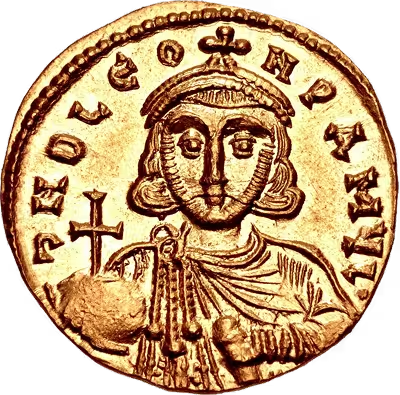
The first occurred under Emperor Leo III the Isaurian (r. 717–741). According to the Chronicle of Theophanes, in 721–722 he ordered the mass baptism of all Jews and Montanists – a Christian heretic sect originating in Phrygia in the 2nd century. Theophanes reports that most Jews refused baptism or renounced the faith soon after accepting it.
The second episode came during the reign of Basil I (r. 867–886), who decreed the mass conversion of all Jews in 873. Both Jewish chronicler Ahimaaz ben Paltiel and Byzantine historians Theophanes Continuatus and Symeon Logothetes recount this persecution. According to the latter, Basil personally oversaw the successful campaign, treating converts with kindness and offering gifts to those who accepted baptism.
Between tolerance and pragmatism.
Outside these episodes, Byzantium generally displayed a pragmatic tolerance toward its Jewish subjects. This was probably partly due to the Roman legacy of behaviour towards Jewish, but also to the Byzantine Church’s traditional opposition to coerced baptism.
Emperor Michael II (r. 820–829), from a family of peasant-soldiers, may have had Jewish ancestry or links to the Judaizing sect of the Athinganoi. This did not prevent his rise to the imperial throne, illustrating the fluid nature of social mobility in certain periods of Byzantine history.
The Fourth Crusade and the fall of Constantinople in 1204 proved catastrophic for both Jews and Orthodox Christians, but the Byzantine reconquest of Constantinople in 1261 under the Palaiologoi dynasty improved conditions for Jewish communities. Yet, in the empire’s successor states, anti-Jewish sentiment occasionally resurfaced. On the Hebrew side, only a letter from Jacob ben Elia to Pablo Christiani can shed light on this period.
Jewish persecution in Epirus and Nicaea.
In 1229, Theodore Komnenos Doukas, ruler of the Despotate of Epirus, initiated persecution against the Jews in his territories. Although poorly documented, Hebrew sources describe the personal hostility of the Despot towards the Jews approaching him, and violent expropriations of Jewish property rather than bans on religious practice. The persecution likely focused on Thessaloniki, which Theodore had conquered in 1224.
Some historians suggest that these measures were financially motivated, intended to fund Theodore’s planned campaign against the Empire of Nicaea after his coronation as Emperor in 1224. His defeat at the Battle of Klokotnitsa in 1230 effectively ended or reduced these anti-Jewish policies, particularly as Macedonia and Thrace soon fell to the Bulgarians.
The Jews were also persecuted in the Empire of Nicaea, but took another form. Emperor John III Doukas Vatatzes (r. 1222–1254) ordered the forced conversion of Jews late in his reign, in line with the traditional anti-jewish measures of some of his predecessors. He issued this decree in 1254, during the final months of his illness causing many sufferings, shortly before his death in his palace of Nymphaion. No confiscations were recorded, suggesting that religious motives were the true motivation. It remains uncertain how widely the policy was enforced or if it continued under his son, Theodore II Laskaris (r. 1254–1258).
The Palaiologoi and renewed tolerance.
When Michael VIII Palaiologos came to power in 1259, he likely reversed these measures, reestablishing a more tolerant policy toward Jews. The few surviving sources mention that Michael invited Jewish leaders to support his claim to the throne, revoking John Vatatzes’s decree of forced baptism.
This conciliatory attitude drew criticism from parts of Byzantine society, especially the clergy. The Patriarch of Alexandria condemned both Michael VIII and his son Andronikos II for their “excessive tolerance toward the Jews,” likely referring to the lack of segregation laws and the coexistence of Jews and Christians in urban areas.
The Late Byzantine Period and Venetian Influence.
By the 14th century, imperial power had greatly weakened, and emperors increasingly relied on foreign allies. The Palaiologoi granted Venetians and Genoese extensive privileges, including the right to reside and trade freely. Some Byzantine Jews acquired Venetian or Genoese citizenship, gaining better taxation conditions and commercial opportunities.
In Constantinople, many Jews lived in or near the Venetian quarters, benefiting from their extraterritorial rights. By the time of the fall of Constantinople in 1453, many Jews in the city likely enjoyed broader privileges than many of their Christian neighbors.
Jewish life and integration in Byzantine Society.
Population and economic integration in the Byzantine Empire.
Jewish communities thrived throughout the Byzantine Empire, both in major cities and in smaller towns. Their quarters, known as the Hebraike, were usually located near markets and sources of running water.
In the 12th century, the rabbi and traveler Benjamin of Tudela from Navarre visited around twenty-five Byzantine Jewish communities. He described settlements in Patras, Krissa, Thebes, Corinth, Chalkis, Armyro, Drama, Kallipolis, Constantinople, and on the islands of Lesbos, Chios, Samos, and Rhode.
Jews were economically integrated into their surroundings. They worked in industry, trade, and crafts – especially in silk production, both in Constantinople and in Thebes, in Boeotia, an important regional production center. They were also dyers, wool weavers, tanners, furriers, smiths, glassmakers, merchants (local and international), real estate agents, physicians, translators, scribes, and agriculturalists.
Constantinople was a major center for Jewish, Samaritan, and Karaite life and learning. Jewish residents lived along the Golden Horn (notably in Hebraike Skala and Pera) and in the quarters of Chalkoprateia and Vlanga. By the time of Benjamin of Tudela, Jews were restricted to the Pera district but were, according to his account, generally treated with respect. Many were wealthy; one even served as the emperor’s personal physician. Benjamin estimated around 2,500 Jews in Constantinople.
Based on the data provided by Benjamin, scholars estimate that the Byzantine Jewish population in the 12th century ranged between 12,000 and 100,000, depending on how Benjamin’s numbers are interpreted – whether they referred to individuals, households, or guild members – and considering communities he did not mention.
Organisation of the Byzantine Jewish communities.
Jewish communities were led by rabbis approved by imperial authorities, who acted as both religious heads and judges, with a large degree of autonomy. Larger communities had officials such as teachers, ritual slaughterers, and charity overseers, supported by communal taxes. These funds financed schools, care for the sick, dowries for orphans, and burial in Jewish graveyard, etc.
A portion of communal revenues was paid to the government, though it remains unclear whether a specific Jewish tax existed. The aurum coronarium, a former tax redirected to the imperial treasury after 429, may have replaced earlier payments to the nasi in Palestine. Jewish academies in the 10th and 11th centuries continued to receive contributions from Byzantine Jews, who had also supported the archipherekitai of the Sanhedrin in Palestine until the Muslim conquest.
Jewish – Byzantine Relations.
The Jewish attitude toward Byzantium was complex. In many Greek-speaking regions, Jewish communities predated Christianity, but the triumph of the new faith surrounded them with a predominantly Christian society whose theology and liturgy drew heavily from Jewish roots.
Jews faced anti-Jewish imperial policies, ecclesiastical hostility, and cultural prejudice. Byzantine art often portrayed Jews negatively, as among the damned in Last Judgment scenes. Nevertheless, intellectual exchange persisted: some Christian scholars, such as Plethon, studied privately with Jewish teachers, while Jewish scholars responded through biblical commentaries and liturgical poetry. However, they were prohibited from openly criticizing Christianity.
Migration and population movements.
Jews migrated regularly into the Byzantine Empire from both Muslim lands and Western Europe. These newcomers quickly assimilated into Byzantine society, though occasional tensions arose with long-established Jewish communities. The empire also maintained contact with Khazaria, whose rulers had adopted Judaism in the 8th century and welcomed Jewish refugees fleeing Byzantine persecution. Later, connections linked Byzantine Jews with the Karaite communities of Crimea, facilitating intellectual and commercial exchanges across the Black Sea.
Some Jewish migration likely continued in the later centuries. We know, for instance, that Emperor Manuel I Komnenos (r. 1143–1180) had a personal physician who was an Egyptian Jew — an exceptional but revealing example that illustrates the enduring mobility and interconnection of Jewish communities across the Eastern Mediterranean. Many Jews were involved in trade, medicine, and finance, professions that naturally encouraged travel and settlement across borders. It is therefore reasonable to assume that both economic opportunities and shifting political conditions in neighboring states fostered continued movement of Jews into and out of the Byzantine Empire.
Intellectual, medical, and religious contributions.
Jewish physicians and scholars.
Jewish physicians enjoyed high reputations in Byzantium. Asaph the Physician, possibly a Byzantine Jew, is sometimes regarded as the earliest known Hebrew medical author. Scholars supporting his historicity consider that he could have been active between the 3rd and 7th centuries in Byzantine Palestine or Mesopotamia, a province in present Syria.
Jewish doctors were trained in both Greek and Arabic medicine and treated all social classes, including the imperial family. An Egyptian Jew even served as personal physician to Emperor Manuel I Komnenos (r. 1143–1180). Despite their skill, Byzantine clergy often distrusted them, and while 9th- and 10th-century hagiographies show some respect toward Jewish doctors, they also expressed suspicion of their learning and faith.
Theological debates and conversions.
The Byzantine Church officially opposed forced baptisms for theological reasons, even though several emperors – Heraclius, Leo III, Basil I, Romanos I Lekapenos, Theodore II of Epirus, and John III Vatatzes of Nicaea – had ordered them. The Church’s stance likely contributed to the general climate of pragmatic tolerance that prevailed for much of Byzantine history.
Interreligious debates between Jews and Christians occasionally occurred, sometimes leading to conversions encouraged by the Church. Notable converts include Constantine the Jew, Makarios (spiritual adviser to Emperor Manuel II), and possibly Romanos the Melodist.
Messianic expectations and the fall of Constantinople.
Jewish responses to persecution often equated imperial power with Esau or Edom, biblical symbols of Israel’s adversary. Messianic hopes for the restoration of an independent Israel resurfaced regularly, especially during crises.
The fall of Constantinople in 1453 inspired both apocalyptic expectation and profound mourning within Jewish communities, expressed in a moving Hebrew laments for the fallen city.
The history of Jews in the Byzantine Empire reflects a complex interplay of tolerance, restriction, and integration. While imperial legislation and occasional persecutions sought to limit Jewish autonomy, many communities thrived economically, culturally, and intellectually. Jews played active roles in trade, crafts, medicine, and scholarship, maintaining connections across the Eastern Mediterranean with Khazaria, Egypt, and the Crimean Karaites. Migration, adaptation, and resilience allowed Jewish communities to navigate the challenges of Byzantine society, leaving a lasting imprint on the empire’s social and cultural fabric.
Sources.
The Oxford Dictionary of Byzantium, Vols. 1–3.
Maas, Michael, ed. The Cambridge Companion to the Age of Justinian. Cambridge: Cambridge University Press, 2005.
Grayzel, Solomon. “The Jews and Roman Law.” The Jewish Quarterly Review 59, no. 2 (October 1968): 93–117.
Brewer, Catherine. “The Status of the Jews in Roman Legislation: The Reign of Justinian 527–565 CE.” European Judaism: A Journal for the New Europe 38, no. 2 (Autumn 2005): 127–139.
Sharf, A. “The Jews, the Montanists, and the Emperor Leo III.” Ramat-Gan.
Prieto Domínguez, Oscar. “The Mass Conversion of Jews Decreed by Emperor Basil I in 873: Its Reflection in Contemporary Legal Codes and Its Underlying Reasons.” In Jews in Early Christian Law: Byzantium and the Latin West, 6th–11th c., edited by J. Tolan, N. de Lange, L. Foschia, and C. Nemo-Pekelman, 283–310. Brepols, 2014.
de Lange, Nicholas. “Jews in the Age of Justinian.” In The Cambridge Companion to the Age of Justinian, edited by Michael Maas, 401–426. Cambridge: Cambridge University Press, 2005.
The Roman (‘Byzantine’) Imperial Policy towards the Jews during the Period 1204–1453. Novo Scriptorium.