
The Raoul (Ralles) family, a noble Byzantine lineage of Norman origin
The Raoul family—known as the Ralles in later Byzantine sources—was a noble Byzantine lineage of Norman origin. Established in the Empire by the 12th century, the family soon became powerful and involved in the imperial power struggles of the Komnenian and Angeloi periods. Their influence endured under the Palaiologan dynasty, when several members served as high-ranking officials, scholars, and diplomats.
Although their political power gradually declined after the fourteenth century – except in the Peloponnese, where they resisted the Ottoman advance – the Raoul family exemplifies how foreign elites could successfully integrate into the Byzantine aristocracy and leave a lasting mark on its political and cultural history.
Origin of the Raoul family.
The Norman origin of the Raoul (Ralles) lineage is well attested, though the details of their establishment in Byzantium remain uncertain. One possible ancestor is Rudolfus Peel de Lan, called Raoul by Anna Komnene in the Alexiad. Rudolfus served as a Norman ambassador to Emperor Nikephoros III Botaneiates (r. 1078–1081) but later defected from Robert Guiscard to Bohemond of Antioch. However, there is no direct evidence that Rudolfus entered Byzantine service.
Another hypothesis, based on Albert of Aachen’s account of a Norman embassy sent in 1080, suggests that Raoul was the brother of Roger, “son of Dagobert”. After the defection of Roger to the Byzantines, Raoul may also have sought refuge at the imperial court – though modern scholars view this theory as even less credible.
Rise to the Byzantine elite.
Evidence for the Raoul family in the 12th century is limited, but its members already belonged to the imperial aristocracy and owned extensive estates in Thrace.
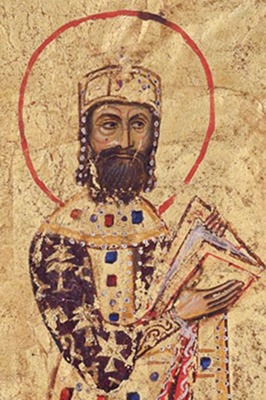
The earliest known figure is Humbert, son of Graoul (Raoul), a counsellor of Emperor Alexios I Komnenos (r. 1081–1118), who signed the Treaty of Devol in 1108 – an agreement intending to make the Principality of Antioch a Byzantine vassal state.
The lineage seems less visible in the following decades. Modern scholar Fassoulakis proposed that Leo Raoul, a scribe of two Byzantine manuscripts dated 1139, may have been Humbert’s brother, though this remains speculative.
By the late 12th century, however, Constantine Raoul, bearing the title sebastos, supported Alexios III Angelos’s usurpation in 1195, confirming the family’s continued prominence.
The Raoul family in the Empire of Nicaea.
After the Fourth Crusade and the fall of Constantinople in 1204, the Raoul family settled in the Empire of Nicaea and became influential at the court of the Laskarid emperors. The protovestiarios Alexios Raoul, possibly the son of Constantine, served as a senior military commander under John III Doukas Vatatzes (r. 1222–1254) and married one of the emperor’s nieces. Theodore II Laskaris (r. 1254–1258) sought to reduce the power of the nobility, and Alexios fell from favor. His title was stripped, and his four sons were imprisoned.
This pushed the family to support the coup of 1258 against the Mouzalon brothers and Michael VIII Palaiologos’s rise to co-emperor with the young John IV Laskaris in 1259. The Raouls thus regained influence when the new emperor rewarded the support of two of Alexios’s sons: John Raoul Petraliphas became protovestiarios, and his brother Manuel Raoul was made pinkernes (cupbearer). John also married in 1261 Theodora Palaiologina Kantakouzene, niece of Michael VIII, securing proximity with the imperial family.
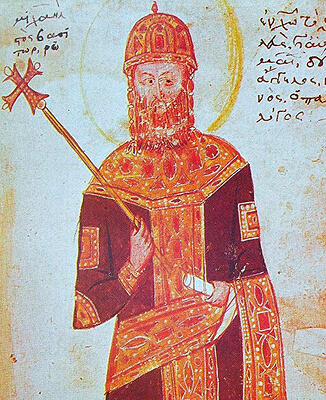
However, after Michael’s reconquest of Constantinople in 1261, the emperor sought to assert sole rule and ordered the blinding of John IV, then promoted the policy of the Union of the Churches. These acts, seen as treacherous and sacrilegious, led to the opposition of Patriarch Arsenios Autoreianos, who excommunicated the emperor.
Supporters of the patriarch—known as the Arsenites—included Theodora Palaiologina and her mother, as well as her step-brothers Manuel and Isaac Raoul. Michael VIII subsequently had the two men arrested and blinded, while the women were exiled to the Saint George fortress on the Black Sea coast. Later freed after Michael VIII’s death, Theodora restored the monastery of Saint Andrew in Krisei in Constantinople, transferred there the relics of Patriarch Arsenios, and was a key intellectual and political figure of her time, corresponding with scholars such as Maximos Planoudes and Nikephoros Choumnos.
Recovery and peak of influence under the Palaiologans.
However, the Raoul regained prominence under Andronikos II (r. 1282–1328). Irene, daughter of John Raoul Petraliphas and Theodora Palaiologina Kantakouzene, married the porphyrogenetos Constantine, a son of Andronikos II, reinforcing the ties of the Raoul with the imperial family. At the same time, another Alexios Raoul became megas domestikos, the commander-in-chief of the Byzantine army, under Andronikos II Palaiologos (r. 1282–1328). One of his own sons held the office of megas stratopedarches, responsible for the organization and logistics of the army.
As other leading houses, the Raoul family pursued strategic marriages with other prominent families. Besides the imperial family, they developed ties with many major houses of their time, such as the Kantakouzenos, Synadenos, and Asan families.
The family maintained their influence further in the 14th century – a time when their name appears Hellenized as Ralles in the sources. Another Alexios was megas domestikos after 1333, and later emigrated to Serres.
Decline and legacy of the Ralles family.
Like other aristocratic lineages of the late Byzantine era, the Ralles saw their fortunes decline amid civil wars and the empire’s territorial losses. Nonetheless, a branch of the family remained influential in the Peloponnese (Morea), where Manuel Raoul (fl. c. 1330–1360), a scholar and rhetorician of the Palaiologan Renaissance, partly lived in Morea and corresponded with Demetrios Kydones and Nikephoros Gregoras.
The family still had some significance until the beginning of the second half of the 15th century. The Moreote branch of the Ralles remained active in resisting the Ottoman conquest. Brothers Thomas and George Ralles led a rebellion against the Turks in 1458–1460, while other relatives accompanied Sophia Palaiologina to Moscow, where they served as diplomats at the Muscovite court.
Key members of the Raoul (Ralles) lineage.
The story of the Raoul (Ralles) family reflects the dynamic transformation of the Byzantine nobility from the 12th to the 15th century. Of Norman origin, they rose rapidly within the Byzantine aristocracy, serving as military commanders, courtiers, and scholars. Their integration illustrates how foreign lineages could assimilate into Byzantine society, adopting its language, traditions, and faith while contributing to its political and cultural life.
Even as the empire waned, members of the family remained active in diplomacy, learning, and local resistance – testament to the adaptability and enduring prestige of the Byzantine elite.
Sources.
Sterios Fassoulakis, The Byzantine Family of Raoul-Ral(les), Athens, 1973
Alexander Kazhdan, Oxford Dictionary of Byzantium, Oxford University Press, 1991, p. 1771
George Ostrogorsky, “Alexios Raul, Grossdomestikos von Serbien” in Festschrift Percy Ernst Schramm, ed. P. Classen, P. Scheibert, vol. 1, Wiesbaden, 1964, p. 340-352.