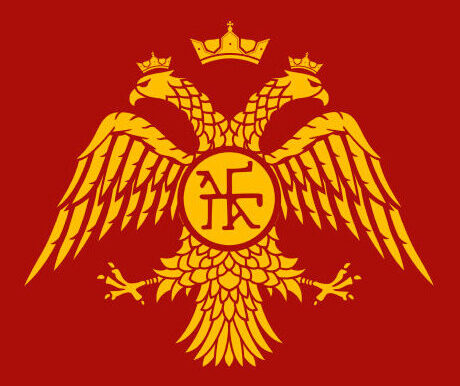

Sakkos of Metropolitan Photius: Byzantine Textile Masterpiece
The Large Sakkos of Metropolitan Photius is a masterpiece of late Byzantine textile art. Created between 1414 and 1417, it was made for Photius, Metropolitan of Kiev and all Rus’. A sakkos is a richly decorated liturgical tunic worn by Orthodox bishops during religious ceremonies, derived from the Byzantine imperial tunic and symbolizing the authority of the prelate. The Sakkos of Photius is not only a masterpiece of late Byzantine textile craftsmanship but also a witness to the political and religious ties between Constantinople and Moscow in the 15th century.
Materials and craftsmanship of the Sakkos of Photius.
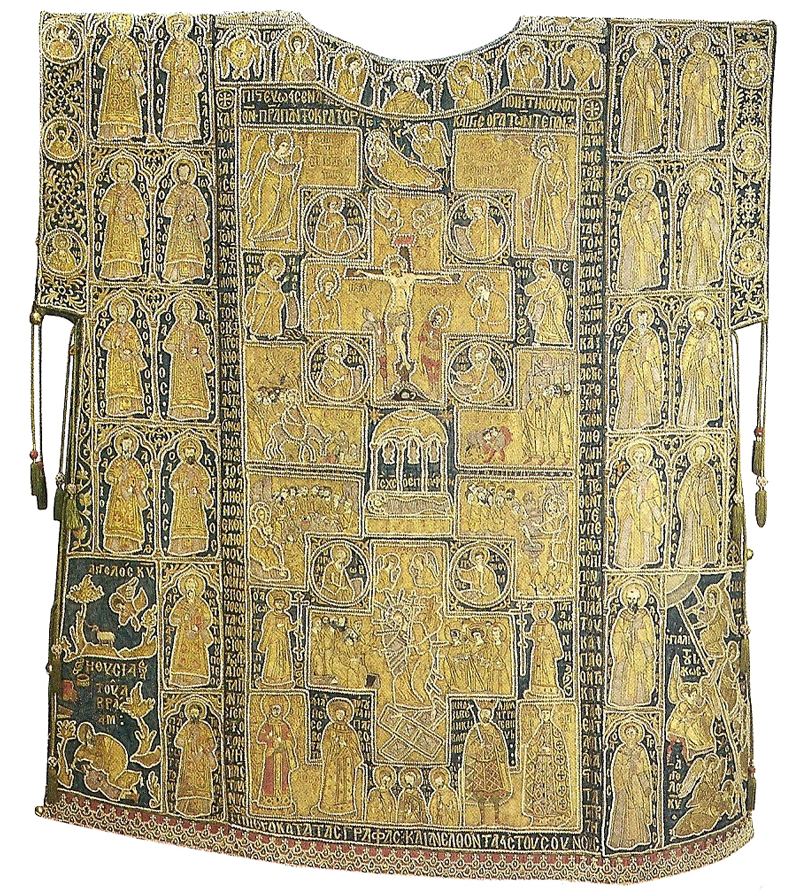
The sakkos was made in Byzantium using the face-sewing technique, a hallmark of late Byzantine embroidery. It was originally crafted from azur blue satin, lined with green taffeta, and embroidered with gold, silver, and silk threads, adorned with pearls. It measured 135 cm long and 112 cm across the shoulders and featured ten small bells and sixteen tasseled ties. It is one of the last masterpieces of the Byzantine artisans of Constantinople, who managed to create a luxurious and visually striking textile, fitting for a metropolitan.
Over time, the sakkos underwent alterations and restorations. The hem, displaying Russian embroidery, was added in the 16th century. The pearls were re-strung in 1631 and 1642, likely contributing to the total of over four kilograms, to preserve and enrich its original splendor.
Religious miniatures and iconography of the liturgical tunic.
With over a hundred embroidered images, the sakkos blends biblical scenes, saints, and portraits of rulers. These miniatures provide both spiritual meaning and historical insight into clothing, ceremonial dress, and political relations. The biblical scenes are particularly rich and adapted to a Russian audience, especially through the representation of the Vilnius Martyrs, demonstrating a notable recognition of local religious circumstances by the commissioners of the sakkos, likely the Byzantine imperial court.
As expected on this type of liturgical vestment, biblical scenes are prominent. At the center is the Crucifixion of Jesus, featuring the Virgin Mary, John the Evangelist, the centurion Longinus, angels, and prophets at the corners. Above, a young Jesus and an angel hold the instruments of the Passion. Below, the Anastasis (Resurrection) is depicted in a rotunda. The embroidery also depicts other important New Testament scenes, including the Annunciation, the Entry of Jesus into Jerusalem, the Last Supper, and the Descent into Hell.
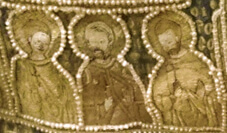
In addition to these major scenes, individual biblical figures are depicted, including prophets such as Solomon, David, Isaiah, and Jeremiah, as well as many Saints. Martyrs are also present, especially the Vilnius Martyrs (Anthony, John, and Eustathius), canonized in 1374, appearing in what is one of the earliest known surviving representations.
Political iconography and historical context of the creation of the Sakkos.
The sakkos was likely embroidered between 1416 and 1418, after the marriage of John VIII to Anna Vasilyevna, daughter of Vasily I, Prince of Vladimir and Moscow, in 1416, and before her death in 1418. The couple probably commissioned the sakkos for Metropolitan Photius and sent it to him as a diplomatic gift, reflecting the strong connections between Moscow and Constantinople. Consequently, alongside the biblical scenes and figures, portraits of statesmen also appear on the sakkos.
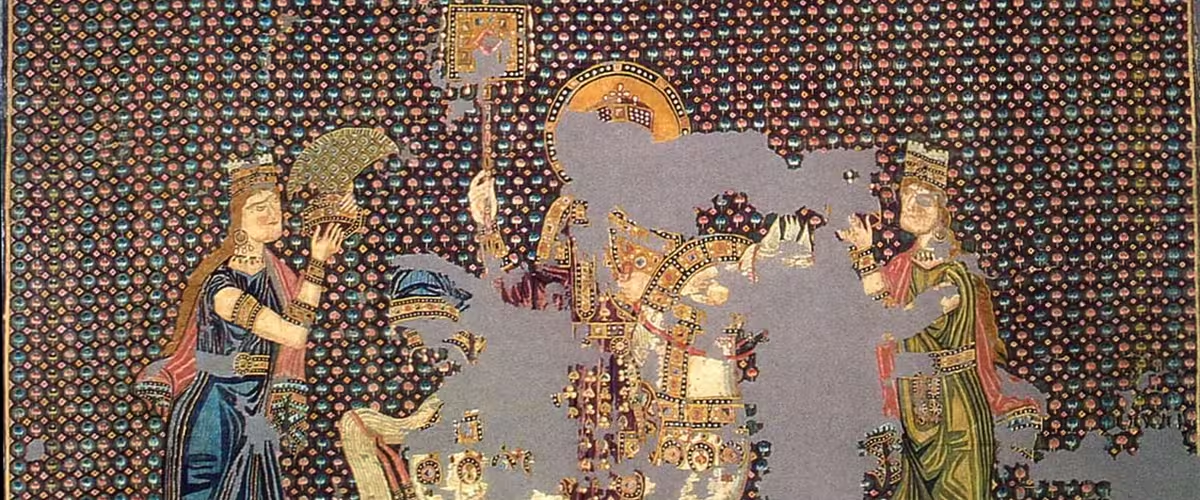
Detailed portraits of Russian and Byzantine rulers are embroidered. Vasily I of Moscow and Sophia Vitovtovna appear in Moscow court attire, with Russian inscriptions identifying them, while John VIII Palaiologos and Anna Vasilyevna are depicted in Byzantine ceremonial dress with Greek inscriptions. Metropolitan Photius is also portrayed, emphasizing his religious and political influence.
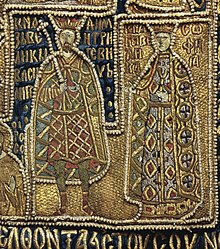 Vasilyi of Moscow and Sophia of Lithuania,
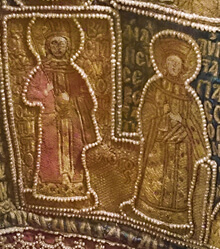 John VIII Palaiologos and his wife Anna
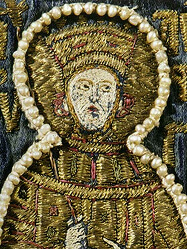 Detail of Anna, daugther of Vasilyi and Sophia
This reflects the political and religious context of early 15th-century Rus’ and Byzantium, demonstrating how the sakkos served as a symbol of their relations—relations that would be further strengthened decades later by another marriage, between Sophia Palaiologina and Tsar Ivan III, symbolically passing the claim to Byzantine imperial authority to the Russian rulers.
The Large Sakkos of Metropolitan Photius is more than a liturgical garment. It is a historical record, an artistic achievement, and a symbol of Byzantine-Rus’ relations. Its detailed embroidery, biblical miniatures, and depictions of rulers make it a unique artifact in medieval textile history. Preserved in the Kremlin Armoury, it continues to inspire art historians and scholars worldwide.