
Byzantine Church of Saint Theodora in Arta
The Church of Saint Theodora is located in the center of Arta, which was also the heart of the Byzantine city. Dating back to the late 11th century or mid-12th century, it originally served as the main church of a monastery dedicated to Saint George. The monastery’s significance transformed in the 13th century due to its association with a major figure of the Despotate of Epirus: Theodora Petraliphaina, wife of Michael II Komnenos Doukas. She spent her final ten years in the monastery and, after her death, was venerated as a saint and became the patron of Arta. This period was pivotal in shaping the building’s current appearance and historical importance.
The monastery of Saint George.
Situated in the bustling heart of medieval Arta, close to the acropolis that would later be the residence of the Despotes, the monastery played a central role in the city’s geography. Most of what we know about the early history of the original church and monastery, dedicated to Saint George, comes from preserved architectural features and the 13th-century hagiography of Saint Theodora, authored by the monk Job Melias.
Scholars date the oldest sections of the buildings, including the church itself, to the late 11th or mid-12th century, a period that likely marks the monastery’s founding.
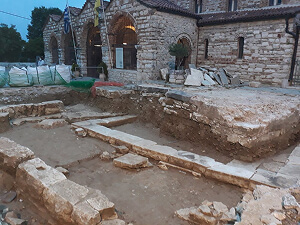
The church was built atop the ruins of an ancient Ambrakian structure, which the Ephorate of Antiquities identified in 2019 as the rectorate (administrative headquarters) of the ancient city. During this time, the church functioned as the katholikon (main church) of a women’s monastic community.
Queen Theodora and the fortune of the monastery.
In the 13th century, Arta became the capital of the Despotate of Epirus. Between 1236 and 1270, Michael II Komnenos Doukas ruled the despotate. He married Theodora Petraleifas, a noblewoman of Norman-Italian descent. She was the daughter of Ioannis Petraleifas, a military commander under Emperor John III Vatatzes, and thus maintained strong ties with the Empire of Nicaea through her close and extended family connections, notably with the influential Raoul family, which held a prominent position at the Nicaean court.
Although the account of Monk Job in the Hagiography of Theodora must be regarded as partly fictional—despite the author being either contemporary or writing shortly after her death—it suggests that Theodora was a highly respected figure in the Despotate, admired for her philanthropic work. Her husband, the despot, by contrast, led a dissolute life, engaging in an extramarital affair and neglecting his wife for his mistress. He appears, however, to have repented, founding two monasteries near Arta, including the monastery of Kato Panagia, as acts of penance. During her lifetime, Theodora also played a significant political role, acting as a mediator between the Despotate and the Empire of Nicaea. She reportedly traveled twice to Nicaea to lead negotiations that culminated in the marriage of her son Nikephoros to the daughter of Emperor Theodore II Laskaris. After her husband’s death in 1270, Theodora, like many Byzantine widows, took monastic vows and retired to the Monastery of Saint George.
Hosting a former queen and mother of the new despot—renowned for her piety—was naturally a great privilege, and the monastery likely benefitted materially from her patronage. Theodora herself had a new narthex constructed to house her monumental tomb and probably undertook improvements to the church. After her death, she was venerated as a saint. Over time, the monastery became known as Saint Theodora, replacing its previous dedication.
Housing her relics, it developed into an important pilgrimage site, becoming the second most prominent monastery in Arta after the Panagia Paregoritissa.
According to the 17th-century Turkish traveler Evliya Çelebi, the church was richly adorned with offerings from across “Frangia” (Western Europe), so numerous that Ottoman authorities collected money for its protection. He reported that as many as two hundred priests served there, providing food and shelter to travelers.
Architecture of the Church of Saint Theodora.
The church underwent three main construction phases.
First phase (late 11th to mid-12th century).
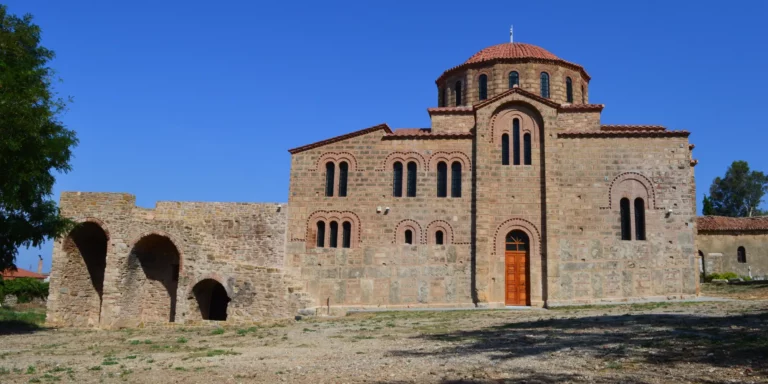
The first and most significant dates to the foundation of the Monastery of Saint George, sometime between the late 11th and the mid-12th century, which gave rise to the church that still stands today. At that time, a typical three-aisled, wooden-roofed basilica was erected. The eastern wall terminates in three broad, three-sided apses. The three aisles are separated by two transverse walls with doorways connecting the sanctuary to the prothesis and the diaconicon. Inside, the basilica is divided by colonnades into three aisles. The central nave rises higher than the side aisles and is covered with a pitched roof, while the side aisles have single-pitched roofs and feature eight bifora windows.
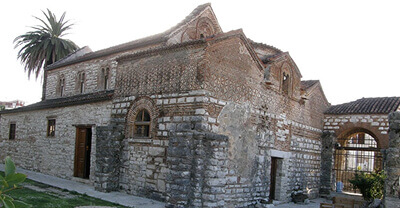 Exterior view of the church, section dating back to the first phase of construction.
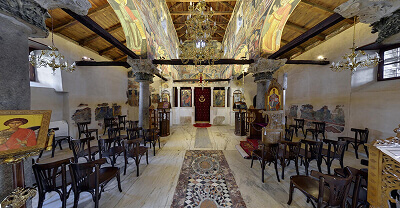 Interior view of the three-aisled church with a wooden roof.
Second phase (ca. 1270-1280).
The second phase dates to the period of the Despotate of Epirus, probably between 1270 and 1280, when Queen Theodora likely renovated the church upon retiring to the monastery. She added a three-part vaulted narthex to the west, featuring a low central dome, three entrances on the west, north, and south sides, and three inner doorways connecting to the nave. Narthexes were often used for funerary purposes in Byzantium, suggesting that the queen intended it to house her tomb—a lavish structure for its time, as indicated by the surviving tomb slab, an extraordinary example of sculpture from the Despotate. Today, the southern doorway is blocked by the tomb of Saint Theodora, reconstructed in 1873 but incorporating older elements after the translation of her relics.
Three pediments adorn the exterior west façade, with the central one—containing a bifora window—rising before the low dome. A similar feature appears in the katholikon of the Monastery of Vlacherna, near Arta, dating to the same period, indicating a local architectural tradition. The addition of two large, pointed pediments on the east and west walls of the central aisle also likely belongs to this same phase of renovation under Theodora’s patronage. These pediments project above the roofline, each with a bifora window.
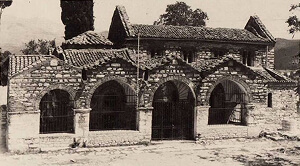 Old picture showing the narthex.
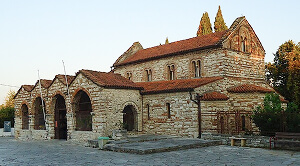 View of the 13th-century narthex and the church.
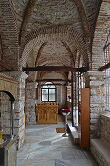 Interior of the narthex.
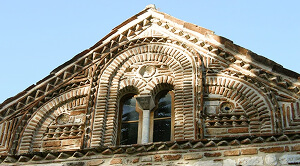 View of one of the pediment of the roof with bifora window and intricate decoration.
Third phase (late 13th – beginning 14th century).
The final phase of construction took place at the end of the 13th and the beginning of the 14th century. It included the addition of an open portico, Π-shaped in plan, which surrounded the west façade of the narthex and extended partly along the north and south sides of the katholikon. Today, only the southwest corner and part of its southern side, supported by pillars, survive. Excavations in 2019 uncovered several architectural features of this gallery and the surrounding courtyard of the monastery.
The church’s masonry.
Externally, the church’s masonry consists of irregular stones interlaid with horizontal brick courses in an irregular pattern. The simplicity of the katholikon’s walls reflects its early date, whereas the tall pediments of the central aisle display elaborate ceramic ornamentation typical of the Despotate’s golden period. These include jagged bands, superimposed plinths, and decorative motifs made from broken pottery. Numerous ceramic friezes also adorn the narthex masonry, featuring crosses, suns, meanders, zigzag lines, and lattice patterns.
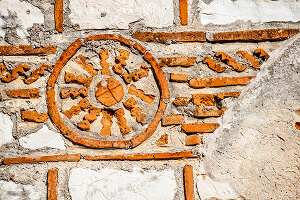 Detail of the intricate decoration in bricks.
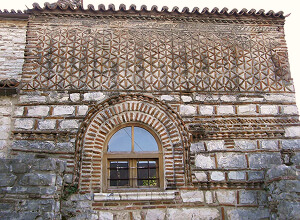 Brick masonry and window
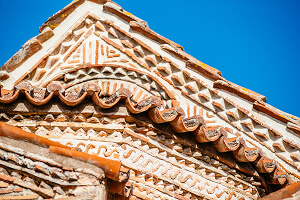 Brick masonry of the roof.
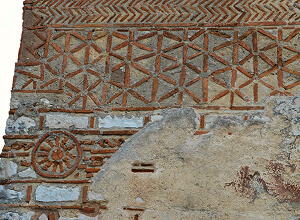 Detail of the lattice patterns and intricate masonry decorations.
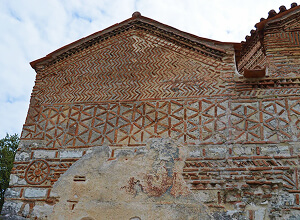 Wall with lattice-patterned brick decoration.
The arched gateway.
The arched gateway – probably the only surviving structure from the monastic precinct – also dates to the 13th century, was likely constructed during phase 2, and is richly decorated with ceramic motifs characteristic of the artistic peak of the Despotate of Epirus.
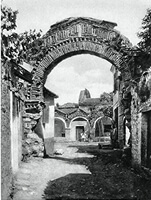 Arched gateway, 1927.
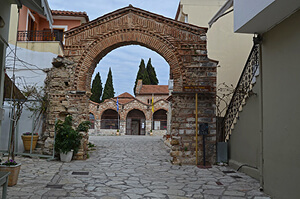 Contemporary view of the gateway.
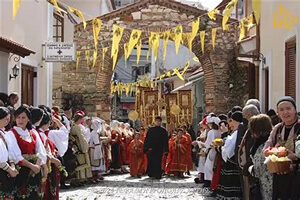 Modern procession going to the church through the gateway.
Artworks inside the Church and the tomb of Saint Theodora.
Sculptural decoration (chancel, capitals).
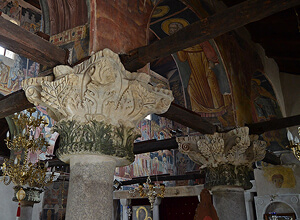
The church features sculptural decorations, particularly in the chancel, which incorporates elements from the original 11th–12th century construction. However, many marble capitals and columns originate from an even older monument, likely dating to the time of Justinian in the 6th century.
The church’s templon screen has been the subject of scholarly research in the past. Recent studies and technical investigations have brought new evidence to light regarding its construction. Composed of both reused elements and original parts stylistically dating to the second half of the 13th century, it was likely built after 1268, when Theodora became a nun at the monastery.
The tomb of Saint Theodora.
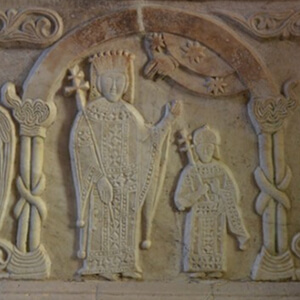
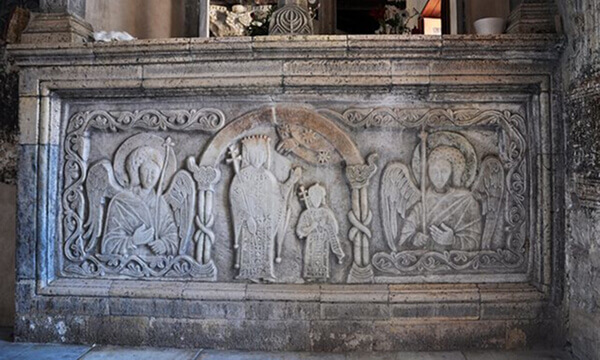
The tomb of Saint Theodora is visible in the narthex or the church. In its current state, the monument dates to 1873 following the translation of the saint’s relics, though it incorporates sculptural elements from various periods. The relief slab is particularly noteworthy.
This rare and remarkable sculpted tomb slab shows Western influence through the use of sculptural representation, which is relatively uncommon in Byzantine art. It depicts Theodora alongside a smaller male figure, probably her son, both adorned in imperial attire with crowns and scepters. Theodora also wears a veil beneath her crown, perhaps indicating that, despite her royal status, she had become a nun. Both figures are framed by the busts of two archangels.
Paintings of the church.
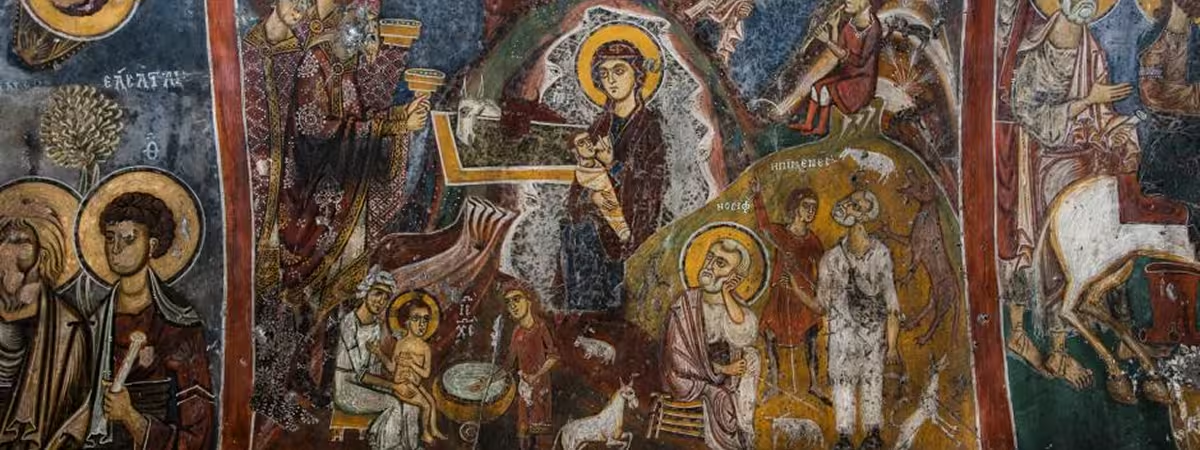
Most of the paintings visible in the church today date to the 18th century. However, conservation and cleaning work have revealed an underlying layer preserving fragments of earlier frescoes from the 13th century.
Post-Byzantine silver reliquary of the saint.
In a conch to the right of the altar area, a silver reliquary – post-Byzantine – houses the relics of Agia Theodora. Her feast is celebrated every March 11th with a procession through the streets of Arta.
Sources.
G. Lampakis and the Archimandrite Antonios, who made the first sketches at the end of the 19th century, have been the first to study the monument.
The church was later studied by G. Millet, and by Anastasios Orlandos in 1936.
Other sources:
Deltion of the Christian Archaeological Society; Deltion ChAE 29 (2008), Series 4. In memory of Anna Marava-Chatzinikolaou (1911-2005); 233-246 (EN)