
Byzantine Monastery of Kato Panagia in Arta
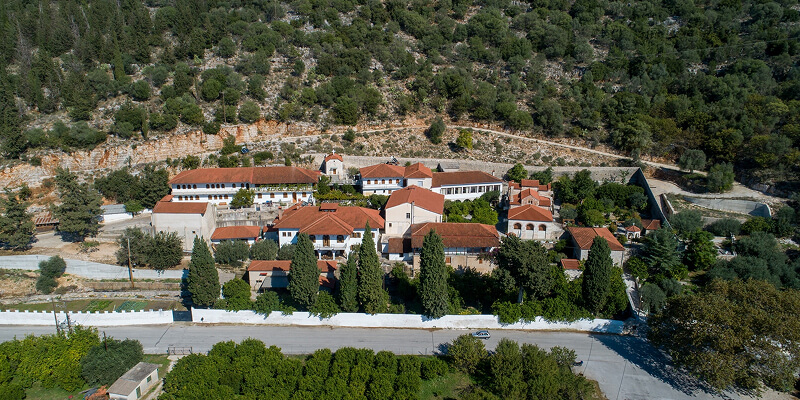
Nestled at the foot of the Peranthi Hills, on the southern outskirts of Arta, the Monastery of Kato Panagia (Greek: Μονή Κάτω Παναγιάς) stands as an architectural legacy of the Despotate of Epirus. It was once overlooking the tranquil waters of the Arachthos River, before modern embankements modified the course of the river. The monastery was founded in 1250 by Michael II Komnenos Doukas, Despot of Epirus, and his wife Theodora – later canonized as Saint Theodora. While many of the monastery’s buildings have been rebuilt over time, its original katholikon (main church) remains preserved.
Kato Panagia, a monastery rooted in repentance.
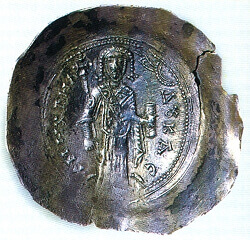
The historical sources about the monastery during the Byzantine period are very scarce. What we know derives mainly from the inscription incrusted in the walls of the church, and the Hagiography of Saint Theodora Petraphilas, consort of Michael II Komnenos Doukas, despote of Epirus from 1237 to 1270.
This Hagiography, written by the 13th century monk Job Melias, reports that the Despote had an extramarital affair with an aristocratic woman from Arta, called Gangrini – which probably doesn´t refer to her first name, but to the noble family of the Gangrinos, whose she may have been a member.
As a repentance for his sins and his unacceptable behaviour towards his wife, he would have commissioned three monasteries: the Kato Panagia, the Panagia tou Vlacherna and Agios Georgios. His wife Theodora spent her final ten years as a nun in the latter, before her death in 1280 – and her rapid canonization.
The inscription of the church confirms its construction in 1250 by Michael II Komnenos Doukas, Despot of Epirus. The monastery was dedicated to the Virgin Mary (Panagia in Greek). The rest of its Byzantine history remains shrouded in obscurity, but its name, “Kato Panagia” (Lower Panagia), dates from modern times and was adopted to distinguish it from Panagia Paregoritissa, another monastery dedicated to the Virgin and the preeminent ecclesiastical monument of Arta, which stands at a higher elevation.
Later history of the monastery of Kato Panagia.
A later and unconfirmed tradition claims that the monastery was visited in disguise by Sultan Bayezid II (1447–1512). In gratitude for the hospitality, he allegedly granted it a favorable firman securing its real estate holdings. Later references to the monastery include a sigillate letter from Patriarch Jeremiah II in the 16th century, which designated the Monastery of the Holy Apostles of Arta as a subdistrict of Kato Panagia.
The monastery indeed possessed great wealth, owning at times entire villages, a port, fish farms, salt pans, and numerous metochia (dependent monasteries). Whether the story of Bayezid’s visit is true or not, it underscores the monastery’s reputation as one of the richest and most influential in the wider Arta region, both during the Byzantine period and, especially, in Post-Byzantine times.
This wealth enabled the monks to commission new decorative programs in the church and undertake renovations of the monastic buildings, notably in the 18th and 19th centuries.
However, the monastery suffered a catastrophe in the 19th century. The uprisings of 1821 and 1854 severely affected it: most of the monastery’s treasures were looted, except for a few items the monks managed to hide outside its walls, and the buildings were heavily damaged. As a result, most of the Byzantine-era structures that may have survived until then were lost. The destruction extended beyond the buildings and valuables – most of the monastery’s library, including its archives, chrysobulls, patriarchal sigils, and sultans’ firmans, was also destroyed. This devastation explains why only a few sources remain today to help reconstruct the monastery’s history.
The monastery was rebuilt in the 19th century and remains in service today. Since 1953, it has hosted a women’s monastic community.
Architectural and artistic legacy of the Kato Panagia Church.
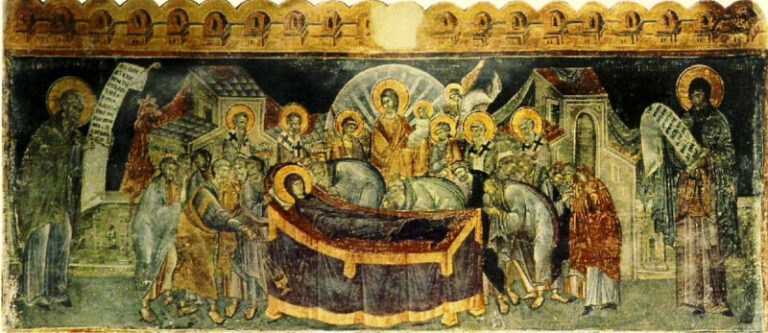
Dedicated to the Dormition of the Virgin, the katholikon of Kato Panagia is the only surviving structure from the original 13th-century monastic complex. The church follows the three-aisled cross-pile basilica type, featuring a domed vault and an inner narthex to the west. It bears a close resemblance to the church of Porta Panagia at Pyli, Trikala, dated to 1283, which was commissioned by Ioannis Doukas, the illegitimate son of Michael II Komnenos Doukas.
 Church taken from the south, photography by Carl Siele, 1910.
 Church taken from the southeast, photography by Carl Siele, 1910.
 Modern view of the church.
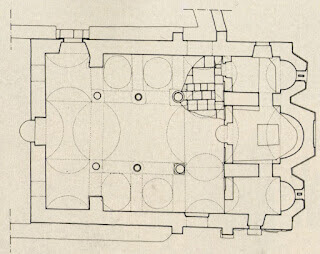 Plan of the church
Externally, and like other contemporary buildings like the Panagia Vlacherna, the church showcases elaborate masonry, incorporating marble elements salvaged from the ruins of ancient Amvrakia and intricate ceramic decorations. It also features two inscriptions, including the most significant attributing the church’s construction to Michael II Doukas, with his monogram beside it.
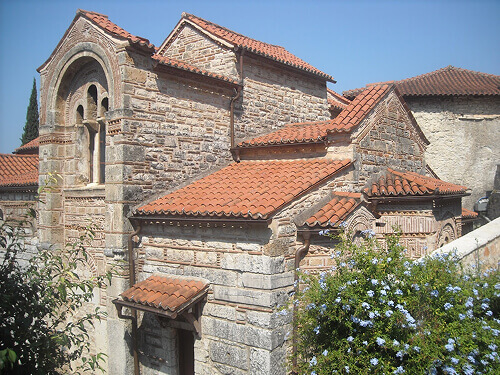 The construction features elaborate masonry.
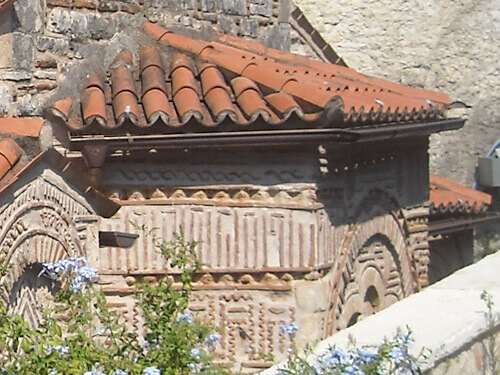 The walls showcases exquisite brickwork.
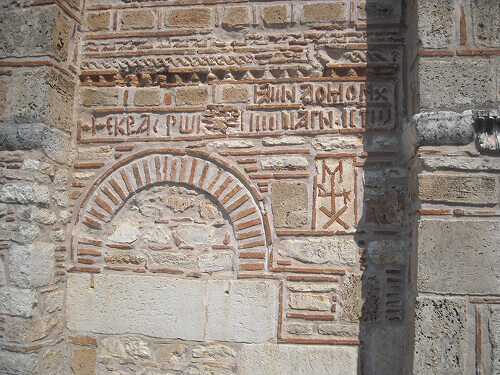 Inscription and monogram of Manuel II Doukas Komnenos.
Inside, the church’s frescoes span multiple eras. The oldest and only Byzantine layer, likely part of the church’s original decorative program, dates to the mid-13th century and is located in the diaconicon. In the apse quadrant, Christ is depicted, with hierarchs shown below. The northern part of the arch features the 12-year-old Christ in the Temple, while the southern part depicts Zacharias rejecting the gifts of Joachim and Anne. On the northern and southern walls of the diaconicon, full-length saints such as Hypatius, Sylvester, and Anthimos are portrayed. These frescoes represent a high level of artistic skill, though somewhat provincial in character, and serve as an important source for the history of mid-13th-century painting in the Despotate of Epirus. The remaining paintings in the church and narthex date to the 18th and 19th centuries.
Recently, Byzantine reliefs belonging to the church’s original marble iconostasis have been discovered, allowing for a partial reconstruction.
The icon collection of the monastery.
The monastery also preserves some ancient artworks, most notably a collection of icons. These include notable Post-Byzantine works, such as an icon of Christ Pantocrator by Emmanuel Tzanes (1678) and another of Saint John the Baptist by George Nomikos (1699). Additionally, two 17th-century icons depict the Virgin Mary and Saint Nicholas, while the remaining icons date from the 19th century.
The Hodegetria icon from the 14th century.
Only one icon originating from the Kato Panagia Monastery can be securely dated to the Byzantine times.
It is a 14th-century Hodegetria icon, which follows the traditional Hodegetria type originating from Constantinople, depicting the Virgin Mary holding Christ in a protective embrace. The composition includes the Deesis – Christ Pantocrator flanked by the Virgin and John the Baptist – at the top, while the Twelve Apostles, led by Peter and Paul, occupy the upper corners and sides, each holding gospels. The Virgin is dressed in a red maphorion with a gold sash. Christ, in a white tunic adorned with lilies, form the central focus. The icon suffered from damage, particularly to the Virgin’s face and edges. A vertical crack and nail holes are also visible. Christ’s features remain better preserved, showcasing a high forehead, lively eyes, and childlike expression.
Stylistically, the icon reflects provincial Byzantine craftsmanship, characterized by schematic folds, limited but vibrant colors, and expressive faces that convey spirituality.
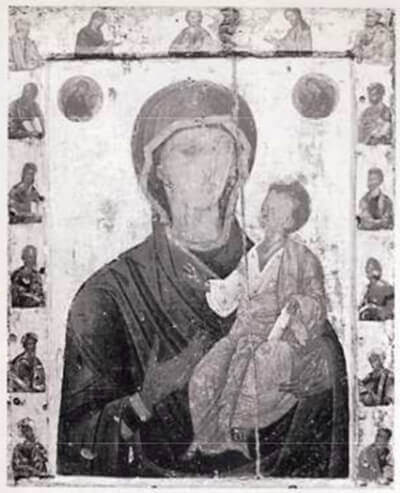
It draws parallels with other works, such as the 14th-century “Eleousa” icon from Chilandar Monastery (Mount Athos) and the two-faced Hodegetria from Ohrid, reinforcing its connection to established Byzantine models. The inclusion of the Apostles—rather than prophets—aligns with Byzantine conventions, though it remains a less common arrangement, underscoring the icon’s unique fusion of local artistry and broader liturgical traditions.
Another Hodegetria icon, possibly Byzantine, with 19th-century overpainting.
This icon, now in the chapel of Saint Agnes, is likely Byzantine in origin but features extensive 19th-century overpainting.
Like the other one, it also follows the Hodegetria type, depicting the Virgin Mary holding Christ in a protective embrace. The Virgin wears a red maphorion with a gold sash, fringes, and star-shaped ornaments. Jesus Christ, seated on her lap, is dressed in an olive-green tunic and a pink himation. He is blessing with his right hand and holding a closed scroll.
The composition includes the Deesis at the top – Christ Pantocrator flanked by the Virgin and John the Baptist- with the Twelve Apostles arranged in six groups along the vertical sides, each holding gospels. Two archangels occupy the upper corners, and a wreathed stem decorates the lower frame.
Stylistically, the icon combines soft color gradations for a plastic effect, with harsh contrasts in lighting and shadows. The frame’s execution is less refined, featuring thick outlines and rough modeling. The crowns on the Virgin and Christ are likely a 19th-century addition with Western influence.
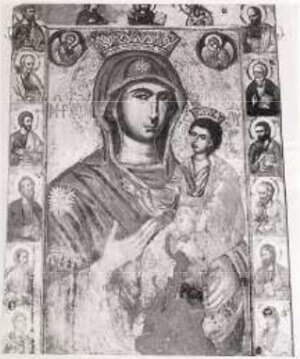
Despite the overpainting, Palaiologan elements remain, such as the iconographic layout, the linear folds of the Virgin’s mantle, and Christ’s posture, suggesting an earlier Byzantine layer beneath. The icon’s similarities to another Hodegetria icon in the monastery’s collection, along with its possible influence on Emmanuel Tzanes’ 1678 Christ Pantocrator, highlight its historical and artistic significance. Nonetheless, it could also be a Post-Byzantine work copying the other Hodegetria icon.
The Monastery of Kato Panagia is a significant architectural and artistic legacy of the Despotate of Epirus in the 13th century. Founded in 1250 by Michael II Komnenos Doukas, its katholikon exemplifies Byzantine design, while its frescoes and reliefs provide rare insights into the era’s artistic traditions. Despite later damage, the monastery remains a key monument for studying the cultural and religious history of the region.
Sources.
L. Vranousis, Chronicles of Medieval and Turkic-occupied Epirus, Society for Epirus Studies, Ioannina, 1962, p. 49
A. Orlandos, The monastery of Kato Panagia, ABME, B, 1936, p. 70-85
Varvara Papadopoulou, The Monastery of Kato Panaghia at Arta, the icon collection, Ηπειρωτικά Χρονικά, Τόμος 37, Ιωάννινα 2003, σ.9-76, σε συνεργασία με Αγλαΐα Τσιάρα