
Monastery of Panagia Vlacherna in Arta, legacy of the Despotate of Epirus
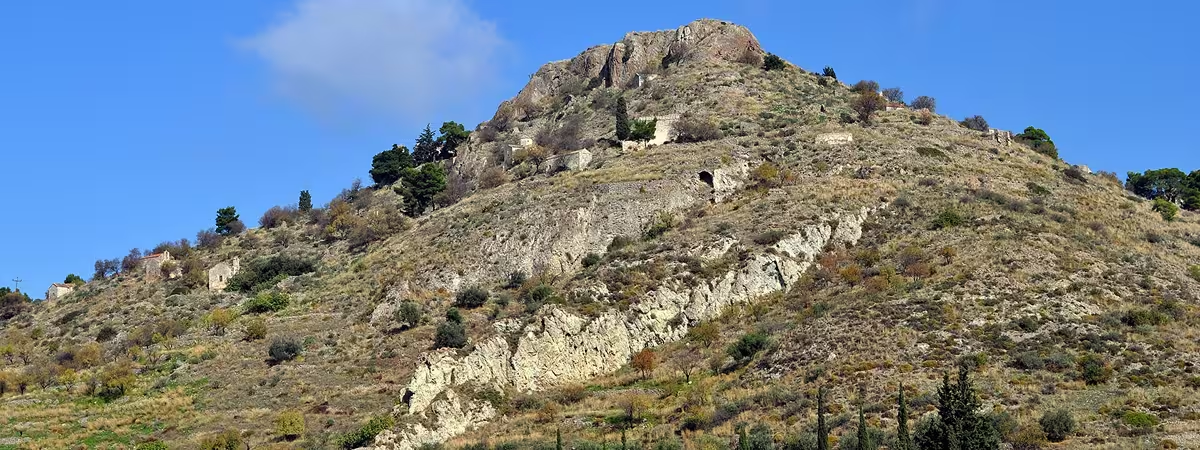
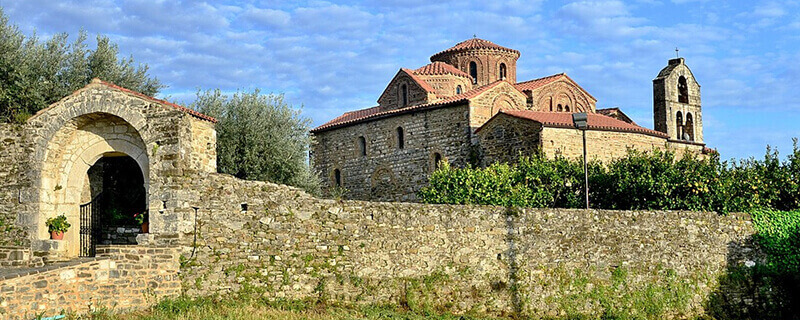
The Monastery of Panagia Vlacherna stands at the foot of a hill opposite the city and castle of Arta, separated from them by the river Arachthos yet maintaining direct visual contact across the water. Originally a monastic foundation for men – established at some point between the late 9th and the mid-12th centuries – it became a convent in the 13th century, closely linked to the prominent aristocratic Petraliphas family and to the Despots of Epirus. Through successive building campaigns throughout the 13th century, these patrons transformed the church into a sumptuous monument decorated with sculpture, floor mosaics, finely executed frescoes, and ceramic ornamentation. It was long thought to have even served as a mausoleum for the Komnenos-Doukas dynasty, although scholars now consider it more likely to have been one for the Petraliphas family. Though slightly altered in post-Byzantine times, the Panagia Vlacherna stands today as one of the most remarkable monuments of Byzantine Arta and Epirus.
History of the monastery of Panagia Vlacherna, and its connection to the elite of Epirus.
The early monastery and its conversion to a nunnery.
Although written sources from the Byzantine period are scarce, the architecture of the church provides valuable clues that allow scholars to partly reconstruct the history of the Monastery of Panagia Vlacherna in Arta. The earliest construction phase is dated by some researchers to the late 9th or early 10th century and is thought to have featured a classical three-aisled basilica. Other scholars, such as Anastasios Orlandos, have proposed a later chronology, placing it in the mid-12th century.
This earlier structure, smaller than the present church, served as the katholikon (main church) of a monastery originally founded for monks. The first known written reference to the monastery appears in a synodal decree by Ioannes Apokaukos, Metropolitan of Nafpaktos and Arta, which concerns its conversion from a male monastery into a nunnery. The decree, issued at the order of Maria Komnene Doukaina Petraliphas, likely dates between 1228 and 1232. This transformation probably aimed to provide refuge for a group of noble nuns from Constantinople – described in the document as “of noble descent and manner” – who sought security and spiritual refuge in the Despotate of Epirus. The Vlacherna Monastery thus became the first active nunnery in the Despotate.
Importance of the monastery in the Despotate of Epirus.
The significance of the Vlacherna Monastery within the Despotate of Epirus can be inferred from its dedication. The reference to Panagia Vlacherna recalls one of Constantinople’s most revered Marian sanctuaries, home to the highly venerated icon of the Virgin until 1453. The Blachernae district was also closely associated with the Komnenos dynasty, from which the Despots of Epirus claimed descent.
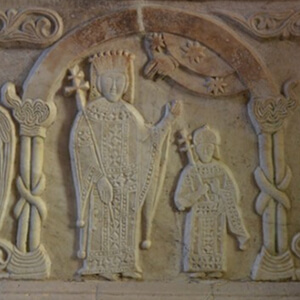
By adopting this dedication, the Despots inscribed their nunnery within the symbolic and spiritual legacy of Constantinople. They emphasized their connection to the Komnenoi, modeling their capital on the Byzantine prototype and asserting their role as heirs of the Byzantine Empire.
Alongside the ruling family’s patronage, the monastery enjoyed the support of prominent aristocratic families, particularly the Petraliphas lineage, whose members—such as Maria Komnene Doukaina Petraliphas and Theodora, wife of Michael II (r. 1230–1266/68)—were closely tied to the ruling dynasty.
This elite patronage in the 13th century triggered three major building phases that profoundly transformed the earlier church, producing the lavishly decorated monument admired today. Its high-quality frescoes, intricate marble floors, sculptural details, and ceramic ornamentation reflect both artistic sophistication and imperial ambition. Although earlier scholars believed that the monastery served as a mausoleum for the ruling family, more recent studies suggest that the remaining funerary monuments belong to the Petraliphas lineage.
Nevertheless, the nunnery maintained close ties with the Despots. When Anna, daughter of Theodoros II and wife of the deposed Serbian ruler Stefanos Radoslav, sought refuge in 1234, she found asylum in a nunnery near her relatives- most likely the Vlacherna Monastery. The enduring legend of an underground passage linking the monastery to the castle of Arta may well symbolize this intimate association with the Despot’s seat of power.
Architectural remodeling of the monastery throughout the 13th century.
The Chronicle of Galaxidi reports a devastating earthquake in 1231 that damaged the church of Galaxidi, prompting Michael II to rebuild it. The same seismic activity likely affected the Vlacherna Monastery, along with other local religious monuments such as Kato Panagia and the Monastery of Saint Theodora, all of which underwent repairs or received new decoration at that time.
For Vlacherna, this rebuilding involved reconstructing the church as a timber-roofed basilica. Portions of the earlier building – specifically the central apse of the tripartite sanctuary and the dividing wall between it and the diaconicon – were incorporated into the new structure.
Later, perhaps in the third quarter of the 13th century under Michael II Komnenos Doukas, three domes were added – one on each aisle – along with a calotte on the north aisle. This intervention converted the church from a timber-roofed to a vaulted-roof basilica.
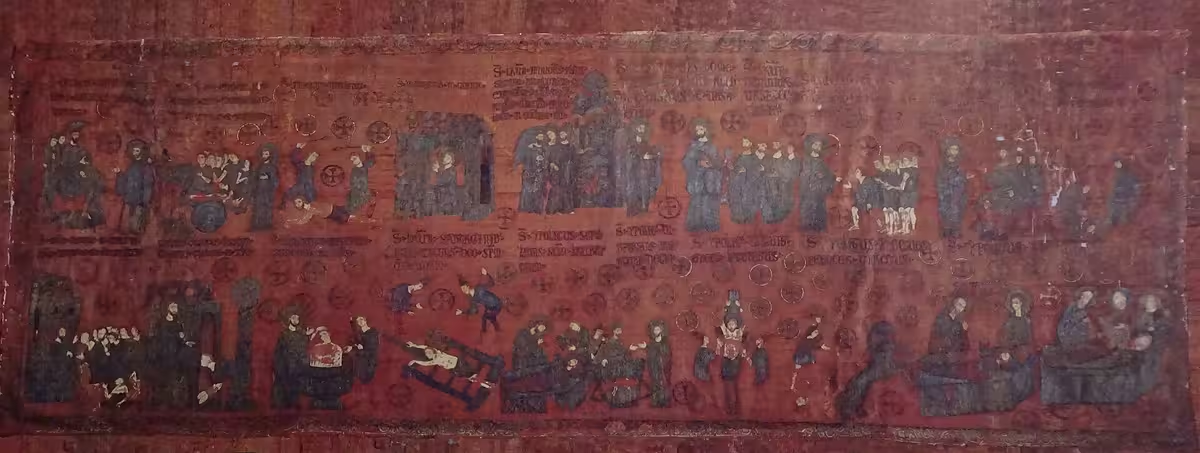
The final 13th-century intervention occurred under Nikephoros I Komnenos Doukas (1267–1269). At this time, a narthex covered by vaults and a calotte was added, along with porticoes on the south and west sides. The iconographic program, including the unique depiction of the procession of the Hodegetria icon through Constantinople’s streets, suggests the involvement of Anna Palaiologina Kantakouzene, Nikephoros’ wife, in the design and decoration.
A few decades later, according to the Chronicle of Morea, the young despot Thomas sought refuge in the Vlacherna Monastery during the 1304 siege of Arta and the nearby castle of Rogon by Charles II of Naples and his allies. From there, he awaited news of the enenmy siege of Rogon and his allies, underscoring once again the monastery’s political and symbolic role.
Later history of the monastery.
In the post-Byzantine period, the monastery’s fortunes declined, its wealth repeatedly encroached upon by Ottoman and Venetian authorities. During the early 18th century, it was briefly converted into a Catholic monastery. In 1814, its dedication changed from the Assumption of the Virgin to the Deposition of the Virgin’s Holy Robe, reflecting renewed devotion to the original Blachernae sanctuary of Constantinople.
In 1816, the monastery sheltered hundreds of residents fleeing a plague in Arta. During the Greek War of Independence, it was fortified as a defensive post and suffered damage, including the piercing of defensive windows. Repairs followed in the 19th century, when a bell tower was added to the western wall of the narthex and the Byzantine porticoes were removed.
Monastic life continued until the early 20th century. However, the original Byzantine monastic buildings did not survive; the extant structures date entirely from the post-Byzantine period, reflecting centuries of adaptation and change.
Major restoration work between 1975 and 1978 revealed many of the church’s frescoes, likely whitewashed after Arta’s surrender to the Ottomans in 1449 to avoid provoking the conquerors. In the 1990s, the cemetery occupying the eastern precinct was removed. Extensive conservation campaigns followed in 2004–2006 and again in 2011–2015, ensuring the preservation of this emblematic monument of Epirus’ Byzantine heritage.
Architecture of the Byzantine Church of Panagia Vlacherna.
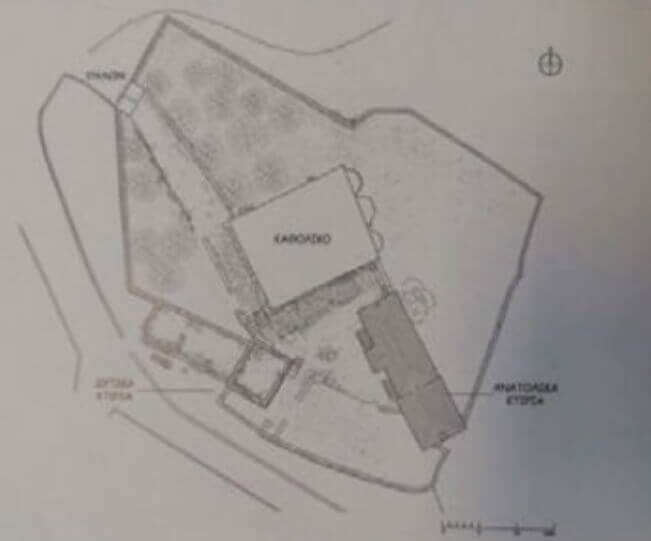
The monastic precinct of Vlacherna appears as an irregular polygon, with maximum dimensions of about 60 x 45 m. The precinct likely respects the form of the original Byzantine monastery, although the current constructions are post-Byzantine, except for the katholikon (main church).
Access to the complex is through a monumental pillar, integrated on the west side of the first and largest enclosure, which embraces the former katholikon from the west, north, and east.
The katholikon, located at the centre of the precinct, presents a quadrilateral floorplan, characteristic of most middle Byzantine temples. Its internal dimensions are 12.6 m in length (without the arch) and 12.9 m in width. The three aisles of the church are nearly equal in width, with the central aisle slightly wider. The colonnades separating the aisles consist of two large columns and a smaller one, added to strengthen and support small converging arches inscribed in a larger arch, ultimately designed to support the dome. Internally, the aisles are framed by semicircular arches, interrupted by the domes and calotte, while externally they are covered by gabled roofs.
The church functions as a vaulted dome basilica. Across the transverse axis, three domes rise – one over each aisle, with the central dome being the most prominent. The roofs, with the central one higher than the others, terminate in pediments to the east and west, featuring double windows, except for the central dome, which has a single east-facing window. The facades of the domes on the north and south sides of the church also end in pediments with single windows, a technique similarly observed in the dome of the narthex of the Saint Theodora church. Externally, the east side features three niches. The southern semicircular niche, with a three-lobed window and amphitheater-like arrangement, now serves as the niche of the Deaconry; in the original church, it functioned as the niche of the sanctuary. The other niches—the central three-sided one and the north niche—contain double-glazed windows framed with simple ceramic decoration and serrated tape on the north and south windows. The gables and east side of the church are also adorned with ceramics.
The porticoes on the south and west sides of the church, which have not survived, and the narthex were the last additions from the Byzantine era. The narthex served as the entrance to the monument, accessed through low doorways on its narrow sides. Equal in width to the church but situated at a lower level, it communicates with the church through its former main entrance, while two smaller entrances that originally led to the sides have been transformed into windows.


The lavish decoration of the Panagia Vlachernissa.
Not only the patrons of the church made sure that the church was decorated with extreme care, high quality materials, and employing skilled artists, probably from Constantinople, but most of the decoration has been – at least – partly preserved, giving us a good insight in one of the Despotate of Epirus artistic masterpiece.
The monumental painting decoration of the walls.
The frescoes of the monastery of Vlacherna have been dated, those of the main church in its final configuration around the middle of the 13th century (first painting phase: around 1250) and those of the late narthex around the end of the same century, shortly after 1284 (second painting phase). They rank among the most important monumental paintings of the 13th century in the state of Epirus, and more broadly in Greece. They also feature in the narthex a scene unique in Byzantine art, the procession of the icon of the Virgin Hodegetria in the streets of Constantinople, likely commandited by Anna Palaiologina, engaged in the debate around the Union of Churches promoted by Emperor Michael VIII Palaiologos.
Discover the magnificent 13th-century frescoes preserved in the church and narthex, featuring unique representations in Byzantine art.
-
Byzantine frescoes of the monastery of Panagia Vlacherna in Arta
The 13th-century frescoes of Panagia Vlacherna in Arta stand as unique examples of the sophisticated art of Byzantine Epirus.

The marble floor mosaic of the church.
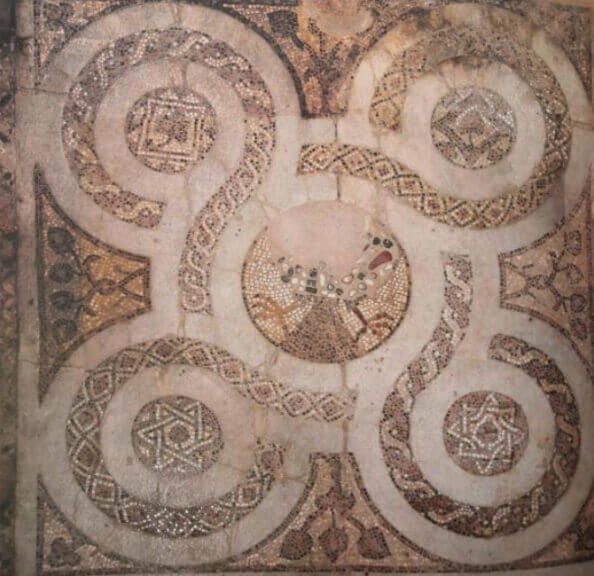
This remarkable mosaic floor, created in the first half of the 13th century, stands as the most significant example of Late Byzantine mosaic pavements in Greece and a unique testimony to the transition toward the Late Byzantine style in this art form. After the conquest of the Byzantine Empire by the Latins in 1204, the financial means to produce such high-quality marble-inlaid floors became severely limited. As a result, only a few examples survive today, preserved where exceptional local circumstances allowed their creation and conservation through the centuries. In the Despotate of Epirus, such works were particularly prized, serving both as symbols of luxury and prestige and as expressions of continuity with Byzantine cultural and artistic traditions.
The floor of the Vlacherna church was originally adorned with large white marble paving stones, within which elongated rectangular or square panels were set. Of these, only the panel of the central aisle and a few fragments from the sides remain intact. The most impressive section lies within the central aisle and refers to the theme of the Five Loaves – the Gospel story in which Jesus feeds a great multitude with five loaves of bread and two fish, miraculously multiplying them so that all are satisfied and food remains.
The marble-inlay decoration features oblique square checkerboard patterns, rows of alternating colored triangles, and sequences of circles. The mosaic bands framing the central section form interlacing chains. The tiles are colored in white, deep green, purple, and pale yellow. The overall simplicity of the composition gives visual prominence to the central mosaic medallion, located beneath the dome. This medallion depicts an eagle—its spread legs and tail are still preserved, though the upper part has unfortunately disappeared. It is likely that the original image represented the double-headed eagle.
Marble iconostasis and sculptural decoration of the Panagia Vlachernissa.
Sculpture plays a significant role in the decorative program of the church of Panagia Vlachernissa. Beyond the funerary monuments, most of the sculpted elements that survive today—either still in situ or preserved in the archaeological collection of Panagia Paregoritissa—originate from the marble iconostasis of the katholikon. This marble screen was probably created during the reign of Michael II Komnenos Doukas, when the monastery underwent major renovations, possibly following the earthquake of 1231.
The original iconostasis is no longer preserved in its entirety. It was likely destroyed during the Ottoman period and replaced by the current wood-carved iconostasis of the 17th century. However, several fragments were reused in later masonry works, especially around the narthex entrances, while others were discovered in various monuments across Arta.
The most remarkable surviving fragment is the left section of the entablature, depicting the Archangel Michael, now set above the south entrance of the narthex. The archangel faces right, his hands raised in prayer, rendered with exceptional delicacy in both drapery and expression—an impressive example of Late Byzantine sculptural finesse.
Other surviving pieces of the marble iconostasis, including sections of the epistyle, pilasters, and colonnades, now frame the gates of the narthex. Their relief decoration features spiral stems, vine scrolls, anthemia, birds, and medallions with archangels venerating the Virgin. These motifs, carved with remarkable precision, attest to the high artistic standards of Constantinopolitan workshops, suggesting that the sculptors of Vlachernissa, like the painters of its frescoes, were trained in the capital’s tradition.
Additional fragments include reliefs depicting griffolions—mythical creatures combining the features of a griffon and a lion—illustrating the rich symbolic vocabulary of Byzantine decorative art.
Some of the church’s column capitals, in Ionic and Corinthian styles, as well as five marble thresholds, were likely spolia—reused architectural elements originating from ancient monuments of Ambrakia, which remain unidentified today.
Finally, fragments of funerary monuments, once housed within the church, represent another important group of sculptures, offering insight into the funerary practices and artistic patronage associated with the monastery’s noble benefactors.
The funerary monuments: Evidence of the Despots of Epirus’ Mausoleum?
Earlier scholarship often held that the Vlacherna Monastery served as the mausoleum of the Komnenos-Doukas dynasty, rulers of the Despotate of Epirus. However, more recent studies tend to attribute the two surviving tombs to the aristocratic Petraliphas family, originally of Latin descent, who were allied with the Komnenos-Doukas through the marriage of Theodora Petraliphas to Michael II.
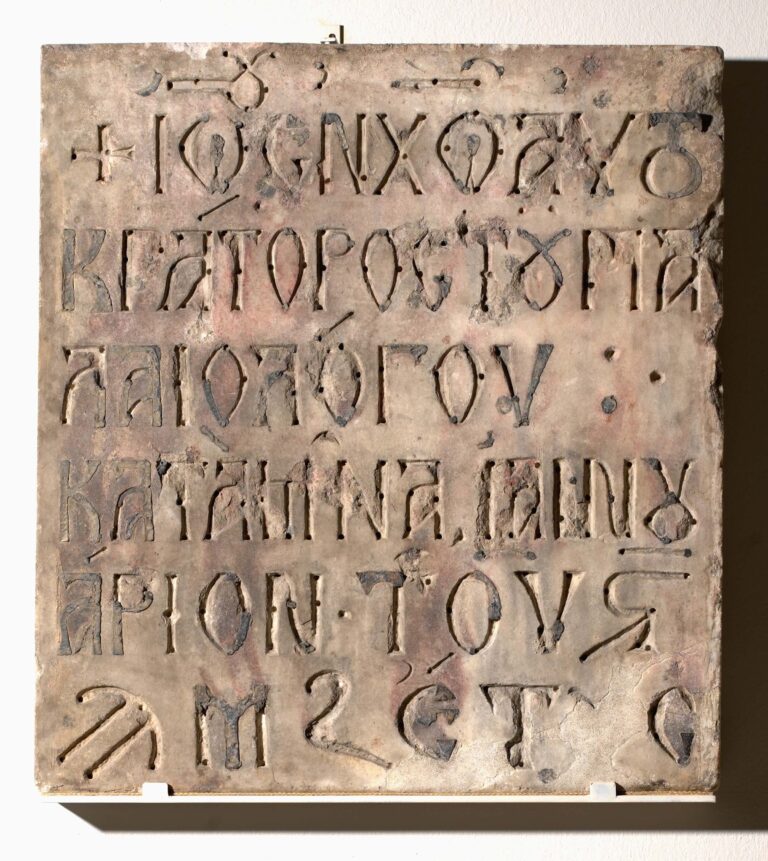
Two tombs have survived, though they were deeply altered over time. Scholars believe they were assembled using elements from three different monumental sepulchers. Both tombs take the form of composite sarcophagi, featuring carved reliefs and inscriptions. Some of these elements are now preserved in the archaeological collection of Panagia Paregoritissa.
Based on the inscriptions and reliefs, debate continues over the original occupants of these tombs. In the past, they were attributed to prominent members of the ruling Komnenos-Doukas family. Recent research, however, challenges this view, suggesting that the funerary monuments more likely belonged to members of the influential Petraliphas lineage.
The brickwork and ceramic decoration.
The church of Panagia Vlacherna is remarkable for its ceramic decoration, which displays an exceptional variety of forms and a distinctive freedom of design. The decorative program reveals a deliberate balance between ornamental richness and restraint – an interplay of symmetry and asymmetry that results in a composition both dynamic and harmonious.
The brickwork ornamentation is concentrated primarily on the eastern façade, the pediments, and the small domes, while the remaining walls are more modestly treated. A wide range of decorative motifs and techniques can be observed, including jagged bands, meanders, herringbone patterns, crosses, stylized vegetal motifs, and even inscribed letters.
The Monastery of Panagia Vlacherna in Arta stands as a key monument of the Despotate of Epirus, reflecting the close ties between the ruling elite and religious institutions. Its 13th-century architectural transformations, lavish frescoes, marble floors, and sculptural decorations reveal both the high quality of its artistry and the influence of Constantinopolitan craftsmen. As a rare example of the transition to Late Byzantine art, the monastery offers invaluable insights into the cultural, political, and artistic ambitions of the period, making it a cornerstone of Epirus’ historical and artistic heritage.
Sources.
P. Vokotopoulos, “Arta,” in Alte Kirchen und Kloster Griechenlands, ed. E. Melas (Schauberg 1972) 135-6.
Dorothea Papathanasiou, Konstantinos-Michael Photeinis, Aikaterini Schismenou, 10 Statements of Significance in ancient, byzantine, ottoman and modern Arta, Transnational Cooperation Programme Interreg Greece‐Albania 2014 ‐2020, 2021.