
Byzantine frescoes of the monastery of Panagia Vlacherna in Arta
The Byzantine frescoes of the Monastery of Vlacherna in Arta date to the 13th century and belong to two principal phases of decoration corresponding to the construction of the church. The first phase, from the mid-13th century, adorns the main church; the second, from the late 13th century, decorates the narthex. Executed with remarkable technical mastery and stylistic refinement, these paintings rank among the finest examples of monumental Byzantine art from the Despotate of Epirus. Their high artistic quality suggests the involvement of painters trained in Constantinople, reflecting the capital’s enduring influence on provincial artistic production.
The narthex cycle is especially notable for including a unique scene in Byzantine art — the Procession of the Icon of the Virgin Hodegetria through the streets of Constantinople. This exceptional depiction was likely commissioned by Anna Palaiologina and reflects the political and theological tensions surrounding the Union of the Churches under Emperor Michael VIII Palaiologos.
Discover more about the history and architecture of this remarkable monastery of Arta.
-
Monastery of Panagia Vlacherna in Arta, legacy of the Despotate of Epirus
Discover the 13th-century Byzantine Monastery of Panagia Vlacherna in Arta, one of the best-preserved legacies of the Despotate of Epirus.

History and realisation of the Late Byzantine frescoes.
Uncovered during the 1975 restoration, the frescoes of the Monastery of Vlacherna decorate niches, domes, arches, and vertical walls throughout the church. Their state of preservation varies, but their artistic and historical value remains exceptional.
The paintings were executed in two main phases that correspond to different construction periods. The first phase, likely dating to the middle of the 13th century, followed the erection of the main church. The second, probably slightly after 1284, adorned the newly built narthex under the rule of Nikephoros Komnenos Doukas and his wife Anna Palaiologina Kantakouzene.
Both phases demonstrate a high level of technical skill and a sophisticated iconographic program, making the murals of Vlacherna a remarkable achievement in 13th-century Byzantine art. The frescoes reveal the hand of well-trained and experienced painters. Their work displays mastery of technique and access to costly materials—gold leaf used in Christ’s wreath during the Passion scenes, and the precious Lapis Lazuli pigment applied to architectural details, garments, and decorative backgrounds. Such materials reflect both artistic refinement and the wealth of the patrons who commissioned the decoration of this dynastic burial church.
The painters prepared the walls with extreme care, applying a thin final layer of mortar to create a smooth surface. They achieved gloss and transparency in the colors through the rare use of black in the preparatory mixture. According to recent studies, the frescoes of the main church were executed by two workshops. Their stylistic qualities point to artists who had come to the Despotate of Epirus from Constantinople as refugees after the Latin conquest.
The frescoes of the church of the Panagia Vlacherna.
The iconographic program of the katholikon of the monastery includes scenes from the Christological cycle and figures of saints from various ranks. On the western arch of the south aisle unfold the scenes of the Prayer, the Betrayal, Pilate’s Judgment, and the Mocking, all referring to the events of Holy Thursday. In the compositions of the south aisle, the emotional intensity of the depicted figures is particularly striking.
The scene of the Prayer of Christ (Agony in the Garden).
This episode is described in the Gospels after the Last Supper. Jesus goes with His disciples to the Garden of Gethsemane, on the Mount of Olives. He asks Peter, James, and John to stay awake and pray, while He withdraws to pray alone.
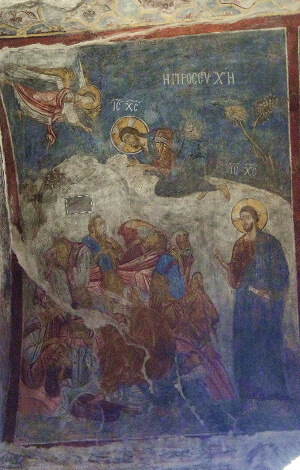
Deeply distressed, He prays to God the Father. According to Luke, an angel appears to strengthen Him, and His sweat becomes like drops of blood.
The composition is divided into two registers. The upper part depicts the Prayer of Christ. The Mount of Olives is suggested by two olive trees at the edge of the rocky landscape. Jesus kneels in prayer, His face turned downward in sorrow and mental anguish, His hands raised toward God. From the heavens, a flying angel descends to strengthen Him, as reported in the Gospel of Luke.
The lower part shows the Conversation of Christ with the Apostle Peter, as described in the Gospels of Matthew and Mark. One disciple watches the exchange, while another sleeps, resting his head on his right hand. The scene resembles the corresponding representation in the Basilica of Saint Mark in Venice, sharing both Christ’s prayerful posture and the distinctive folding of the right foot beneath the left.
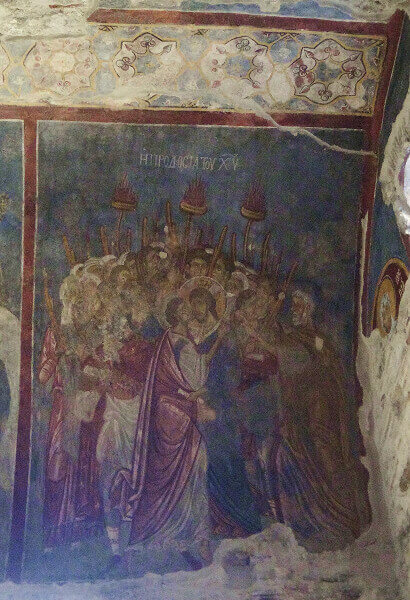
The scene of the Betrayal of Judas.
In this scene, identified by an inscription at the top, the grieving Christ receives Judas’s kiss. Behind them, a crowd of Jews and soldiers stands with lanterns, torches, and weapons, ready to seize Him.
At the right edge of the composition, Peter raises his knife to cut off the ear of the high priest’s servant, Malchus. The painter depicts Malchus leaning on Christ’s arm, anticipating the episode’s outcome – Peter’s reprimand and Christ’s healing of the wounded man.
At the center, Judas grasps the ends of a white rope already looped around Christ’s neck – a rare detail in Byzantine art. This striking feature visually underscores Judas’s responsibility for the arrest and ensuing Passion of Christ.
The mocking scene.
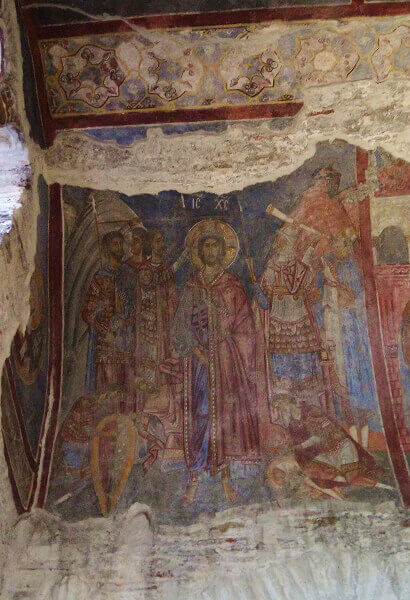
In the Mocking scene, Christ occupies the center of the composition. He wears a crown of thorns, emphasizing His dominance within the scene. This effect is reinforced by His luxurious garments and upright posture, but above all by His austere expression and the majesty of His face conveying authority and dignity.
To the left, a mime laughs at Him, while soldiers holding spears continue to mock Christ, highlighting the contrast between human cruelty and divine composure.
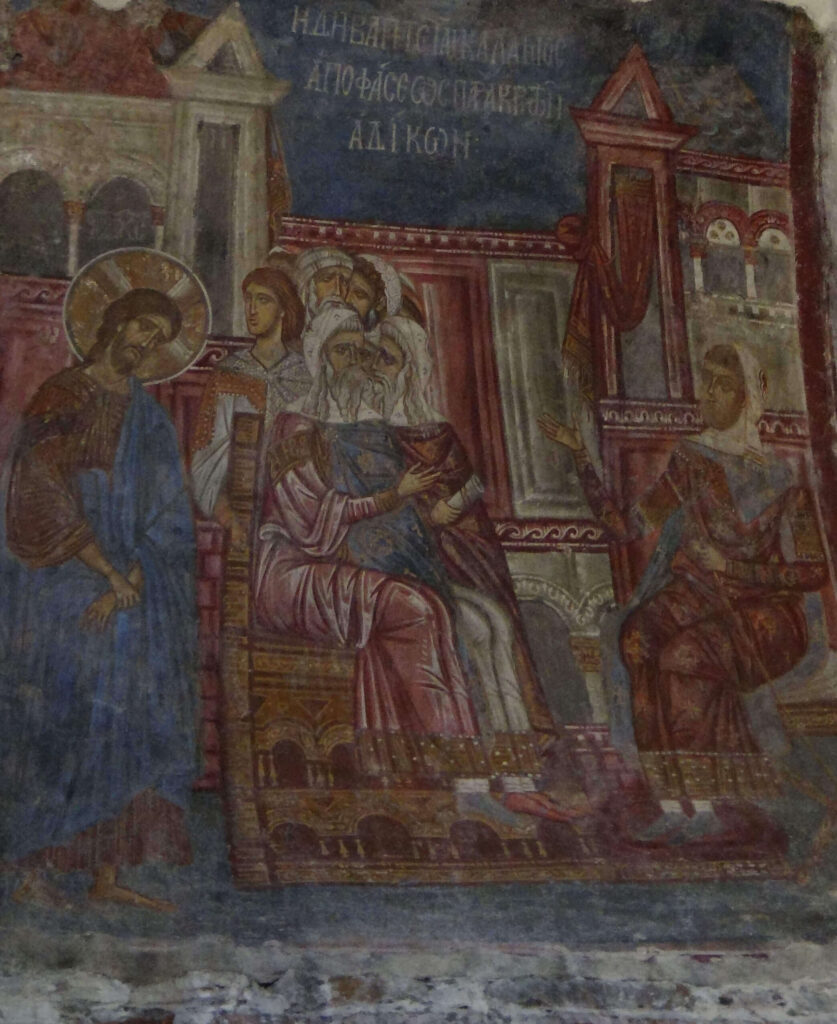
The Judgment of Pontius Pilatus.
In front of majestic buildings rendered with luxurious detail, the two high priests, Anna and Caiaphas, sit on the left, holding the Law that condemns Christ to death.
On the right, Pontius Pilate is depicted holding a scepter.
Behind him, the scribes and Pharisees appear to agree with the judgment.
Christ, his face weary from the blows of the Mocking, is brought to court with His hands bound.
The Deposition and the Resurrection.
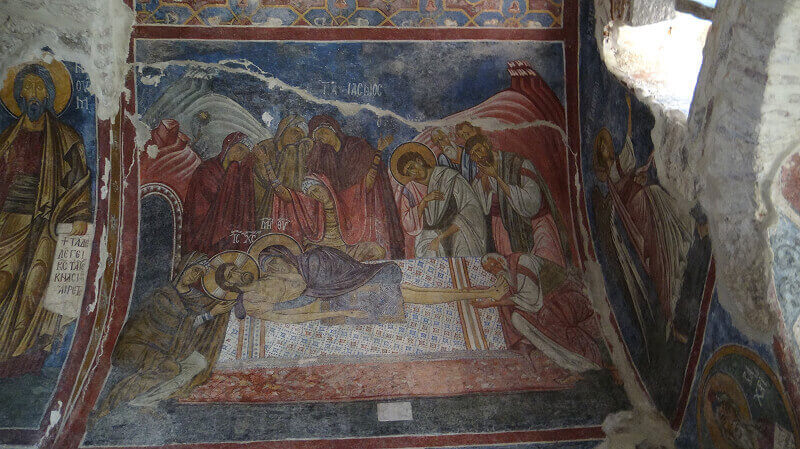
Another striking scene is that of the Lamentation over Christ. In the background, rocky hills appear. In the foreground, Christ has been taken down from the Cross and lies upon an embroidered cloth. A woman – Mary Magdalene – bends to touch His head, while His mother, the Virgin Mary, leans over His body in grief. At His feet, a man, likely John the Apostle, gently holds Him.
Behind them, on the right, four male disciples or followers stand in sorrow while on the left, four women mourns with deep emotion. The scene captures the moment between the Crucifixion and the Entombment, emphasizing both human mourning and divine pathos.
Unlike the southern aisle, the north is dominated by a sense of splendor with more plastic tones, while Christ in the next two scenes is presented in a hegemonic form in the type of the Pantocrator.
The Greeting of Myrrh-Bearers.
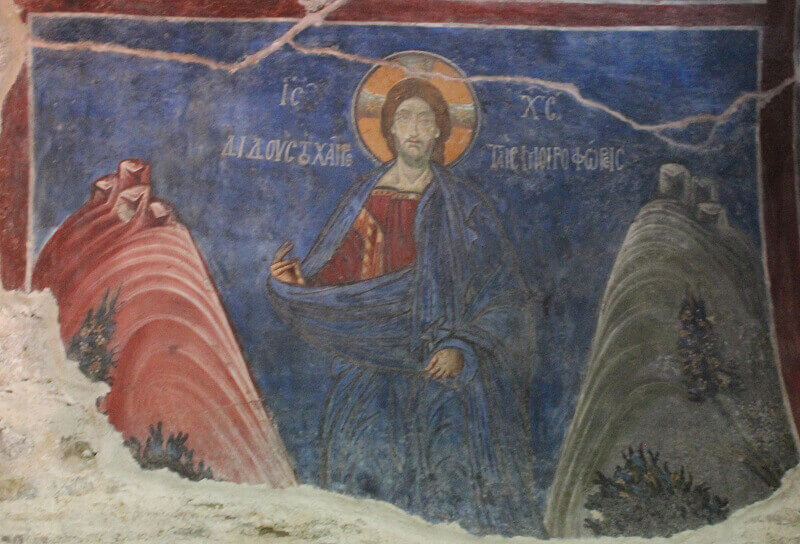
This scene depicts the moment when Christ appears to the Myrrh-Bearing women and greets them – the first revelation of the Resurrection, making them the first witnesses and heralds of His victory over death. The depiction follows the conventions of Byzantine art: the risen Christ stands at the center of the composition, flanked by two mountains that reminds of the rocky landscape depicted in the Lamentation scene. He is radiant and dressed in luxurious, brightly colored garments, symbolizing the splendor of the Resurrection. The Myrrh-Bearers appear below Him, in the lower section of the composition, which has suffered extensive damage over time.
The Incredulity of Saint Thomas.
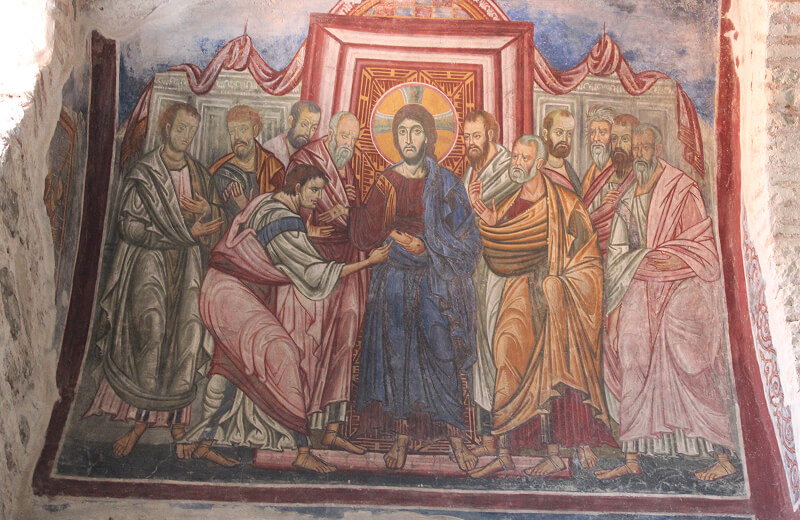
In this vivid and well-preserved scene, the painter masterfully renders the wounds on Christ’s hands from the nails of the Crucifixion. He depicts the moment when Christ, with His right hand, invites the doubting Thomas to touch His side. Thomas reaches out his hand, while the other disciples watch in astonishment. At the same time, the composition invites all believers and non-believers alike to witness and affirm Christ’s Passion and Resurrection. The scene is framed by architectural elements and draped curtains, effectively emphasizing Christ’s figure and suggesting the indoor setting of the event.
The Healing of the Paralytic.
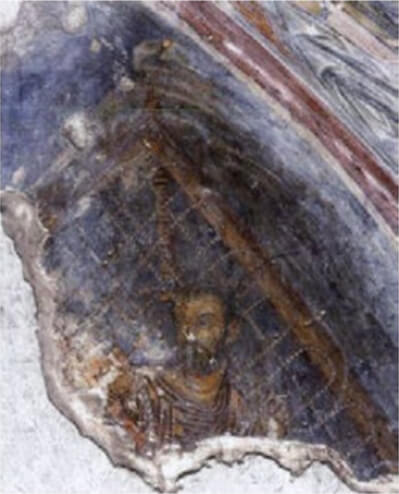
The episode of the Healing of the Paralytic at Bethesda is partially preserved. On the left, Christ stands prominently among a small group of three disciples. On the right, the figure of the paralytic is shown rising at the command of the Lord (“Take up your bed and walk”, John 5:8). The bed lies diagonally, parallel to his movement, stripped of mattress and bedding. The paralytic looks at Christ with admiration, emphasizing the miraculous nature of the healing.
The Scene of Pentecost.
The Pentecost scene likely occupied the entire dome of the southern arch, with the central motif depicting either the Preparation of the Throne or a representation of the Holy Spirit. Only three apostles with halos survive, seated on thrones around the central throne. In the background, a light red hue suggests the flames of the Holy Spirit appearing as fiery tongues.
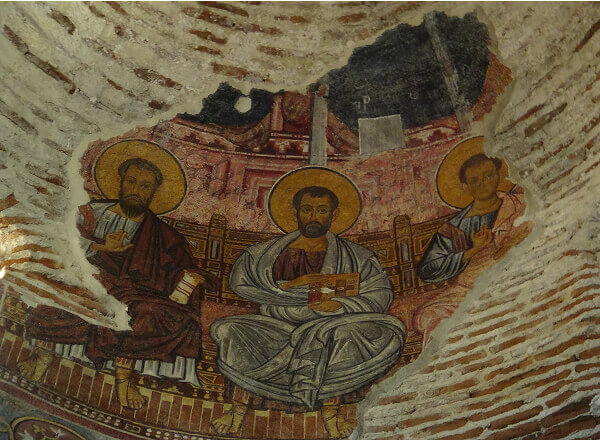
The iconographic program of the Holy Bema.
The bema is the raised area around the altar in a Byzantine church, reserved for clergy and the performance of the liturgy. In the Panagia Vlacherna, two consecutive representations from the cycle of the Mother of God are preserved, reflecting the church’s dedication to the Virgin of the Blachernae.
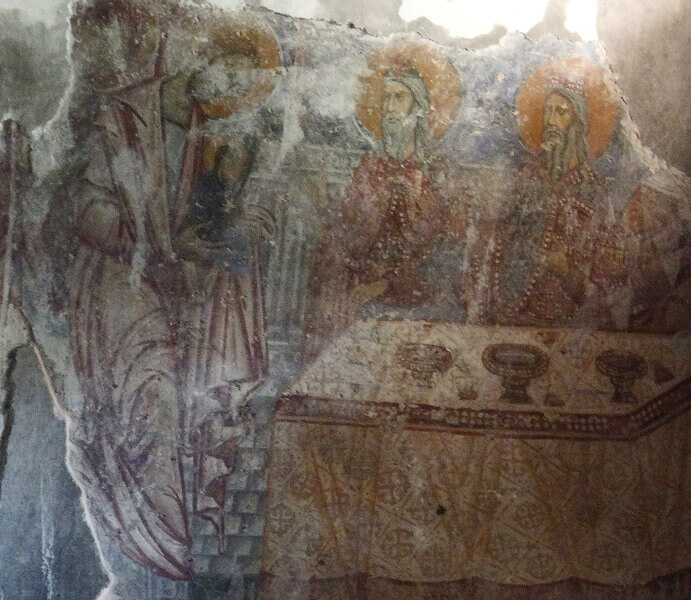
In the upper zone, the Blessing of the Priests is depicted, a theme rarely represented in monumental painting before the 13th century.
In the lower zone, the Assumption of the Virgin and Elizabeth is shown. Another scene shows Joachim approach with his head bowed in respect for the priests of the Old Testament. He holds the infant Virgin, who sits with a richly patterned garment and a mask, confronting the priests face to face. Behind him, Saint Anna follows, completing the composition.
Another scene depicts the Kiss of the Virgin with her older cousin Elizabeth, when Elizabeth welcomes her into her home. The painter captures both the youthful face of the Virgin, with her large almond-shaped eyes and delicate features, and the aged, wrinkled face of Elizabeth. Their emotional embrace reflects a variation common in the mid-Byzantine period. The intensity of their gesture is further emphasized by the rich folds of their garments and the dynamic posture of their bodies.
Individual figures are also depicted. They include Saint John the Baptist and Old Testament prophets, such as Ezekiel, as well as the king-ancestor of Christ, Hezekiah, shown in a unique pairing with Solomon. Hierarchs such as Saint Eleftherios and hymnographers like Saint John of Damascus and Saint Kosmas the Melodist are also present. Among the witnesses is Saint Mardarios, whose bust appears in a deep-red medallion in the southwestern recess of the southern dome, below the Pentecost scene. Possibly, the other Five Witnesses of Sebaste—Afxentios, Eugenios, Mardarios, and Orestes—were depicted on nearby surfaces. These saints were popular in Byzantium during the mid-Byzantine period for their healing activities, with Mardarios belonging to this tradition. He is shown holding the cross of martyrdom in his right hand, with his left hand raised, palm outward. His luxurious garments suggest a wealthy person of Oriental origin. Saint Damian and Saint Anargyros also appear, likely depicted together with Saint Kosmas Anargyros. Saint Damian holds a box of medicines in his left hand and a pair of tweezers in his right. Below him, the upper part of another full-body witness survives, most likely Saint Polyeuctus.
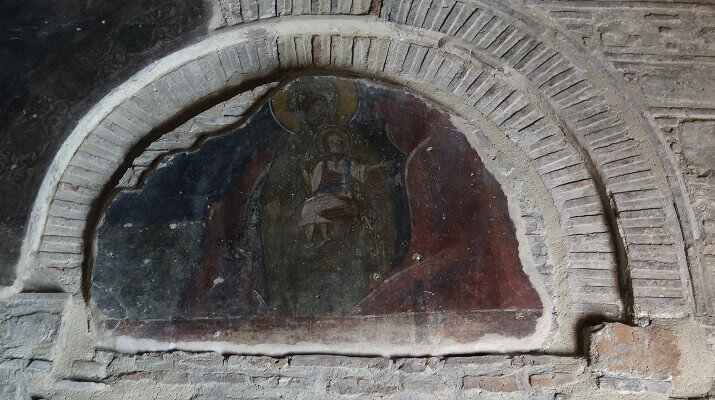
The frescoes of the narthex.
The construction and decoration of the narthex date to the time of Nikephoros I Komnenos Doukas (1267–1296) and his wife Anna Palaiologina Kantakouzene, niece of Emperor Michael VIII Palaiologos. The frescoes include scenes from the Second Coming in the furnace and depictions of the Four Ecumenical Councils on the southern arch. The Hospitality of Abraham appears on the tympanum of the south wall. The west side shows the Litany of the Icon of the Virgin Hodegetria in Constantinople. Other compositions depict the Virgin Mary with two accompanying archangels, the Flight of Elizabeth, and figures of holy hierarchs, martyrs, and saints. Unfortunately, the preservation of these frescoes is poor, and many sections have been lost.
Second Coming.
The Second Coming, in Christian belief, is the future return of Christ at the end of time to judge the living and the dead and establish God’s kingdom.
The scene of the Second Coming occupies the half-dome of the narthex. Only certain elements have survived, which allow us to identify the scene but do not permit a full reconstruction or detailed study. The composition is organized in perimetric cycles, most likely two, around a central figure, presumably the Righteous Judge, Christ. In comparable depictions, Christ is seated on a throne, calling the faithful to enter Paradise with an outstretched right arm. The righteous are placed on His right, the impenitent on His left.
From the surviving figures of the righteous, some bodies are visible in luxurious garments, with halos around their heads. The leading figure of the congregation holds a parchment containing the Mass, though the text is illegible. Christ is surrounded by the Apostles, seated on thrones, as indicated by the two surviving apostolic figures.
Two elements of Paradise survive. One depicts Abraham, a common Old Testament motif, holding a sheet in which the heads of two infants from Herod’s Massacre of the Innocents are visible. The second shows a formalized paradise landscape with trees and nature. Among them appears the Penitent Thief, depicted naked except for a cloth around his waist. His head is bowed, and he holds the cross of his martyrdom, a detail that identifies him.
The Second Coming was a frequent theme in the Middle Byzantine period, appearing in both miniature and monumental painting. Examples include Our Lady of Chalke (1030), the first layer of St. Stephen in Mavriotissa, Kastoria (9th century), churches in Cappadocia, Torcello (1200), Our Lady in Kritsa, Crete, St. Demetrius Avlonarius, and the Chora Monastery (1314–1320).
Ecumenical Councils.
The Four Ecumenical Councils established the dogmas of the Church and safeguarded the correctness of the faith. Failed attempts to unite the churches, along with the East’s distrust of the Pope and Western rulers, compelled the Byzantines to defend the purity of their faith.
On the southern arch, the first Ecumenical Council of Nicaea (325) is identified by the name of Arius, written on the chest of the first of two heretics. At the center, on an elevated throne, Emperor Constantine presides over the Synod. Behind him stand official guards, while two hierarchs sit on either side. In front, hierarchs confront a few heretics.
One group includes five holy high priests. The first holds a scroll containing the decisions of the Synod. Arius, dressed in bright green, turns to the high priests in a gesture that seems apologetic, while the priests maintain serious, decisive expressions.
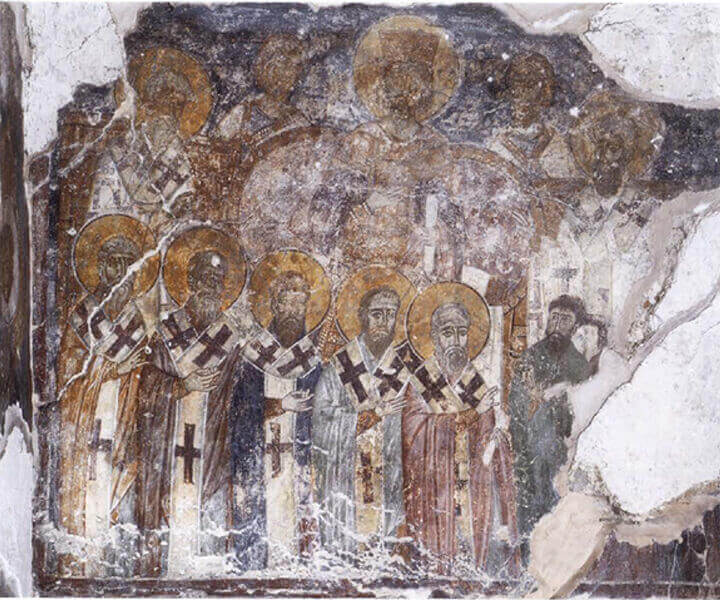
The other Ecumenical Councils survive only in fragments and follow a similar iconographic pattern. Two women are also present in these fragments. Scholars speculate that this iconography may depict either the Synod of the Vlachernai or the Synod of Adramytion.
Fresco of Abraham’s Hospitality.
This notable depiction, symbolizing the Holy Trinity, has been deliberately placed between the Ecumenical Councils that addressed dogmas and heresies. The composition includes a rectangular table with two glazed white bases and white plates. Abraham is seated on the left, while Sarah appears on the right. She holds a small jug in one hand and presses a white towel to her chest with the other, conveying both restraint and disbelief at the announcement of Isaac’s birth.
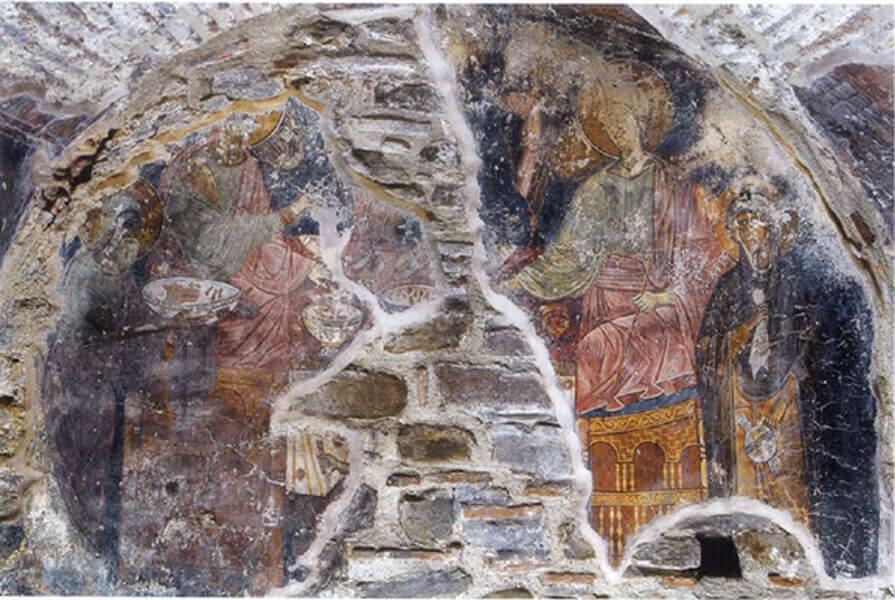
The Christmas Verse.
In the northernmost apse of the west wall of the narthex at the Monastery of Vlacherna in Arta survives a rare and partly preserved fresco known as the Sticheron of Christmas (Christmas Verse). This remarkable composition represents one of the earliest known visual interpretations of the hymn. It accompanies the idiomelon sung during Vespers on the feast of Christmas and again on December 26, at the Synaxis of the Most Holy Theotokos in Vlachernai.
Translation of the hymn:
What shall we bring you, Christ, who have appeared on earth as man for our sake? For each creature made by you gives you thanks, bringing: The angels, their song; heaven, the star. The Wise Men, gifts; the shepherds, the miracle; the earth, the cave; the desert, the manger; and we the virgin mother. God, who is before all ages, have mercy on us.
The inclusion of this doxological hymn to the Virgin Mary, balanced by the depiction of the Procession of the Hodegetria on the opposite wall, reflects the deep veneration for the Virgin Vlachernitissa, to whom the katholikon was dedicated. Both scenes express honor and praise to the Theotokos, whose glory and intercession were central to Byzantine spirituality
The fresco illustrates also how, after the period of Iconoclasm – and particularly during the Palaiologan era – new iconographic programs emerged, inspired by the hymnography of the Church. According to the text of the Christmas Verse, the Virgin appears enthroned with the Child Christ on her lap, though only the lower part of the scene survives. She sits on a throne with a dotted footstool, wearing a blue tunic, and holds the infant Christ at her feet. The composition is deliberately austere: no architectural background or landscape interrupts the spiritual focus.
To either side of the Virgin, in perfect symmetry, stand the Magi and the shepherds. The Magi, richly dressed as kings, offer gifts in rectangular caskets, while the shepherds, in humble attire, gaze in awe at the miracle. One young Magus and one shepherd gesture toward the Virgin, their expressive movement inviting the viewer to share in their praise and wonder. An older shepherd, barefoot and clothed in a coarse blue cape, raises his hands in astonishment and prayer.
Below the Magi appears the personification of Earth – a regal female figure dressed in fine garments – offering a cave as her gift to Christ, echoing the verse “the earth, the cave.” Opposite her, the Desert, depicted as an elderly woman with white hair and a simple robe, presents a manger, fulfilling “the desert, the manger.” At the bottom, groups of men and women—kings, clergy, monks, and laypeople—raise their hands toward the Virgin and Child in adoration, offering themselves as the gift of humanity.
In the now-lost upper part of the composition, angels and celestial symbols likely appeared: the hymn, the star, and the heavens, completing the cosmic chorus. Drawing from familiar iconographic models of the Nativity and the Adoration of the Magi, the painter skillfully merged these with new theological imagery to create a unified vision of universal praise – an image of all creation offering homage to the Incarnate Word and His Mother.
This synthesis recalls early imperial iconography, where rulers received gifts from personified provinces or cities. Here, however, the focus shifts from imperial power to divine revelation. The fresco serves both as a hymn in color and a theological statement—celebrating the mystery of the Incarnation, witnessed and glorified by heaven, earth, and all humankind.
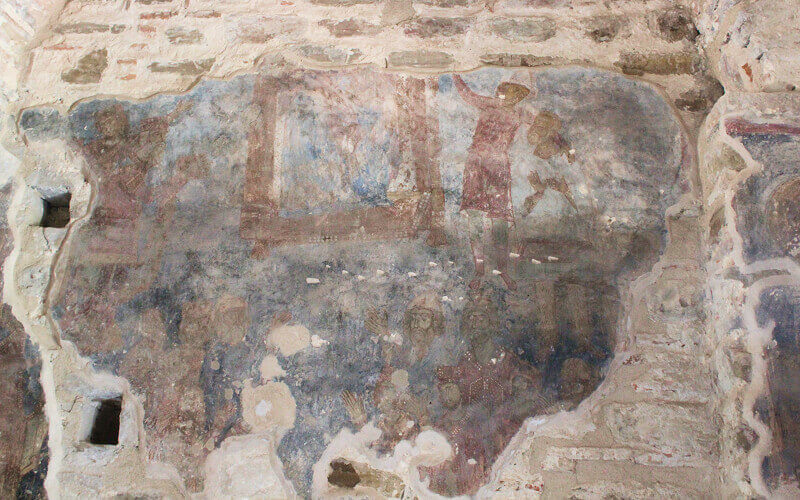
The Litany of the icon of the Virgin Hodegetria, a unique depiction in Byzantine art.
The fresco in the south arch of the west side of the narthex at Panagia Vlacherna in Arta depicts the Litany of the Icon of the Virgin Hodegetria, a unique subject in Byzantine monumental painting. The composition, although partially damaged, vividly represents the famed Constantinopolitan procession established by Empress Pulcheria (r. 414–453) at the Hodegon Monastery, where the miraculous icon of the Virgin Hodegetria was venerated every Tuesday. This image held immense religious and political importance in Byzantium, serving as a palladium and symbol of divine protection for the empire. The artist’s meticulous attention to topographical and ceremonial details suggests either a Constantinopolitan origin or direct knowledge of the litany, reflecting the living memory of the capital’s traditions in provincial Epirus. The inclusion of clergy, deacons, aristocrats, and common worshippers captures both the grandeur of the ritual and the diversity of its participants, embedding the provincial church of Arta within the spiritual landscape of the imperial metropolis.
Iconographically, the fresco intertwines historical memory with contemporary references. The three aristocratic women – identified as Irene-Eulogia, her daughter Anna Palaiologina Kantakouzene, wife of the Despot of Epirus, and Theodora Raoulaina – symbolize reconciliation after the schism of the Council of Lyon (1274) and the restoration of Orthodoxy under Andronikos II. Surrounding scenes of vendors and market life, with detailed depictions of caviar sellers, vegetable merchants, and women offering holy water, evoke the vibrant Constantinopolitan square that framed the procession. These figures, rare in Byzantine art, highlight women’s active roles in public and commercial life. The fresco thus fuses sacred ritual with urban realism, presenting both a historical commemoration of Anna’s return to Orthodoxy and a vivid portrayal of Constantinople’s devotional and social life as remembered from afar in late thirteenth-century Epirus.
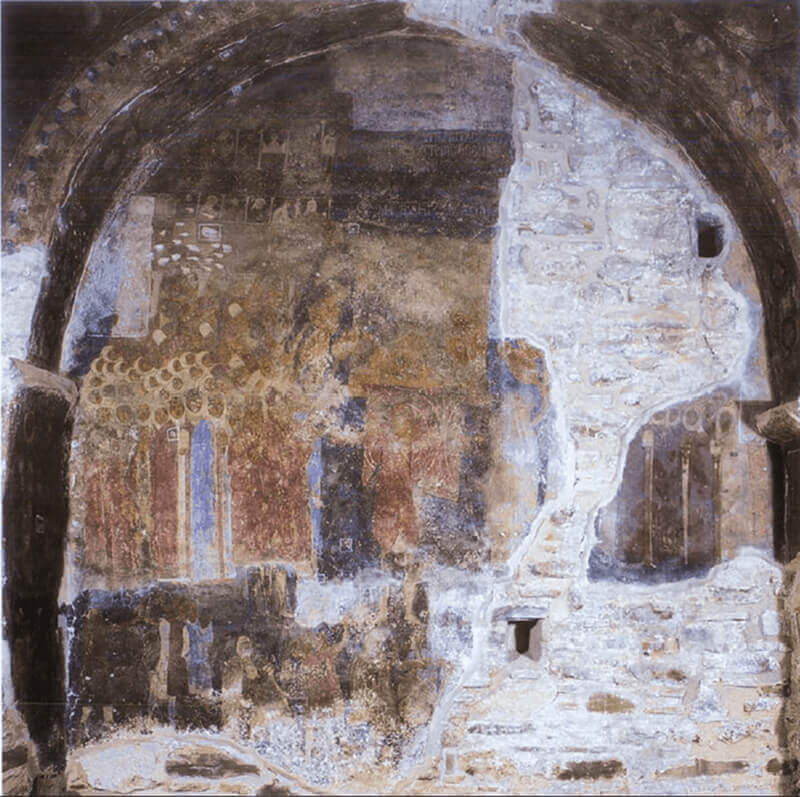
Later post-Byzantine frescoes.
In the 19th century, parts of the narthex were covered with new plaster, and the east side was repainted. On either side of the main gate appear busts of Christ, the Virgin, John the Baptist, and the martyr Christopher. The Virgin is depicted in a bust with Christ in her arms, bearing the name Vlacherna and surrounded by fiery clouds. These 19th-century frescoes are roughly contemporary with the painting in the dome of the main church.
Sources:
Recent studies of the monument were published by Giannoulis, 2010; and Acheimastou-Potamianou, 2009).