
The Mosaics of the Church of the Panagia Paregoritissa in Arta
The mosaics of the church of Panagia Paregoritissa in Arta rank among the most ambitious – and ultimately unfinished – artistic programs of the late 13th-century Byzantine world. Commissioned by the Despots of Epirus for their capital’s grandest church, these mosaics were conceived to rival the splendor of Constantinople and Thessaloniki, reflecting both artistic ambition and political aspiration. However, political turmoil and the death of their patron, Nikephoros I Komnenos Doukas, likely brought their completion to an abrupt end. What survives today offers a rare and revealing glimpse into the technical mastery, iconographic sophistication, and interrupted legacy of a Byzantine successor state.
The political context of the mosaic program of the Paregoritissa.
The emergence of a Byzantine successor state: The Despotate of Epirus.
After the Fourth Crusade fragmented the Byzantine Empire in 1204, the Byzantine noble Michael I Komnenos Doukas seized control of lands once loyal to Constantinople around Arta, in northwestern Greece, and founding the Despotate of Epirus. He established a dynasty, and his nephew, Theodore Komnenos Doukas (r. 1215–1230), transformed the Despotate into one of the most powerful Greek successor states. Theodore expanded its territory, conquering Thessaly, Macedonia, and Thrace, and even capturing Thessaloniki in 1224, where he crowned himself Emperor in a bold claim to the Byzantine throne.
However, Theodore’s ambitions collapsed in 1230, when a crushing defeat by the Bulgarians at the Battle of Klokotnitsa shattered Epirote power. His successors ruled over a shrinking and increasingly unstable territory, centered on Arta and Ioannina. Though the Despotate remained an important regional power in the 13th century, pressure from the restored Byzantine Empire, Frankish states, and Serbian expansion gradually eroded its independence. Its territories dwindled over time, culminating with the capture of Arta by the Byzantine Empire circa 1337 and the final fall of its remnants to the Ottomans in 1479.
Michael I Komnenos Doukas fortified Arta in the early 13th century, making it the Despotate’s initial capital and power base. Throughout the century, the ruling family expanded the city’s religious architecture, adding monuments such as the Church of the Kato Panagia and the Monastery of Saint Theodora. However, their most impressive commission was the Panagia Paregoritissa, intended as the cathedral church of Arta and a reflection of the prestige of the Doukas-Komnenos dynasty.
Architectural grandeur of the Paregoritissa.
-
Church of Panagia Paregoritissa, Byzantine masterpiece in Arta
Discover the Panagia Paregoritissa in Arta, a masterpiece of the Despotate of Epirus, with innovative architecture and striking mosaics.

Likely replacing an earlier structure from circa 1250, the current church is dedicated to the Virgin – Panagia Paregoritissa, meaning “Our Lady the Comforter.” It dates to the 1290s and was completed under the patronage of Nikephoros I Komnenos Doukas (r. ca. 1268–1297), his wife Anna Kantakouzene, and their son Thomas. By commissioning such a grand religious monument, the dynasty asserted its political legitimacy, wealth, and commitment to Orthodox Christianity, serving as a bold statement of defiance and faith during a period of instability.
The Paregoritissa’s exceptional scale distinguishes it from contemporary structures. The ground-floor plan measures 20 by 22 meters, combining a cubic exterior with a central dome supported by eight pilasters and three tiers of columns. This innovative design created an open, uninterrupted interior, a rarity in Byzantine architecture.
Architecturally, the church reflects the patrons’ ambition to rival the great churches of Constantinople and Thessaloniki. At the time of its construction, it was likely the largest Byzantine-era church in Epirus and the second-largest in Greece, surpassed only by Hagia Sophia in Thessaloniki. Its bold design served as a visual declaration: the Despotate of Epirus was not merely a regional power but an heir to the Byzantine imperial tradition.


The mosaic program of the Panagia Paregotissa.
The mosaics preserved today in the Panagia Paregoritissa are confined to the dome and its pendentives. From the surviving elements, scholars have reconstructed an upper-register scheme consistent with other late Byzantine domes: the cosmic Christ Pantocrator above, flanked by the four Evangelists below.
The surviving mosaics.
The Christ Pantocrator and the heavenly court in the dome.
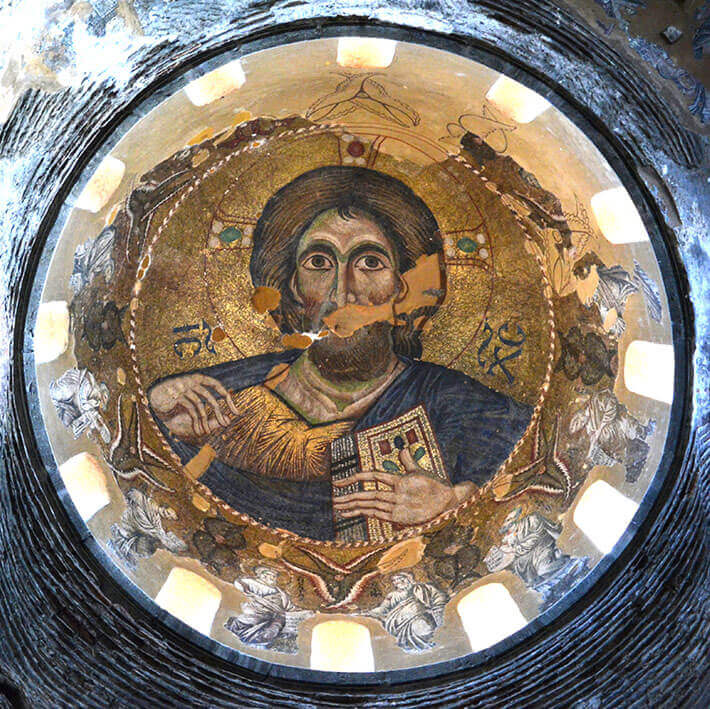
The most significant mosaic – and the only one to appear in a relatively complete state is the Christ Pantocrator and the heavenly court adorning the central dome. The mosaic circle measures 4.53 meters in diameter, with the Pantocrator’s head alone standing 2.22 meters tall. While limited to the domes, Arta’s Pantokrator and mosaics earn a mention among the most beautiful Byzantine mosaics still visible today — the art’s outpost in independent Epirus.
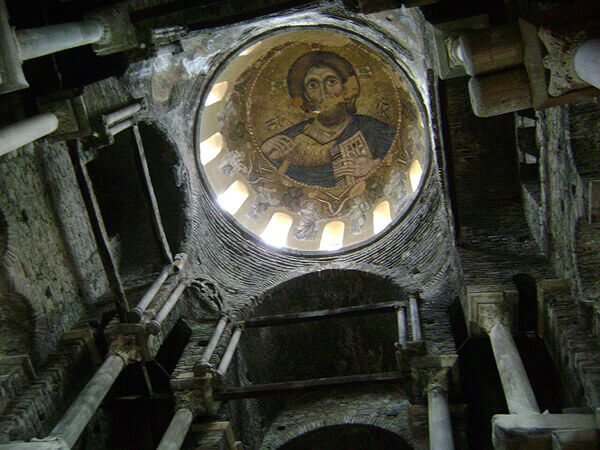
Surrounding the Pantocrator is the heavenly court, its figures arranged in hierarchical tiers to reflect their spiritual significance. Closest to Christ are the Cherubim, powerful angels in Christian angelology, often depicted as guardians of God’s throne with multiple faces or eyes (like in the mosaic), and the Seraphim, the highest-ranking angels, symbolizing divine love, purity, and holiness; they are described as fiery beings with six wings. Below, on the drum of the twelve windows, were Prophets, holding manuscripts, and identified with inscriptions. Only height of them are completely or partly preserved.
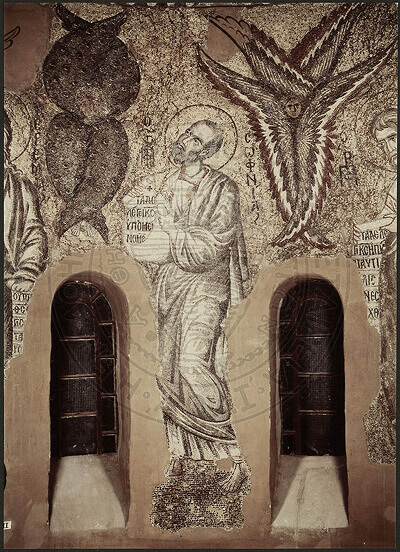
Cherubim, Prophet, and Seraphim 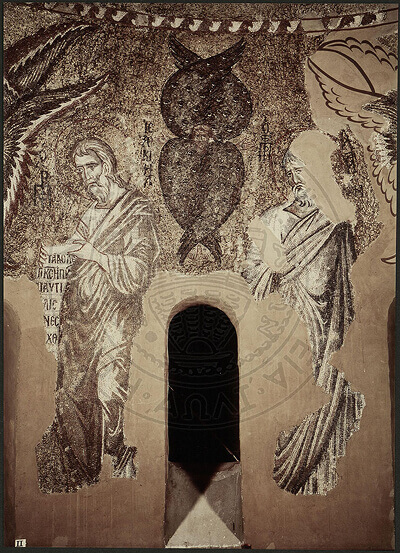
Cherubim and two prophets 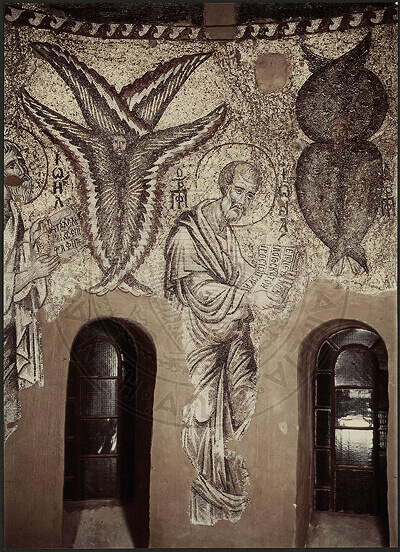
Seraphim, Cherubim, and prophets 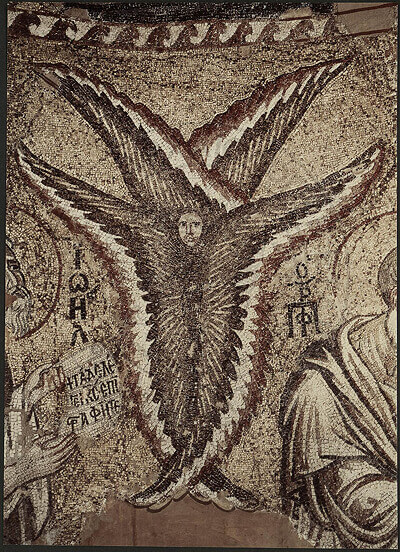
A Seraphim 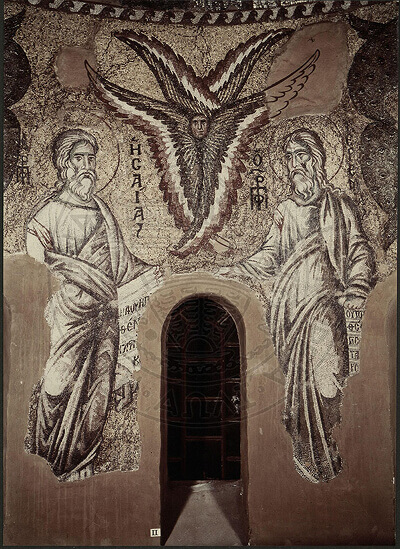
Two prophets and a Seraphim 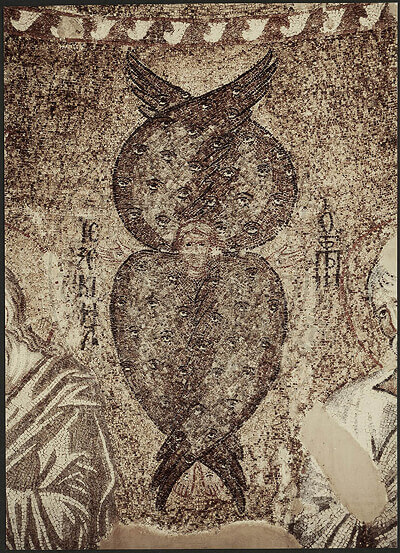
A cherubim
The Four Evangelists in the pendentives.
In the lower register, each pendentive was intended to feature a seated Evangelist. Only a fragmentary depiction of Saint Mark survives in the northwest pendentive, limited to the aureole and head. The other Evangelists endure only as traces, suggesting these mosaics may never have been completed or were lost.
Technique and influence of major Byzantine centers.
The surviving tesserae and preparatory layers reveal a three-layer mosaic stratigraphy typical of Constantinople: a coarse keyed ground, a finer bedding layer, and the tessera layer, which embeds gold and glass pieces. Stylistically, the figures combine the monumentality and soft modeling characteristic of the Palaeologan revival. Faces are rendered with delicate shading, drapery employs nuanced light and shadow, and the gold backgrounds evoke the heavenly realm.
Certain details also draw parallels with the Macedonian School, centered in Thessaloniki – particularly when compared to the mosaics of the Holy Apostles in that city. The influence of regional centers is often underestimated; while the Macedonian School maintained close ties with Constantinople, it is possible that the artists from Arta trained in Thessaloniki (which itself was influenced by Constantinople), or that a local workshop incorporated models from both centers.
A dialogue of mosaics and sculpture.
The decorative program extended beyond mosaics. The church also featured sculptural elements with Western, or “Italianate,” features, reflecting the Despotate’s openness to cross-cultural influences. Mosaics and sculpture were designed to complement each other, creating a harmonious visual experience – though most of the mosaics are now lost or unfinished.
This integrated approach highlights the Despotate’s ability to balance tradition with innovation, opening the decorative language to Western visual solutions and artistic ideas while maintaining a Byzantine aesthetic in line with the evolution of its time.
An unfinished decorative program.
Large areas of the dome and upper walls remain bare or unfinished, with missing archivolts, incomplete corbels, and unexecuted decorative zones. Scholars agree that this was not later destruction, but interruption. The most likely cause? Political disruption, likely the death of Nikephoros I around 1296–1298, which may have halted funding and labor.
Even incomplete, the scheme signals a deliberate theological message. The Christ Pantokrator in the dome declares cosmic rule. The Evangelists in the pendentives assert the Gospel foundation of the church. Taken together the program projected both spiritual authority and the political legitimacy of the Epirote court. The choice of such an ambitious dome decoration indicates the Despotate’s desire to align itself aesthetic-wise with other late Byzantine centers.
The mosaics of Panagia Paregoritissa stand as a testament to the artistic ambition and political aspirations of the Despotate of Epirus. Their unfinished state also serves as a historical indicator of the fragility of the Despotate’s power, which, despite its regional influence and imperial pretensions, ultimately failed to restore the Byzantine Empire. The surviving fragments not only illustrate the technical mastery and iconographic sophistication of late Byzantine mosaic art but also highlight the interplay between political instability and renewed cultural production in the late 13th century.
Sources.
Svetlana V. Tsymbal, Stylistic features of the mosaics in the Church of the Paregoritissa in Arta, Bulletin “Literary theory. Linguistics. Cultural studies”, 2019
Lorenzo Riccardi’s “Uniform, Incomplete and Partly Lost: On the Mosaic and Sculptural Decoration of the Paregoretissa Church in Arta” (2020,