
Church of Saint Basil of the Bridge (Agios Vasileios tis Gefyras) in Arta
This small Byzantine church of Saint Basil of the Bridge (in greek, Agios Vasileios tis Gefyras) lies about one kilometer northwest of the Bridge of Arta, in an area formerly known as “Top Alti,” a name meaning “within the range of the castle’s cannons.” It owes its name to its proximity to the bridge and to distinguish it from another church in Arta dedicated to the same saint ! St. Basil of the Market. For centuries, the church remained half-buried due to alluvial deposits from the Arachthos River. In 1969–1971, it was excavated, restored, and systematically studied.
Probably dating to the second half of the 9th century, it is considered the oldest surviving church in Arta. Yet its medieval history remains shrouded in obscurity and can only be reconstructed through later sources and the study of its architectural and archaeological features.
A small and simple church from the 9th century.
Studies carried out during the renovation of the church concluded that the building probably dates to the second half of the 9th century. Saint Basil of the Bridge is therefore the oldest church in Arta, and among the oldest in the wider region, along with the Church of Saint Demetrios at Katsouris, dating to the late 8th or early 9th century, and Saint Paraskevi at Drakos. It stands as a rare witness to the development of Arta and its surroundings during this early period, marked by the construction of several important monuments.
The church is small in size (8.65 × 5.96 meters). When first built, it was not frescoed and only received its painted decoration centuries later. It also lacked an iconostasis, suggesting a modest structure that likely served a small local community nearby. Over the centuries, the building underwent several alterations, largely due to the frequent flooding of the Arachthos River. These floods damaged the painted decoration and deposited layers of alluvium that gradually raised the ground level. By the 20th century, the church was half-buried under up to two meters of accumulated alluvial deposits. To adapt, new floors and entrances were built at higher levels during different periods over time. The narthex was also a later addition, which required the demolition of the original west wall to connect it to the new structure. The upper part of the dome was likely rebuilt during the Late Byzantine period.
The first written reference to the monument dates only to the 19th century. Seraphim Xenopoulos, Metropolitan of Arta, mentioned that the Church of Saint Vasileios of the Bridge was originally the katholikon of a monastery, renovated in 1632 under Ottoman rule by the hieromonk Theoktitos. In 1821, it served as a parish church, and subsequent repairs in 1852 further altered its form.
In 1969, the Greek Archaeological Service, under the supervision of Professor Panagiotis Vokotopoulos, began excavations and restoration works that lasted three years. They confirmed that the alluvial deposits had accumulated in three distinct phases, as evidenced by the discovery of three successive paved floors and two consecutive Holy Tables. Based on these findings and the construction techniques, Vokotopoulos dated the foundation of the church to the second half of the 9th century.
Architectural features of Saint Basil of the Bridge.
The church has a cross-shaped plan topped by a dome. It is the only church in Arta that displays a free-standing cross plan, rather than one inscribed within a rectangular structure. However, the later Church of Saint Paraskevi of Drakos shows a somewhat similar layout. The building terminates to the east with a semicircular apse.
Until 1969, the main entrance on the western side reached almost to the roof of the church. It had likely been opened after the last major flood, which had once again raised the ground level. As a result, a large section of this façade had to be reconstructed, since the excavation revealed the original position of the entrance to the narthex. During restoration, the doorway, wooden lintel, brick arched tympanum with its surrounding dentil molding, and the wall above were all rebuilt.
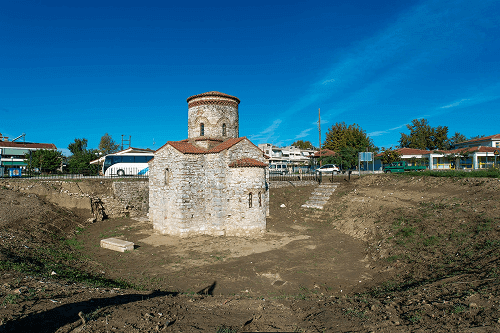
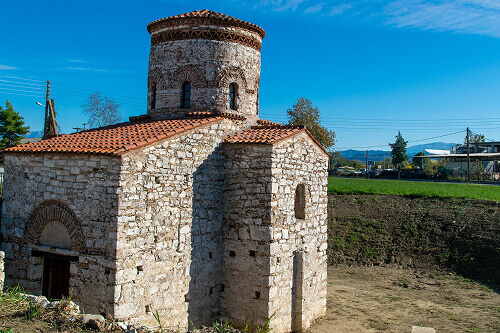
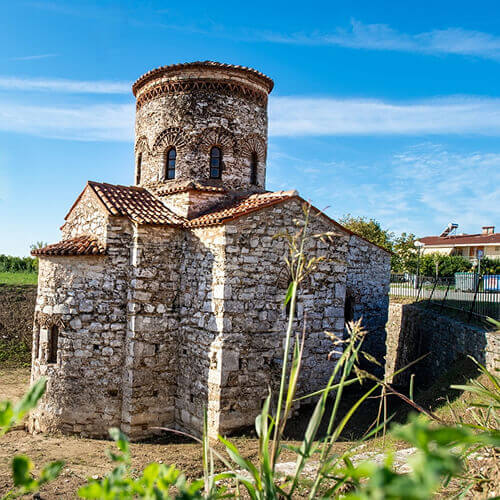
The most striking feature of the monument is its cylindrical dome with a conical roof, rising at the point where the arms of the cross meet. It appears unusually tall in proportion to the rest of the building. Archaeologist G. Velenis considered that the upper part of the dome belongs to a later construction phase, which would explain its disproportionate height. The dome is also the only part of the church that bears ceramic decoration.
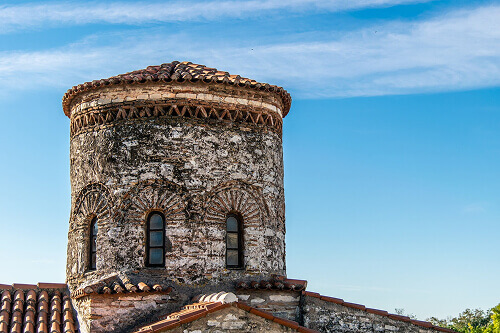
Its high drum, measuring 3.05 meters, features brick frames and dentil bands around the windows and beneath the roof cornice. A decorative ceramic band encircles the drum, showing the care given to the church’s exterior. Along this band, bricks were arranged to form a continuous zigzag pattern, a motif common in Epirote churches.
The rest of the masonry is simple and irregular, made of uneven stones and small brick fragments, with no additional ornamentation.
The monument’s plan is completed by a square narthex to the west, which extends the vertical arm of the cross. Inside, the church is small and divided into two parts—the main nave and the narthex—separated by two partially ruined piers. These piers are what remain of the original west wall, demolished when the narthex was added and the floor raised after the last phase of alluvial deposition. The entire interior is covered with barrel vaults.
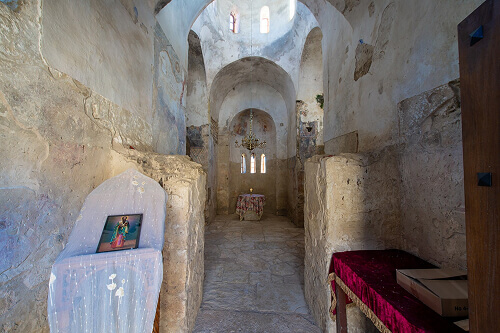
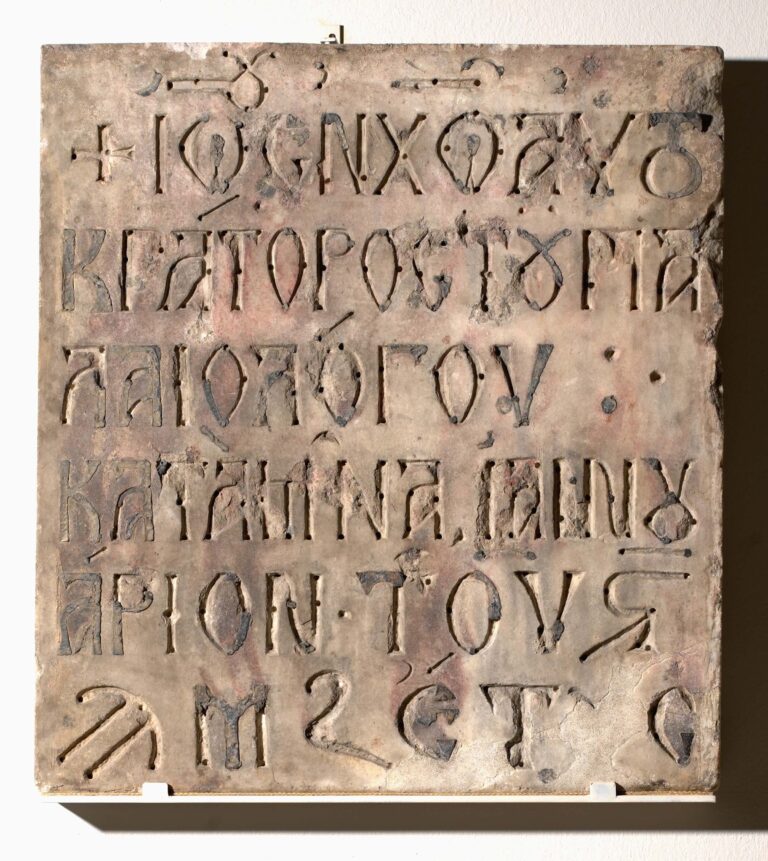
There is no iconostasis, and none appears to have existed originally, as no traces were found. No sculpted decoration survives, except for a funerary stele and half a pilaster, now preserved in the museum housed in the Paregoretissa Church. During the excavations, graves were discovered in the northern, southern, and western arms of the cross. They consisted of upright stone slabs enclosing unadorned burials.
During the 1969 restoration works, the floor was paved and a low altar was constructed.
The layers of frescoes in Agios Vasileios tis Gefyras.
Despite humidity, floods, and the wear of time, parts of the painted decoration have survived, though in poor condition. They were uncovered during the restoration works starting in 1969. Vokotopoulos then identified four layers of frescoes, each covered by successive plasters. This renewal of decoration may have been necessary due to the passage of time and repeated flooding that damaged the building. During the restoration, these layers were revealed.
The church was first decorated with frescoes centuries after its construction, in the second half of the 13th century. This period marked a golden age for Arta, then the capital of the Despotate of Epirus. Many churches and monasteries, such as the Panagia Paregoritissa, the Panagia Vlacherna, the Church of Saint Theodora, and the Kato Panagia, were built or embellished during the same decades.
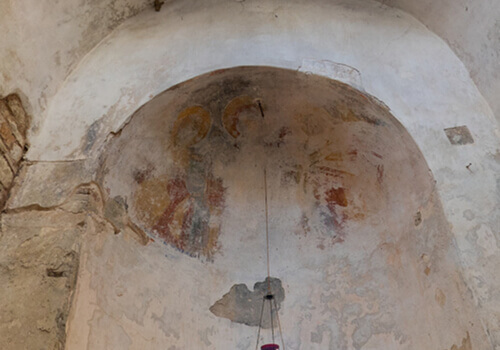
This first decorative phase is heavily damaged, yet a significant portion remains. In the sanctuary, the dominant figure of the Virgin Orans (Our Lady of the Sign) is framed by two angels. On the wall with the trifora window appear the figures of a saint, two hierarchs, and two deacons; Saint Stephen, the first martyr, is depicted on the left. Other iconographic themes include full-length frontal saints such as Saint Panteleimon and the physician saints Kosmas and Damianos.
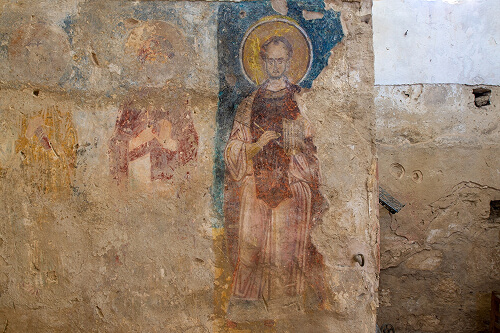
The later, post-Byzantine layers are clearly visible on part of the southern arm of the cross, to the left of the apse. A bishop is depicted frontally, and in the layer beneath him, Saint Basil appears wearing a richly ornamented phelonion. On the opposite wall of the same arm stand Saints Constantine and Helen. In the upper zone, a fragment of the Baptism of Christ is preserved. Finally, on the western wall of the northern arm, two mounted saints are depicted.
The fresco of Saint Basil likely dates to the 16th century, while the depiction of the bishop partially covering him! as well as the representations of Saints Constantine and Helen, the Baptism of Christ, and the full-length and mounted saints—belong to later phases of the 17th or 18th century, characterized by more modest artistic quality.
No scraping of the mortar covering the vault was carried out during the 1969–1972 restoration, suggesting that additional paintings may still survive in the upper part of the building, yet to be uncovered.
The Church of Saint Basil of the Bridge stands as a significant monument of the Byzantine past of Arta. Its small yet carefully designed architecture, rare free-standing cross-shaped plan, and layered frescoes offer valuable insight into the religious and artistic life of the city across centuries. The church also reflects the continuity of local devotion and the adaptation of sacred spaces to environmental challenges, such as flooding. As one of the earliest surviving ecclesiastical structures in Arta, it serves as a crucial witness to the city’s development from the middle Byzantine period through the era of the Despotate of Epirus and into the post-Byzantine era, bridging past and present.