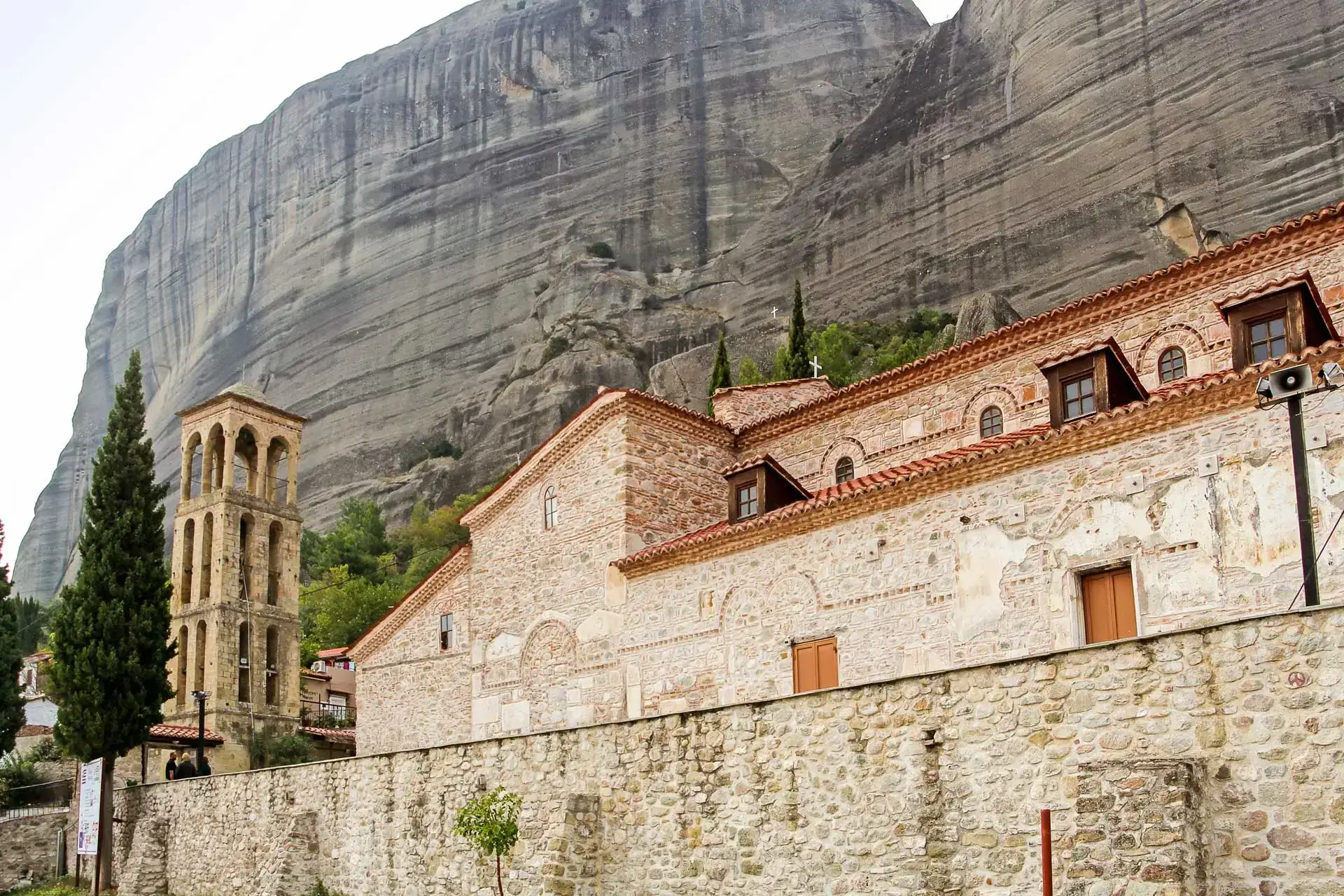
The Byzantine city of Kalabaka – Stagoi in Thessaly
Kalabaka (sometimes spelled Kalambaka) is a town in the region of Thessaly, in central Greece. It lies near the Meteora monasteries, an important monastic center with roots in the medieval period. Although the early history of the town remains obscure, a spolia embedded in the walls of its oldest church points to the existence of an ancient Greek settlement called Aiginion, which is believed to have been located nearby.
The city of Stagoi during the Byzantine era.
In Byzantine times, Kalabaka was known as Stagoi. It was first mentioned in the Diatyposis of Emperor Leo VI the Wise (886–912). By the 10th century, the settlement probably possessed both a fortress and a bishopric. After the end of the Bulgarian Wars, the emperor Basil II ceded the bishopric of Stagoi to the Bulgarian archbishopric of Ochrid by a sigillion issued after May 1020. The name Stagoi also occurs in the text of Skylitzes (second half of the 11 th century).
One of the most important source about the settlement is a partial document relating to the bishop of Stagoi, dating from 1163. It records some information about the settlement. The town belonged to the Theme of Servia and had a castle. The document also notes that the bishop was owning 85 mulberry trees. These trees may be connected to the silk industry, which was flourishing in nearby Boeotia during the 12th century. Although there is no direct evidence of silk production in Thessaly itself, it is possible that the region supplied Boeotia with raw materials.
In 1204, after the fall of Constantinople, Stagoi became part of the Despotate of Epirusi Sythiakakis. Its bishopric then probably belonged to the metropolis of Larissa, as listed in the Taktikon no. 10, dating from after 1204.
According to documents from 1163, 1336, and 1339, the town of Stagoi repeatedly acquired funds and privileges from the Byzantine emperors; at least two of these documents, a chrysobul issued by the emperor Andronicus III (1336) and a sigillion issued by the Patriarch of Constantinople (1393), were later copied on the northern wall of the narthex in the Church of the Virgin. The name “Kalampaka,” which replaced that of Stagoi, is probably of Turkish origin. In an official Ottoman document, the town Stagoi (Istagos) is also mentioned as Kalabaqqaya, meaning “the rock with the monks’ hoods”. In their accounts, travelers who visited the city, such as Leake and Heuzey left descriptions of the cathedral with its magnificent ambo. Important information is also provided by the Russian monk V. Barskij, who drew sketches of the Meteora Monasteries in 1745
The bishopric enjoyed privileges and donations from the Byzantine Emperors throughout the middle Byzantine era. It owned significant stretches of land and had dependant farmers in neighboring settlements. Besides its possession in northern Thessaly, its territory included and extensive mountainous zone in Asia and central Pindos. It was a suffragan of the Metropolis of Larissa.
At the end of the 13th-century, they fell under the Duchy of Neopatria. In 1334, they were taken over once more by the Despot of Epirus, John II Orsini, and shortly thereafter they came under the control of the Byzantine Empire. In 1348, they were conquered by the Serbs of Stephen Dushan.
Later, the Ottomans conquered Thessaly and Kalabaka was placed under the administration rule of the Pasha of Larisa, and later on of the Sanjak of Trikala. The name “Kalabaka” originates from this time, and would mean “powerful fortress” in turkish.
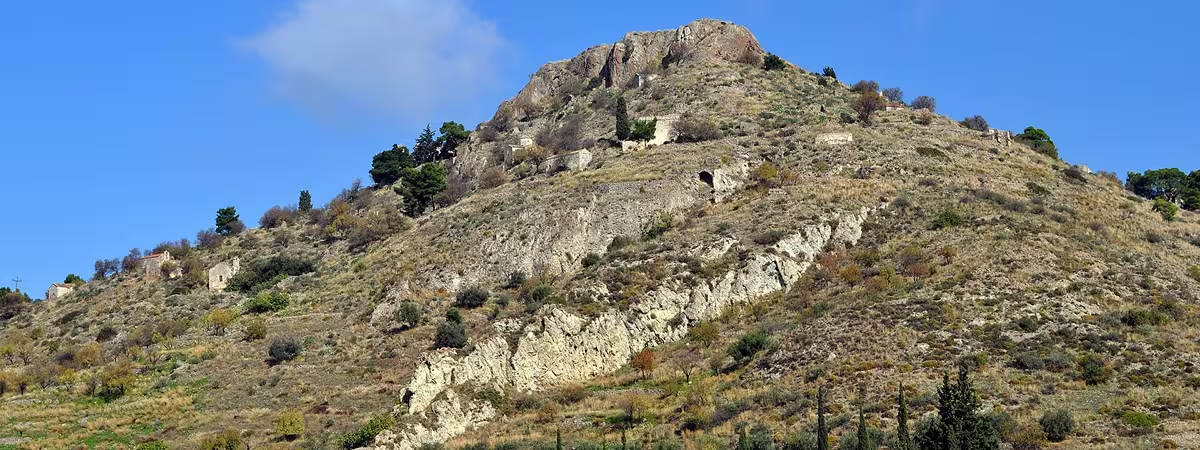
Remains of the Byzantine Kalabaka.
Kalabaka preserves its main church of the Dormition (which is the cathedral of the city). It is dedicated to the Dormition of the Virgin Mary. Up to this day, the three-aisled basilica of the Dormition of the Virgin in Kalampaka was regarded by the scholars as a 12 th c. construction on the ruins of an early Christian basilica. New evidence during recent restoration work and careful study of the building have revealed that the early Christian building never existed and that the original construction of the building, which was paved with a mosaic floor, dates probably from the 9 th – early 10 th c. This early-byzantine building has survived to the present day, with minor reconstructions and alterations in the 11–12 th c. and again in the 16 th c., and with the addition of the exonarthex in the 18 th c. The study of the marble furnishings led to the reconstruction of the original 11–12 th c. marble templon of the church, as well as to the conclusion that the actual marble furnishing (parts of the templon, ciborium, ambo) belong to a uniform group that dates from the period around 1100.
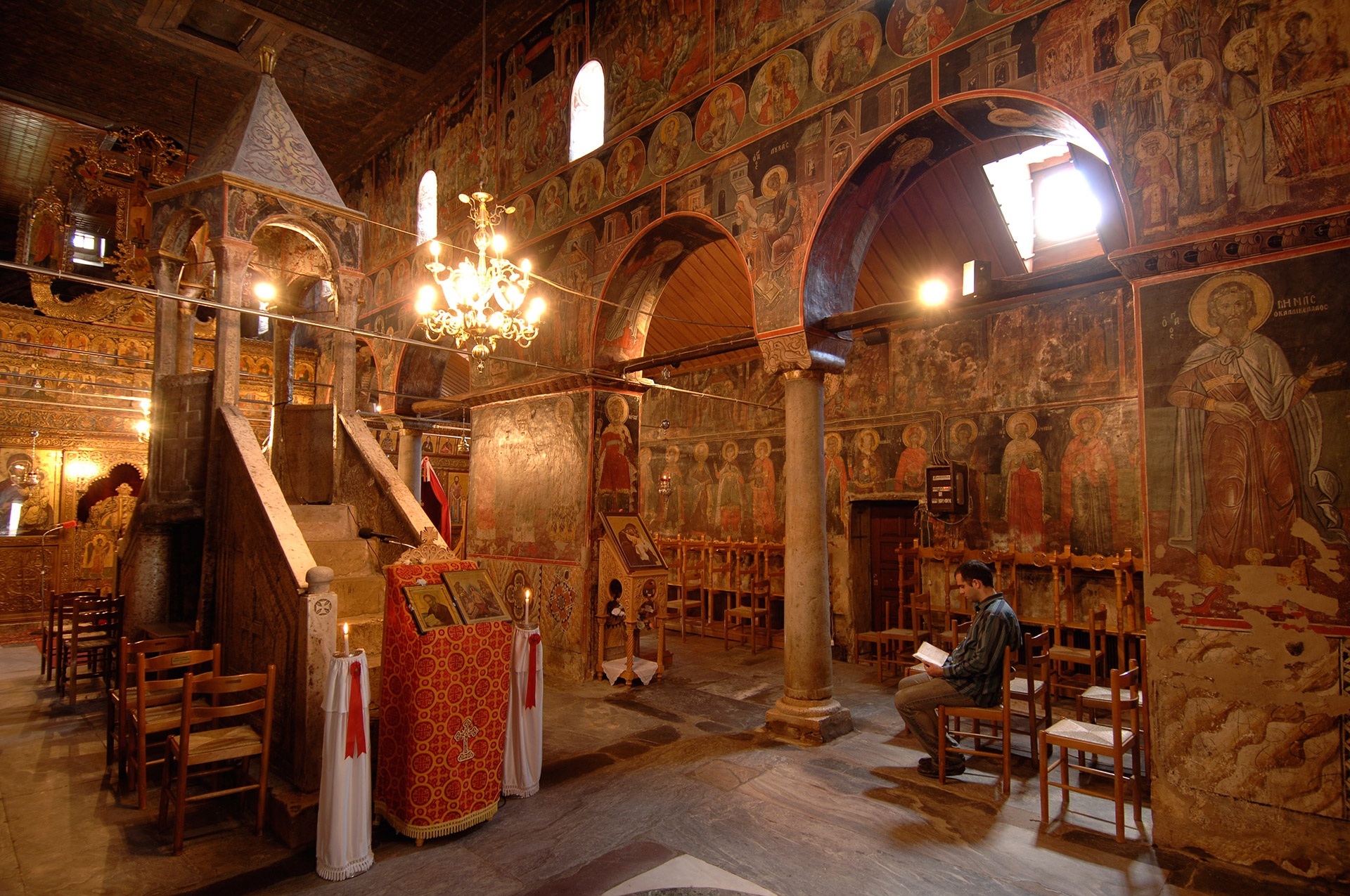
Another church, of the Virgin Mary, incorporates the relics of an ancient Greek temple, probably of god Apollo.
Source here.