
Church of Saint Basil of the Market (Agios Vasileios Agoras) in Arta
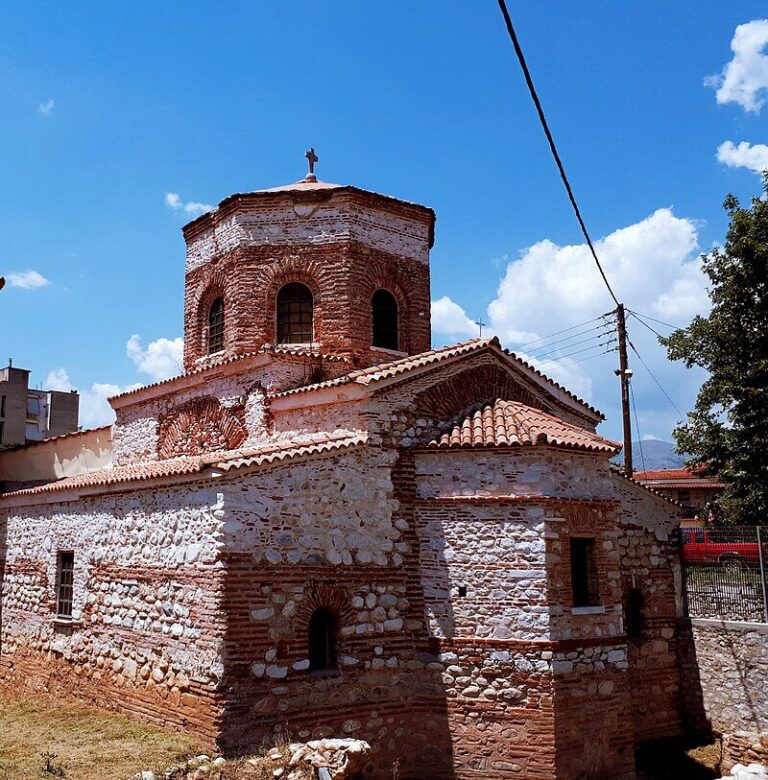
The Church of Saint Basil of the Agora (Agios Vasileios tis Agoras) is one of two churches in Arta dedicated to the same saint, the other being the small Church of Saint Basil of the Bridge. It is located south of the Castle of Arta, in the heart of the lower city, close to the Byzantine Church of Saint Theodora. Probably erected during the 13th century as an aisleless basilica with wooden-roof, the church main characteristic is its very rich ceramic decoration, as well as icons that are embedded in its walls.
History of the church of Saint Basil of the Agora.
As with most of the churches and monasteries in Arta, very few written sources survive from the medieval period. No information regarding the date of the church’s foundation has come down to us, and only its architectural features allow for some estimation. Based on construction techniques and stylistic criteria, earlier scholarship, cautiously supported by Orlandos, dated the monument to the early 14th century. More recent studies, emphasizing the close similarities it shares with earlier structures, tend to place its foundation in the second half of the 13th century. This was a period when many buildings in and around Arta were being constructed or renovated under the Despots of Epirus, such as the Kato Panagia, the Panagia Paregoritissa, the Panagia Vlacherna, and the church of Saint Theodora. This latter date is now generally considered the most probable.
Later, in the 14th or 15th century, two lower chapel-wings were added to the building: the southern one, dedicated to Saint Gregory of Nazianzus, and the northern one, to Saint John Chrysostom. Together with Basil the Great, these saints are among the most important Greek Fathers of early Christianity. The porch that protects the main entrance on the western side of the church is an even later addition, and was once covered with a wooden-roof.
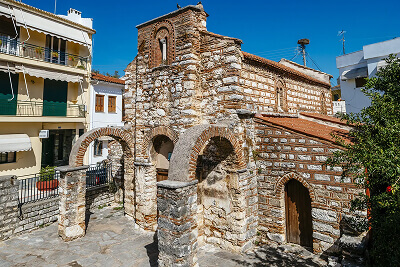 The arches of the porch.
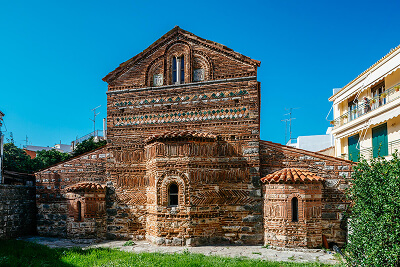 Rear view showing the apse and the two side chapels.
The church appears in written documents only in post-Byzantine times. In the courtyard of the church operated, from 1662 to 1821, a higher Greek school named after its founder, Philippos Manolakis. A very wealthy fur merchant from Kastoria, Manolakis served as chief furrier to Sultan Mehmed IV. The existence of such a school presupposes a spacious courtyard, which cannot correspond to the cramped forecourt of the church as it exists today.
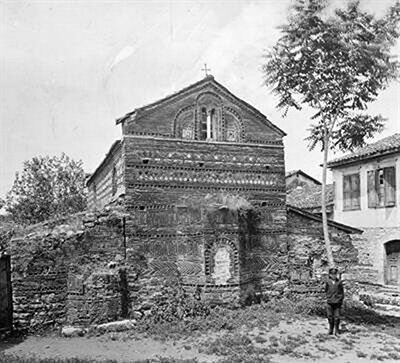
In 1821, during the Greek Revolution, the region rose against Ottoman rule, and reprisals were carried out against the local population and churches. The roof of the church burned, and the school ceased to function. The building was left exposed for a time before being repaired, which contributed to the deterioration of its interior decoration.
In the 20th century, the church – especially the chapels – was in poor condition and underwent restoration.
Architectural features and decoration of the church.
The Church of Saint Basil of the Market in Arta is a high, single-aisled, wooden-roofed basilica with two lower chapel-wings attached. A porch on the west side, at the main entrance, consists of two brick vaults supported by rectangular piers and the church wall.
On the same side, a small projection rises to roof level, ending in a flat surface. Scholars suggest it may have supported a belfry that has not survived. To the east, the church ends in three apses: the central apse is three-sided, while the apses of the chapels are five-sided. Almost the entire building is constructed in brick, and where stones are used, their joints are framed with a double row of bricks.
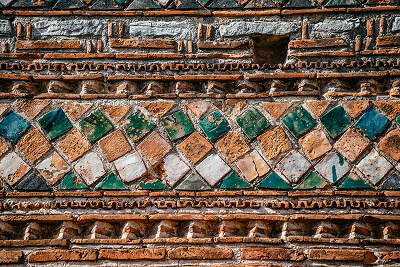
The most striking feature of the Church of Saint Basil of the Market is its exterior. It displays exceptionally rich brick decoration, giving the monument a distinctive and picturesque character. The patterns vary widely (meanders, herringbone, double-sigma motifs, wavy lines, toothed bands, etc.) and appear in a density not found in any other church in Arta. Particularly notable are two friezes of square tiles—the avakia—set in a rhomboid pattern on the northern and eastern façades. Although similar avakia appear in churches such as the Paregoritissa and the church of the Kokkinis Monastery, the use of glazed tiles in four colors here is unique.
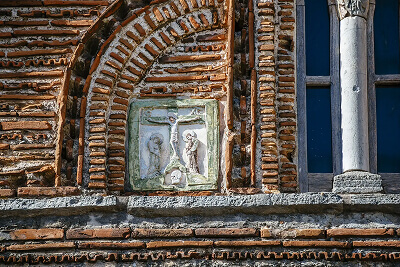
Even more remarkable are two glazed clay relief icons embedded in the pediment of the eastern façade, flanking the central window. One depicts the Crucifixion; the other, the Three Hierarchs, suggesting that the church was originally dedicated to them. Their style shows Western artistic influences, visible in the slender figures and softer expressions, as well as the gestures of the Virgin and John at the Crucifixion. The glazing technique and stylistic features played a key role in dating the monument. Apart from these, the only sculptural decoration consists of Corinthian-style capitals in the window openings.
Post-Byzantine interior decoration.
The interior of the church was painted in the late 17th century, maybe connected to the period when a Greek school was installed in its courtyard. The decoration suffered after the roof burned in 1821, when the building remained exposed to rain. The frescoes follow the usual post-Byzantine arrangement in three zones: full-length saints below, busts of saints in the middle, and scenes from the liturgical cycle above. The halos of the saints are formed in relief from plaster, imitating metal. The warrior saints also wear costumes with raised clay buttons, inscribed with the text “The Holy Trinity, Jesus, God of All,” a unique detail.
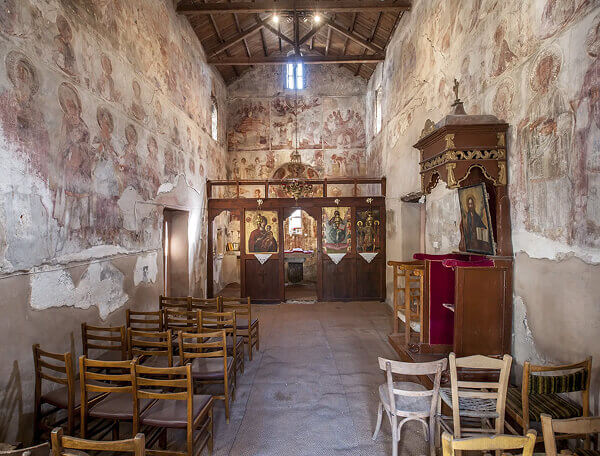
The church also preserves a portable icon from the later wooden iconostasis, dated to 1716 and painted in the Cretan style, depicting the Virgin holding the Christ Child, both with engraved halos. The interiors of the two side chapels are entirely bare and are no longer used for worship.
While saint Basil of the market is not the most striking church of Arta, compared to the paregoritissa, Saint Theodora or the Vlacherna monastery, it still presents the richest ceramic decoration of all thechurches dating back to the despotate of Epirus, and as such, completes the corpus of the surviving Byzantine churches in the area.
Sources:
Giannelos, K. Theodoros, The Byzantine Monuments of Arta. Entiposis Publications, Arta, 2001.