
Church of the Holy Apostles, Thessaloniki: Palaiologan Architecture and the Last Byzantine Mosaics
Near the western walls of Thessaloniki, in a small square now surrounded by twentieth-century apartment blocks, stands one of the final masterpieces of Byzantine art. The Church of the Holy Apostles was built in the early fourteenth century as the main church (katholikon) of a large monastery, and it preserves two things of world importance: the most elaborate decorative brickwork of any surviving Byzantine church exterior, and — along with the Chora and Pammakaristos churches in Constantinople — some of the last mosaics ever created in the Byzantine Empire. Since 1988 it has been one of the fifteen monuments inscribed on the UNESCO World Heritage List as the Paleochristian and Byzantine Monuments of Thessaloniki.
Planning to see it in person? It is an easy stop on any walking tour of the city’s monuments — see our complete visitor guide to Byzantine Thessaloniki.
Quick facts
Built
Early 14th century — founded under Patriarch Niphon I (1310–1314); timber dated to c. 1329
Original dedication
Probably the Virgin Mary; the name “Holy Apostles” is an 18th-century tradition
Type
Cross-in-square katholikon with five domes and U-shaped ambulatory; 17.6 × 19.3 m
Famous for
The finest brickwork facade in Byzantine architecture and some of the empire’s last mosaics
Ottoman era
Mosque from c. 1520s (Soğuksu Camii); reconsecrated as a church in 1912
UNESCO
World Heritage Site since 1988 (Paleochristian & Byzantine Monuments of Thessaloniki)
Location
Olympou Street, by the western city walls
Entry
Free — active Orthodox parish church; mornings most reliable
A patriarch’s foundation — and a dating puzzle
The founder is not in doubt. An inscription carved on the marble lintel above the main portal, together with monograms worked directly into the brickwork of the outer narthex, names Niphon I, Patriarch of Constantinople (r. 1310–1314), as the ktetor — the founder. A painted inscription over the entrance to the naos adds a second name: the monk Paul, Niphon’s disciple and the monastery’s abbot (hegoumenos), described as “second founder.” A donor fresco above the same doorway shows Paul kneeling before the enthroned Virgin and Child.
Niphon himself is a fascinating, worldly figure. Born in Berroia, he rose from abbot of the Great Lavra on Mount Athos to metropolitan of Kyzikos — where he organized the city’s defense against the Turks — before reaching the patriarchal throne in 1310. His career ended the way several Byzantine ecclesiastical careers did: deposed in 1314 on charges of simony, he retired to the Peribleptos Monastery in Constantinople, where he died in 1328.
His deposition matters for the building’s chronology. Although the inscriptions point to 1310–1314, scientific analysis of the church’s timber — dendrochronological study by Kuniholm and Striker, supported by radiocarbon results — dates the wood to around or just after 1329. Scholars have proposed two explanations: either construction paused when Niphon fell from office and was completed later, probably under Paul, or the entire building simply dates to the later moment. The evidence suggests the structure was erected as a single, unified campaign rather than in stages.
Why “Holy Apostles”? A church that lost its name
Remarkably, the church’s famous name is probably not its original one. The dedication to the Holy Apostles is first documented only as a local tradition in the mid-eighteenth century. The building’s own decoration points elsewhere: the donor fresco of Paul kneeling before the Virgin, and a cycle of scenes from the Life of Mary in the narthex, indicate a church dedicated to the Theotokos. Most scholars identify it as the katholikon of the Monastery of the Theotokos Gorgoepikoos (“the Virgin who is quick to hear”), known from historical sources.
Of that great monastery — its precinct covered more than 10,000 m² beside the western walls, just south of the vanished Letaia Gate — two structures survive besides the church: the remains of a monumental gatehouse to the south, and a vaulted cistern to the north, measuring 16.35 × 8.27 m, which collected spring water from the hills above the city. The cistern gave the neighbourhood its Ottoman-era name: Soğuksu, “cold water.”
Architecture: the finest brickwork facade in the Byzantine world
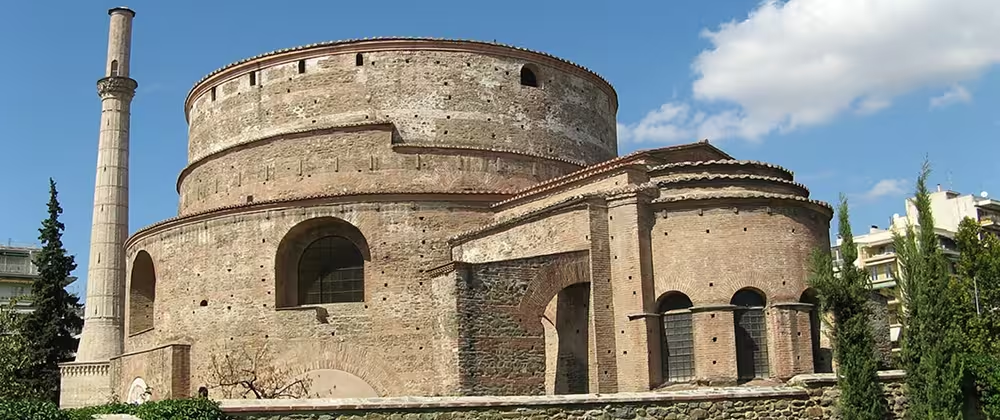
The church is a textbook of late Byzantine design, and a compact one — the building measures just 17.6 × 19.3 m. Its core is a cross-in-square naos whose central dome rests on four ancient columns, recycled from earlier buildings: three carry Corinthian capitals, probably of the fourth century, and one a sixth-century composite Ionic capital — Late Antiquity literally holding up the last Byzantine century. Around this core wraps a U-shaped ambulatory with a domed chapel at each of its four corners, giving the church its five-domed silhouette. The western arm, originally an open, arcaded porch, forms the outer narthex.
The interior is startlingly vertical: the central bay is five times as tall as it is wide, an effect that pulls the eye — and, by design, the mind — upward into the dome.
But it is the exterior that made the building famous. The facades, built in cloisonné masonry (courses of cut stone framed by brick), erupt into ornamental brickwork of a richness unmatched anywhere in surviving Byzantine architecture: lozenges, rosettes, meanders, interlace, zigzags, sawtooth bands and sunburst patterns, concentrated with special extravagance on the eastern facade. In the empire’s final century, when monumental resources were shrinking, Byzantine builders turned the humble brick into ornament — and nowhere with more virtuosity than here.
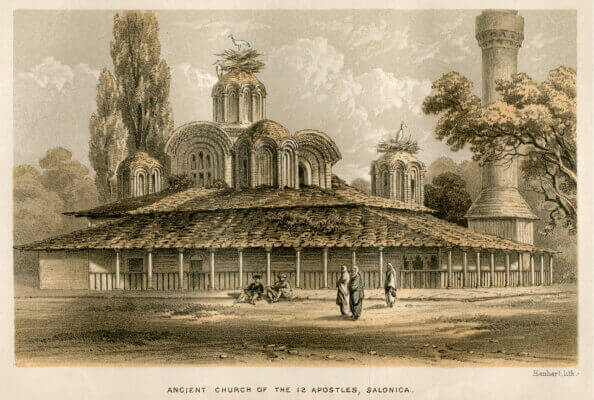 Ancient view of the Holy Apostles
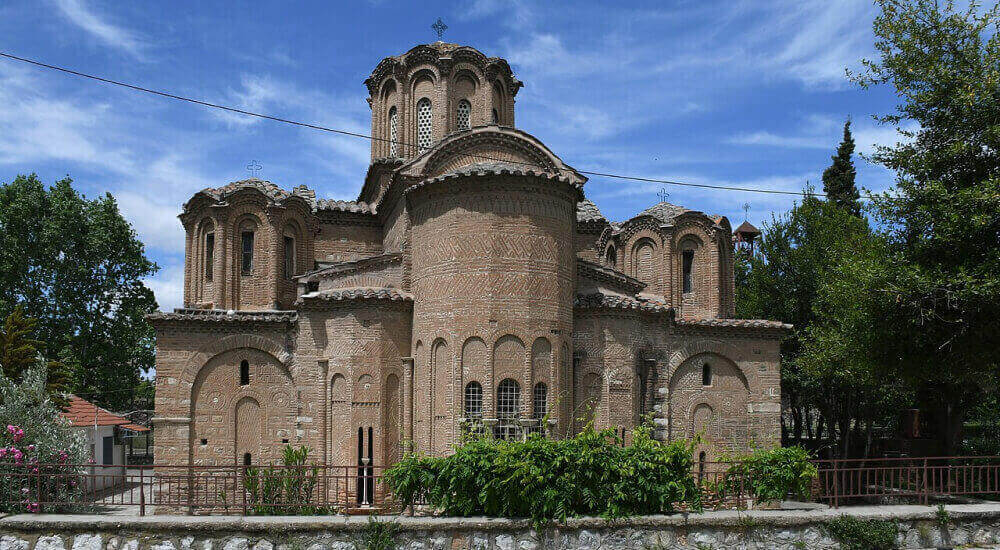 Byzantine Church of the Holy Apostles of Thessaloniki
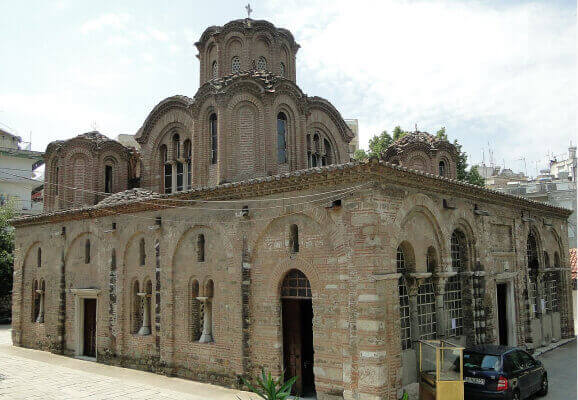 Byzantine Church of the Holy Apostles of Thessaloniki
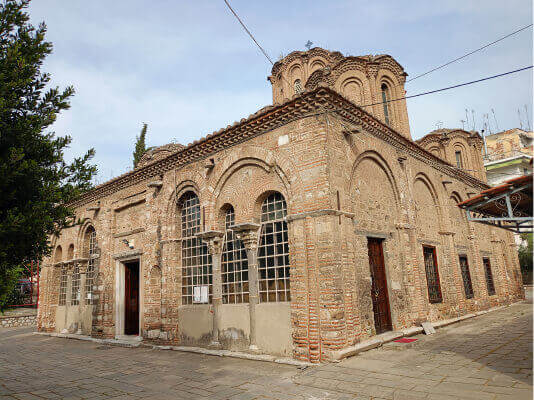 Byzantine Church of the Holy Apostles of Thessaloniki
The mosaics: the last golden light of Byzantium
The upper zones of the naos preserve what is, with the Chora and the Pammakaristos in Constantinople, one of the last significant mosaic ensembles produced in the Byzantine world — and the very last in Thessaloniki. Their style is so close to the Chora mosaics that some scholars have attributed them to the same Constantinopolitan workshop; others argue for a shared style rather than a shared team. Either way, the connection to the capital is unmistakable.
In the apex of the dome is Christ Pantokrator — his head and upper shoulders now lost — encircled by a band bearing a quotation from the Psalms: “The Lord looked down from his sanctuary on high… to hear the groans of the prisoners and release those condemned to death.” Around him stand ten Old Testament prophets; the Four Evangelists occupy the pendentives, with Saint Matthew the best preserved; and the Holy Mandylion, the miraculous image of Christ’s face, appears at the eastern base of the dome.
The barrel vaults carried the cycle of the Twelve Great Feasts, of which six survive in part:
- The Nativity (south vault) — the most complete: the Christ Child watched by the ox and donkey and two shepherd boys, angels bringing the news, midwives bathing the infant, and the Magi arriving on galloping horses.
- The Baptism (south vault) — fragmentary, but two angels facing Christ survive in fine condition.
- The Transfiguration (west vault) — Peter, James and John sprawled on the rocks of Mount Tabor below Christ, Moses and Elijah.
- The Entry into Jerusalem (west vault) — Christ on the donkey before a walled Jerusalem crowned by a round, domed temple.
- The Crucifixion (north vault) — largely lost; the midsection of the crucified Christ survives, flanked by fragments of the Virgin, the myrrh-bearing women and Saint John.
- The Anastasis (north vault) — the best preserved: Christ in a billowing mandorla strides over the shattered gates of Hell, pulling Adam from his sarcophagus, with Eve, John the Baptist and King David looking on.
A Dormition of the Virgin, mostly lost, occupies the west wall, and mosaic saints survive elsewhere — including the Five Martyrs of Sebaste and Saint Kosmas the Hymnographer holding a scroll of his own verse.
One feature strikes every visitor: the gold is gone. The luminous gold ground that survives at Chora is here almost entirely missing, leaving the figures floating against bare plaster. The most common explanation is that the gold tesserae were systematically stripped when the Ottomans converted the church — carefully removed before the interior was whitewashed. Some scholars add a poignant earlier possibility: that parts of the decoration, like the marble revetment the lower walls never received, were left unfinished when Niphon fell from power in 1314 and shipments from Constantinople stopped. Between plunder and interruption, the Holy Apostles shows Byzantine art’s last brilliance — and its fragility — in a single room.
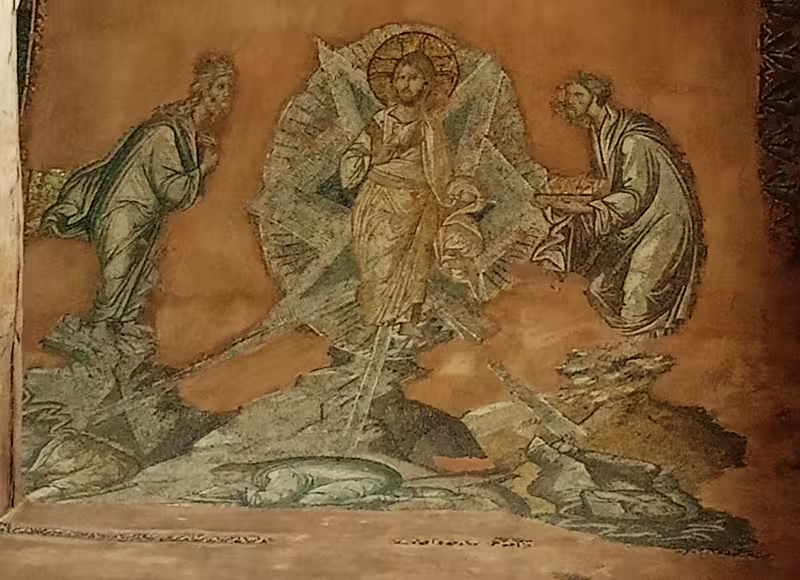
The Transfiguration, Credits Giovanni Dall’Orto 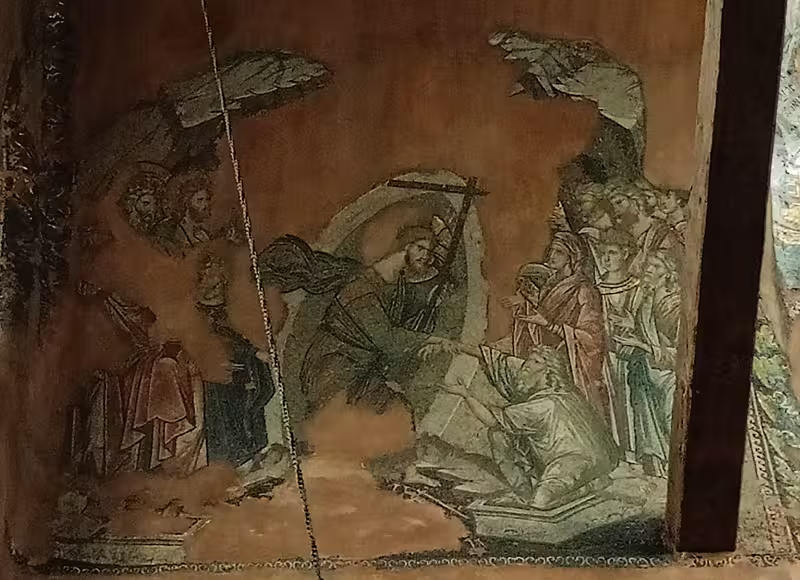
The Resurrection, Credits Giovanni Dall’Orto 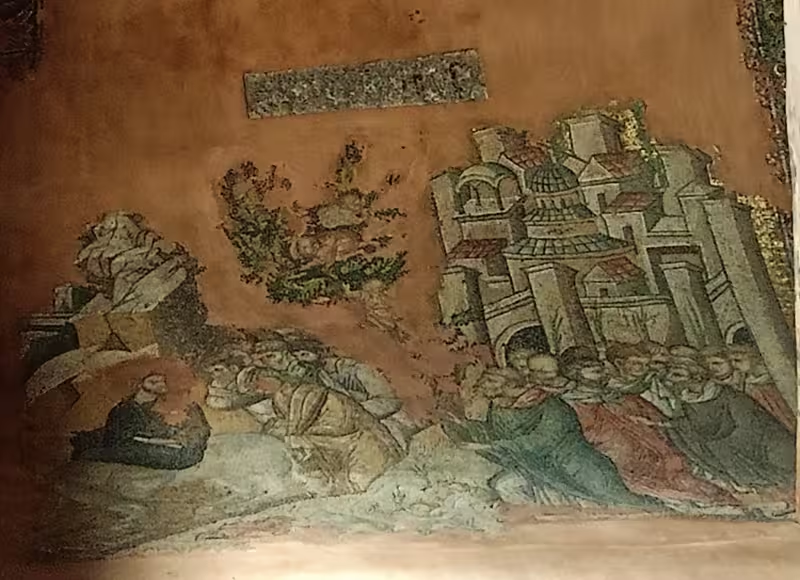
Entry of Christ in Jerusalem, Credits Giovanni Dall’Orto
The frescoes
Where the mosaics stop, frescoes take over — on the lower walls of the naos, in the narthex, and in the ambulatory. They were probably executed under the abbot Paul, after 1314 or in the years around 1328–1334, and they too speak the artistic language of Constantinople. The narthex carries scenes from the Birth and Life of the Virgin — part of the evidence for the church’s original Marian dedication. The northern chapel preserves a notable image of John the Baptist, suggesting it was dedicated to him, while the southern chapel contains a Tree of Jesse, the genealogy of Christ spreading across the vault like the branches it depicts.
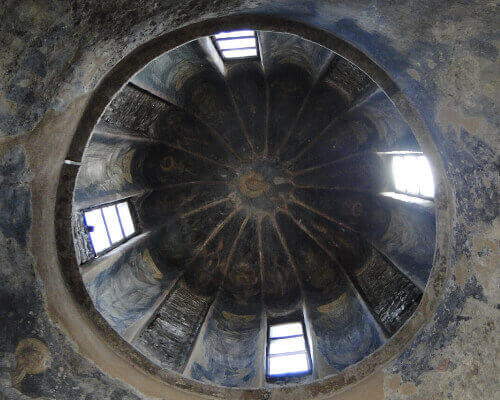 View of the southern dome
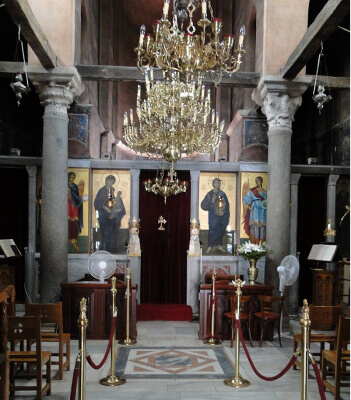 Interior of the church
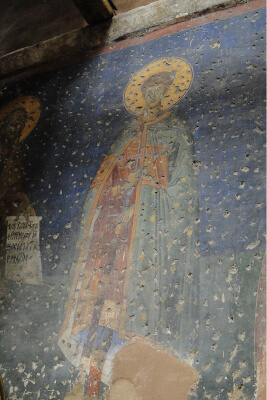 Frescoe of a Saint
Mosque, church, monument
Thessaloniki fell to the Ottomans in 1430, but the church was converted to a mosque only around the 1520s (some evidence may point as early as 1455). It received a minaret at its southwest corner — visible in every nineteenth-century photograph — and a low wooden porch along its northern and western sides. Its Turkish name, Soğuksu Camii (“Cold Water Mosque”), after the old monastic cistern nearby, is first recorded in the nineteenth century. The mosaics and frescoes disappeared under plaster and whitewash.
When Thessaloniki returned to Greek control in 1912, the building was reconsecrated as a church. The slow recovery of its art began with restorations in 1926–1928 and 1940–1942, which stripped away the Ottoman plaster and revealed the mosaics and frescoes beneath. The building was consolidated after the 1978 Thessaloniki earthquake, and the mosaics were cleaned and restored in 2002. Unlike the monuments of the city centre, the Holy Apostles was spared by the great fire of 1917 — one reason its medieval fabric survives so completely.
Visiting the Church of the Holy Apostles
The church stands at the start of Olympou Street, beside the western stretch of the Byzantine walls — about a fifteen-minute walk west of the Panagia Chalkeon and the Roman Forum. It is an active Greek Orthodox parish church: entry is free, and opening hours follow parish practice, so mornings are the most reliable time to find it open (check locally, as hours change). Dress respectfully — covered shoulders and knees. Look for the founder’s monograms in the brickwork of the outer narthex, the reused ancient capitals inside, and the surviving gatehouse and cistern of the old monastery a short distance south and north of the church.
For the city’s other monuments and a suggested two-day itinerary, see our complete guide to Byzantine Thessaloniki.
When was the Church of the Holy Apostles built?
In the early 14th century. Inscriptions name Patriarch Niphon I (1310–1314) as founder, while scientific dating of the roof timbers points to completion around 1329, probably under the abbot Paul.
Why is it called the Holy Apostles?
The name is a local tradition first recorded in the 18th century. The original church was almost certainly dedicated to the Virgin Mary, and most scholars identify it as the katholikon of the Monastery of the Theotokos Gorgoepikoos.
Are the mosaics original?
Yes — they are among the last mosaics created in the Byzantine world, contemporary with the Chora and Pammakaristos in Constantinople. Their gold background is largely missing, most likely stripped during the Ottoman conversion of the church.
Is it a UNESCO World Heritage Site?
Yes. It is one of the fifteen Paleochristian and Byzantine Monuments of Thessaloniki inscribed by UNESCO in 1988.
Is it free to visit?
Yes. It is an active parish church; entry is free and visitors are welcome outside service times. Mornings are the most reliable time to find it open.
Sources and further reading
- UNESCO World Heritage Centre, Paleochristian and Byzantine Monuments of Thessalonika (ref. 456-009).
- David Hendrix, “Church of Holy Apostles (Thessaloniki)”, The Byzantine Legacy.
- Hellenic Ministry of Culture, Ναός Αγίων Αποστόλων, Θεσσαλονίκη (Odysseus portal).
- Alexander Kazhdan (ed.), The Oxford Dictionary of Byzantium, Oxford University Press, 1991, pp. 940–941.
- P. I. Kuniholm & C. L. Striker, “Dendrochronology and the architectural history of the Church of the Holy Apostles in Thessaloniki,” Architectura 20 (1990).
- M. L. Rautman, The Church of the Holy Apostles in Thessaloniki: A Study in Early Palaeologan Architecture.
- S. Ćurčić, Architecture in the Balkans: From Diocletian to Süleyman the Magnificent, Yale University Press, 2010.
- R. Ousterhout, Eastern Medieval Architecture, Oxford University Press, 2019.