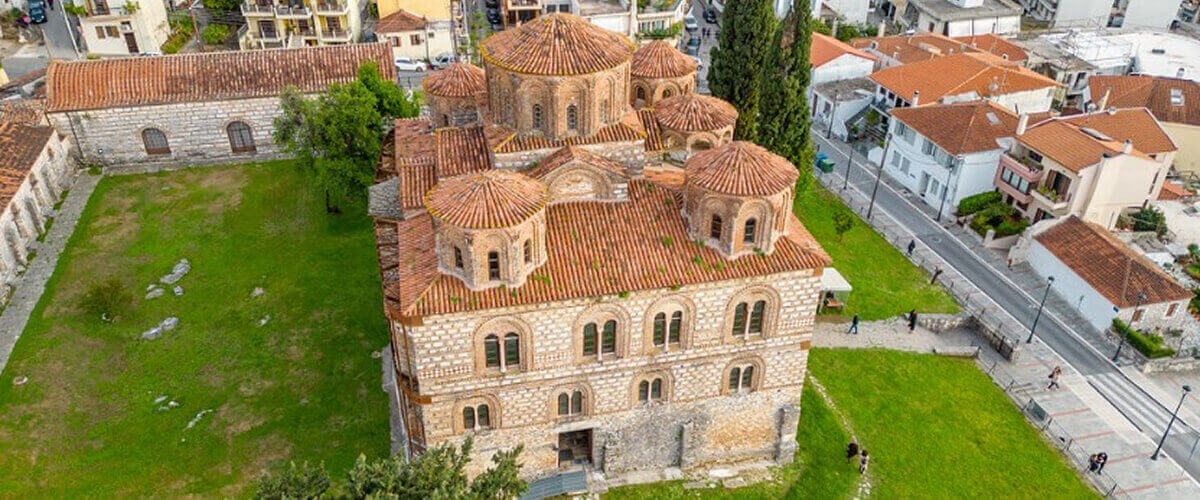
Church of Panagia Paregoritissa, Byzantine masterpiece in Arta
The Metropolitan Church of the Virgin Paregoritissa is the most important surviving Byzantine monument in Arta. Initially founded in the mid-13th century, it acquired its current form in the 1290s through a major reconstruction commissioned by the ruling family of the Despotate of Epirus. Its bold architectural conception and lavish interior decoration—although never fully completed—make it the most significant architectural legacy of the Despotate in Arta.
History of the Church of Panagia Paregoritissa.
An earlier church was probably founded on this site in the mid-13th century, either by the despot Michael II Komnenos Doukas or by a prominent member of his court. Parts of this original structure were later incorporated into the large-scale rebuilding project of the late 13th century, undertaken after the church had suffered damage for reasons that remain unknown.
The restoration was carried out by the ruling family. The founding inscription on the western wall, above the entrance, states that the church was rebuilt between 1294 and 1296 by Nikephoros I Komnenos Doukas (r. 1271–1296), his second wife Anna Palaiologina Kantakouzene, and their son Thomas. The building was intended to serve as the katholikon (main church) of a monastery. This renovation was in effect a complete reconstruction, even though some elements of the earlier church were retained. It was also a political statement: the bold architecture, the rich sculptural decoration with evident Western influences, the marble revetment, and the unique mosaic program expressed the prestige and aspirations of the Despotate of Epirus—at a time when the resources needed for such ambitious projects were scarce. Sixteenth-century frescoes by the painter Ananias survive in the sanctuary, while seventeenth-century frescoes adorn the nave.
From the monastic complex, cells and the refectory have survived, dating back to the 16th century.
A sigillion issued by Patriarch Jeremiah II, who visited Arta in 1578, informs us that at that time the monastery was female and stauropegic—that is, under the direct authority of the Ecumenical Patriarchate. It also suggests a period of decline, likely due to financial difficulties, which led to its incorporation as a metochion (dependency) of the Monastery of Kato Panagia, also in Arta.
Under Ottoman rule, the church was not converted into a mosque. However, some architectural elements were removed to decorate a nearby mosque. In 1821, during the Greek War of Independence, the church was used as a defensive bastion.
Architectural features and decoration of the church.
The Panagia Paregoritissa stands as the most striking monument in Arta and likely the most remarkable artistic legacy of the Despotate of Epirus, owing to its bold architectural design and the lavish decoration that has partially survived.
A bold architecture.
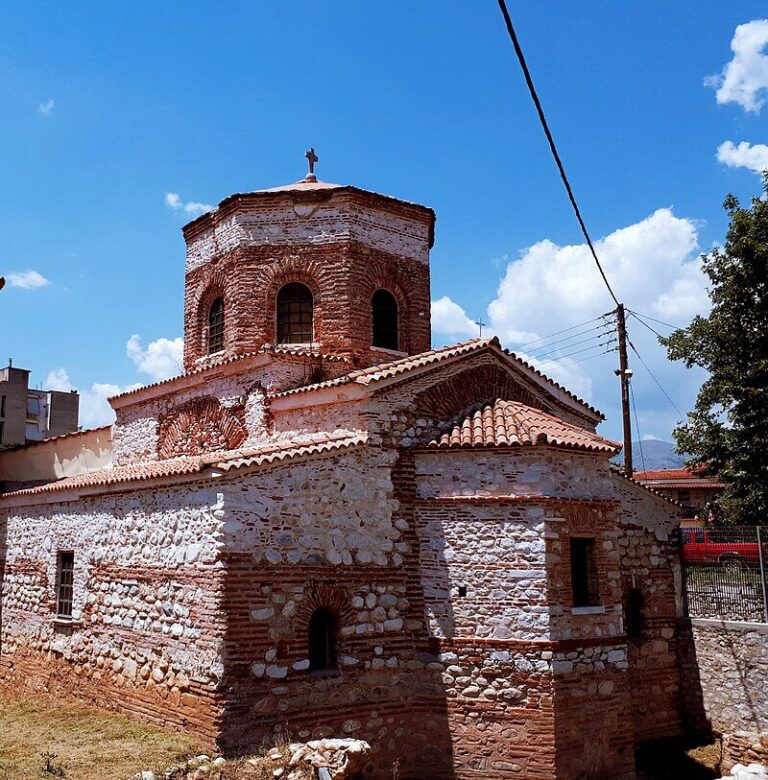
The church measures 20.30 × 22 m and its design is bold according to the standards of Byzantine architecture. It has a compact, block-like appearance, with an almost square outline. It rises on three storeys with rows of windows, resembling the palatial architecture of the period. In particular, it recalls the palace of Nymphaion – one of the residences of the emperors of Nicaea, built around the same time – as well as the Palace of the Porphyrogenitus in Constantinople. Its roofline is almost horizontal and supports five domes and a lantern.
The interior is spacious and is structured on the ground floor as a domed octagon, similar to Nea Moni on Chios. However, above the eight wall piers stand columns arranged in three superimposed tiers, with reused columns serving both as consoles and as vertical supports. On the upper level, the church follows the type of the cross-in-square plan. This system leaves the interior space unobstructed and creates a distinctive and innovative arrangement for supporting the dome, with no known parallel in other Byzantine monuments.
On the ground floor, the main church is flanked to the north and south by two chapels, dedicated to the Archangels and to the Forerunner (John the Baptist). It also communicates with the narthex to the west, together forming a peristyle-like arrangement. The upper floor follows a similar layout for the women’s gallery.
Exterior wall decoration.
The exterior walls, especially on the eastern side where the five apses project, display ceramic ornamentation made of bricks arranged in various patterns. Meanders, crosses, and diamonds combined with double arches, phial-shaped openings, and small tiles create a striking polychromy, second only to that of the Church of Saint Basil of the Market. Parts of the earlier church remain visible, mainly on the north side of the present building.
Interior wall decoration.
Today, the interior walls are adorned with frescoes from different periods—the earliest date to the 14th century, but most were painted in the 16th and 17th centuries.
Originally, however, the walls were covered with luxurious marble revetment, up to the level of the surroundings galleries. Some fragments of this decoration survive on the western side above the main entrance. It is possible that portions of the revetment were removed during the Ottoman period to decorate a nearby mosque.
The mosaic program.
The Panagia Paregoritissa preserves the most ambitious mosaic program surviving from the period of the Despotate of Epirus. Although it was likely never completed—due to the death of Nikephoros and the political difficulties the despotate faced at the time—the dome contains a large figure of Christ Pantokrator surrounded by seraphim and cherubim, with twelve prophets placed between the windows of the drum. Traces of the Evangelists, in a lower register, also survive.
The mosaicists were probably brought from a major Byzantine artistic center outside Epirus, though their precise origin remains unknown.
-
The Mosaics of the Church of the Panagia Paregoritissa in Arta
Explore the Byzantine mosaics of Panagia Paregoritissa in Arta: a grand yet unfinished artistic legacy of the Despotate of Epirus.

The sculptural program.
The carved Romanesque sculptures, featuring monsters and biblical themes, also adorned the interior and were designed to interact visually with the surrounding mosaics. Such sculptures are quite rare in Byzantine monuments and clearly show Western influences, reflecting the original art that developed in Epirus—shaped by Byzantine traditions and centers, regional particularities, and influences from the Latin world.
The Panagia Paregoritissa stands as a singular testament to the artistic and architectural ambitions of the Despotate of Epirus. Its innovative structural design, lavish decoration, and unique mosaic and sculptural programs reflect a sophisticated synthesis of Byzantine tradition, regional creativity, and Western influences. Despite the passage of centuries and periods of decline, the church continues to convey the cultural prestige and spiritual significance of its time, remaining the most remarkable monument of Arta and a masterpiece of late Byzantine art in the region.
Sources.
Slobodan Curcic, Architecture in the Balkans: From Diocletian to Suleyman the Magnificent. New Haven and London, Yale University Press, 2010, p. 567
Timothy E. Gregory, Nancy Patterson Ševčenko, The Oxford Dictionary of Byzantium, “Arta”, ed. Alexander Kazhdan, Oxford University Press, pp. 191-192.
“Ναός Παναγίας Παρηγορήτισσας Άρτας”, Hellenic Ministry of Culture (in Greek), retrieved 2010-06-12