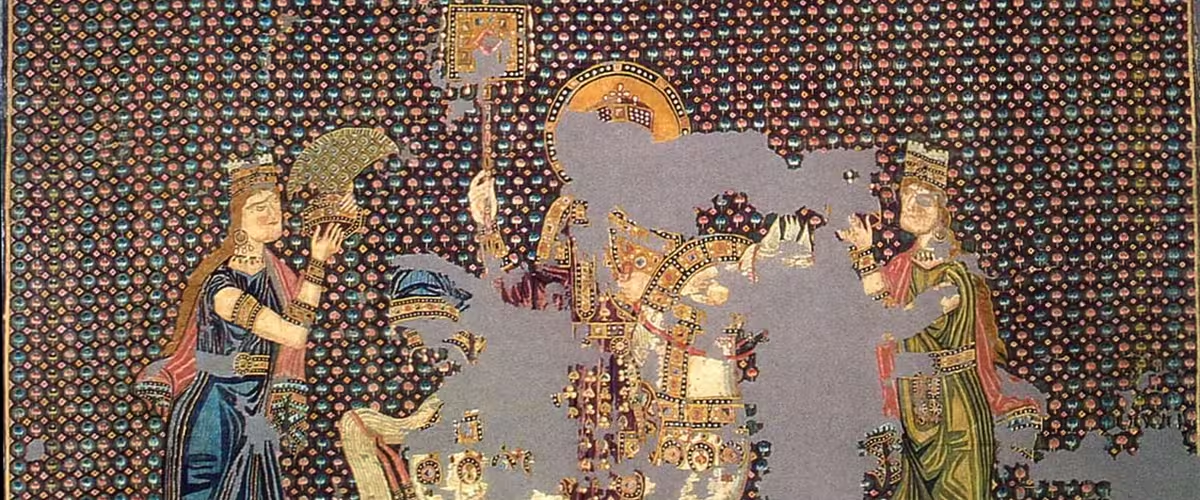

8th century Byzantine chronicle found in St Catherine Monastery, Sinai
Researchers from the Austrian Academy of Sciences recently identified a significant historical document at Saint Catherine’s Monastery in Egypt. This 1,300-year-old world chronicle offers fresh insights into the political and religious shifts of Late Antiquity. Originally written in Syriac and later translated into Arabic, the manuscript provides a rare perspective on the transition from the Byzantine era to the rise of the Islamic Caliphate.
Technical recovery of the Maronite Chronicle of 713.
Historian Adrian Pirtea discovered the text while reviewing digitized manuscripts. Now known as the “Maronite Chronicle of 713,” the work covers human history from its beginnings until 692-693.
The text survived within a damaged 13th-century manuscript where pages were stuck together. Scientists used high-resolution digital imaging from the Early Manuscripts Electronic Library to decrypt the content. The anonymous author belonged to a Syriac-Christian community traditionally aligned with Constantinople.
However, the text reflects a period where these communities began to distance themselves from the Byzantine capital due to theological disputes. Interestingly, the author possessed knowledge of events beyond the Near East, including developments in Rome, Sicily, and the Balkans.
New perspectives on Byzantine-Arab conflicts.
A crucial section of the chronicle details the Byzantine-Sassanid War of 602-628, which exhausted the Byzantine empire and allowed the subsequent expansion of the Arab Empire, starting in 632.
The chronicler specifically describes the Battle of Yarmuk in 636, a decisive Byzantine defeat that led to the retreat of Emperor Heraclius from Syria. This turning point opened the Levant, Egypt, and North Africa to Arab expansion, while Anatolia became a battlefield for centuries and even Constantinople was threatened. The document serves as one of the earliest Christian sources recording the Islamic conquests and the resulting territorial losses of the Byzantine Empire.
Impact on Syriac Historiography and Research.
This discovery acts as a key to reconstructing lost traditions of early medieval Syriac historiography. It likely connects to a missing 8th-century source used by later historians. By providing a direct view of the 7th-century Eastern Mediterranean, the chronicle enriches our understanding of how contemporary Christians perceived the end of Byzantine rule in the Levant. Ongoing work focuses on a full translation to share these findings with the global academic community.
This find underscores the importance of the Sinai archives for Byzantine studies. It clarifies the complex relationship between the imperial center and its eastern provinces during a time of total transformation.
Source (in german) here.
Photographic credit (cover):