
Byzantine communion bread loaves excavated in Anatolia
In the rugged hills of Karaman province, Turkey, archaeologists have uncovered a remarkable artifact: a 1,300-year-old loaf of communion bread from the 7th – 8th centuries. This well-preserved find, discovered at the Topraktepe archaeological site of ancient Eirenopolis, features a rare depiction of Christ as the ‘Farmer’ or ‘Sower,’ accompanied by a Greek inscription expressing gratitude. This discovery offers valuable insights into early Christian rituals and the symbolic integration of faith and agriculture in Byzantine Anatolia.
Discovery of the carbonized loaves at Topraktepe.
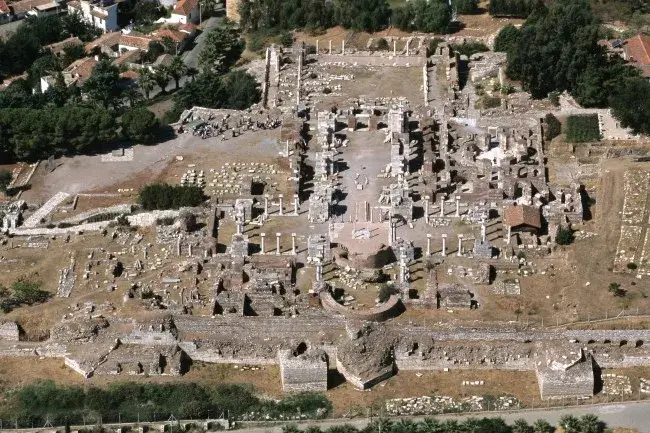
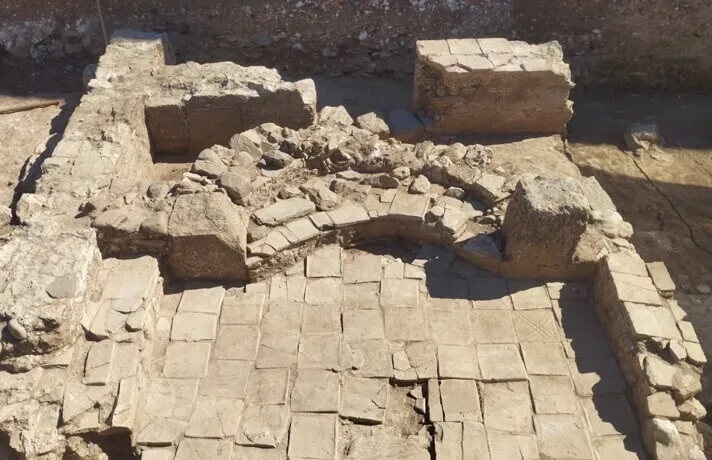
The site of Topraktepe corresponds to the ancient and Byzantine Eirenopolis, the “city of peace.” It was located in the historical region of Isauria, on the road connecting Germanicopolis with Anemurium. Fortified in the mid-4th century, it held ecclesiastical significance in Early Byzantine times, sending representatives to major church councils until the 9th century. On the imperial level, however, the city was of little importance. Excavations led by the Karaman Museum and the Turkish Ministry of Culture and Tourism can therefore shed light on local forms of devotion and practices that would otherwise remain unknown.
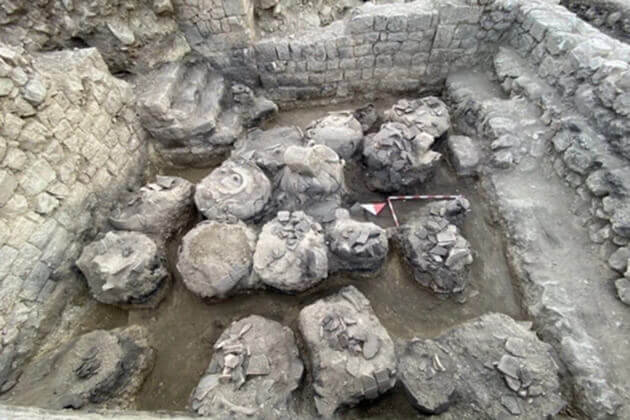
The discovery of five carbonized communion bread loaves in the Byzantine layers of Eirenopolis exemplifies this.
The exceptional preservation of these breads, carbonized over more than 1,300 years and preserved in an oxygen-free environment, makes them some of the most remarkable examples of liturgical bread ever discovered in Anatolia. This preservation allows scholars to study the materials and methods used in early Christian bread-making.
The loaves are made of barley and date from a period spanning the 7th to 8th centuries.
A rare iconographic depiction of Christ as the ‘Farmer’ on the bread.
Among the five loaves discovered, one stands out It features a depiction of Christ as the “Farmer” or “Sower”. This depiction differs from the traditional of Christ as Pantokrator, the all-mighty shown enthroned in full glory, blessing and holding the gospels. This rare depiction highlights the connection between faith, labor and agricultural fertility, in a community that primarily relied on fields work and production to thrive. It also likely symbolizes the integration of spiritual beliefs, maybe even predating the Christian era, with the agricultural practices central for livelihood.
Accompanying the image is a Greek inscription that translates to “With our thanks to Blessed Jesus.” This expression of gratitude suggests that the bread was not merely sustenance but held sacred significance within the community’s religious practices.
The remaining loaves bear cross-shaped imprints, indicating their possible use as Eucharistic or ‘communion bread’ in early Christian rituals.
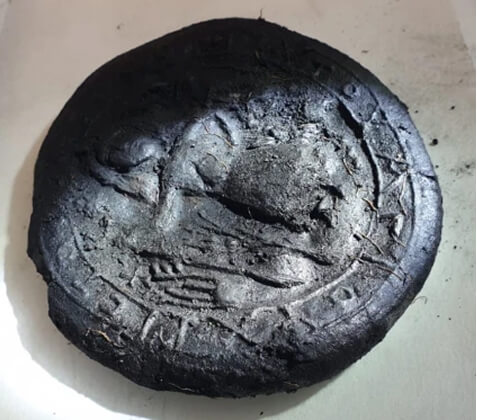 Bread with Christ the Farmer or Sower.
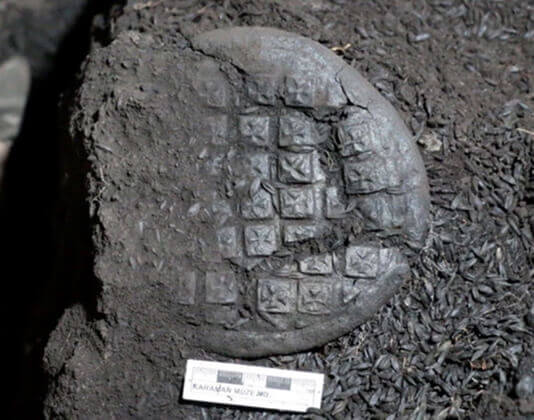 Bread with crosses pattern
Such rare findings of goods that would normally not survive the passage of time provide valuable physical evidence of liturgical practices, offering insights into how communities expressed their faith through everyday objects and the iconography they used, thus enriching our understanding of Byzantine culture with significant details.