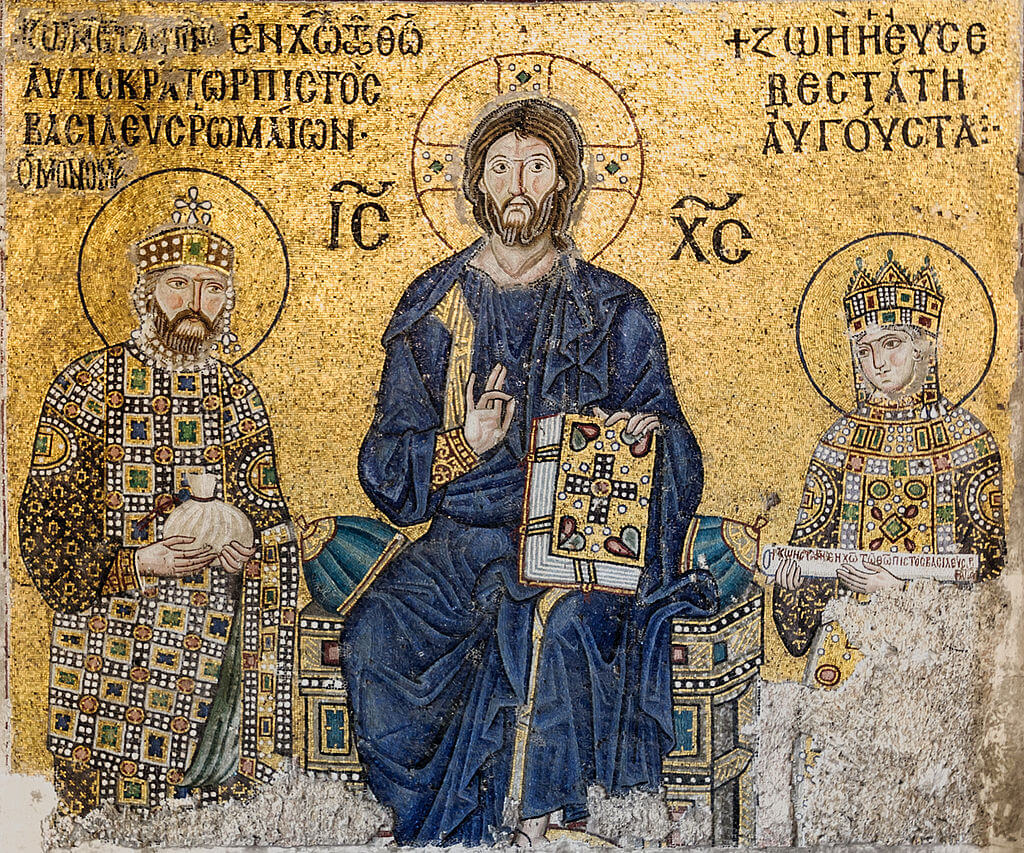
The mosaic of Zoe Porphyrogenita and her husbands with Christ in Hagia Sophia
The mosaic of Zoe and her husband(s) belongs to the imperial mosaics commissioned by the ruling sovereigns to commemorate themselves and their donations to the Great Church. It is the older of two surviving panels, located on each side of a window, on the eastern wall of the south gallery, on the second level above the south aisle. This part of the church was traditionally reserved for imperial use during church services, and was near a doorway connecting the Great Church with the Great Palace.
The mosaic was discovered in 1934 by the Byzantine Institute, and fully uncovered and restored in the following years. It dates back to the years between 1028 and 1055, and is also one of only two mosaics of the Great Church depicting a member of the Macedonian family, one of the greatest dynasty of Byzantium. And this member, the real star of the mosaic, is a fascinating figure of Byzantine history: Zoe Porphyrogeneta, one of the last family member, carrying the legetimity of the dynasty, whose marriage was a high political matter, and who influenced BYzantine history.
On the other side of the window, the Komnenian mosaic follows the same pattern, even though it was executed decades later. The lower part of both mosaic panels is lost, while the one depicting Zoe and her husband survives to a greater extent.
A mosaic reflecting the turbulent end of the Macedonian dynasty.
At the end of the 11th century, the famed and popular Macedonian dynasty, which had brought the Byzantine Empire to heights not seen since the 6th century, ran short of male heir. This opened a complex succession struggle in which female figures played a key role. Among them, Zoe Porphyrogenita was the most prominent. Her marriage became a matter of state, and her personality, preferences, and dislikes significantly influenced the course of the Empire’s history.
Her father, Constantine VIII, married her at the age of 50 to Romanos Argyros, intending to pass the throne to him through Zoe’s legitimacy, a plan that initially succeeded. The mosaic depicting them in Hagia Sophia was likely created during the seven years of their marriage, between 1028 and 1034. However, Zoe disliked Argyros and instead favored a stable boy, Michael. They plotted her husband’s demise, which succeeded: Argyros was killed in his bath. Zoe then enthroned her lover as emperor.
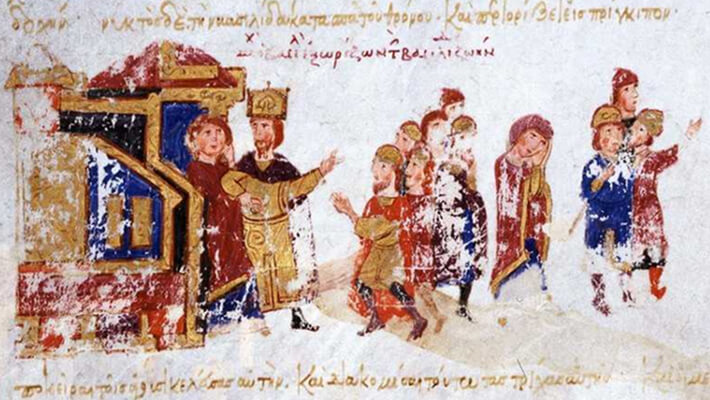
After Michael’s death a few years later, he was succeeded by his nephew, Michael V. The new emperor disregarded Zoe and imprisoned her. He possibly ordered the destruction of the empress’s image, and Zoe’s face in the mosaic was likely damaged at that time. Nonetheless, this political move proved disastrous. Zoe, embodying the legitimacy of a successful dynasty, was popular among the people of Constantinople. A riot ensued, Michael V was ousted, and Zoe was restored in 1042.
After a brief sole rule with her sister Theodora, she married Constantine IX Monomachos at the age of 70. The mosaic was altered a third time: Michael’s face was replaced by Constantine’s, the inscription updated, Zoe’s face restored – though with youthful features she likely no longer had – and even Christ’s face was renewed. The reasons for this latter change remain debated, but the artist may have sought visual consistency among the three figures.
As such, the mosaic provides an invaluable witness to this turbulent period in Byzantine history, highlighting Zoe’s decisive role in the succession of the Macedonian dynasty and demonstrating the influence women could wield in certain circumstances within the otherwise patriarchal Byzantine society.
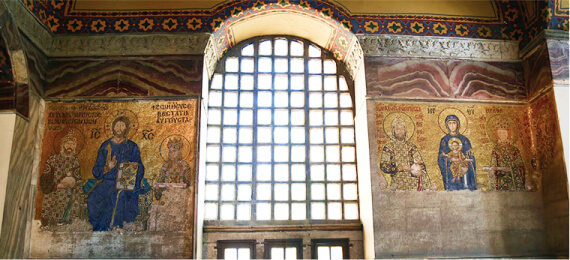
The representation of Zoe´s husbands: Romanos and Constantine IX.
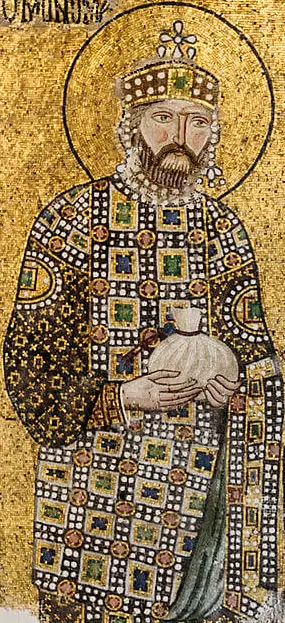
On the left side of Christ appears the figure of the emperor, against a gold background. In its current state, it represents Constantine IX, the third and last husband of Zoe – but it was created to depict a former husband of Zoe, probably Romanos Argyros.
The figure shows the traditional code of imperial authority. Constantine is clad in a chiton and a richly ornate divitision, a long silk tunic. He also wears the loros, a long strip of silk cloth embroidered with precious stones, which was draped over the left shoulder and around the waist, and exclusively reserved for the emperor and the imperial family during certain ceremonies.
He also wears a conical jeweled crown, adorned with a cross on top and prependoulia – pearl pendants on the side. His his head is surrounded by a halo, a common depiction for holy figure and imperial ones, underlining their link with the sacred. Constantine holds a purse, called pokombion, a symbol for his donation to the Church personified by Christ next to him. The inscription around him reads “Constantine, in Christ the God, Autocrat, faithful King of the Romans”.
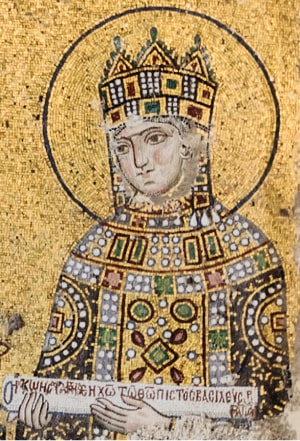
The depiction of Empress Zoe Porphyrogenita.
Empress Zoe, while depicted on the right side of Christ, is the true main historical figure of the mosaic. The text above the head of the empress says “Zoë, the very pious Augusta”.
Like her husband, the empress is dressed in chiton, divitision, and loros. A missing area of the divitision in the lower part of her figure revealed a detailed pattern of fresco paint on the setting bed and a shield with a cross, which helped the conservators restore the thorakion as part of her garment. Her figure, like the others, is shown against a gold background. Turquoise green dominates the decoration of her shoulder piece, loros, and elaborated crown. Dark green tesserae were used in the background around her figure in order to intensify the green of the stones in her garments and to make her image more distinct.
She holds a scroll, which symbolizes the donations she made to the church.
The depiction of Christ in Majesty.
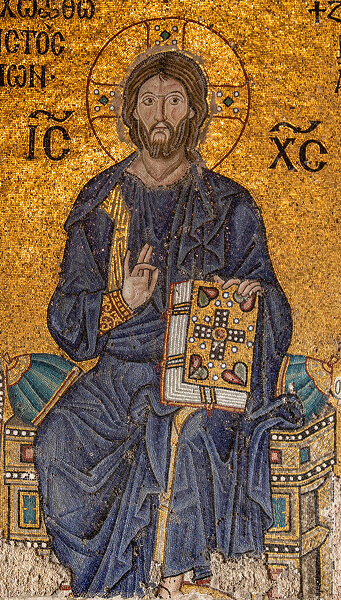
The figure of Christ appears larger in scale than the two imperial figures positioned to his left and right.
He is seated on a jewel-decorated throne and wears a dark blue chiton. With his right hand he gestures in benediction, while in his left hand he holds an ornamented Gospel book.
Traces of restoration are visible around his hair, indicating that his facial features were altered, likely to correspond with the renovation of the surrounding emperor and empress.
The lower part of the panel is missing. Originally, the bottom of the panel was probably on the same level as the windowsill situated to its left.
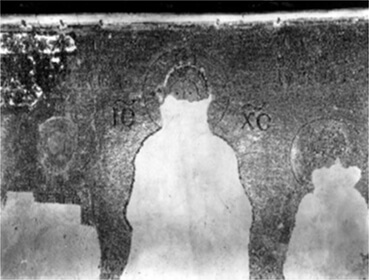 Partially uncovered mosaic in the 1930s.
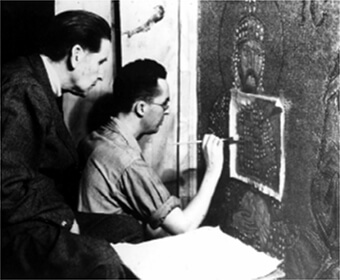 Members of the Byzantine Institute working on the mosaic, ca. 1938.