The Silk of Thebes: Boeotia’s Role in the Byzantine Textile Industry
When we think of Byzantine silk, Constantinople usually takes center stage. Yet, in the 12th century, Boeotia—an inland region of central Greece centered on the city of Thebes—emerged as a vital hub of silk weaving and dyeing. Alongside Constantinople, the Morea and Athens within the empire, and Sicily and Egypt beyond its borders, it was one of the few key centers of textile production in the Mediterranean.
Historical testimonies, archaeological evidence, and the region’s natural resources all point to a flourishing industry that clothed the Byzantine elite in sumptuous garments. Celebrated across the Mediterranean, Theban silk enriched Boeotia, attracted the commercial ambitions of Venice and Genoa, and even provoked destructive Norman raids. This overlooked chapter of Byzantine textile history highlights how Thebes and Boeotia became decisive actors in the empire’s silk economy during the Middle Byzantine era.
Historical Evidence of Theban Silk.
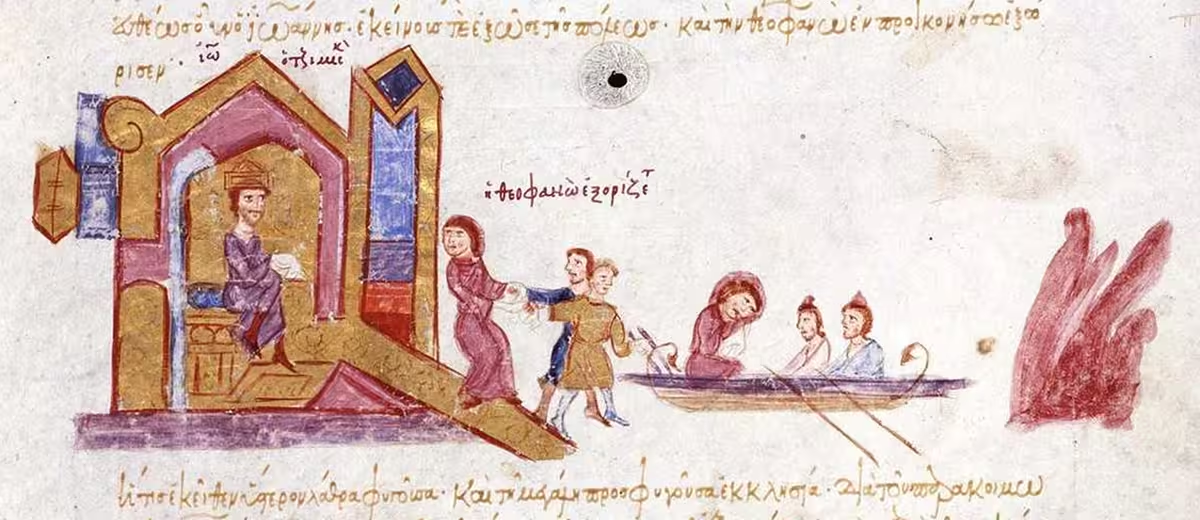
Written sources attest to Boeotia’s central role in the Byzantine silk economy. By ca. 1100, Italian merchants already associated the region with purple dye, while the satirical work Timarion described the abundance of robes and threads from Boeotia and the Peloponnese. The Norman raid of Thebes in 1146-47 further confirms its textile prestige: the invaders captured included skilled silk weavers, while ships were laden with fabric.

Other witnesses corroborate this reputation. Benjamin of Tudela, visiting Thebes in the 1160s, praised its Jewish silk artisans as the finest in Greece. Michael Choniates, metropolitan of Byzantine Athens in the late 11th and beginning 12th century, complained that Thebes contributed less tax than nearby Athens, despite being a major supplier of silk to Constantinople’s aristocracy.
Even foreign rulers recognized the extraordinary value of Boeotian silk. Nicetas Choniates recounts that in 1195, the Seljuk governor of Ankara, Muhyi al-Din, launched raids in Bithynia in support of a Byzantine pretender to the throne.
During negotiations, he agreed to withdraw his forces only on condition of a heavy tribute: five hundred pounds of silver as immediate payment, three hundred pounds annually thereafter, and forty silk vestments from Thebes. This demand reveals not only the economic worth of Theban silk – placed on equal footing with silver – but also the international prestige it commanded, serving as a currency of power in its own right. An inventory of King Philip V of France from 1317 included a red silk fabric from Thebes, further attesting this prestige.
The emergence of the Boeotian silk industry.
The sources that document the Boeotian silk industry date primarily from the 12th century, a chronology supported by archaeological evidence. Most of the structures uncovered in Thebes during the 1970s that may be linked to textile production also belong to the late 11th or 12th century, suggesting that the industry likely took shape in the mid-11th century. Earlier references to silk activity point elsewhere: the mid-10th-century Vita Basilii attests to production in the Morea, while Constantine Porphyrogennetos’ De Administrando Imperio mentions “purple fishers” in the same region. Boeotia, however, is absent from such accounts. On the contrary, the Cadaster of Thebes, a land-tax register from the second half of the 11th century, makes no mention of mulberry trees, an essential resource for sericulture. Taken together, these clues suggest that the rise and flourishing of the silk industry in Boeotia should be placed in the 12th century.
Nonetheless, Boeotia offered highly favorable conditions for the development of silk production. The nearby Morea and Constantinople already possessed the necessary savoir-faire, while the region itself provided an environment well suited to the industry. Thebes, for example, was supplied by the rivers Dirce and Ismenos, both rich in calcium and magnesium, which, as the poet John Tzetzes observed, enhanced the quality of fabrics and improved dye absorption. The southern parts of Boeotia yielded kermes oak, a key source of red dye, while the coastline provided access to murex snails used in purple dyeing. These natural advantages, combined with the skill of local craftsmen and increasingly sophisticated production methods, enabled Boeotia to foster a silk industry of exceptional quality that rose to prominence in the 12th century.
Dye extraction and silk production in Thebes and Boeotia.
Dye extraction was an essential activity for the silk industry. While no source clearly specifies which dyes were used for Boeotian silk, two main possibilities emerge: Tyrian purple, secreted by the sea snail Murex brandaris, and kermes, a red dye obtained from the kermes insect, a pest of the kermes oak. Tyrian purple had enjoyed prestige for centuries, while kermes became increasingly popular as an alternative luxury dye, particularly in Western Europe.
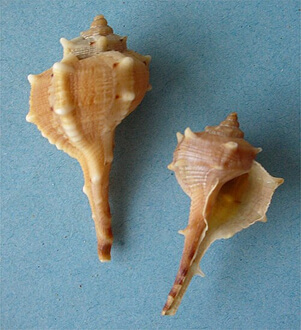
The extraction of purple was by no means an easy endeavor. The Murex brandaris produced only a minute quantity of usable substance, requiring intensive fishing and processing. Archaeological evidence at Kastorion may point to dye production. On the northern slope of the city’s lower acropolis, long-term surveys uncovered two Middle Byzantine churches, a tower, and what may have been a dye-extraction site from the same period. This latter area is marked by a vast deposit of crushed murex shells, measuring roughly 65 by 70 meters on one axis and 30 meters on the other, offering valuable insight into the scale of production. Other coastal sites in Boeotia, such as Livadostro, Vathy, and Porto Germeno, may likewise have served as centers for snail fishing and dye processing, though no surveys or excavations have yet provided relevant evidence.
Kermes production was equally demanding. Cultivating and maintaining the kermes oak required considerable care, while harvesting the insects was a labor-intensive process that had to be precisely synchronized with their seasonal cycle. Once harvested, the insects were dried and crushed to produce the dye. Kermes production is not directly attested in Boeotia during the 12th century, but the tree was widespread there in the 18th and 19th centuries, which may reflect continuity from medieval times. By contrast, kermes dye production is securely attested in the Morea during the 13th and 14th centuries and was highly sought after by Western textile manufacturing centers.
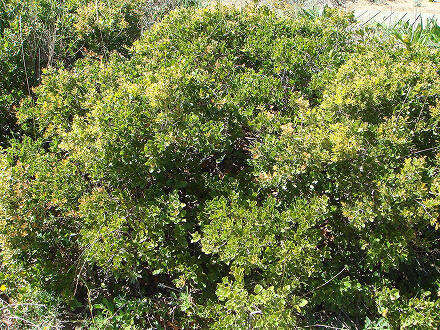


It is highly probable that silks dyed with Tyrian purple or kermes were produced in Boeotia, both of which were luxury goods affordable only to the highest social classes, within and beyond the empire. Yet it is also possible that lower-grade silks were manufactured, even if they left no trace in the sources. The Byzantines may have employed cheaper methods of producing purple, such as mixing red and blue plant-based dyes or using alternative species of snails. Such practices are attested in Roman imperial sources, although later authors consistently noted that these substitutes produced colors inferior to true Tyrian purple.
At the same time, mulberry trees were cultivated in Boeotia to provide the raw material for sericulture. It is also possible that neighboring regions grew mulberries to meet the demands of the thriving Boeotian silk industry. For instance, in 1163 the bishop of Stagoi (modern Kalabaka) in Thessaly is recorded as owning eighty-five mulberry trees. Yet it remains uncertain whether these trees were intended to host silkworms or simply cultivated for their fruit, which was also consumed by the Byzantines.
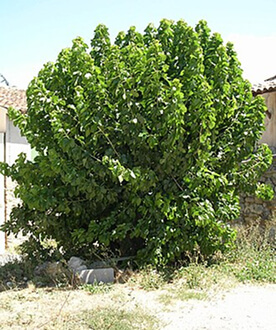 Mulberry tree used for the silkworm culture
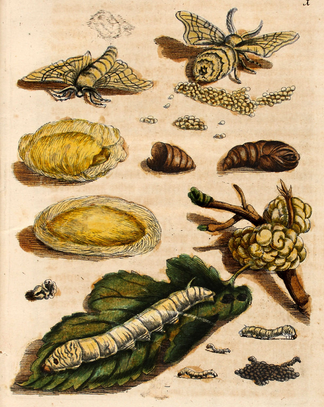 Study of the silkworm metamorphosis, by Maria Sibylla Merian, 1689
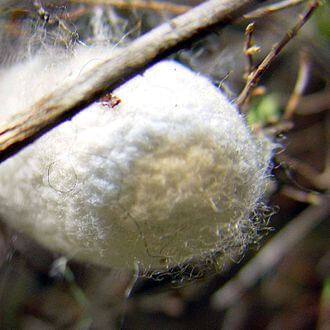 Domesticated silk mooth cocoon
Thebes, the boeotian hub of silk production.
Thebes was the principal hub of silk production in the region. The twelfth-century Jewish traveler Benjamin of Tudela, who estimated the city’s Jewish population at around two thousand, praised them as the finest silk manufacturers in Greece. Such conditions enabled Theban and other Boeotian workshops to produce textiles of exceptional brilliance and durability, rivaling even the renowned silks of Constantinople. Production took place entirely in privately owned units, either in houses or in specialized workshops. When the Normans attacked the region in 1147, they deliberately seized skilled craftsmen to transfer them to Palermo and expand the Sicilian silk industry. Yet this disruption does not appear to have permanently weakened Theban production, since Benjamin of Tudela still described the city as prosperous in the 1160s—a prosperity that seems to have continued into the Frankish period.

Although most of Byzantine Thebes now lies beneath the densely built modern city, excavations since the 1970s have uncovered probable traces of its silk industry. Archaeologists have identified rock-hewn chambers, underground water pipes, tool fragments, rubble walls, and large plastered pits—features consistent with workshop activity. Particularly significant is the so-called “Jewish quarter” (Εβραϊκά), where a four-year rescue excavation recently revealed at least one, and possibly several, Byzantine-era workshops. The site contained more than thirty wells and numerous circular, mortar-coated basins carved directly into the rock and linked by a network of canals, all enclosed within substantial walls.
While their precise function cannot be established with absolute certainty, the extensive infrastructure for water management strongly suggests a connection with textile production, where dye preparation and silk immersion required immense quantities of water. Indeed, the natural supply from rivers, aquifers, and rainfall often proved insufficient in the region. In the late 12th century, Archbishop Kaloktenis built an aqueduct to supply the twenty water mills around Thebes, and facilitate the irrigation of crops. We can also assume that it helped supporting the needs of the city’s thriving silk industry.
Thebes and the silk trade.
Theban silk was never intended for common markets but for the highest echelons of society. These luxurious fabrics adorned the Byzantine aristocracy and often served as diplomatic gifts. The Byzantine government likely regarded Boeotian production as a highly valuable commodity, since it granted Venice the exclusive right to purchase “precious silk wares” in Thebes while forbidding access to all others. When the Venetians were mass-arrested in 1171 as part of imperial efforts to curb the influence of the Serenissima on the Byzantine economy, the Genoese ambassador petitioned Manuel I (1143-1180) to transfer to Genoa the silk-related privileges Venice had enjoyed in Thebes. Yet Venice appears to have quickly regained its hold on this trade, as numerous contracts show Venetians returning to Thebes from 1175 onwards – legally or otherwise. The strong Italian presence in Thebes underscores its role as an international center of commerce and reinforces its position as a major regional hub, which may have supported a population of 20,000 to 30,000 inhabitants at its peak.
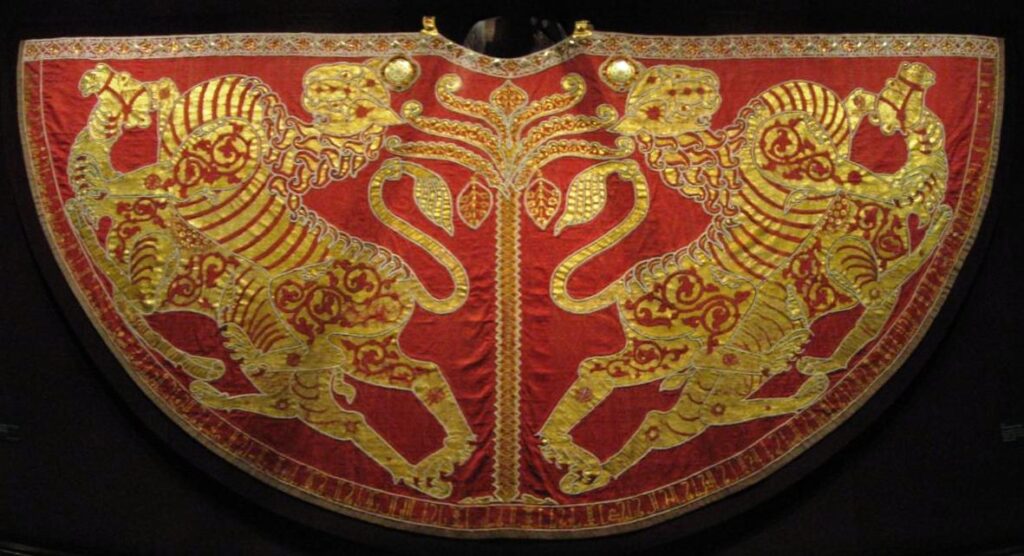
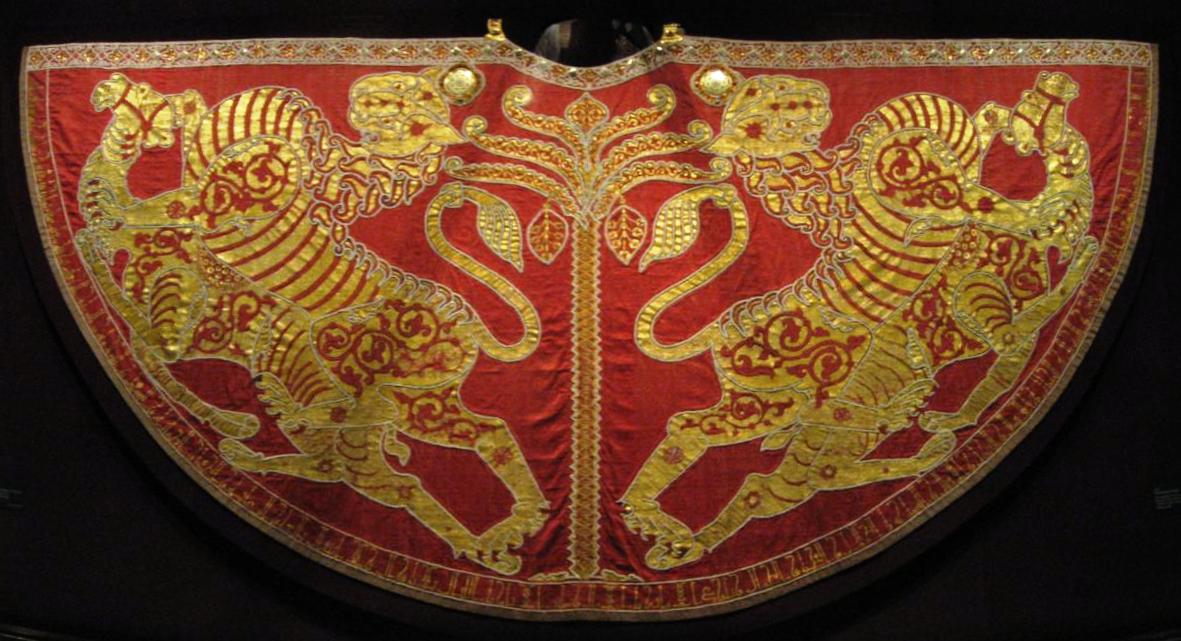
Unfortunately, no certain example from the Boeotian silk industry has survived to our day. Yet the coronation mantle of Roger II of Sicily, produced in the royal workshop of Palermo in 1133–1134 and made of Byzantine kermes silk, offers a vivid glimpse of how sumptuous such textiles could be. The exact provenance of the silk remains unknown—it may have originated in Boeotia, but it could equally have come from another Byzantine production center.
Without doubt, 12th-century Boeotia – and especially Thebes – was one of the foremost centers of Byzantine silk production. Natural resources, skilled artisans, and a favorable geographic position combined to create fabrics coveted inside and outside the empire. Next to Constantinople, Athens and the Peloponnese, Thebes and Boeotia played a decisive role in sustaining the empire’s luxury economy and long-distance Mediterranean trade, offering a lasting reminder of the skill and artistry of Byzantine textile craftsmen.
Sources.
Elie de Rosen, “The silk industry of Middle Byzantine Boeotia”, in DIOGENES ISSUE, An Open-access and Peer-reviewed Journal of Gate to the Eastern Mediterranean (GEM) – Society for the Students at the Centre for Byzantine, Ottoman and Modern Greek Studies, University of Birmingham, 7 March 2019 , pp. 30-48.
Aspasia Louvi-Kizi, “Thebes.” In The economic evolution of Byzantium: From the seventh to the fifteenth century, edited by Angeliki Laiou, pp. 631-38. Washington, D.C.: Dumbarton Oaks, 2002.