
Discovery of a rare 6th-century pseudo-Byzantine gold coin in Essex
Early medieval Essex, a region in eastern England, remains relatively poorly documented in contemporary written sources, and much of what we know about its elite activity comes from archaeology. The discovery of a 6th-century pseudo-Byzantine gold pendant near Thaxted therefore offers a rare and valuable insight into the area. It shows how local communities engaged with long-distance networks and appropriated the prestige of Byzantine imperial imagery.
A Byzantine echo in the Essex early medieval landscape.
A 6th-century pseudo-Byzantine gold coin pendant discovered near Thaxted, Essex, is reshaping how scholars understand elite presence in the region during the early medieval period. The object, found by a metal detectorist and declared treasure by a coroner, measures 19.6 mm and represents the first archaeological indicator of high-status groups in this part of the county.
Its significance has drawn immediate institutional interest. The Saffron Walden Museum plans to acquire the pendant once it passes through the British Museum’s Treasure Valuation Committee. For a county with no surviving written sources for the 6th century, the pendant provides rare material evidence for social structures normally hidden from the historical record.
Pseudo-Imperial identity: Reworking a solidus of Justin II.
Solidi were a high-value gold coins introduced by Emperor Constantine in the early 4th century and refined under his successors. Renowned for its consistent weight and purity, it became a key instrument of Byzantine economic and political power until the end of the Middle Byzantine period.
By the 6th century, solidi of Justinian and Justin II circulated far beyond the empire through diplomatic gifts, commercial exchange, military payments, and long-distance networks linking the Mediterranean to northern Europe. Many post-Roman polities – Anglo-Saxons, Franks, Lombards, Visigoths – produced imitations, like the one used for the pendant. However, finds from Essex remain exceptionally scarce. Most parallels cluster in Kent, Suffolk, and Norfolk, highlighting how unusual this Thaxted example is.
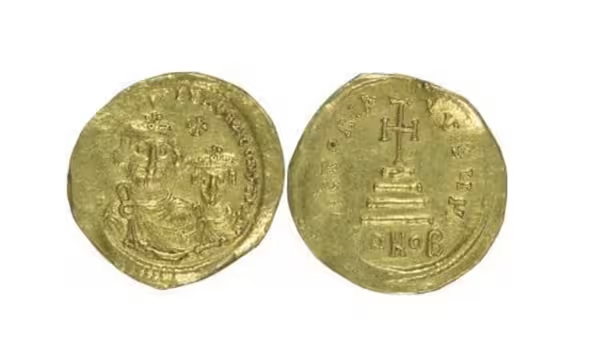
The pendant imitates a gold solidus of Emperor Justin II (r. 565–578), reflecting the enduring prestige of Byzantine imperial imagery well beyond the empire’s borders. The obverse reproduces the emperor in helmet and armor, holding a Victory figure and shield, accompanied by the inscription DN IVSTINVS PP AVG. The reverse shows the personification of Constantinople with scepter and cross-topped globe, framed by VICTORIA AVGGG and the mintmark CONOB.
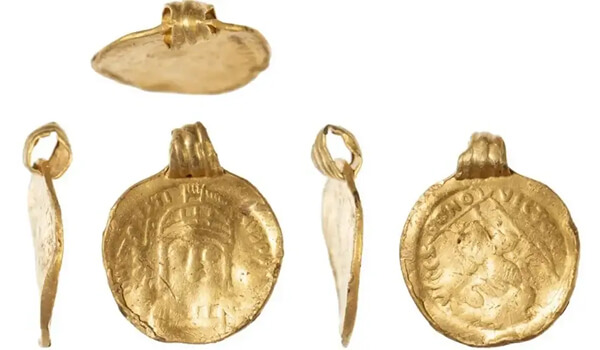
Its adaptation into jewellery further enhances its interpretive value. A suspension loop with five longitudinal ribs, a feature typical of the late 6th to early 7th century, was added above the imperial portrait. The worn reverse shows it was worn for a long period against the skin. The decision to display Justin II’s image outward suggests intentional appropriation of Byzantine imperial authority, a practice often associated with elite self-representation in post-Roman Europe.
Reassessing the Early Medieval Elite of Essex
For Essex County Finds Liaison Officer Lori Rogerson, the pendant “flips what we thought we knew about Essex at this time on its head.” Elite objects of this type rarely appear in controlled excavations, implying that the high-status individuals who used them remain largely invisible unless such chance discoveries occur.
The Thaxted pendant now joins a growing group of high-status finds that include the celebrated Prittlewell burial chamber, near Southend-on-Sea, as well as notable objects from Colchester, Chelmsford, and Epping Forest. Together, they point to a more complex and affluent elite culture in early medieval Essex than previously assumed. “We’re now seeing evidence of high-status individuals from all corners of the county,” Rogerson notes. The engagement with the visual language of Constantinople also reflects the enduring prestige of imperial authority, transformed into instruments of local identity, legitimacy, and power.
The discovery of this gold pendant thus contributes to a better understanding of the ruling class in early medieval Essex. It reveals a community operating within wider economic and ideological networks – networks in which Byzantine imagery retained symbolic power. As such, the find offers a rare glimpse into how local elites engaged with, adapted, and displayed distant imperial iconography to articulate status and identity in a rapidly changing post-Roman world.
Image credit: Colchester and Ipswich Museum Services