
Byzantine Nymphaion: Imperial residence and stronghold of the Empire of Nicaea
Nymphaion, a fortified town in Lydia, western Asia Minor, rose to prominence after the fall of Constantinople in 1204. Under the Empire of Nicaea, it became a favored residence of the Laskarid dynasty, especially in winter. From here, emperors strengthened their hold on Asia Minor, negotiated with Western powers, and prepared the ground for the eventual reconquest of Constantinople in 1261.
Nymphaion in Middle Byzantine times.
Little is known about Nymphaion’s early history. The town first appears in the writings of Anna Komnene. In 1108, it served as a base for Eumathios Philokales in his campaigns against the Turks. During the 12th century, it was also the seat of a bishop. Yet it was only after the creation of the Empire of Nicaea that Nymphaion gained real importance.
Nymphaion under the Laskarids.
After 1204 and the fall of Constantinople, the Byzantine world shifted. For the first time, imperial power was no longer concentrated in one city. The Laskarid dynasty, rulers of the Empire of Nicaea, divided their centers of power. Nicaea became the administrative hub and the seat of the exiled Patriarch. Magnesia housed the imperial mint and treasury. Nymphaion, in Lydia, western Asia Minor, became the emperors’ main winter residence.
The Laskarid emperors transformed Nymphaion into a key political and military site. John III Doukas Vatatzes spent much of his life there and died in the city. His successors, Theodore II and Michael VIII, were both proclaimed emperor in Nymphaion. The city also became a stage for diplomacy. In 1214, a treaty with the Latins was signed here. In 1261, the Treaty of Nymphaion sealed an alliance with Genoa against Venice, paving the way for the Byzantine reconquest of Constantinople.
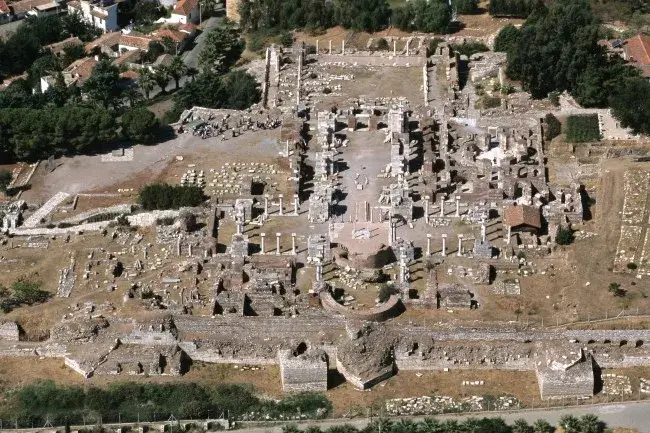
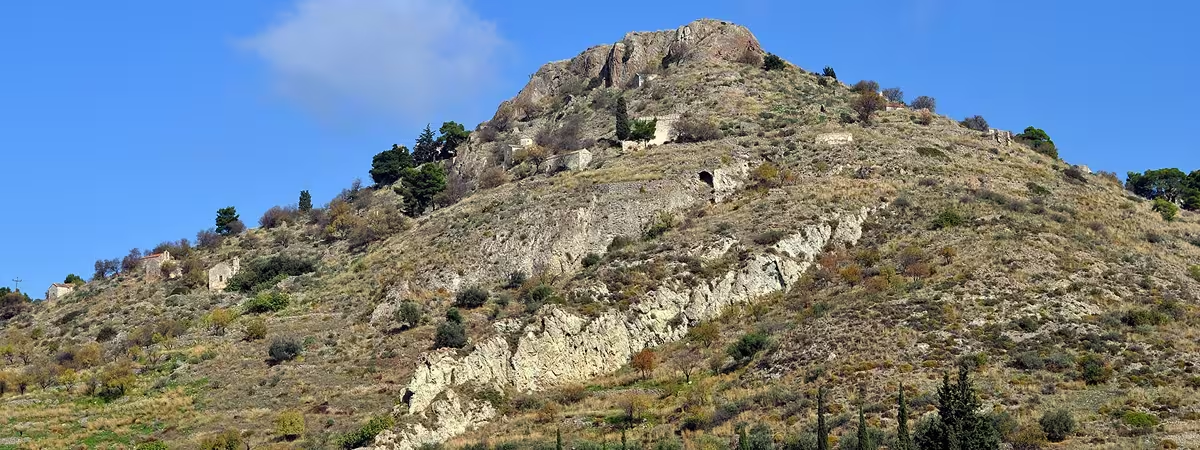
Vatatzes likely built the imperial palace, whose ruins still stand outside the town, and strengthened the surrounding fortifications. A strong castle on the hills above Nymphaion turned the site into one of the main Byzantine fortresses in western Anatolia. This dual function – as imperial residence and military base – made the city important to the defense of the Empire of Nicaea.
The Laskarids also raised Nymphaion’s ecclesiastical status. They made it an archbishopric in the 13th century. In 1234, the church council originally convened in Nicaea was transferred to Nymphaion, confirming its growing importance within the empire.
Nymphaion under the Palaiologan.
The city’s role changed in the late 13th century. Michael VIII Palaiologos ended the Laskarid line by blinding and exiling John IV. Soon after, in 1261, he recaptured Constantinople, restoring the Byzantine Empire and shifting the imperial court back to the old capital.
Even so, Nymphaion remained significant. Andronikos II stayed in the city between 1292 and 1294, likely using the former Laskarid palace. In 1296, it served as headquarters for Alexios Philanthropenos, who campaigned against the Turks before rebelling against the dynasty.
The Palaiologans, however, prioritized their western frontiers. This policy weakened their hold on Asia Minor. Turkish beyliks advanced steadily, and by 1315 Nymphaion, along with nearby Magnesia, fell to the Turks of Saruhan.
Byzantine landmarks of the city.
Nymphaion still preserves important traces of its Byzantine past: the ruins of the Laskarid imperial palace – a rare example of Byzantine civil architecture, and the castle overlooking the town.


Nymphaion was more than a provincial town. In the 13th century, it became both an imperial residence and a fortified base for the Laskarid emperors of Nicaea. From its palace and castle, John III Vatatzes and his successors ruled, negotiated with foreign powers, and prepared the recovery of Constantinople. Even under the Palaiologan dynasty, the site remained strategically important until its fall in 1315. Today, the ruins of the palace and fortress still recall Nymphaion’s central role in the survival and revival of the Byzantine Empire in western Anatolia.
Source.
C. Foss, “Late Byzantine Fortifications in Lydia,” JOB 28 (1979) 309-12, 316-20.
H. Buchwald, “Lascarid Architecture,” pp. 263—68.
T. Kirova, “Un palazzo ed una casa di eta tardo-bizantina in Asia Minore,” FelRav 103-04, 1972, pp. 275-305.